
How Mass Timber is Rewriting the Rules of High-Rise Architecture
Engineered wood panels are allowing developers to build skyscrapers that match the strength of concrete while actively pulling carbon out of the atmosphere.
By Factlen Editorial Team
- Structural Engineers & Builders
- Prioritizes the mechanical performance, precision, and on-site efficiency of engineered wood.
- Sustainable Architecture Advocates
- Focuses on the urgent need to transition away from carbon-intensive materials to turn cities into carbon sinks.
- Urban Developers
- Evaluates mass timber through the lens of cost-competitiveness, tenant appeal, and zoning advantages.
What's not represented
- · Traditional concrete and steel industry representatives
- · Forest conservationists concerned about logging volumes
Why this matters
The buildings we live and work in are responsible for a massive portion of global carbon emissions, primarily due to the production of concrete and steel. The rapid advancement of mass timber means the next generation of urban housing and office spaces will not only be built faster and more sustainably, but will actively pull carbon out of the atmosphere while providing warmer, nature-connected environments.
Key points
- Mass timber uses engineered wood panels, like Cross-Laminated Timber (CLT), to match the structural strength of concrete at a fraction of the weight.
- A single cubic meter of CLT sequesters approximately one ton of carbon dioxide, drastically reducing the embodied carbon of new high-rise buildings.
- Milwaukee's Neutral Edison Tower is currently under construction and will become the Western Hemisphere's tallest mass timber building at 31 stories.
- Because panels are prefabricated in factories with millimeter precision, mass timber buildings can be assembled significantly faster than traditional concrete structures.
- During a fire, the thick outer layer of mass timber chars, creating a natural insulating barrier that protects the structural core.
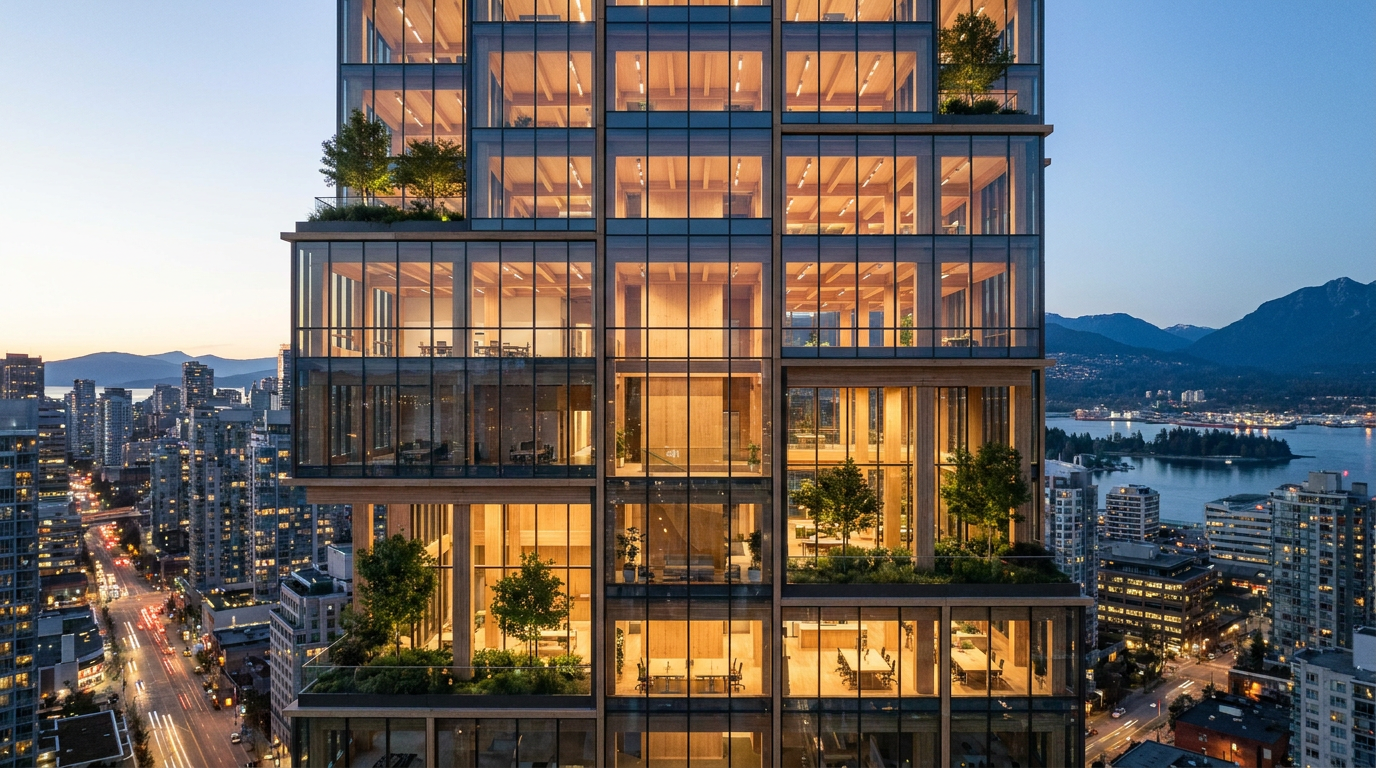
The skyline of Milwaukee is undergoing a profound transformation, but the change is not being driven by the familiar roar of concrete mixers or the blinding sparks of steel welders. Instead, it is rising with the quiet, calculated precision of engineered wood. The 31-story Neutral Edison Tower recently broke ground along the city's riverfront, standing on the very site where raw timber logs once floated downriver to fuel Milwaukee's industrial mills over a century ago. When completed in 2027, the $133.3 million project will reach 259 feet into the air, officially becoming the tallest mass timber building in the Western Hemisphere. It is a towering monument to a material that is rapidly rewriting the rules of modern construction, proving that the skyscrapers of the future might not be forged in furnaces, but grown in forests.[2]
For over a century, steel and concrete have dictated the absolute limits of urban architecture, monopolizing the skylines of every major city on Earth. But a quiet, structural revolution is taking root across the globe. Mass timber—a broad category of advanced engineered wood products—is rapidly becoming the material of choice for developers and architects looking to build taller, faster, and greener. Unlike traditional light-frame wood construction used in single-family homes, mass timber is designed for massive scale, capable of supporting the immense gravitational and lateral loads required for high-rise commercial and residential towers. This shift represents one of the most significant architectural evolutions since the invention of the steel I-beam, offering a climate-positive alternative to the carbon-heavy status quo of the construction industry.[1]
To truly understand the mechanics of this architectural shift, one must look closely at the engineering behind Cross-Laminated Timber (CLT), the undisputed workhorse of the mass timber movement. CLT is manufactured by taking standard, kiln-dried lumber boards—often sourced from smaller, lower-grade timber that would otherwise be discarded—and stacking them in alternating, perpendicular layers. These layers, which are typically arranged in odd numbers of three, five, or seven plies, are then bonded together under immense pressure using specialized structural adhesives. The manufacturing process takes place in highly controlled factory environments, ensuring that every panel meets exact performance specifications before it ever reaches a construction site.[4][5]
The true genius of Cross-Laminated Timber lies in its perpendicular geometry. Regular timber is an anisotropic material, meaning its physical properties and strength change depending on the direction in which force is applied—it is strong along the grain but weak across it. By orienting the wood grain at 90-degree angles in each successive layer, the resulting CLT panel neutralizes wood's natural tendency to expand, contract, or split. This cross-hatching technique delivers exceptional structural rigidity in all directions, allowing the panels to be used not just for floors and roofs, but for primary load-bearing walls and shear walls in mid- and high-rise construction.[4]

The resulting engineered panels rival the structural capacity of traditional reinforced concrete, yet they weigh approximately five times less. This dramatic reduction in mass triggers a cascade of practical advantages throughout the entire lifespan of a project. Because the building's superstructure is so much lighter, the foundational requirements are significantly reduced, requiring less excavation and less concrete poured into the ground. Furthermore, in seismically active regions, the lighter weight of a mass timber building means it experiences far lower lateral forces during an earthquake, making it inherently more resilient and easier to engineer for seismic safety than heavier, stiffer concrete towers.[4]
Beyond the physics of the material itself, mass timber fundamentally alters the logistics of the construction process. Unlike concrete, which must be poured, vibrated, and cured on-site in a messy, weather-dependent process that can take weeks per floor, CLT panels are entirely prefabricated off-site. Inside climate-controlled manufacturing facilities, state-of-the-art computer numerical control (CNC) routers cut the massive wooden panels to exact millimeter tolerances. These machines pre-route intricate channels for electrical wiring and plumbing, and cut precise, finished openings for doors, windows, and elevator shafts based on highly detailed 3D building information models.[5]
When these prefabricated panels finally arrive at the construction site, they are assembled more like a massive piece of flat-pack furniture than a traditional high-rise. Because the pieces fit together with absolute precision, a remarkably small crew can install thousands of square feet of flooring in a single day. During the construction of the University of British Columbia's 18-story Brock Commons, the mass timber structure was erected in just eight weeks. This rapid assembly drastically reduces overall construction timelines, minimizes neighborhood disruption from noise and dust, and significantly lowers the on-site labor costs that traditionally inflate high-rise development budgets.[4][5]

When these prefabricated panels finally arrive at the construction site, they are assembled more like a massive piece of flat-pack furniture than a traditional high-rise.
Yet, the most profound and urgent impact of mass timber lies in its environmental mathematics. The global construction industry is currently trapped in a carbon-intensive paradigm; the production of concrete and steel alone accounts for nearly 15 percent of all global greenhouse gas emissions. The chemical process of baking limestone to create cement releases massive amounts of CO2 into the atmosphere. Wood, by stark contrast, does the exact opposite. It is the only primary building material on Earth that acts as a natural carbon sink, actively removing pollution from the air during its creation.[1][4]
As trees grow in a sustainably managed forest, they absorb carbon dioxide from the atmosphere through photosynthesis, releasing oxygen and storing the carbon in their cellular structure. When that wood is harvested and engineered into mass timber, the sequestered carbon remains securely locked inside the building's structural frame for decades, or even centuries. A single cubic meter of Cross-Laminated Timber sequesters approximately one ton of carbon dioxide. When factoring in the emissions avoided by not using concrete and steel, mass timber buildings can achieve up to a 60 percent reduction in total embodied carbon, effectively turning urban skyscrapers into massive, functional carbon vaults.[4]
For decades, the primary hurdle preventing the widespread adoption of mass timber was the public and regulatory perception of fire risk. However, extensive testing has proven that heavy timber behaves highly predictably in a fire. Unlike light-frame wood, which burns quickly, mass timber relies on a phenomenon known as the charring effect. When exposed to intense heat, the outer layer of the thick wooden panel chars, creating a natural, insulating barrier of carbon. This char layer protects the structural core of the beam, preventing it from igniting and allowing it to maintain its load-bearing capacity far longer than unprotected steel, which can rapidly warp, buckle, and collapse under extreme temperatures.[1]

Recognizing this robust fire performance, regulatory bodies have steadily modernized their rules. The International Building Code was significantly updated in 2021 to permit mass timber structures up to 18 stories tall. Now, structural engineers are pushing those limits even further by utilizing sophisticated hybrid systems. Milwaukee's 31-story Neutral Edison Tower, for example, combines a reinforced concrete elevator core for lateral wind stability with a sprawling mass timber superstructure for gravity loads. This hybrid approach satisfies stringent fire separation requirements while maximizing the use of sustainable wood, paving the way for timber towers to safely push past the 30-story threshold.[2]
The innovation within the mass timber sector is not limited to towering vertical heights; it is also fundamentally reshaping architectural geometry. For decades, mass timber was strictly rectilinear—flat, rigid panels forming predictable, box-like structures. But in April 2026, architecture firm Lake Flato and engineering company StructureCraft unveiled a major breakthrough at the International Mass Timber Conference in Portland, Oregon: a self-supporting, curved timber shell. The experimental pavilion challenged the rectilinear logic that had defined the industry, proving that engineered wood could achieve sweeping, organic forms previously reserved exclusively for poured concrete or bent steel.[3][6]
The Portland pavilion utilized a specialized material known as Dowel-Laminated Timber (DLT), a system that remarkably uses absolutely no glue or metal nails. Instead, softwood planks are held together entirely by hardwood dowels. Because the hardwood has a lower moisture content, it naturally expands after insertion, locking the softwood layers together through pure friction. The engineering team discovered that by taking these flat-packed DLT panels and bending them on-site, the timber gained immense structural rigidity from its curvature alone. The wood acted as an active structural shell rather than a traditional flat beam, opening up entirely new aesthetic possibilities for sustainable architecture.[3][6]

As the technology matures and the aesthetic possibilities expand, major urban developers are taking serious notice. Mass timber is no longer viewed merely as a niche environmental experiment, but as a highly competitive financial asset. In Florida, billionaire developer Jeff Greene recently unveiled plans for a sweeping 25-story mass timber tower in downtown West Palm Beach. Filed under Florida's Live Local Act, the mixed-use project aims to dedicate roughly 40 percent of its 399 units to workforce housing. This development proves that engineered wood can be cost-competitive enough to support affordable urban density while still delivering premium architectural quality.[7]
Ultimately, the rapid rise of mass timber offers a rare and optimistic convergence of structural innovation, climate responsibility, and human-centric design. By choosing to leave the engineered wood exposed on the interior of these buildings, architects are embracing biophilic design—a philosophy that connects building occupants to natural materials. Studies have consistently shown that living and working in spaces with exposed wood grain can reduce heart rates, lower stress levels, and improve overall mental well-being. As cities look toward a rapidly urbanizing future, they are increasingly finding that the most advanced, resilient, and beautiful building material is one that simply grows from the earth.[1][4]
How we got here
1990s
Cross-laminated timber (CLT) technology is first developed and utilized in Europe.
2021
The International Building Code is updated to permit mass timber structures up to 18 stories.
2022
Ascent MKE in Milwaukee is completed at 25 stories, becoming the world's tallest mass timber building at the time.
April 2026
Architects unveil the world's first self-supporting curved dowel-laminated timber shell at the Mass Timber Conference.
2027
The Neutral Edison Tower is projected to open in Milwaukee, reaching 31 stories and setting a new global height record.
Viewpoints in depth
Sustainable Architecture Advocates
Focuses on the urgent need to transition away from carbon-intensive materials to turn cities into carbon sinks.
This camp argues that the built environment is one of the largest contributors to global emissions, primarily due to the energy required to forge steel and bake cement. By transitioning to mass timber, they believe the construction industry can flip from being a net emitter to a net sequesterer of carbon. They emphasize that when paired with responsible forestry practices, mass timber creates a financial incentive to maintain healthy, growing forests rather than clearing land for other agricultural uses.
Structural Engineers & Builders
Prioritizes the mechanical performance, precision, and on-site efficiency of engineered wood.
For engineers and contractors, the appeal of mass timber lies in its predictability and speed. Because panels are milled in factories using precise CNC machines, the on-site assembly requires a fraction of the labor and time of traditional concrete pours. This camp focuses heavily on fire-testing data and structural load calculations, advocating for updated building codes that recognize the insulating properties of wood char. Their primary goal is proving that timber can safely match or exceed the performance of steel in high-rise applications.
Urban Developers
Evaluates mass timber through the lens of cost-competitiveness, tenant appeal, and zoning advantages.
Developers are increasingly viewing mass timber not just as an environmental statement, but as a financial asset. The lighter weight of the buildings reduces foundation costs, while the faster construction timeline lowers carrying costs on construction loans. Furthermore, this camp highlights the "biophilic premium"—the reality that commercial tenants and residential renters are often willing to pay higher rates for spaces with exposed natural wood, which offer a warmer, more inviting aesthetic than sterile drywall and concrete.
What we don't know
- How global supply chains will scale if mass timber captures a dominant share of the high-rise construction market.
- The long-term performance of hybrid timber-concrete systems in extreme seismic events over a 100-year lifespan.
- Whether the cost of engineered wood will remain competitive if global timber prices experience severe volatility.
Key terms
- Cross-Laminated Timber (CLT)
- An engineered wood panel made by gluing layers of lumber at alternating right angles to achieve extreme structural strength.
- Dowel-Laminated Timber (DLT)
- A mass timber product that uses expanding hardwood dowels instead of glue or nails to bind softwood layers together.
- Embodied Carbon
- The total greenhouse gas emissions generated by manufacturing, transporting, and assembling building materials before a building is even occupied.
- Carbon Sequestration
- The process by which trees absorb carbon dioxide from the atmosphere and lock it into their wood, keeping it out of the air.
- Biophilic Design
- An architectural approach that connects building occupants more closely to nature, often using exposed natural materials like wood to improve mental well-being.
Frequently asked
Is mass timber a fire hazard?
No. During a fire, the thick outer layer of mass timber chars, creating a natural insulating barrier that protects the structural core and maintains its load-bearing capacity far longer than unprotected steel.
Does mass timber contribute to deforestation?
When sourced from sustainably managed and certified forests, mass timber supports forest health and does not deplete overall tree cover, acting instead as a long-term carbon sink.
Is mass timber cheaper than concrete?
It is often cost-neutral or slightly cheaper when factoring in the reduced on-site labor, significantly faster construction timelines, and lighter foundation requirements.
Sources
Source coverage
7 outlets
3 viewpoints surfaced







[1]Factlen Editorial TeamSustainable Architecture Advocates
Synthesis by Factlen editorial team
Read on Factlen Editorial Team →[2]Construction DiveStructural Engineers & Builders
World's tallest mass timber building breaks ground in Wisconsin
Read on Construction Dive →[3]DezeenUrban Developers
Experimental pavilion in Oregon 'challenges the rectilinear logic' of mass timber
Read on Dezeen →[4]Naturally WoodSustainable Architecture Advocates
What is Cross-Laminated Timber (CLT)?
Read on Naturally Wood →[5]APA – The Engineered Wood AssociationStructural Engineers & Builders
Cross-Laminated Timber (CLT) Basics
Read on APA – The Engineered Wood Association →[6]StructureCraftStructural Engineers & Builders
2026 Pavilion at the International Mass Timber Conference
Read on StructureCraft →[7]World Red EyeUrban Developers
Jeff Greene Proposes Florida's Tallest Mass Timber Tower in West Palm Beach
Read on World Red Eye →

Every angle. Every day.
Get culture stories with full source coverage and perspective breakdowns delivered to your inbox.