
The Rise of Agrivoltaics: How Dual-Use Solar is Transforming Farming
By co-locating solar panels and agriculture on the same land, agrivoltaics is solving the conflict between clean energy and food production while boosting crop resilience.
By Factlen Editorial Team
- Agricultural Sector
- Focuses on maintaining crop yields, soil health, and farm profitability without disrupting operations.
- Renewable Energy Developers
- Prioritizes maximizing energy output, grid integration, and overcoming permitting hurdles for solar expansion.
- Land-Use & Climate Analysts
- Views agrivoltaics as a critical tool to solve the spatial conflicts of the energy transition and build climate resilience.
What's not represented
- · Traditional fossil fuel energy providers
- · Local zoning board officials
Why this matters
As the world races to build renewable energy, land-use conflicts are intensifying. Agrivoltaics offers a rare win-win, allowing farmers to generate dual incomes, save water, and protect crops from extreme heat without sacrificing arable land.
Key points
- Agrivoltaics combines solar panels and farming on the same land, solving major land-use conflicts.
- The panels create a microclimate that reduces heat stress and cuts irrigation needs by up to 30%.
- Shade-tolerant crops can see yield increases, while sun-intensive staples require wider panel spacing.
- Plant transpiration naturally cools the solar panels, increasing their electrical efficiency.
The global transition to renewable energy comes with a massive and undeniable spatial footprint. As nations race to decarbonize their grids, the expansion of utility-scale solar power is projected to require millions of acres of land by the middle of the century. This insatiable appetite for flat, sun-drenched acreage frequently puts energy developers in direct competition with the agricultural sector. For decades, the assumption has been that land can either produce food or produce energy, but never both. This perceived zero-sum game has sparked fierce zoning battles, as rural communities push back against the industrialization of their local landscapes and the loss of generational farmland.[2][7]
For years, the standard industry practice for constructing ground-mounted solar farms involved a highly disruptive process. Developers would typically strip the topsoil, lay down gravel to prevent weed growth, and fence off the perimeter for security. This approach effectively sterilized the earth beneath the panels, removing the land from active food production for the 25-to-30-year lifespan of the solar array. As the pace of solar deployment accelerates to meet ambitious climate targets, this single-use model has become increasingly untenable. Policymakers and environmental advocates alike have recognized that sacrificing arable land to generate clean electricity creates a new set of ecological and economic problems, prompting a desperate search for a more integrated solution.[2][6]
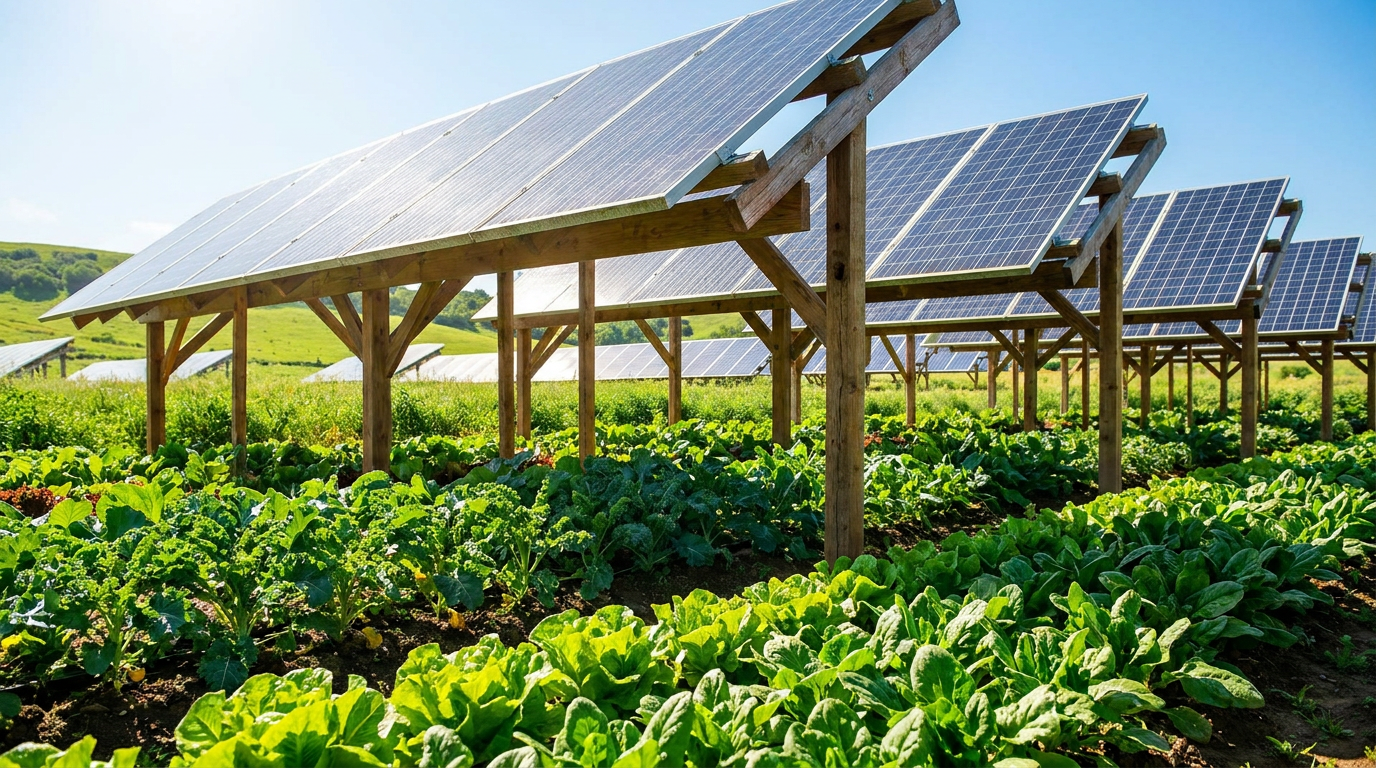
Enter agrivoltaics—a hybrid, dual-use approach that elegantly co-locates solar panels and active agriculture on the exact same plot of land. Rather than treating farming and energy generation as mutually exclusive activities, agrivoltaics integrates them into a single, symbiotic system. By elevating photovoltaic arrays on specialized steel racking systems or spacing the rows of panels more widely than traditional layouts, farmers are able to cultivate crops, graze livestock, or maintain native pollinator habitats directly beneath and between the energy infrastructure. This paradigm shift transforms solar farms from sterile, fenced-off industrial zones into vibrant, multi-purpose landscapes that actively contribute to both the local food supply and the national power grid.[1][7]
What began as a niche academic concept has rapidly transitioned into a commercially viable reality across the globe. In the United States, the footprint of agrivoltaic installations has experienced explosive growth over a remarkably short period. Between 2020 and late 2024, the total acreage dedicated to dual-use solar more than doubled, expanding from 27,000 acres to over 62,000 acres. Today, there are nearly 600 operational agrivoltaic sites across the country, collectively generating roughly 10 gigawatts of clean solar capacity—enough to power millions of homes. This surge in deployment signals that the technology has moved well beyond the pilot phase and is now being embraced by major agricultural and energy stakeholders.[2][7]

Europe is experiencing a similar, if not more structured, boom in dual-use solar deployment. Across the continent, there are now over 200 commercial-scale agrivoltaic projects currently in operation, driven by a combination of land scarcity and aggressive climate mandates. Countries like Germany, France, and Italy are leading the charge, having introduced specific technical standards and legislative frameworks designed to accelerate adoption. Crucially, these new regulations allow landowners to harvest solar energy and sell it to the grid without losing their essential agricultural subsidies. This policy alignment has removed a major financial barrier, encouraging European farmers to view solar developers as partners rather than competitors for their land.[3][4]
The core scientific mechanism driving the agronomic success of agrivoltaics is the creation of an artificial, highly beneficial microclimate beneath the panels. In a traditional open field, crops are entirely exposed to the harsh realities of the local weather, including blistering midday sun and extreme temperature fluctuations. Solar panels alter this dynamic by providing a layer of partial shading, which acts as a physical buffer against the elements. During the peak heat of summer, the panels significantly lower the ground surface temperature, protecting delicate plants from severe heat stress, leaf scorch, and sunburn, thereby creating a more stable and forgiving growing environment.[5][6]
This protective shading effect dramatically alters the hydrological cycle of the agricultural field, resulting in profound water conservation benefits. By intercepting direct sunlight and reducing the ambient temperature at the soil level, the solar panels significantly decrease the rate of soil evaporation and plant transpiration. In arid and semi-arid regions, where water scarcity is a constant existential threat to farming, these microclimatic changes are transformative. Field studies have demonstrated that agrivoltaic systems can reduce irrigation water requirements by 20% to 30%. As climate change continues to exacerbate drought conditions globally, this ability to grow food with substantially less water is becoming one of the technology's most compelling selling points.[2][5]

However, agronomists are quick to point out that not all crops thrive under a solar canopy. The success of an agrivoltaic system depends heavily on meticulously matching the right plant species to the altered light environment. Shade-tolerant crops—such as leafy greens like lettuce and spinach, as well as tomatoes, broccoli, and certain berries—often flourish in these conditions. In many trials, these specific crops have actually seen yield increases ranging from 8% to 18%. For these plants, the physiological benefits of reduced heat stress and enhanced moisture retention far outweigh the slight reduction in direct, photosynthetically active radiation reaching their leaves.[5][6]
However, agronomists are quick to point out that not all crops thrive under a solar canopy.
Conversely, sun-intensive staple crops present a much more complex challenge for dual-use systems. Crops like corn, wheat, and sugarcane require massive amounts of uninterrupted sunlight to achieve maximum growth and yield. When planted beneath standard agrivoltaic arrays, these crops typically experience yield reductions of 15% to 30% due to the shading effect. To accommodate these vital staples, developers must heavily modify their designs, utilizing significantly wider panel spacing or employing specialized translucent solar modules. This requires a delicate balancing act, forcing project managers to carefully weigh the trade-offs between maximizing electrical output and maintaining acceptable levels of food production.[5][6]
Fascinatingly, the biological benefits of this pairing are not a one-way street; the relationship is genuinely symbiotic. While the solar panels protect the plants from the sun, the plants actively work to cool the panels. As crops undergo transpiration—the process of releasing water vapor through their leaves into the atmosphere—they naturally cool the surrounding air. Because photovoltaic panels inherently lose electrical efficiency when their operating temperatures climb too high, this localized, plant-induced cooling effect is highly valuable. Studies have shown that panels installed over transpiring crops actually generate electricity more efficiently than identical panels installed over bare dirt, gravel, or concrete.[1][6]
Beyond traditional crop cultivation, agrivoltaics is being widely and successfully deployed for livestock management. Sheep, in particular, have proven to be the ideal partners for dual-use solar farms. When allowed to graze beneath the arrays, the flock naturally maintains the height of the vegetation, completely eliminating the need for the solar operator to hire crews with fossil-fuel-powered mowers. In return, the steel infrastructure provides the sheep with vital, life-saving shade during the hottest parts of the day, improving animal welfare. This specific application, known as solar grazing, is currently the most widespread form of agrivoltaics in the United States due to its simplicity and immediate mutual benefits.[1][7]

Technologically, the solar industry is rapidly adapting its hardware to optimize this dual-use model and minimize agricultural disruption. One of the most significant advancements has been the widespread adoption of bifacial solar panels in agricultural settings. Unlike traditional monofacial panels, bifacial modules are capable of capturing direct sunlight on their top surface while simultaneously absorbing ambient light reflected off the ground and crops onto their underside. This innovation not only increases the total energy generation of the array but also allows more diffused light to pass through the system, creating a much more favorable photosynthetic environment for the plants growing below.[5][6]
In addition to advanced panel technology, the physical mounting structures are being completely re-engineered to accommodate the realities of modern, mechanized farming. Standard solar farms feature panels mounted just a few feet off the ground, making agriculture impossible. In contrast, modern agrivoltaic systems utilize elevated racking systems that raise the arrays to heights of 10 to 15 feet. This crucial design modification allows farmers to drive standard tractors, harvesters, and irrigation equipment directly underneath the panels. By ensuring that the integration of energy infrastructure does not obstruct established farming workflows, developers are making the technology far more palatable to traditional agricultural operators.[6][7]
From an economic perspective, agrivoltaics offers a highly compelling proposition for rural landowners: the creation of a diversified, dual-income stream. By leasing the airspace above their fields to solar developers, or by owning the arrays outright, farmers gain a steady, predictable source of revenue that is entirely independent of the agricultural cycle. In an industry notoriously plagued by volatile commodity prices, unpredictable weather events, and razor-thin profit margins, this guaranteed energy income acts as a powerful financial hedge. It provides the economic stability necessary to keep multi-generational family farms operational, even during years when crop yields are decimated by drought or disease.[2][3]
Despite the clear agronomic and financial benefits, the primary hurdle to the widespread, mainstream adoption of agrivoltaics remains the substantial initial capital expenditure. Building a solar array high enough to accommodate a combine harvester requires significantly more structural steel, much deeper concrete foundations, and highly customized engineering to withstand high wind loads. These structural requirements can increase the upfront installation costs of an agrivoltaic facility by 10% to 20% when compared to a traditional, low-to-the-ground solar farm. While the long-term dual revenues often justify the investment, securing the initial financing for these premium systems remains a significant barrier for many developers and farming cooperatives.[6]

Regulatory fragmentation and outdated zoning laws also pose a formidable challenge to the industry's expansion. While some progressive regions have fully embraced the dual-use model, many local and national jurisdictions still lack clear legal definitions for land that simultaneously produces food and electricity. This bureaucratic gray area leaves farmers deeply uncertain about their property tax assessments and their continued eligibility for crucial agricultural grants and subsidies. Until governments standardize the regulatory treatment of agrivoltaics, ensuring that landowners are not financially penalized for adding solar infrastructure, the permitting process will remain a complex, localized battle that slows down broader deployment.[4][6]
Despite these financial and regulatory friction points, the macro-level potential of agrivoltaics is nothing short of staggering. Comprehensive land-use research indicates that the spatial requirements for the global energy transition could be met with minimal disruption to the food supply. In fact, studies suggest that converting just 1% of current agricultural land to optimized agrivoltaic systems could satisfy massive portions of national renewable energy targets in both the United States and Europe. This extraordinary efficiency completely bypasses the need to clear pristine forests, drain wetlands, or sacrifice vital ecosystems in the pursuit of zero-carbon electricity generation.[2][3]
As the underlying technology matures, costs inevitably decline, and policy frameworks finally catch up to the science, agrivoltaics represents a rare and profound paradigm shift in resource management. Instead of treating global food production and clean energy generation as competing interests locked in a destructive zero-sum game, dual-use solar proves that a more integrated approach is possible. With careful agronomic design and collaborative planning, the agricultural and energy sectors can actively enhance one another, building a more resilient, sustainable, and economically vibrant future for rural communities around the world.[6][7]
How we got here
Early 2010s
Initial academic research and small-scale pilot projects begin testing the viability of co-locating solar and agriculture.
2015
The U.S. Department of Energy launches the InSPIRE project to formally study the ecological and economic impacts of dual-use solar.
2021
Germany introduces the first technical standards and guidelines specifically defining and supporting commercial agrivoltaic systems.
2024–2025
The U.S. agrivoltaic footprint surpasses 60,000 acres, while the European Commission formally recognizes solar as a complementary tool for agriculture.
Viewpoints in depth
The Agricultural View
Farmers and agronomists weigh the benefits of shade against the complexities of farming around steel infrastructure.
For the agricultural community, the primary concern is ensuring that food production remains the dominant use of the land. Agronomists emphasize that agrivoltaics is not a one-size-fits-all solution; it requires meticulous crop selection and customized panel spacing. While shade-tolerant crops like berries and leafy greens thrive, farmers of staple crops like corn and wheat remain cautious about potential yield drops. However, the promise of a stable secondary income from electricity generation—especially in an era of volatile weather and fluctuating commodity prices—is increasingly viewed as a vital lifeline for rural economies.
The Energy Developer View
Solar companies see dual-use land as the key to unlocking massive scale while avoiding local zoning battles.
Renewable energy developers face mounting opposition when attempting to convert pristine or arable land into traditional, single-use solar farms. Agrivoltaics offers a strategic workaround to these permitting bottlenecks. By keeping the land agriculturally active, developers can win local community support and access prime, flat acreage near existing grid infrastructure. While the specialized elevated racking systems increase upfront capital expenditures by up to 20%, developers argue that the accelerated permitting process and the slight boost in panel efficiency from plant-induced cooling make the economics highly favorable.
The Climate & Land-Use View
Analysts highlight the systemic efficiency of solving food, water, and energy challenges simultaneously.
Environmental analysts view agrivoltaics through the lens of the 'food-energy-water nexus.' As the global energy transition accelerates, the sheer spatial footprint of utility-scale solar threatens to trigger massive land-use conflicts. Analysts point out that dedicating just 1% of existing farmland to dual-use solar could meet major national renewable targets without clearing a single acre of forest. Furthermore, the water-saving benefits of the artificial microclimate—reducing evaporation by up to 30% in arid regions—position agrivoltaics as a crucial climate adaptation strategy as droughts become more severe.
What we don't know
- The long-term impact of altered microclimates on soil microbiomes over a 30-year solar project lifespan.
- How quickly fragmented local zoning laws will standardize to accommodate dual-use agricultural tax exemptions.
Key terms
- Agrivoltaics
- The simultaneous use of land for both solar energy generation and agricultural production.
- Microclimate
- A localized set of atmospheric conditions that differ from those in the surrounding areas, often created by the shading of solar panels.
- Evapotranspiration
- The combined process of water evaporating from the soil and transpiring from plant leaves into the atmosphere.
- Bifacial Solar Panels
- Photovoltaic modules that can capture sunlight from both their front and back sides, utilizing light reflected off the ground.
- Land Equivalent Ratio (LER)
- A metric used to measure the productivity of a dual-use system compared to using separate plots of land for farming and solar.
Frequently asked
Do solar panels block too much sun for crops to grow?
It depends on the crop. Shade-tolerant plants like lettuce and berries often thrive and see yield increases, while sun-intensive crops like corn require specialized panel spacing to ensure enough light reaches the ground.
Can farmers still use tractors with solar panels in the way?
Yes. Modern agrivoltaic systems use elevated racking systems—often 10 to 15 feet high—and wider row spacing specifically designed to allow standard agricultural machinery to pass underneath.
Does agrivoltaics work with livestock?
Absolutely. Sheep grazing is one of the most common forms of agrivoltaics. The sheep safely maintain the vegetation under the panels, while the panels provide them with essential shade.
Why don't all solar farms use this method?
Agrivoltaics requires a higher initial capital investment for specialized steel structures and complex engineering. Additionally, fragmented zoning laws and regulatory hurdles can make these projects harder to permit than standard solar farms.
Sources
Source coverage
7 outlets
3 viewpoints surfaced







[1]National Renewable Energy Laboratory (NREL)Renewable Energy Developers
Agrivoltaics: Co-locating Agriculture and Solar
Read on National Renewable Energy Laboratory (NREL) →[2]Institute for Energy Economics and Financial AnalysisLand-Use & Climate Analysts
Agrivoltaics: An economic option for farmers and rural development
Read on Institute for Energy Economics and Financial Analysis →[3]EmberLand-Use & Climate Analysts
Agri-PV: How solar and farming can benefit each other
Read on Ember →[4]SolarPlazaRenewable Energy Developers
Agrivoltaics in Europe: Moving Beyond Pilots
Read on SolarPlaza →[5]MDPI AgronomyAgricultural Sector
Experimental Agrivoltaics Field Studies: A Systematic Review
Read on MDPI Agronomy →[6]Factlen Editorial TeamAgricultural Sector
Synthesis by Factlen editorial team
Read on Factlen Editorial Team →[7]U.S. Department of EnergyRenewable Energy Developers
Agrivoltaics: Solar and Agriculture Co-Location
Read on U.S. Department of Energy →
Every angle. Every day.
Get environment stories with full source coverage and perspective breakdowns delivered to your inbox.