
How 'Self-Driving' Labs Are Automating Scientific Discovery
Autonomous laboratories combining artificial intelligence with advanced robotics are compressing months of scientific experimentation into hours, accelerating breakthroughs in medicine and materials science.
By Factlen Editorial Team
- AI Tool Builders
- Focus on computational speed, agentic reasoning, and scaling discovery through software.
- Bench Scientists
- Focus on reproducibility, hardware reliability, and the shifting role of human expertise.
- Institutional Leaders
- Focus on capital allocation, cloud lab democratization, and scaling institutional discovery.
What's not represented
- · Hardware Technicians and Maintenance Engineers
- · Regulatory and Biosafety Officials
Why this matters
The speed of scientific discovery directly dictates how fast we can cure diseases, build better batteries, and solve climate challenges. By removing the physical bottleneck of manual lab work, autonomous systems promise to bring life-saving and planet-saving technologies to market years earlier than previously possible.
Key points
- Self-driving laboratories combine AI and robotics to automate the entire scientific discovery process.
- Recent AI systems have compressed 900-hour biological discovery cycles into under two hours.
- Autonomous labs are already synthesizing novel materials for batteries and quantum computing.
- Most current systems operate at Level 2 or 3 autonomy, requiring human goal-setting and hardware maintenance.
- Cloud-accessible labs are democratizing science by allowing researchers to run experiments remotely.
The traditional image of science—a researcher in a white coat, pipetting fluids under a fume hood at midnight—is stubbornly accurate. For decades, the limiting reagent in scientific progress hasn't been a lack of ideas, but the slow, manual generation of high-quality experimental data.[8]
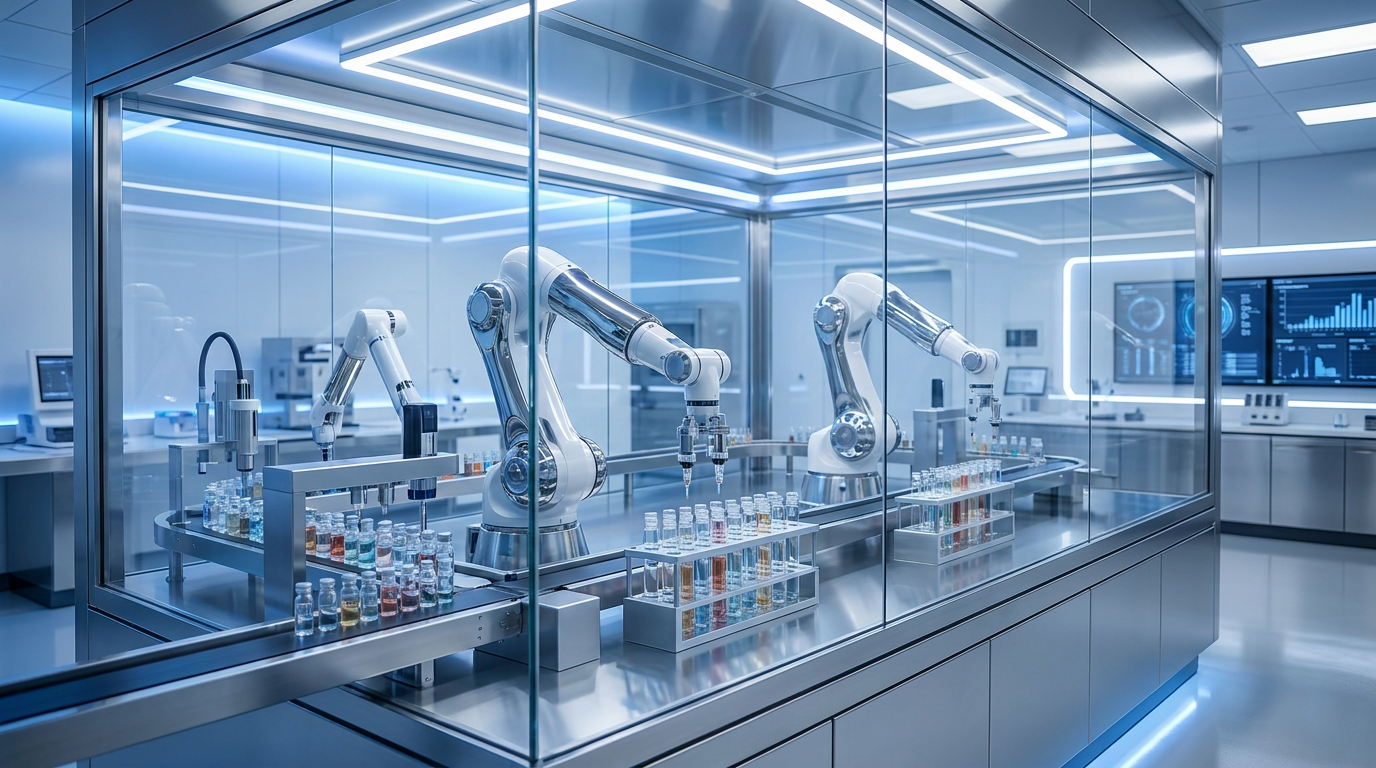
In 2026, that bottleneck is shattering. A new paradigm known as the "self-driving laboratory" (SDL) has moved from theoretical whitepapers to physical reality. These autonomous facilities combine artificial intelligence with advanced robotics to execute the entire scientific method without human intervention.[3][4]
The results are staggering. In a landmark demonstration published this year, an AI system named Robin—developed by the research organization FutureHouse—completed a full experimental biology discovery cycle in under two hours. The same cognitive and physical work would have consumed roughly 900 hours of a human scientist's life.[5]

Robin successfully identified novel therapeutic candidates for dry age-related macular degeneration. The bench was still running, and the centrifuge was still spinning, but the human researcher was no longer the bottleneck.[5][8]
To understand how an SDL works, it is necessary to look past the robotic arms and examine the cognitive architecture. The core mechanism is the Design-Build-Test-Learn (DBTL) cycle. In a traditional lab, human scientists design an experiment, build the physical setup, test the hypothesis, and learn from the data over weeks or months.[4]
In a self-driving lab, this loop is entirely closed by AI. A multi-agent system acts as the brain. For example, Robin utilizes three specialized agents: "Crow" scours millions of scientific papers to generate hypotheses; "Falcon" conducts deeper investigations to evaluate supporting evidence; and "Finch" acts as the experimental director, writing the code that commands the robotic hardware.[5]

The physical execution relies on a concept computer scientists call "Experiment-as-Code." Just as cloud computing relies on Infrastructure-as-Code to manage servers, modern SDLs use declarative programming to manage heterogeneous, stateful physical instruments. The AI compiles its experimental intent into safe, reproducible scripts that liquid handlers, spectrometers, and bioreactors can execute.[6]
The AI compiles its experimental intent into safe, reproducible scripts that liquid handlers, spectrometers, and bioreactors can execute.
As the robotic hardware runs the experiment, data is captured continuously. The AI evaluates the results in real-time, updating its model of the problem and immediately deciding what parameters to adjust for the next run. This allows the system to navigate high-dimensional experimental spaces with exceptional efficiency.[2][3]
The impact is already reshaping materials science. At Lawrence Berkeley National Laboratory, an autonomous system known as A-Lab recently ran continuously for 17 days. Combining computational screening with active learning and robotics, A-Lab successfully synthesized 36 novel inorganic compounds from 57 targets.[3]
These materials are not mere digital predictions. Following Google DeepMind's release of millions of predicted crystal structures, 736 of those AI-discovered materials have now been physically synthesized and independently confirmed in laboratories around the world.[5][8]
The acceleration factor is profound. At North Carolina State University, which houses the largest operational SDL ecosystem in U.S. academia, researchers report that self-driving labs can accelerate discovery up to 100 times faster than conventional methods. Their "Rainbow" platform, designed to optimize quantum dots, can conduct and analyze up to 1,000 experiments per day.[2]

The biotechnology sector is scaling this infrastructure rapidly. Companies like Ginkgo Bioworks have launched cloud-accessible autonomous labs, featuring dozens of interconnected instruments spanning sample preparation, liquid handling, and analytical readouts. Researchers anywhere in the world can submit an experimental prompt via a web interface and let the automated facility handle the execution.[1]
Despite the rapid progress, the industry is careful to distinguish between hype and reality. Researchers evaluate SDLs on a five-level autonomy scale, similar to self-driving cars. Level 0 is entirely manual, while Level 5 represents a fully autonomous facility operating indefinitely without human oversight.[3]
The vast majority of systems marketed as "self-driving" today operate at Level 2 or 3. They excel at closed-loop optimization on specific, narrow tasks—such as finding the perfect temperature and chemical ratio for a catalyst—but still require humans to set the overarching goals and resolve hardware anomalies. True Level 5 autonomy remains an engineering aspiration.[1][3]

The physical world also presents stubborn challenges. While AI agents can reason brilliantly in the digital realm, physical instruments require precise calibration. A clogged pipette, a misaligned robotic gripper, or a degraded chemical reagent can derail an entire automated workflow. Ensuring reproducibility across different labs with heterogeneous equipment remains a major hurdle.[1][6]
Yet, the trajectory is clear. The European Union has allocated €33 million specifically for autonomous laboratory automation in 2026, and major pharmaceutical companies are integrating AI agents directly into their drug discovery pipelines.[7][8]
Ultimately, the self-driving lab is not designed to replace human scientists, but to elevate them. By automating the repetitive grunt work of pipetting and parameter-tuning, SDLs free researchers to focus on high-level experimental design and creative hypothesis generation. Science is transitioning from an era of manual labor to an era of cognitive direction, promising to accelerate the breakthroughs society desperately needs.[2][4]
How we got here
2020
Early automated labs focus on high-throughput screening, executing pre-programmed steps without AI decision-making.
2023
Generative AI models begin successfully predicting millions of new material structures, creating a backlog of physical testing.
2025
Lawrence Berkeley National Laboratory's A-Lab demonstrates 17 days of continuous, autonomous material synthesis.
March 2026
Ginkgo Bioworks and others launch commercial cloud-accessible autonomous labs for biological research.
May 2026
FutureHouse's Robin AI completes a full biological discovery cycle in under two hours, a task that traditionally takes 900 hours.
Viewpoints in depth
AI Tool Builders
Focus on computational speed, agentic reasoning, and scaling discovery through software.
This camp, largely composed of computer scientists and AI researchers, views the physical lab as an execution engine for digital intelligence. They emphasize the exponential gains in speed—such as reducing a 900-hour workflow to two hours—and argue that the primary bottleneck to scientific progress is no longer human ingenuity, but the slow pace of manual data generation. Their goal is to abstract away the physical hardware entirely, allowing researchers to interact with labs via natural language prompts and code.
Bench Scientists
Focus on reproducibility, hardware reliability, and the shifting role of human expertise.
Traditional researchers and lab technicians acknowledge the power of automation but caution against overestimating current capabilities. They point out that physical chemistry and biology are messy; a clogged pipette, a degraded reagent, or a miscalibrated sensor can silently ruin an automated run. This camp advocates for a "co-pilot" model rather than full autonomy, emphasizing that human intuition is still required to troubleshoot physical anomalies, ensure safety compliance, and interpret unexpected results that fall outside the AI's training distribution.
Institutional Leaders
Focus on capital allocation, cloud lab democratization, and scaling institutional discovery.
University administrators and biotech executives view self-driving labs as a paradigm shift in resource allocation. Rather than funding redundant, manual equipment for every individual principal investigator, they are investing in centralized "cloud labs" that operate 24/7. This perspective highlights the democratizing potential of the technology: by providing remote access to state-of-the-art autonomous facilities, smaller startups and underfunded universities can execute complex experimental campaigns without needing to build their own multi-million-dollar physical infrastructure.
What we don't know
- How quickly physical hardware bottlenecks, such as sensor calibration and reagent degradation, can be fully automated.
- The regulatory frameworks that will govern AI-driven autonomous discoveries in the pharmaceutical industry.
- How the widespread adoption of cloud labs will alter the traditional career pipeline for PhD researchers.
Key terms
- Self-Driving Laboratory (SDL)
- A research facility where artificial intelligence and robotic hardware work together to autonomously design, execute, and learn from experiments.
- Design-Build-Test-Learn (DBTL)
- The iterative cycle of scientific discovery, moving from hypothesis generation to physical execution, data collection, and analysis.
- Experiment-as-Code
- The practice of writing scientific experiments as software scripts, allowing AI to precisely command robotic lab instruments.
- Active Learning
- A machine learning technique where the AI dynamically chooses the next best experiment to run based on the results it just received.
- Cloud Lab
- A centralized, highly automated laboratory that researchers can access and control remotely via the internet.
Frequently asked
Will self-driving labs replace human scientists?
No. Experts view them as 'co-pilots' that automate repetitive tasks like pipetting and data gathering. This frees human scientists to focus on creative hypothesis generation and high-level experimental design.
What is the Design-Build-Test-Learn cycle?
It is the core workflow of experimental science. Researchers design an experiment, build the setup, test the hypothesis, and learn from the data. Self-driving labs automate this entire loop.
Are these labs fully autonomous yet?
Not entirely. Most operate at Level 2 or 3 on a 5-level autonomy scale. They can optimize specific tasks autonomously, but still require humans to set the overarching goals and maintain the hardware.
How do scientists access these automated labs?
Increasingly, through 'cloud labs.' Researchers can write an experimental protocol on their computer and send it over the internet to a centralized robotic facility, which runs the experiment and sends back the data.
Sources
Source coverage
8 outlets
3 viewpoints surfaced








[1]R&D WorldInstitutional Leaders
Benchling bets lab automation can ground AI co-scientists in the physical world
Read on R&D World →[2]NC State University NewsInstitutional Leaders
Self-driving labs are accelerating the discovery of new molecules and materials
Read on NC State University News →[3]Royal Society Open ScienceBench Scientists
Autonomous, 'self-driving' laboratories: combining AI and automation
Read on Royal Society Open Science →[4]Frontiers in Artificial IntelligenceBench Scientists
From co-pilot to lab-pilot: The era of multimodal, agentic systems in science
Read on Frontiers in Artificial Intelligence →[5]NatureAI Tool Builders
Multi-agent AI system automates scientific discovery
Read on Nature →[6]arXivAI Tool Builders
Experiment-as-Code: A declarative stack for AI-driven scientific reasoning
Read on arXiv →[7]Fierce HealthcareInstitutional Leaders
Nvidia, Abridge partner to build AI clinical assistant
Read on Fierce Healthcare →[8]Factlen Editorial TeamInstitutional Leaders
Synthesis by Factlen editorial team
Read on Factlen Editorial Team →

More in ai
See all 9 stories →Open-Source AI
Open-Source AI Reaches a Tipping Point as June Releases Rival Proprietary Giants
8 sources
Edge AI
Why Enterprises Are Abandoning Massive AI Models for 'Small Language Models'
9 sources
Agentic AI
Agentic AI: How Autonomous Agents Are Automating Everyday Digital Tasks
7 sources
Local AI
The Rise of Local AI: How Small Language Models Are Putting Privacy First
7 sources

Every angle. Every day.
Get ai stories with full source coverage and perspective breakdowns delivered to your inbox.