
The Rise of Local AI: How Small Language Models Are Putting Privacy First
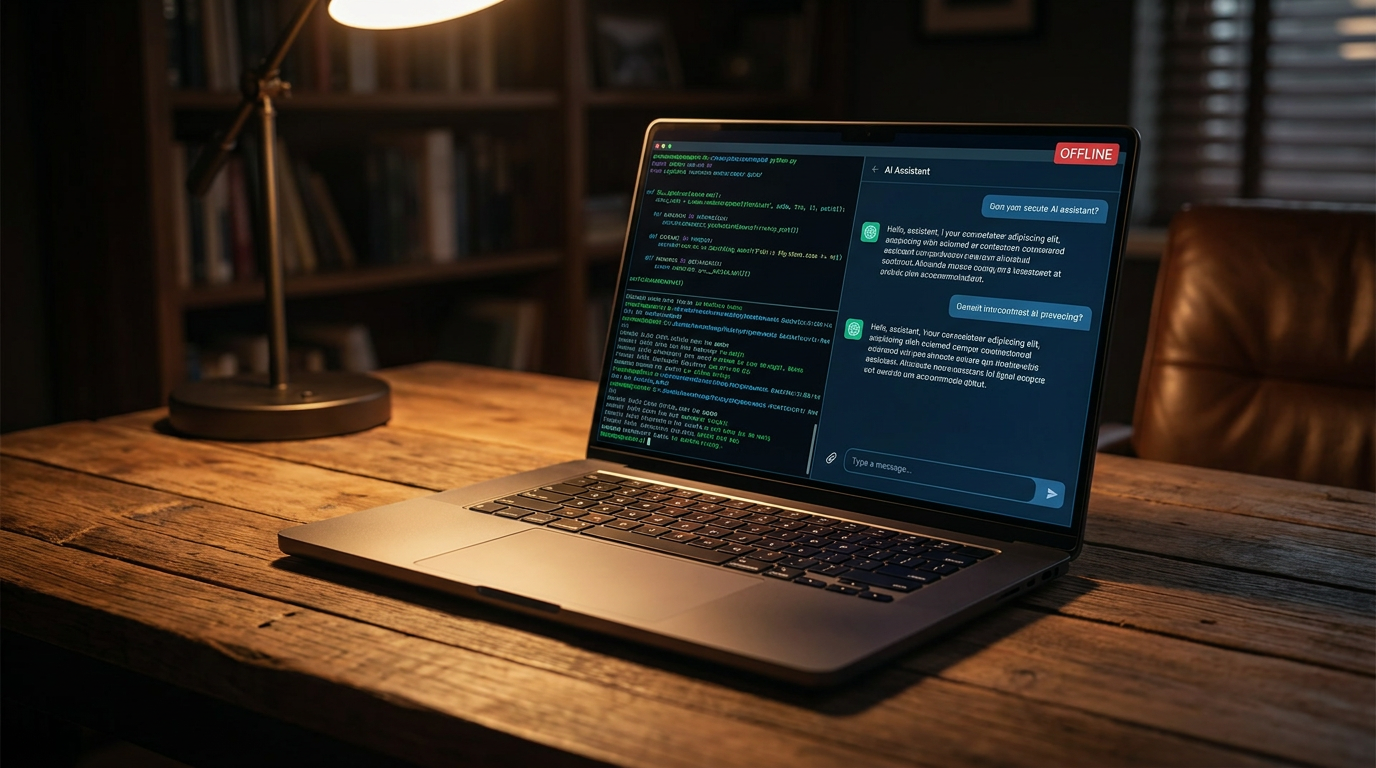
As privacy concerns and cloud costs mount, a new generation of highly efficient 'Small Language Models' is allowing users to run powerful AI directly on their laptops and phones without an internet connection.
By Factlen Editorial Team
- Enterprise Pragmatists
- Focus on the cost-efficiency, zero-latency, and compliance benefits of specialized local models.
- Privacy & Sovereignty Advocates
- Argue that local AI is a fundamental requirement for digital privacy and data protection.
- Technology Analysts
- Evaluate the trade-offs between local efficiency and the advanced reasoning capabilities of the cloud.
What's not represented
- · Hardware Manufacturers
- · Regulatory Bodies
Why this matters
Running AI locally means your sensitive data—like financial documents, personal emails, or proprietary code—never leaves your device. This eliminates recurring subscription fees and protects you from corporate data harvesting while still providing powerful automation.
Key points
- Small Language Models (SLMs) allow users to run powerful AI directly on consumer hardware without an internet connection.
- Local processing ensures sensitive data never leaves the device, solving major privacy and compliance concerns.
- Specialized hardware like Neural Processing Units (NPUs) and software compression techniques make this efficiency possible.
- While SLMs excel at specific tasks like document summarization, they lack the broad reasoning capabilities of massive cloud models.
For the past three years, using artificial intelligence meant making a fundamental trade. You received a remarkably smart answer, but you paid for it by sending your data to a server owned by a tech giant. Every prompt, every uploaded document, and every question was processed in a distant data center.[1]
By mid-2026, that paradigm is fracturing. A quiet revolution is moving AI out of massive, energy-hungry server farms and directly onto the devices sitting on our desks and in our pockets. This shift is democratizing access to artificial intelligence, transforming it from a rented cloud service into a private, offline utility.[1][5]
The engine behind this shift is the "Small Language Model" (SLM). Unlike frontier models like GPT-4, which boast over a trillion parameters and require supercomputers to run, SLMs typically operate with fewer than 10 billion parameters. Despite their smaller footprint, they are remarkably capable.[4][6]
These compact neural networks are designed for efficiency without sacrificing utility. By training on highly curated, "textbook quality" synthetic data rather than the entire unfiltered internet, developers have proven that smaller models can punch far above their weight class, executing specific tasks with near-perfect accuracy.[6]

Software alone did not make this possible. The hardware landscape has evolved rapidly to meet the moment. Neural Processing Units (NPUs)—specialized chips designed specifically for AI math—are now standard in modern consumer hardware, allowing laptops and phones to run complex models without instantly draining their batteries.[5]
Alongside NPUs, a mathematical technique called "quantization" has been crucial. Quantization compresses a model's weights, essentially reducing the precision of the math involved. Because of this, an AI model that once required 16 gigabytes of RAM can now run comfortably on just 4 gigabytes, making it accessible to average consumer laptops.[3][4]
The primary driver for local AI is privacy. In regulated industries like healthcare, finance, and legal services, sending sensitive client data to a third-party cloud API is often a severe compliance violation. Local models ensure that proprietary data never leaves the physical hardware it resides on.[5][6]
Apple has made this on-device processing the cornerstone of its "Apple Intelligence" rollout. The system defaults to running tasks locally on the iPhone or Mac, ensuring that personal context—like emails, text messages, and calendar appointments—is analyzed without ever being transmitted to the cloud.[2]
Apple has made this on-device processing the cornerstone of its "Apple Intelligence" rollout.
When an Apple device encounters a request too complex for its local SLM, it routes the task to "Private Cloud Compute." This is a secure server environment where data is processed and immediately destroyed, ensuring it is never stored or used to train future models.[2]
Beyond privacy, local models offer a massive advantage in speed. Cloud APIs inherently suffer from network latency, adding hundreds of milliseconds of delay before the first word appears on screen. On-device inference eliminates this round-trip, enabling truly real-time interactions.[5]

Furthermore, local AI works completely offline. Whether a user is on an airplane, in a remote field location, or experiencing a network outage, an on-device model remains fully functional. For field workers and disaster response teams, this offline capability is a strict requirement, not just a convenience.[5]
For developers and enthusiasts, deploying these models has become remarkably simple. Open-source tools like Ollama and LM Studio act as lightweight runners, allowing users to download and chat with models like Meta's Llama 3 or Microsoft's Phi-3 with a single click, entirely bypassing complex command-line setups.[3][7]
Where do these small models excel? They are highly effective at Retrieval-Augmented Generation (RAG). In a RAG setup, an SLM is connected to a local folder of documents, allowing users to query their own private wikis, HR manuals, or research PDFs securely and accurately.[6]
They are also exceptional at structured data extraction. An SLM can instantly read a messy, unstructured invoice and output a clean JSON file containing the total amount, date, and vendor name, running entirely on a standard laptop CPU in milliseconds.[6]

However, SLMs are not a complete replacement for massive cloud models. Because they have significantly fewer parameters, they lack the broad world knowledge embedded in trillion-parameter systems. They are highly trained specialists, not omniscient generalists.[6]
If asked to write a nuanced thesis comparing 18th-century philosophical movements, an SLM will likely hallucinate or provide a shallow, repetitive response. They simply do not have the internal memory capacity to store deep, esoteric knowledge across every conceivable domain.[6]
Performance also varies wildly depending on hardware. While models like Phi-3 are optimized for CPUs, running them without a dedicated GPU or NPU can still result in sluggish generation speeds of under 5 tokens per second, which can frustrate users expecting the instant output of cloud services.[7]

How we got here
Dec 2023
Google announces Gemini Nano, an early on-device model designed specifically for Android smartphones.
Apr 2024
Microsoft releases Phi-3, proving that highly capable models trained on synthetic data can run efficiently on laptop CPUs.
Sep 2025
Apple launches iOS 26 with Apple Intelligence, defaulting to on-device processing to protect user privacy.
Early 2026
Open-source tools like Ollama and LM Studio mature, making local AI deployment accessible to non-engineers.
Viewpoints in depth
Privacy & Sovereignty Advocates
Argue that local AI is a fundamental requirement for digital privacy.
This camp views cloud-based AI as a massive data-harvesting vulnerability. They argue that sending personal emails, financial documents, or proprietary corporate code to third-party servers is inherently risky, regardless of corporate privacy promises. For them, the rise of SLMs is a necessary course correction, ensuring that users retain absolute sovereignty over their data while still benefiting from generative AI.
Enterprise Pragmatists
Focus on the cost and compliance benefits of specialized local models.
IT leaders and developers view SLMs through the lens of return on investment. Paying recurring API fees for a massive model to perform simple tasks—like extracting invoice numbers or routing customer service tickets—is seen as wasteful. By deploying highly optimized, task-specific local models, enterprises can drastically cut infrastructure costs while easily complying with strict data residency regulations like the EU AI Act.
Cloud AI Maximalists
Maintain that the future of AI still relies on massive, centralized compute.
Proponents of frontier cloud models acknowledge the utility of SLMs for basic edge tasks, but argue that true artificial general intelligence requires scale that consumer hardware will never match. They caution that over-relying on local models can lead to degraded user experiences, as SLMs are prone to hallucinations when pushed beyond their narrow training data. In their view, the cloud will always remain the primary engine for advanced reasoning.
What we don't know
- How quickly hardware manufacturers will scale NPU performance to handle larger models on mobile devices.
- Whether open-source SLMs will face new regulatory scrutiny as they become more powerful and ubiquitous.
- The long-term impact of local AI adoption on the subscription revenue models of major cloud AI providers.
Key terms
- Small Language Model (SLM)
- A compact AI model, typically under 10 billion parameters, designed to run efficiently on consumer hardware.
- Neural Processing Unit (NPU)
- A specialized hardware chip designed specifically to accelerate artificial intelligence calculations without draining battery life.
- Quantization
- A compression technique that reduces the precision of an AI model's internal math, allowing it to use significantly less memory.
- Retrieval-Augmented Generation (RAG)
- A technique where an AI model searches a specific, private database of documents to answer questions accurately based only on that data.
- Inference
- The active process of an AI model analyzing a prompt and generating a response.
Frequently asked
What is a Small Language Model (SLM)?
An SLM is a compact artificial intelligence model, typically with fewer than 10 billion parameters, designed to run efficiently on consumer hardware like laptops and smartphones rather than massive cloud servers.
Can I run local AI on my current laptop?
Yes. If your laptop has at least 8GB of RAM, you can run quantized models like Microsoft's Phi-3 or Meta's Llama 3 using free, open-source software like Ollama or LM Studio.
Is local AI completely free to use?
Yes. Because the processing happens entirely on your own hardware, there are no subscription fees or per-message API costs.
Will a local model be as smart as ChatGPT?
No. Local models are highly capable at specific tasks like summarizing text or formatting data, but they lack the broad world knowledge and complex reasoning of massive cloud models.
Does Apple Intelligence use local AI?
Yes. Apple Intelligence defaults to on-device processing for most tasks to protect user privacy, only utilizing secure cloud servers for highly complex requests.
Sources
Source coverage
7 outlets
3 viewpoints surfaced







[1]Factlen Editorial TeamTechnology Analysts
Synthesis by Factlen editorial team
Read on Factlen Editorial Team →[2]ApplePrivacy & Sovereignty Advocates
Apple Intelligence and privacy on iPhone
Read on Apple →[3]Towards Data ScienceEnterprise Pragmatists
Small Language Models: Using 3.8B Phi-3 and 8B Llama-3 Models on a PC
Read on Towards Data Science →[4]Pioneer AIEnterprise Pragmatists
A guide to Small Language Models (SLMs)
Read on Pioneer AI →[5]AIMagicXPrivacy & Sovereignty Advocates
On-device AI has crossed a critical threshold in 2026
Read on AIMagicX →[6]ForgeNEXEnterprise Pragmatists
The 2026 Landscape: Evolution of the Titans
Read on ForgeNEX →[7]Dev.toEnterprise Pragmatists
The Problem With Choosing a Local Model
Read on Dev.to →


Every angle. Every day.
Get ai stories with full source coverage and perspective breakdowns delivered to your inbox.