
Agentic AI: How Autonomous Agents Are Automating Everyday Digital Tasks
The era of the chatbot is giving way to 'agentic AI'—autonomous systems that can plan, reason, and execute multi-step tasks across different software platforms. From managing personal inboxes to orchestrating complex enterprise workflows, these agents are fundamentally shifting how humans interact with computers.
By Factlen Editorial Team
- Enterprise Automation Advocates
- Focus on scaling business operations and reducing costs through multi-agent workflows.
- Personal Productivity Enthusiasts
- Focus on individual empowerment and delegating digital chores to reclaim time.
- Academic & Research Analysts
- Focus on the architectural shift, governance, and long-term economic impact of autonomous systems.
What's not represented
- · Freelance workers facing task displacement
- · Traditional software developers
Why this matters
Instead of just generating text or code, AI can now take action on your behalf. Understanding how to delegate digital chores to these autonomous agents will be a critical skill for saving time and boosting personal productivity in the coming years.
Key points
- Agentic AI represents a shift from generative AI that simply talks to autonomous AI that takes action.
- Personal AI agents can now manage inboxes, schedule meetings, and navigate the web to complete digital chores.
- Enterprises are replacing rigid automation tools with multi-agent workflows that can handle exceptions and complex reasoning.
- Security concerns require 'zero-trust' architectures and human-in-the-loop checkpoints to prevent costly AI hallucinations.
- By 2028, a third of all enterprise software is expected to feature embedded agentic capabilities.
In 2026, the era of the chatbot is giving way to something far more autonomous and capable. For the past few years, artificial intelligence has largely functioned as a highly capable conversationalist: users typed a prompt, and the AI generated text, code, or images in response. But the user still had to execute the actual work, copying and pasting the output into emails, documents, or codebases. Now, the paradigm has shifted toward "agentic AI"—systems designed not just to talk, but to take independent action on behalf of the user.[1][7]
Unlike static large language models that wait passively for human instructions, agentic AI operates on a continuous loop of perception, reasoning, and action. When given a high-level goal, these systems can break it down into a step-by-step plan, use external software tools to execute those steps, and adapt dynamically if they encounter an obstacle. If an agent tries to book a meeting but finds a calendar conflict, it doesn't just halt and wait for a human; it reasons through the problem, proposes an alternative time, and updates the schedule autonomously.[1][4]
"The agentic AI age is already here," notes MIT Sloan professor Sinan Aral, pointing out that autonomous systems are already being deployed at scale across the economy. This transition marks a fundamental change in how both individuals and enterprises interact with software. The unit of work is no longer a single prompt and response. Instead, it is moving toward a paradigm of delegating a complete objective to an AI and simply reviewing the final outcome.[1][7]
For everyday users, this shift is manifesting in a new breed of personal AI assistants. Tools like Zapier Central, Lindy, and OpenAI's Operator are moving far beyond drafting emails. They are actively managing inboxes, negotiating meeting times with external clients, and executing tedious web-based chores that previously consumed hours of the workday.[2]

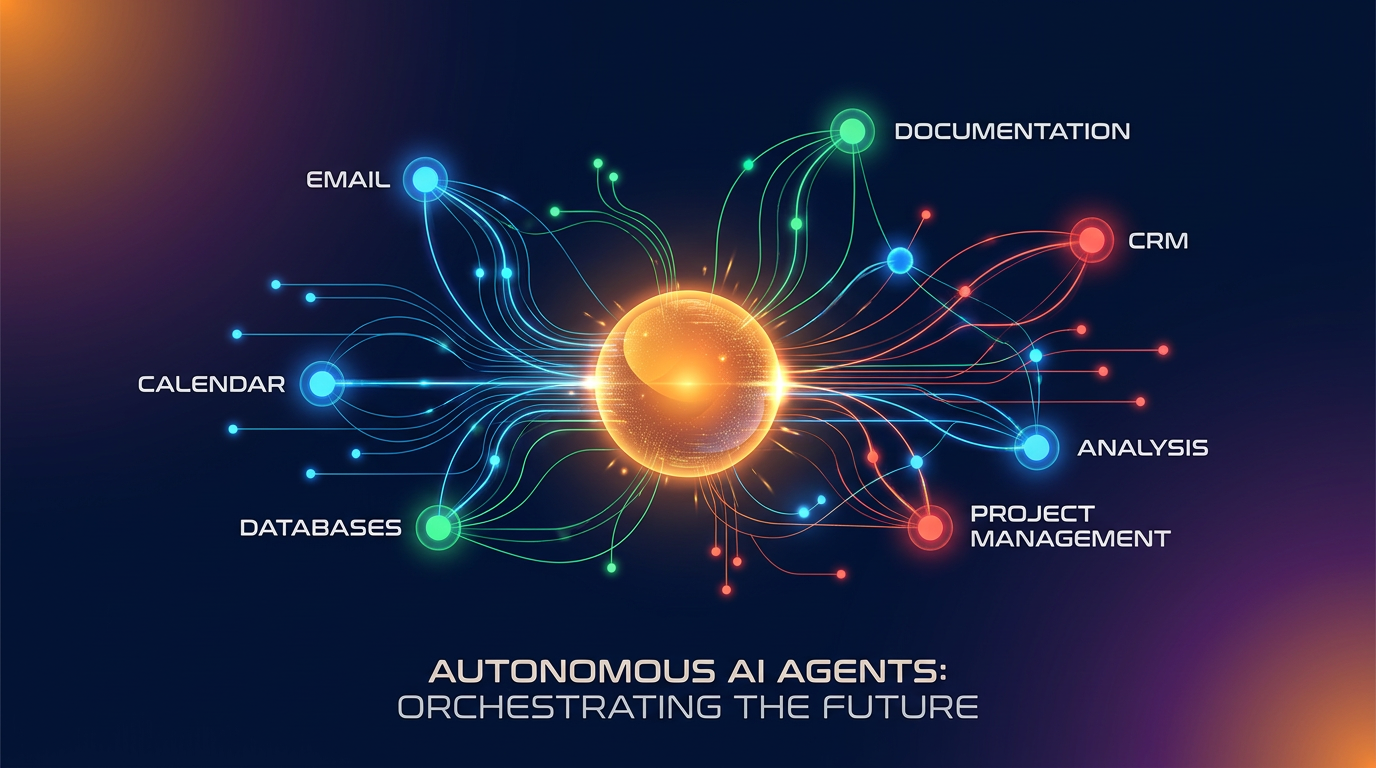
A personal AI agent can be granted permission to access a user's calendar, email, and browser. When asked to "reschedule my afternoon meetings and book a flight to Chicago for tomorrow morning," the agent doesn't just provide a link to an airline. It cross-references the calendar, drafts cancellation emails to the affected parties, navigates the airline's website, selects a flight within the user's budget, and completes the booking autonomously.[2][7]
This capability relies on what developers call "tool use" or "computer-using agents." By interacting with application programming interfaces (APIs) or visually navigating web interfaces just as a human would, these agents bridge the gap between digital reasoning and digital execution. They can click, scroll, type, and read screens, allowing them to operate virtually any software that a human can.[2]
In the enterprise sector, the impact of agentic AI is even more pronounced. Organizations are rapidly moving away from rigid robotic process automation (RPA). Traditional RPA works well for perfectly uniform tasks but breaks down the moment a process deviates from its pre-programmed rules. Instead, businesses are adopting "agentic workflows" that can handle exceptions and variability with human-like judgment.[6]
Agentic workflows organize AI agents into structured, multi-step processes that span entire departments. For example, in human resources, an agentic system can autonomously coordinate across an applicant tracking system, payroll software, and email servers. When a candidate is hired, the agents proactively schedule onboarding sessions, provision software accounts, and flag any missing documentation—adjusting their approach dynamically if a step fails or requires clarification.[6]
Agentic workflows organize AI agents into structured, multi-step processes that span entire departments.
Boston Consulting Group highlights that these intelligent software agents act as autonomous, decision-making entities that can analyze vast amounts of data and plan tasks in real time. This allows companies to automate complex, judgment-heavy processes—such as reviewing insurance claims, triaging IT security threats, or optimizing supply chain logistics—that were previously impossible to hand over to traditional software.[3][4]

The architecture of these systems is also evolving rapidly to support this new scale of automation. While many consumer applications start with a single "full-stack" agent handling a task end-to-end, enterprise deployments increasingly rely on sophisticated multi-agent orchestration.[5]
In a multi-agent setup, specialized AI models collaborate to complete a larger objective. One agent might be strictly responsible for retrieving data from a customer relationship management (CRM) system, another for analyzing that data for trends, and a third for drafting a client report. An "orchestrator" agent oversees the entire workflow, ensuring each sub-agent completes its task correctly before routing the output to the next step.[5][6]
This orchestration layer is critical for turning raw agentic potential into reliable business execution. It enforces strict governance, manages dependencies between different software systems, and determines exactly when human oversight is required to validate an AI's decision.[4][6]
Despite the rapid adoption and clear productivity gains, the shift to autonomous AI introduces significant new risks. When an AI model hallucinates in a chat window, the result is merely a factual error on a screen. But when an agentic AI hallucinates while holding the keys to a company's database or a user's credit card, the consequences are immediate, tangible, and potentially severe.[1][5]
Security and governance have thus become the primary bottlenecks for widespread deployment. Experts emphasize the absolute necessity of "zero-trust" security models and strict permission boundaries. Agents must operate with the principle of least privilege, being granted access only to the specific data and systems strictly necessary for their assigned tasks, and nothing more.[1][5]

Accountability is another major concern that organizations are scrambling to address. Companies must clearly delineate who bears responsibility when an autonomous agent makes an error, such as autonomously approving a fraudulent loan, sending an incorrect invoice to a client, or misconfiguring a cloud server.[1]
To mitigate these operational risks, developers are heavily relying on "human-in-the-loop" checkpoints. For any high-stakes decisions—like finalizing a financial transaction, altering a secure database, or publishing a public statement—the agent prepares all the necessary work but pauses to require explicit human approval before executing the final, irreversible action.[5][6]

As agentic workflows become deeply embedded in both personal and professional daily life, the fundamental nature of human work is expected to shift from manual execution to high-level supervision. Analysts project that by 2028, a third of all enterprise software will include agentic capabilities, fundamentally altering the global productivity landscape.[5][6]
Ultimately, the promise of agentic AI is not about replacing human judgment, but preserving it for where it matters most. By delegating the repetitive connective tissue of digital chores to autonomous agents, humans are freed to focus their cognitive energy on strategy, creativity, and complex problem-solving.[3][7]
How we got here
Late 2022
Generative AI chatbots like ChatGPT introduce the public to advanced language models, focusing on text generation.
Mid 2024
Developers begin experimenting with 'tool use,' allowing language models to trigger basic external APIs.
Early 2025
The first wave of autonomous 'computer-using agents' demonstrates the ability to navigate web browsers and software interfaces.
2026
Agentic workflows become a core feature of enterprise software, shifting the focus from AI conversation to AI execution.
Viewpoints in depth
Enterprise Automation Advocates
Focus on scaling business operations and reducing costs through multi-agent workflows.
This camp, heavily represented by enterprise software vendors and management consultancies, views agentic AI as the ultimate lever for operational efficiency. They argue that by orchestrating multiple specialized agents, businesses can automate complex, judgment-heavy processes like HR onboarding or supply chain routing that traditional robotic process automation (RPA) could never handle. Their primary metric for success is the reduction of manual intervention and the seamless scaling of digital labor.
Personal Productivity Enthusiasts
Focus on individual empowerment and delegating digital chores to reclaim time.
For individual users and startup innovators, agentic AI is the realization of the ultimate personal assistant. This perspective celebrates tools that can autonomously manage inboxes, negotiate meeting times, and conduct web research. They view the technology as a great equalizer that gives everyday workers access to the kind of administrative support previously reserved for executives, fundamentally reducing the daily cognitive load of digital life.
AI Safety & Governance Researchers
Focus on the risks of autonomous execution and the need for strict permission boundaries.
While acknowledging the utility of agents, this group emphasizes the severe risks introduced when AI is given the power to act. They point out that a hallucination in a chatbot is merely a factual error, but a hallucination in an agentic system could result in unauthorized purchases, deleted databases, or misrouted communications. They advocate for 'zero-trust' architectures, strict principle-of-least-privilege access, and mandatory human-in-the-loop checkpoints for any consequential actions.
What we don't know
- How quickly legacy enterprise systems can be upgraded to support secure API access for autonomous agents.
- The long-term impact of agentic automation on entry-level administrative and knowledge-worker jobs.
- How legal liability will be definitively assigned when an autonomous agent makes a costly error on behalf of a user.
Key terms
- Agentic AI
- Artificial intelligence systems capable of planning, making decisions, and executing multi-step tasks autonomously to achieve a specific goal.
- Computer-Using Agent (CUA)
- An AI model trained to visually perceive and interact with standard computer interfaces, allowing it to click, scroll, and type like a human user.
- Orchestration
- The coordination layer in a multi-agent system that sequences tasks, manages dependencies between different AI agents, and enforces business rules.
- Human-in-the-loop
- A safeguard mechanism where an autonomous system pauses to require explicit human review and approval before executing a high-stakes action.
- Zero-Trust Security
- A cybersecurity framework requiring all users and AI agents to be continuously authenticated and granted only the minimum permissions necessary to perform their tasks.
Frequently asked
What is the difference between an AI agent and a chatbot?
A chatbot waits for your prompt and generates a text response. An AI agent understands a goal, plans the necessary steps, and actively uses software tools to complete the work on its own.
Can I use an AI agent for my personal tasks today?
Yes. Tools like Zapier Central, Lindy, and OpenAI's Operator are currently available to help users automate inbox management, scheduling, and web research.
Are AI agents safe to use with my personal data?
While highly capable, agents require strict permission boundaries. Experts recommend using 'human-in-the-loop' settings for any actions involving payments, sensitive data, or public communications.
Will agentic AI replace human jobs?
Current consensus suggests agents will replace specific routine tasks rather than entire jobs, shifting human roles toward supervising the AI, handling exceptions, and focusing on strategic work.
Sources
Source coverage
7 outlets
3 viewpoints surfaced







[1]MIT SloanAcademic & Research Analysts
Agentic AI, explained
Read on MIT Sloan →[2]ZapierPersonal Productivity Enthusiasts
The 9 best AI personal assistant apps in 2026
Read on Zapier →[3]Boston Consulting GroupEnterprise Automation Advocates
AI Agents: What They Are and Their Business Impact
Read on Boston Consulting Group →[4]UiPathEnterprise Automation Advocates
What is Agentic AI?
Read on UiPath →[5]VirtidoEnterprise Automation Advocates
Agentic Workflow Patterns & Best Practices
Read on Virtido →[6]Automation AnywhereEnterprise Automation Advocates
What are Agentic Workflows? The 2026 Enterprise Guide
Read on Automation Anywhere →[7]Factlen Editorial TeamAcademic & Research Analysts
Synthesis by Factlen editorial team
Read on Factlen Editorial Team →


Every angle. Every day.
Get ai stories with full source coverage and perspective breakdowns delivered to your inbox.