
The Science of 'Pre-Bunking': How Psychologists Are Vaccinating the Mind Against Misinformation
Researchers have discovered that exposing social media users to 'micro-doses' of manipulation tactics can build psychological immunity against fake news before it spreads.
By Factlen Editorial Team
- Cognitive Psychologists
- Argue that human minds can be inoculated against rhetorical manipulation just as bodies are inoculated against viruses.
- Technology Platforms
- View pre-bunking as a scalable, frictionless way to combat misinformation without engaging in direct content censorship.
- Free Speech Advocates
- Support source-agnostic interventions that teach critical thinking rather than dictating which specific facts are true or false.
What's not represented
- · Bad-faith actors who utilize these manipulation techniques
- · Traditional fact-checking organizations whose debunking model is being critiqued
Why this matters
As AI makes generating fake news cheaper and faster than ever, traditional fact-checking can no longer keep up. Learning how to spot the underlying psychological tricks of manipulation is becoming the only scalable way to protect your own decision-making.
Key points
- Traditional fact-checking is often too slow and can trigger defensive, partisan reactions.
- "Pre-bunking" uses psychological inoculation to warn users about manipulation tactics before they encounter them.
- A massive YouTube experiment showed 90-second videos improved users' ability to spot manipulation by 5%.
- The intervention is source-agnostic, teaching users how to spot rhetorical tricks rather than dictating what is true.
- The psychological immunity effect works equally well across the political spectrum for both liberals and conservatives.
The traditional approach to fighting online misinformation—fact-checking a claim after it has already gone viral—suffers from a fatal flaw: it is simply too slow. By the time a falsehood is thoroughly debunked, it has already lodged itself in the memories of millions of readers.[6]
Furthermore, traditional fact-checking often triggers defensive reactions. When a platform or an organization labels a specific claim as false, users who already believe the claim frequently interpret the correction as a partisan attack or an attempt at outright censorship.[2]
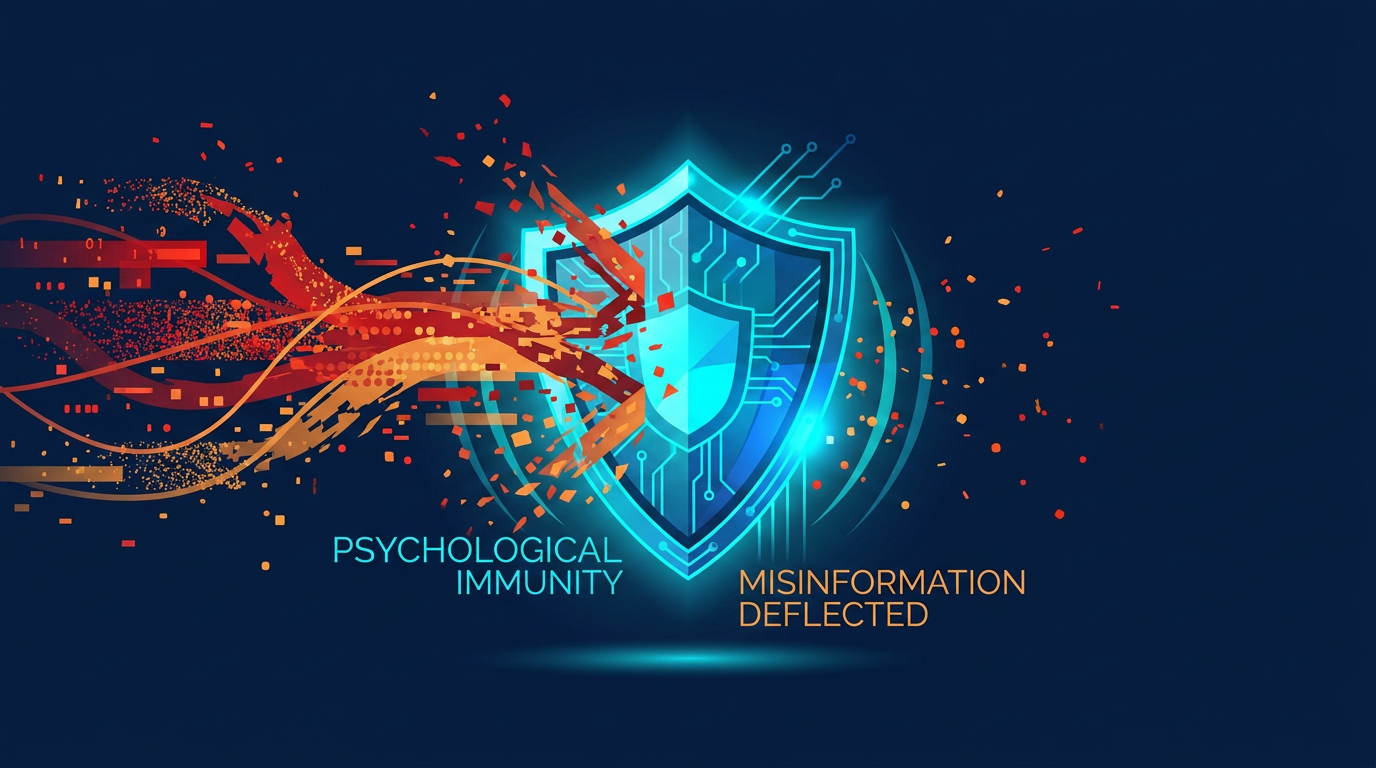
But a growing coalition of cognitive psychologists and technology researchers is pioneering a radically different approach. Instead of chasing down individual lies after they spread, they are deploying a psychological "vaccine" to immunize internet users before the exposure even happens.[1][2]
The strategy is known as "pre-bunking," and it is rooted in a concept called inoculation theory. First developed by social psychologist William McGuire in the 1960s during the Cold War, the theory posits that the human mind can build defenses against persuasive manipulation in the exact same way the biological body builds immunity to a virus.[3]

The mechanism is straightforward: give the subject a warning that they might be manipulated, expose them to a severely weakened "micro-dose" of the manipulation tactic, and then provide the refutation to show exactly how the trick works.[2][5]
Researchers at the University of Cambridge’s Social Decision-Making Lab, in partnership with Google’s Jigsaw unit, have spent the last several years adapting this Cold War-era theory for the modern, high-speed social media landscape.[2][3]
Their breakthrough insight was to make the interventions entirely "source-agnostic." Rather than telling users what specific facts to believe—which inevitably invites accusations of bias—the pre-bunking videos teach users how to spot the underlying rhetorical tricks used by propagandists of all stripes.[2]
The researchers identified five primary manipulation techniques that form the core of the modern "misinformation playbook": emotionally manipulative language, false dichotomies, ad hominem attacks, scapegoating, and deliberate incoherence.[1][5]

To test the theory at scale, Cambridge and Google Jigsaw launched a massive field experiment on YouTube. They created 90-second animated videos explaining these manipulation tactics, using relatable pop-culture references like Star Wars and Family Guy to illustrate the concepts without triggering political defensiveness.[2][5]
To test the theory at scale, Cambridge and Google Jigsaw launched a massive field experiment on YouTube.
These pre-bunking videos were deployed into YouTube's standard pre-roll advert slots, reaching roughly 5.4 million viewers in the United States. Almost a million users watched the educational videos for at least 30 seconds before skipping.[2][5]
Within 24 hours of viewing the ad, a random subset of users was presented with a voluntary test question featuring a fictional social media post. They were asked to identify which manipulation technique was being used in the text.[5]
The results, published in the peer-reviewed journal Science Advances, were highly encouraging. The group that had been exposed to the pre-bunking video was, on average, 5% more likely to correctly identify the manipulation technique compared to a control group that saw no video.[1][5]

Crucially, the researchers found that this psychological inoculation effect was consistent across the political spectrum. It worked equally well for both liberals and conservatives, and it held true regardless of the viewer's age, education level, or personality type.[2]
Beyond passive video consumption, researchers are also gamifying the inoculation process. A study published in the Harvard Kennedy School Misinformation Review demonstrated that an online game called "Bad News"—where players step into the shoes of a fake news creator to learn their tactics—successfully conferred psychological resistance against misinformation across multiple languages and cultures.[4]
The success of these trials has prompted immediate real-world deployments. Google Jigsaw has already rolled out pre-bunking campaigns in Poland, Slovakia, and the Czech Republic to preemptively counter anti-refugee narratives, and recently launched a similar initiative across Europe ahead of the EU parliamentary elections.[3][5]

The approach is not a total panacea. Dr. Jon Roozenbeek, a researcher involved in the studies, notes that pre-bunking is a "light-touch" intervention. The videos must be highly captivating to hold a viewer's attention in a fast-paced feed, and the cognitive immunity they provide may require periodic "booster shots" to maintain its effectiveness over time.[3]
Nevertheless, pre-bunking represents a profound shift in the architecture of digital trust. By focusing on the mechanics of manipulation rather than the specifics of individual claims, platforms can scale their defenses to reach hundreds of millions of users without stepping into the fraught role of arbiters of truth.[2][6]
How we got here
1960s
Psychologist William McGuire first develops 'inoculation theory' to understand resistance to Cold War propaganda.
Feb 2020
Harvard Kennedy School publishes research showing the 'Bad News' game builds misinformation immunity across cultures.
Aug 2022
Cambridge and Google Jigsaw publish results of a 5.4 million-user YouTube experiment proving video pre-bunking works.
May 2024
Google rolls out pre-bunking ad campaigns across Europe ahead of the EU parliamentary elections.
Viewpoints in depth
Cognitive Psychologists
Researchers focused on the mechanics of the human mind and how memory works.
Psychologists argue that the human brain is highly susceptible to the 'illusory truth effect'—the tendency to believe false information after repeated exposure. Because debunking requires repeating the false claim to correct it, it can accidentally reinforce the lie. By shifting to inoculation, psychologists aim to build 'mental antibodies' that trigger critical thinking before the lie can take root in memory.
Technology Platforms
Social media companies looking for scalable ways to improve information quality.
For platforms like Google and YouTube, pre-bunking solves a massive operational headache: the impossibility of fact-checking millions of posts per minute. Furthermore, it allows platforms to improve the quality of discourse without acting as 'arbiters of truth,' a role that frequently invites accusations of political bias and censorship from lawmakers.
Free Speech Advocates
Commentators concerned with preserving open discourse and avoiding top-down censorship.
Anti-censorship advocates generally praise the pre-bunking model because it is 'source-agnostic.' Rather than deleting posts or banning users, pre-bunking empowers the individual user with the tools to make up their own mind. By teaching critical thinking rather than dictating facts, it preserves the open nature of the internet while mitigating the harm of coordinated propaganda.
What we don't know
- How long the psychological immunity lasts before a user requires a 'booster shot' video.
- Whether pre-bunking is effective against highly personalized, AI-generated micro-targeted propaganda.
- If users who learn to spot manipulation actually change their long-term sharing behavior on social media.
Key terms
- Pre-bunking
- The process of preemptively warning and exposing people to weakened doses of misinformation tactics to build psychological resistance.
- Inoculation Theory
- A psychological framework suggesting that exposure to a weak argument helps people build defenses against stronger persuasive attacks in the future.
- False Dichotomy
- A manipulation tactic that falsely presents only two extreme options, ignoring nuance or middle ground.
- Scapegoating
- Unfairly blaming a specific group or individual for a complex problem to stoke anger and division.
- Source-Agnostic
- An approach that focuses on the rhetorical techniques being used, rather than judging the credibility of the person or outlet speaking.
Frequently asked
What is the difference between pre-bunking and debunking?
Debunking tries to correct a false claim after a person has already heard it. Pre-bunking teaches people how to spot the trick before they are ever exposed to the lie.
Does pre-bunking tell people what political views to hold?
No. The interventions are 'source-agnostic,' meaning they only teach users how to identify manipulation tactics like scapegoating or false dichotomies, regardless of who is using them.
Does this work on everyone?
Studies show the inoculation effect is consistent across the political spectrum, working equally well for both liberals and conservatives, as well as across different education levels.
How long does the psychological immunity last?
While the initial effect is measurable, researchers note that the cognitive immunity can fade over time, suggesting that users may need periodic 'booster shots' to maintain their defenses.
Sources
Source coverage
6 outlets
3 viewpoints surfaced






[1]Science AdvancesCognitive Psychologists
Psychological inoculation improves resilience against misinformation on social media
Read on Science Advances →[2]University of CambridgeCognitive Psychologists
Social media experiment reveals potential to 'inoculate' millions of users against misinformation
Read on University of Cambridge →[3]TIMETechnology Platforms
Inside Google's Plans to Combat Misinformation Ahead of the EU Elections
Read on TIME →[4]Harvard Kennedy School Misinformation ReviewCognitive Psychologists
Prebunking interventions based on “inoculation” theory can reduce susceptibility to misinformation across cultures
Read on Harvard Kennedy School Misinformation Review →[5]Silicon RepublicTechnology Platforms
How Google is 'pre-bunking' fake news on YouTube videos
Read on Silicon Republic →[6]Factlen Editorial TeamFree Speech Advocates
Synthesis by Factlen editorial team
Read on Factlen Editorial Team →
More in news politics
See all 6 stories →Fed Watch
Federal Reserve Holds Rates Steady as Warsh Signals Potential Hikes Amid Inflation Surge
8 sources
Middle East Diplomacy
U.S. and Iran Release Draft Memorandum of Understanding to End Regional Conflict
7 sources
US-Iran Deal
US and Iran Agree to 60-Day Ceasefire and Memorandum of Understanding to End War
8 sources
US-Iran Peace Deal
US and Iran Agree to 14-Point Memorandum to End War and Reopen Strait of Hormuz
8 sources
Every angle. Every day.
Get news politics stories with full source coverage and perspective breakdowns delivered to your inbox.