
The Rise of Local LLMs: How Powerful AI Moved from the Cloud to Your Laptop
Advancements in software and open-weight models have made running artificial intelligence locally accessible to everyday users, offering unprecedented privacy and cost savings.
By Factlen Editorial Team
- Privacy & Security Advocates
- Focus on data sovereignty, GDPR compliance, and the elimination of third-party data logging.
- Open-Source Developers
- Value the flexibility, cost-efficiency, and API access provided by local model runtimes.
- Consumer Ecosystem Builders
- Prioritize seamless native integration, hardware acceleration, and user-friendly interfaces.
What's not represented
- · Cloud API Providers
- · Enterprise IT Administrators
Why this matters
Running AI locally gives you complete ownership over your data and eliminates monthly subscription costs. By moving processing to your own device, you can safely use AI for sensitive work—like personal finances, medical questions, or proprietary code—without a third party ever seeing your prompts.
Key points
- Local LLMs allow users to run powerful AI models entirely on their own hardware, ensuring complete data privacy.
- Tools like Ollama and LM Studio have eliminated complex setups, making local AI as easy to install as a standard app.
- Running models locally replaces variable cloud API subscription costs with the fixed cost of electricity.
- Apple has raised the hardware bar, requiring 12GB of unified memory for its most advanced on-device AI features.
- The industry is adopting a hybrid approach, using local models for sensitive tasks and cloud APIs for complex reasoning.
For years, artificial intelligence was strictly a cloud-bound phenomenon. Every prompt sent to ChatGPT, Claude, or Gemini traveled to a remote data center, was processed on industrial-scale hardware, and left a permanent record on a third-party server.[4]
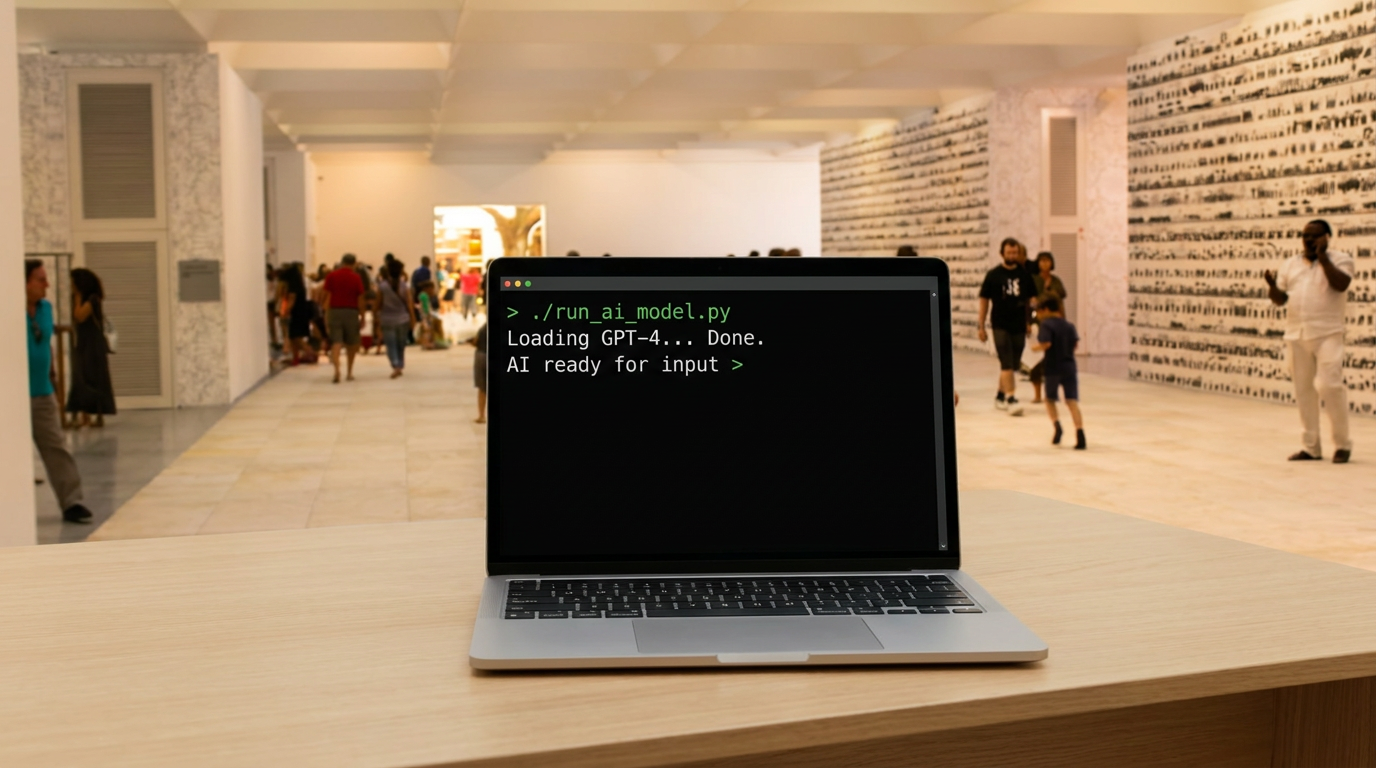
In 2026, that paradigm has fundamentally shifted. Local large language models (LLMs)—running entirely on personal laptops, smartphones, and home servers—have evolved from clunky hobbyist experiments into mainstream productivity engines.[6]
The primary catalyst for this migration is data sovereignty. When dealing with proprietary codebases, sensitive medical records, or confidential legal drafts, transmitting data to external servers introduces significant security risks and regulatory hurdles.[7]
By executing the model locally, the data never leaves the user's machine. There are zero network requests, zero API logs, and immediate compliance with stringent frameworks like Europe's GDPR, effectively eliminating the legal landmines associated with cloud processing.[4][7]

Economics provide the second major incentive. Cloud-based AI APIs operate on a metered, per-token billing model, meaning costs scale linearly with usage—a significant burden for heavy users, developers, or bootstrapping startups.[7]
Local inference replaces these variable monthly bills with the fixed, predictable costs of hardware and electricity. A modern laptop running a mid-sized model consumes roughly 30 to 60 watts, translating to mere pennies per day in operational costs.[4]
The software ecosystem has matured rapidly to facilitate this transition. In the past, running a local model required navigating complex Python dependencies and fragile environments; today, it is as simple as installing a standard desktop application.[3][6]
Two dominant platforms have emerged to serve different user needs. Ollama operates as a developer-first background service, allowing users to download models with a single terminal command and interact with them via an OpenAI-compatible local API.[3]
Two dominant platforms have emerged to serve different user needs.
For users who prefer a visual interface, LM Studio provides a polished, desktop-native application. Often described as the "Spotify for LLMs," it features a built-in model browser, a chat interface, and simple sliders for adjusting hardware settings without touching a command line.[3][6]
Under the hood, this accessibility is powered by advanced quantization techniques and the GGUF file format. Quantization compresses the massive neural networks—reducing the precision of their weights—so they can run efficiently on standard consumer hardware without a catastrophic loss in reasoning quality.[6]
Despite software optimizations, hardware remains the ultimate bottleneck, with memory capacity being far more critical than raw processing speed. The industry rule of thumb in 2026 dictates that a quantized model requires roughly 0.5 to 1 gigabyte of RAM per billion parameters.[4][6]

Apple has aggressively capitalized on this hardware-first approach with its "Apple Intelligence" architecture, weaving on-device AI deeply into the fabric of iOS 27 and macOS.[2]
At WWDC 2026, Apple introduced AFM 3 Core Advanced, a 20-billion-parameter sparsely activated model. By utilizing an architecture that only activates a fraction of its parameters for any given request, it delivers high performance while conserving battery life on mobile devices.[2]
However, this capability demands significant hardware resources. Apple recently raised the baseline memory requirement for its most advanced on-device features to 12GB of unified memory, meaning the standard iPhone 17 is excluded in favor of the iPhone 17 Pro and the new iPhone Air.[1]

Meanwhile, the open-weight model ecosystem has exploded with highly capable, compact models. Google's Gemma 4, Meta's Llama 4, and Alibaba's Qwen 2.5 offer frontier-level performance that rivals the massive cloud models of just a year ago.[5][8]
A 12-billion-parameter model can now run comfortably in 16GB of system RAM, handling complex coding, summarization, and agentic tasks at speeds exceeding 50 tokens per second on modern silicon.[5]
Despite these remarkable advances, local models do not entirely replace the cloud. For massive multi-step reasoning, analyzing 50-page documents, or orchestrating complex enterprise workflows, the sheer compute power of cloud giants still holds a distinct advantage.[4][7]

Consequently, the industry is settling into a pragmatic hybrid pattern. Users and enterprises deploy local models for 80% of their routine, privacy-sensitive tasks, while seamlessly routing the most complex queries to cloud APIs—delivering the ultimate balance of privacy, cost, and capability.[6][9]
How we got here
Early 2023
The release of LLaMA sparks the open-source AI movement, though running models requires complex Python environments.
Late 2023
The GGUF format and tools like Ollama emerge, drastically simplifying the installation process for local models.
Mid 2024
Apple announces its initial push into on-device AI, integrating small foundation models directly into iOS and macOS.
April 2025
The release of Llama 4 introduces massive context windows to the open-weight ecosystem, rivaling proprietary cloud models.
June 2026
Apple unveils AFM 3 Core Advanced and raises hardware requirements, while tools like LM Studio make local AI accessible to non-technical users.
Viewpoints in depth
Privacy & Security Advocates
Focus on data sovereignty, GDPR compliance, and the elimination of third-party data logging.
For industries handling sensitive information—such as healthcare, law, and enterprise software development—sending data to cloud providers is a non-starter. This camp argues that local LLMs are the only viable path forward, as they guarantee zero network requests and eliminate the need for complex data processing agreements. By keeping inference on-device, organizations completely bypass the risk of their proprietary data being used to train future commercial models.
Open-Source Developers
Value the flexibility, cost-efficiency, and API access provided by local model runtimes.
Developers view local AI as a fundamental shift in how software is built. Without the friction of variable API costs or rate limits, engineers can experiment freely, run continuous coding agents, and integrate AI into background processes that would be prohibitively expensive in the cloud. This camp champions tools like Ollama for their ability to provide a stable, OpenAI-compatible endpoint that runs entirely offline, preventing vendor lock-in.
Consumer Ecosystem Builders
Prioritize seamless native integration, hardware acceleration, and user-friendly interfaces.
Hardware manufacturers and GUI developers focus on bringing AI to the masses by removing technical barriers. Apple's approach with 'Apple Intelligence' exemplifies this, embedding sparsely activated models directly into the operating system to ensure low latency and high privacy without requiring user configuration. Similarly, tools like LM Studio cater to this viewpoint by offering a polished, visual experience that abstracts away the complexities of quantization and terminal commands.
What we don't know
- How quickly hardware manufacturers will increase baseline RAM in budget laptops to accommodate growing local models.
- Whether future regulatory frameworks will mandate local processing for specific types of sensitive enterprise data.
- How cloud providers will adjust their pricing models to compete with the rising popularity of free, local inference.
Key terms
- Quantization
- A compression technique that reduces the precision of an AI model's weights, allowing massive neural networks to run on standard consumer hardware with minimal loss in quality.
- GGUF
- A popular file format designed specifically for running quantized language models efficiently on CPUs and Apple Silicon.
- Inference
- The process of a trained AI model generating a response or prediction based on a user's prompt.
- Unified Memory
- A hardware architecture, prominently used in Apple Silicon, where the CPU and GPU share the same pool of high-speed memory, greatly accelerating on-device AI tasks.
- Open-weight Model
- An AI model whose core architecture and trained parameters are made publicly available for anyone to download, run, and modify.
Frequently asked
Do I need a powerful GPU to run AI locally?
While a dedicated GPU significantly speeds up response times, it is no longer strictly required. Modern quantization techniques allow capable models to run entirely on a standard laptop's CPU and system RAM, though at a slower generation speed.
Is running a local LLM completely free?
Yes, the software (like Ollama or LM Studio) and the open-weight models (like Llama 4 or Gemma 4) are free to download and use. Your only costs are the hardware you already own and the electricity required to run it.
Can local models connect to the internet?
By default, local LLMs operate entirely offline and cannot browse the web. However, developers can connect them to external tools or search engines using frameworks that feed web data into the model's context window.
What is the difference between Ollama and LM Studio?
Ollama is a command-line tool designed for developers, running as a background service with an API. LM Studio is a desktop application with a graphical interface, making it easier for beginners to browse, download, and chat with models visually.
Sources
Source coverage
9 outlets
3 viewpoints surfaced









[1]MacRumorsConsumer Ecosystem Builders
Apple's Most Powerful On-Device AI Now Requires iPhone 17 Pro or iPhone Air
Read on MacRumors →[2]AppleConsumer Ecosystem Builders
Maximizing on-device AI capabilities with AFM 3 Core Advanced
Read on Apple →[3]ContaboOpen-Source Developers
Ollama vs LM Studio: Which Local LLM Runtime Should You Use in 2026?
Read on Contabo →[4]FreeAcademyPrivacy & Security Advocates
The Real Tradeoffs Between Local and Cloud LLMs in 2026
Read on FreeAcademy →[5]PinggyConsumer Ecosystem Builders
Running powerful AI language models locally in 2026
Read on Pinggy →[6]TechsyOpen-Source Developers
Run LLMs Locally 2026: The 5-Minute Setup for Any GPU
Read on Techsy →[7]DanubeDataPrivacy & Security Advocates
Run Ollama on a VPS: Self-Host Local LLMs in Europe (2026)
Read on DanubeData →[8]Create AI AgentOpen-Source Developers
Why 2026 is the Year of Local Intelligence
Read on Create AI Agent →[9]Factlen Editorial TeamConsumer Ecosystem Builders
Synthesis by Factlen editorial team
Read on Factlen Editorial Team →

More in ai
See all 5 stories →Frontier AI Regulation
The Great American AI Act of 2026: The Evidence Behind the First Comprehensive Federal Framework
6 sources

Content Provenance
How Invisible Watermarking and C2PA Are Securing the Internet Against Deepfakes
7 sources

Open-Source AI
Open-Source AI Reaches a Tipping Point as June Releases Rival Proprietary Giants
8 sources

Every angle. Every day.
Get ai stories with full source coverage and perspective breakdowns delivered to your inbox.