
Steam Deck OLED vs. ASUS ROG Ally X: Choosing the Right Premium Handheld in 2026
As handheld PC gaming matures in 2026, the choice between Valve's Steam Deck OLED and the ASUS ROG Ally X comes down to a battle between seamless efficiency and raw Windows-powered performance.
By Factlen Editorial Team
- Seamless Console Advocates
- Prioritize a frictionless user interface, instant suspend/resume features, and battery efficiency over raw graphical power.
- Windows Power Users
- Value raw performance, high refresh rates, and the freedom to install any game launcher or anti-cheat software without restrictions.
- Hardware Modders
- Focus on the physical upgradeability of the devices, such as swapping SSDs, adding external GPUs, and tweaking thermal limits.
What's not represented
- · Budget-conscious gamers who rely on sub-$400 entry-level handhelds
- · Cloud-gaming exclusive users who don't need local processing power
Why this matters
With premium handheld gaming PCs now costing between $550 and $1,000, buyers are making a significant investment. Understanding the fundamental trade-offs between Valve's curated ecosystem and ASUS's brute-force Windows approach ensures you buy the device that actually fits your gaming habits.
Key points
- The Steam Deck OLED excels in battery efficiency, OLED contrast, and providing a seamless, console-like user interface.
- The ROG Ally X dominates in raw performance, offering a sharper 1080p resolution and a 120Hz VRR display.
- ASUS equipped the Ally X with a massive 80Wh battery to compensate for its higher power draw during AAA gaming.
- Windows 11 on the Ally X allows native Xbox Game Pass support but requires more tinkering than SteamOS.
- SteamOS offers a frictionless experience but lacks compatibility with some anti-cheat multiplayer games.
The handheld PC market has evolved from a niche hobbyist curiosity into one of the most vibrant sectors in gaming. By mid-2026, the experimental phase is over, and the market has consolidated around a few highly refined premium devices. For gamers looking to take their PC libraries on the go, the decision almost always comes down to two heavyweights: Valve's Steam Deck OLED and the ASUS ROG Ally X.[1][3]
These two devices represent entirely different philosophies regarding what a portable PC should be. Valve has doubled down on a curated, console-like experience powered by its custom SteamOS, prioritizing efficiency, battery life, and a frictionless user interface. ASUS, partnering closely with Microsoft, has taken the brute-force route, building a native Windows 11 machine that prioritizes raw processing power, high refresh rates, and total ecosystem flexibility.[2][6]
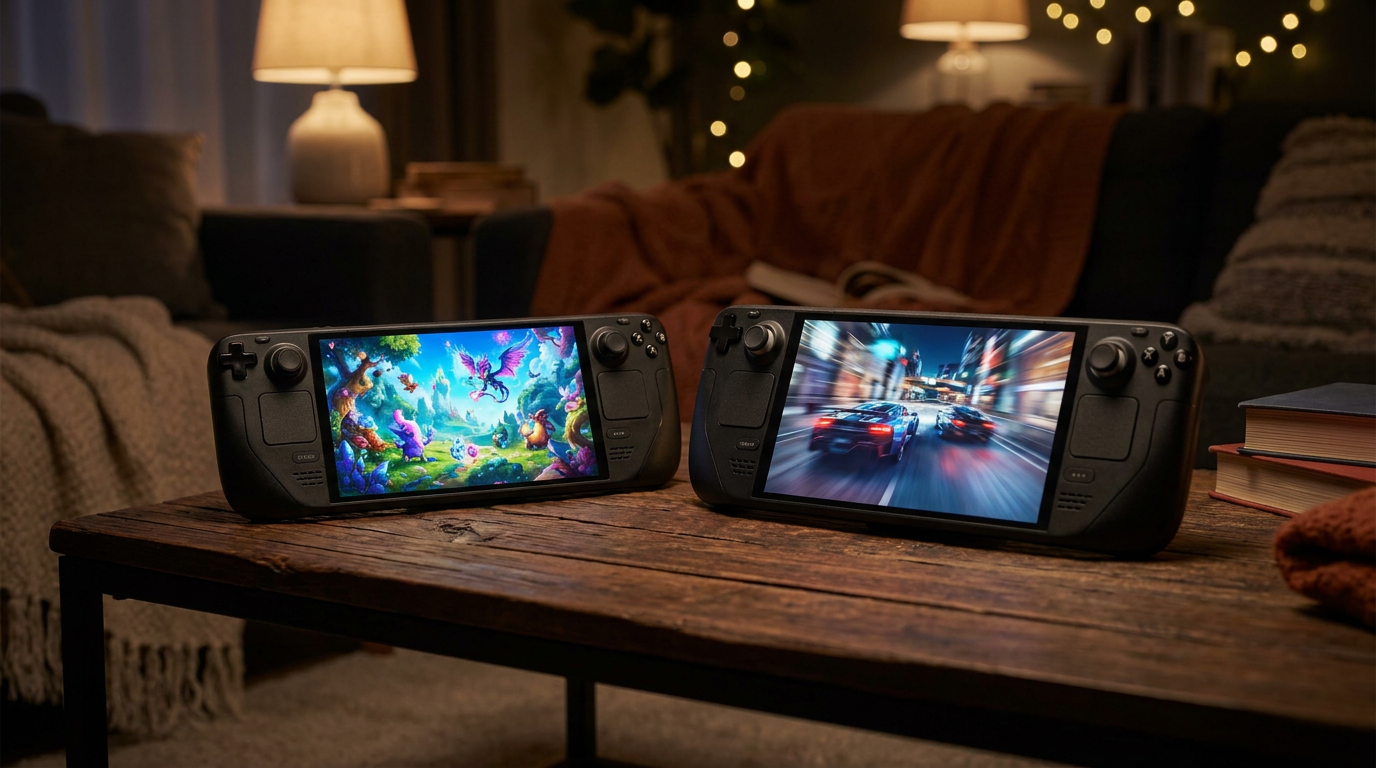
The most immediate difference between the two lies in their displays. The Steam Deck OLED features a 7.4-inch, 1280x800 HDR OLED screen running at 90Hz. For atmospheric, single-player games, this panel is virtually unbeatable. The OLED technology provides perfect, inky blacks and vibrant color reproduction that makes games pop, while the HDR implementation is widely considered best-in-class for a handheld.[4][6]
The ROG Ally X counters with a 7-inch, 1920x1080 IPS LCD panel running at a faster 120Hz. While it lacks the perfect contrast of OLED, it offers a significantly sharper image due to the higher pixel density. Crucially, the Ally X display features Variable Refresh Rate (VRR) technology, which synchronizes the screen's refresh rate with the game's frame rate. This makes performance dips almost imperceptible, resulting in a profoundly smooth experience during fast-paced action games.[3][5][6]
Under the hood, the ROG Ally X is a powerhouse designed to push the limits of the 7-inch form factor. Equipped with an AMD Ryzen Z2 Extreme APU and a massive 24GB of high-speed LPDDR5X RAM, it is built to handle modern AAA titles. That extra memory is particularly vital, as it allows the system to allocate more VRAM to the graphics processor without starving the Windows operating system.[3][5]

Valve's Steam Deck OLED takes a more conservative approach to silicon. It utilizes a custom, highly efficient AMD APU paired with 16GB of RAM. Valve's engineering focus wasn't on winning synthetic benchmark charts, but rather on maximizing performance-per-watt. The hardware is meticulously tuned to extract the best possible frame rates at lower power draws, ensuring the device doesn't overheat or drain its battery in minutes.[2][6]
Valve's Steam Deck OLED takes a more conservative approach to silicon.
In real-world AAA gaming, the performance gap is noticeable. When running demanding titles like Cyberpunk 2077 at 1080p, the ROG Ally X can comfortably deliver 40 to 50 frames per second on medium settings. The Steam Deck OLED, running at its native 800p resolution, typically hovers around 30 frames per second in the same heavy titles. For players who demand the highest fidelity in the newest games, the Ally X holds a distinct advantage.[1][4][5]
However, that performance comes at a steep cost to battery life, which brings us to the most complex trade-off between the two devices. To feed its power-hungry internals, ASUS equipped the ROG Ally X with a massive 80Wh battery—double the capacity of the original Ally and the largest in its class. The Steam Deck OLED features a smaller 50Wh battery.[3][5][6]
Despite the smaller battery, the Steam Deck OLED is the undisputed king of efficiency. At lower power limits (under 10 watts), Valve's APU dramatically outperforms the Z2 Extreme. For players enjoying indie games, older titles, or emulation, the Steam Deck OLED can stretch its 50Wh battery to an astonishing 8 to 12 hours. The Ally X, burdened by the overhead of Windows 11, struggles to match that longevity in lightweight scenarios.[1][6]
Conversely, when both devices are pushed to their absolute maximum power draw to run heavy AAA games, the math flips. The Ally X's sheer battery size allows it to outlast the Steam Deck OLED when both are running at full tilt, offering nearly three hours of high-end gaming compared to the Deck's roughly two hours.[4][5]

The software experience is where the philosophical divide is most apparent. SteamOS is a marvel of user-centric design. It allows players to suspend and resume games instantly, tweak performance overlays with a single button press, and navigate menus seamlessly with a controller. It feels like a dedicated game console that just happens to play PC games. However, because it relies on the Proton compatibility layer to translate Windows code to Linux, certain multiplayer games with kernel-level anti-cheat software—like Call of Duty or Valorant—simply will not run.[2][6]
The ROG Ally X runs a full desktop version of Windows 11. This is its greatest strength and its most frustrating weakness. On the positive side, it offers total freedom: players can natively install Xbox Game Pass, the Epic Games Store, Battle.net, and any anti-cheat software on the market. On the negative side, navigating a desktop OS designed for a mouse and keyboard on a 7-inch touchscreen can be clunky, and users must contend with standard Windows updates, driver installations, and background processes.[1][3][5]
Ergonomically, both devices have their champions. The Steam Deck is wider and lighter, featuring dual trackpads that make mouse-heavy strategy and simulation games entirely playable on the go. The Ally X features refined, deeper grips, offset Xbox-style thumbsticks, and dual USB-C ports (including a USB4 port for external GPUs), making it feel like a premium, versatile controller tailored for traditional action games.[2][3][6]

Ultimately, declaring a single winner is impossible without knowing the player. The Steam Deck OLED fits perfectly for gamers who want a frictionless, console-like experience, value battery efficiency, and primarily play single-player games from their Steam library. The ROG Ally X is the definitive choice for power users who demand high frame rates, rely on Xbox Game Pass, play competitive multiplayer shooters, and don't mind tinkering with Windows settings to unlock the machine's full potential.[4][6]
How we got here
Feb 2022
Valve launches the original LCD Steam Deck, effectively creating the modern premium handheld PC category.
Jun 2023
ASUS releases the first ROG Ally, introducing Windows 11 and a 120Hz screen to the handheld space.
Nov 2023
Valve releases the Steam Deck OLED, featuring a vastly improved screen, larger battery, and better thermals.
Mid 2024
ASUS launches the ROG Ally X, doubling the battery capacity to 80Wh and increasing the RAM to 24GB.
Early 2026
The handheld market matures with refined Z2 Extreme chips and widespread adoption of portable PC gaming.
Viewpoints in depth
Seamless Console Advocates
Gamers who prioritize a frictionless user interface and battery efficiency over raw graphical power.
This camp argues that a handheld device should feel like a dedicated console, not a miniature laptop. They point to Valve's SteamOS as the gold standard, praising its ability to instantly suspend and resume games, its unified controller-friendly interface, and its lack of background bloatware. For these users, the perfect contrast of the OLED screen and the unmatched battery efficiency at lower wattages make the Steam Deck the only logical choice for playing on the go.
Windows Power Users
Gamers who value raw performance, high refresh rates, and the freedom to install any software.
Power users view the limitations of SteamOS as a dealbreaker, arguing that a PC should act like a PC. They champion the ROG Ally X for its brute-force approach, citing the 24GB of RAM and the Z2 Extreme APU as necessary for modern AAA gaming. For this camp, the ability to natively install Xbox Game Pass, Epic Games, and kernel-level anti-cheat software for competitive shooters far outweighs the occasional clunkiness of navigating Windows 11 on a touch screen.
Hardware Modders
Enthusiasts focused on the physical upgradeability and thermal tweaking of the devices.
This smaller but vocal community evaluates handhelds based on how easily they can be pushed past their factory limits. They favor the ROG Ally X for its inclusion of a USB4 port, which allows the connection of external desktop GPUs for docked 4K gaming. They also appreciate the Ally X's internal layout, which makes swapping in larger M.2 2280 SSDs significantly easier than on competing devices.
What we don't know
- How upcoming ARM-based handhelds will disrupt the x86 dominance of both Valve and ASUS.
- When Valve will officially announce a true 'Steam Deck 2' with a next-generation APU.
Key terms
- APU
- Accelerated Processing Unit, a single chip that combines both the central processor (CPU) and the graphics processor (GPU), which is crucial for saving space in handheld devices.
- VRR
- Variable Refresh Rate, a display technology that synchronizes the screen's refresh rate with the game's frame rate to eliminate screen tearing and make performance dips less noticeable.
- Proton
- A compatibility layer developed by Valve that allows games built for Windows to run seamlessly on the Linux-based SteamOS.
- TDP
- Thermal Design Power, which refers to the maximum amount of heat a chip is allowed to generate, effectively dictating how much battery power it consumes during gameplay.
Frequently asked
Can I play Xbox Game Pass on the Steam Deck?
Not natively through SteamOS. You can stream Game Pass via the cloud, or undergo the complex process of installing Windows on the Deck, but it lacks the native, out-of-the-box support found on the ROG Ally X.
Does the ROG Ally X have an OLED screen?
No, the ROG Ally X uses a 1080p IPS LCD panel. While it lacks the perfect blacks of OLED, it compensates with a sharper resolution, a faster 120Hz refresh rate, and Variable Refresh Rate (VRR) technology.
Which device is better for competitive multiplayer games?
The ROG Ally X is generally the better choice. Because it runs native Windows 11, it supports all kernel-level anti-cheat software required by games like Valorant and Call of Duty, which are currently blocked on SteamOS.
Which handheld has better battery life?
It depends on the game. The Steam Deck OLED is vastly more efficient for lightweight indie games and can last up to 12 hours. However, for demanding AAA games running at maximum power, the Ally X's massive 80Wh battery gives it a slight edge.
Sources
Source coverage
6 outlets
3 viewpoints surfaced






[1]PCMagWindows Power Users
The Best Handheld Gaming PCs for 2026
Read on PCMag →[2]PC GamerSeamless Console Advocates
The best handheld gaming PC in 2026
Read on PC Gamer →[3]Tom's HardwareWindows Power Users
Best Handheld Gaming PCs 2026
Read on Tom's Hardware →[4]IGNWindows Power Users
The Best Handheld Gaming PCs
Read on IGN →[5]Rock Paper ShotgunHardware Modders
Asus ROG Ally X Review - The best gaming handheld thanks to faster RAM and a huge 80 Wh battery
Read on Rock Paper Shotgun →[6]Windows ForumSeamless Console Advocates
Steam Deck OLED vs ROG Ally X: 2026 Handheld War
Read on Windows Forum →


Every angle. Every day.
Get entertainment stories with full source coverage and perspective breakdowns delivered to your inbox.