
How Bidirectional Charging is Turning 2026's EVs into Massive Home Batteries
Vehicle-to-Home (V2H) and Vehicle-to-Grid (V2G) technologies are reaching mainstream adoption, allowing electric vehicles to power households during outages and generate revenue. We break down the hardware, the costs, and the battery health realities of bidirectional charging.
By Factlen Editorial Team
- Grid Operators & Utilities
- Views EVs as a massive, decentralized virtual power plant to stabilize the grid.
- Energy Independence Advocates
- Focuses on the resilience and self-sufficiency unlocked by V2H technology.
- Battery Health Skeptics
- Cautions that using a vehicle as a home battery accelerates wear and tear.
- Automotive Manufacturers
- Balances the consumer demand for V2X features against the liability of battery warranties.
What's not represented
- · Renters and apartment dwellers who cannot install home charging infrastructure.
- · Independent electricians facing complex installation and permitting hurdles.
Why this matters
For decades, cars have been a depreciating expense that only consumed energy. Bidirectional charging transforms the electric vehicle into a financial asset that can slash your home utility bills, provide days of emergency backup power, and even earn money from the grid.
Key points
- Bidirectional charging allows EVs to send power back to homes (V2H) or the electrical grid (V2G).
- A modern EV battery holds roughly 60 to 130 kWh, enough to power an average home for up to 10 days.
- V2H requires specialized hardware, including a bidirectional charger and an islanding controller, costing $3,000 to $8,000.
- Homeowners can save money by charging at cheap night rates and powering their home from the EV during peak evening hours.
- Pilot programs show EV owners can earn up to $780 annually by selling stored energy back to the grid.
- Major automakers are updating warranties to permit approved V2H use without voiding battery protections.
The paradigm shift is quietly unfolding in driveways around the world. For a century, cars have been pure consumers of energy. In 2026, the electric vehicle is undergoing a fundamental identity change. It is no longer just a mode of transportation; it is the largest battery most people will ever own. As bidirectional charging technology reaches mainstream adoption, EVs are transforming into mobile power stations capable of running a household or stabilizing the local power grid.[1][7]
The sheer scale of the energy stored in a modern EV is difficult to overstate. A standard home battery, such as a Tesla Powerwall, holds roughly 13.5 kilowatt-hours of electricity. By contrast, a modern electric vehicle carries anywhere from 60 to over 130 kilowatt-hours. A Ford F-150 Lightning, equipped with its extended-range battery, packs 131 kilowatt-hours—nearly ten times the capacity of a dedicated residential storage unit.[2]

Tapping into that massive reservoir requires a technology known as bidirectional charging. Historically, EV charging has been a one-way street: alternating current flows from the grid, is converted to direct current by the car's onboard charger, and is stored in the battery. Bidirectional systems reverse this flow, allowing the stored direct current power to be pulled out of the vehicle, converted back to alternating current, and pushed into a home or the broader electrical network.[4]
This two-way energy transfer falls under the umbrella term Vehicle-to-Everything, which the industry divides into three distinct capabilities. The simplest and most widely available is Vehicle-to-Load. Vehicles equipped with this feature have standard electrical outlets built directly into the cabin or the charging port via an adapter. This allows drivers to plug in laptops, power tools, or camping equipment directly, drawing up to 3.6 kilowatts without any specialized home hardware.[5][6]
The second, and currently most sought-after capability in 2026, is Vehicle-to-Home. Instead of powering a single appliance, this connects the vehicle to the home's main electrical panel. During a power outage, a fully charged electric vehicle can keep a typical household running for three to ten days, depending on energy consumption and whether the home has rooftop solar panels to recharge the car during the day.[2][6]
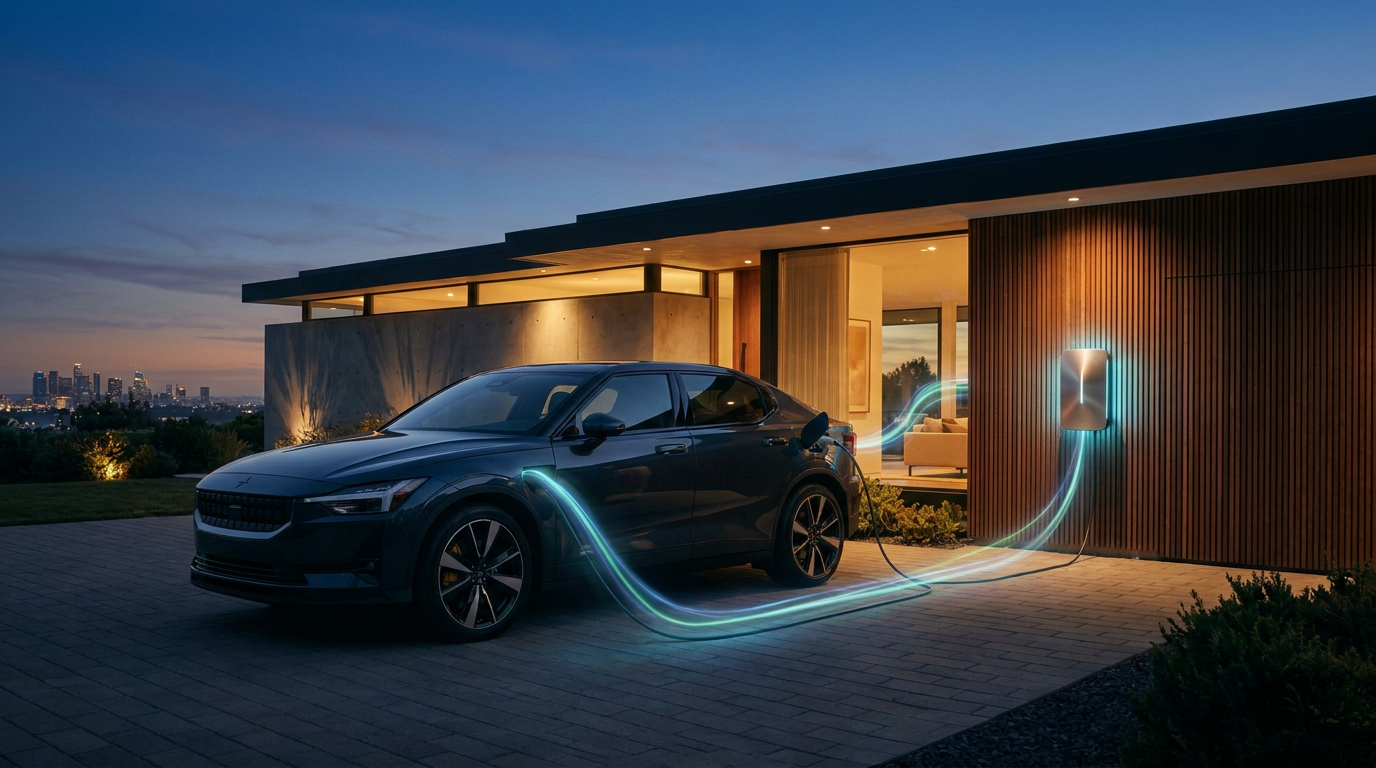
To make this work safely, homeowners must install specific hardware. The setup requires a bidirectional charger, which contains the heavy-duty inverter necessary to convert the car's direct current power back to alternating current. Crucially, it also requires an islanding controller or automatic transfer switch. When the grid goes down, this device physically disconnects the house from the utility lines, ensuring that the vehicle's power does not back-feed into the neighborhood grid and endanger utility workers repairing the lines.[4]

Beyond emergency backup, powering the home unlocks a powerful financial mechanism known as Time-of-Use arbitrage. Many utilities charge significantly higher rates for electricity during the evening peak—typically between late afternoon and mid-evening—when demand is highest. With a bidirectional setup, a homeowner can charge their vehicle overnight when rates are dirt cheap, and then program the car to power the house during the expensive evening hours, effectively zeroing out peak energy costs.[3][6]
Beyond emergency backup, powering the home unlocks a powerful financial mechanism known as Time-of-Use arbitrage.
For households with rooftop solar, the synergy is even stronger. Instead of exporting excess solar generation to the grid at midday for a meager feed-in tariff, the solar panels can charge the vehicle. When the sun goes down, the house seamlessly transitions to drawing that stored solar energy from the car, maximizing self-consumption and drastically reducing reliance on the utility company.[6]
The third and most complex tier of bidirectional charging is Vehicle-to-Grid. While home-focused systems keep the energy behind the meter, grid-focused systems allow the homeowner to sell their stored power back to the utility. Because electric vehicles are parked an estimated ninety to ninety-five percent of the time, millions of plugged-in cars represent a massive, decentralized power plant that grid operators can tap into during extreme demand spikes, such as summer heatwaves.[3]
Utilities are highly motivated to access this capacity, and they are willing to pay for it. In pilot programs analyzed across the United Kingdom, California, and Japan, households enrolled in grid services earned between four hundred and twenty and seven hundred and eighty dollars annually. By allowing the utility to draw a small percentage of the battery's charge during critical hours, owners turn their depreciating asset into a revenue-generating grid resource.[3]
Despite the clear benefits, the transition to a bidirectional future faces significant friction, starting with hardware costs. While standard home chargers cost a few hundred dollars, bidirectional chargers remain expensive in 2026. Factoring in the specialized inverter, the islanding controller, and professional installation, a complete setup typically runs between three thousand and eight thousand dollars. For many consumers, the return on investment requires years of energy arbitrage to break even.[2][3]

The other major uncertainty revolves around battery degradation. Lithium-ion batteries degrade with every charge and discharge cycle. Skeptics argue that using an expensive vehicle as a daily home battery accelerates wear and tear, potentially compromising the car's primary function and resale value. The fear of voiding the battery warranty has made some early adopters hesitant to plug their cars into these advanced systems.[3]
However, emerging evidence suggests these fears may be overstated. Engineering models indicate that the shallow, low-power micro-cycles required for home backup or peak shaving cause minimal degradation compared to the high-heat stress of highway driving or fast charging. In response, automakers are gradually updating their warranties. In 2026, several major manufacturers explicitly permit bidirectional charging, provided it is done through approved hardware and within specified annual energy limits.[3]
Vehicle compatibility is also rapidly expanding. While early bidirectional capability was largely limited to older models with aging plug standards, 2026 has seen a breakthrough for modern charging ports. Automakers including Ford, Kia, Hyundai, and General Motors now offer capable models. Furthermore, companies like Volkswagen have begun unlocking bidirectional features on existing vehicles via over-the-air software updates, instantly turning thousands of cars already on the road into mobile power plants.[5]
As the regulatory hurdles clear and hardware costs slowly decline, bidirectional charging represents a fundamental rewiring of the energy economy. The electric vehicle is no longer just a consumer product; it is a critical piece of infrastructure. By bridging the gap between transportation and home energy, this technology is empowering consumers to take control of their power supply, lower their bills, and build resilience against an increasingly unpredictable grid.[1][7]
How we got here
Early 2010s
The Nissan Leaf introduces early bidirectional capability via the CHAdeMO plug standard, mostly used in pilot programs.
2022
Ford launches the F-150 Lightning with 'Intelligent Backup Power', bringing V2H to the mainstream US market.
2024
Major automakers commit to adopting the NACS (Tesla) plug standard, initiating a transition period for charging hardware.
2025
V2G pilot programs in California, the UK, and Japan demonstrate viable revenue streams for participating households.
2026
Bidirectional capability becomes standard on a majority of new EV models, with companies like VW unlocking the feature via software updates.
Viewpoints in depth
Energy Independence Advocates
Focuses on the resilience and self-sufficiency unlocked by V2H technology.
For off-grid enthusiasts and homeowners in outage-prone areas, the primary appeal of bidirectional charging is raw resilience. This camp views the electric vehicle as the ultimate insurance policy against extreme weather and aging grid infrastructure. By pairing an EV with rooftop solar, they argue, homeowners can achieve near-total energy independence, using the car to store excess daytime generation and power the house indefinitely without relying on utility companies.
Grid Operators & Utilities
Views EVs as a massive, decentralized virtual power plant to stabilize the grid.
Utility companies and grid managers see Vehicle-to-Grid (V2G) as a critical tool for the clean energy transition. Because EVs are parked 90 to 95 percent of the time, millions of plugged-in cars represent gigawatt-hours of untapped storage. This camp focuses on incentivizing drivers to allow the grid to draw small amounts of power during peak demand spikes—such as summer heatwaves—which prevents blackouts and reduces the need to fire up highly polluting fossil-fuel 'peaker' plants.
Battery Health Skeptics
Cautions that using a vehicle as a home battery accelerates wear and tear.
Automotive purists and battery health analysts warn that lithium-ion cells degrade with every charge and discharge cycle. This camp argues that using a $50,000 vehicle to save a few hundred dollars a year on electricity bills is a false economy. They emphasize that micro-cycling the battery for grid services could prematurely degrade the pack, reducing the vehicle's driving range, harming its resale value, and potentially running afoul of strict manufacturer warranty limits.
What we don't know
- How quickly the upfront costs of bidirectional chargers will drop as the technology scales.
- The exact long-term impact of daily V2H micro-cycling on the lifespan of newer solid-state and LFP battery chemistries.
- How utility companies will standardize V2G compensation rates across different regional energy markets.
Key terms
- Bidirectional Charging
- Technology that allows electricity to flow both into an electric vehicle's battery and back out to external systems.
- V2H (Vehicle-to-Home)
- A setup where an electric vehicle powers a household directly, typically used for backup power or avoiding peak electricity rates.
- V2G (Vehicle-to-Grid)
- A system that allows an electric vehicle to sell its stored energy back to the local utility company to help stabilize the power grid.
- V2L (Vehicle-to-Load)
- A feature allowing users to plug standard 120V or 240V appliances directly into the car's built-in electrical outlets.
- Islanding Controller
- A safety device that physically disconnects a home from the utility grid during a blackout, preventing the EV from sending power into dead power lines.
- Time-of-Use Arbitrage
- The practice of charging a battery when electricity is cheap and discharging it to power the home when utility rates are most expensive.
Frequently asked
Can any electric vehicle power my home?
No. Both the vehicle and the home charger must be explicitly designed for bidirectional charging. While many 2026 models support it, older EVs generally do not.
Will using V2H void my car's battery warranty?
It depends on the manufacturer. Many automakers now explicitly allow V2H and V2G use under their warranties, provided you use approved hardware and stay within annual energy export limits.
Do I need solar panels to use bidirectional charging?
No. You can charge your EV from the standard grid overnight when electricity is cheap, and use that stored power for your home during the day. However, solar panels greatly increase your backup duration during an outage.
How long can an EV power a house during a blackout?
A fully charged modern EV with a 60 to 130 kWh battery can typically power an average home for three to ten days, depending on your energy usage and climate control needs.
Sources
Source coverage
7 outlets
4 viewpoints surfaced







[1]EcoFlowGrid Operators & Utilities
Bidirectional Charging: Integrating V2H with Home Energy
Read on EcoFlow →[2]NuWatt EnergyEnergy Independence Advocates
Bidirectional EV Charging & V2H in 2026: Can Your EV Replace a Home Battery?
Read on NuWatt Energy →[3]Energy Solutions IntelligenceBattery Health Skeptics
Bidirectional EV Charging 2026: Which Cars Can Power Your Home and the Grid?
Read on Energy Solutions Intelligence →[4]TeslaAutomotive Manufacturers
Bidirectional Charging 101: Vehicle-to-Home
Read on Tesla →[5]ElectroverseAutomotive Manufacturers
What is bidirectional charging?
Read on Electroverse →[6]SolarQuotesEnergy Independence Advocates
EV batteries - V2L, V2G and V2H
Read on SolarQuotes →[7]Factlen Editorial Team
Synthesis by Factlen editorial team
Read on Factlen Editorial Team →
More in shopping
See all 5 stories →


Every angle. Every day.
Get shopping stories with full source coverage and perspective breakdowns delivered to your inbox.