
How Electric Hydrofoils Are Solving the Marine Industry's Biggest Physics Problem
By combining underwater wings with aerospace software, a new generation of electric boats is cutting energy consumption by 80 percent and making zero-emission maritime transit a reality.
By Factlen Editorial Team
- Marine Technologists
- Engineers view hydrofoiling primarily as a software and efficiency triumph rather than just a hull redesign.
- Commercial Ferry Operators
- Transit operators are focused on the transformative economics of 90 percent lower operational costs.
- Traditional Boaters
- Legacy boating enthusiasts remain cautious about the complexity, cost, and durability of foiling vessels.
- Environmental Advocates
- Conservationists champion hydrofoils for eliminating emissions, noise pollution, and destructive wakes.
What's not represented
- · Marina infrastructure developers
- · Marine mechanics facing obsolescence
Why this matters
The maritime industry is a massive contributor to global carbon emissions, but electrifying boats has historically been hindered by the sheer weight of batteries. Hydrofoil technology bypasses this limitation, paving the way for silent, zero-emission ferries and recreational vessels that cost a fraction to operate.
Key points
- Water resistance has historically made electrifying boats difficult due to the massive battery weight required.
- Hydrofoils act as underwater wings, lifting the hull out of the water and reducing drag by up to 80 percent.
- Advanced flight control software adjusts the wings 100 times per second to ensure a smooth, stable ride.
- A Candela C-8 recently completed the first electric intercontinental crossing from Europe to Africa for just €8 in energy.
- Commercial operators are adopting the technology for passenger ferries to slash fuel costs and eliminate carbon emissions.
The fundamental physics of boating have always been dictated by a single, stubborn fact: water is dense. For thousands of years, moving a vessel forward meant violently pushing water out of the way, a process that generates immense friction and drag.
This hydrodynamic reality has been the primary bottleneck for the electrification of the marine industry. While electric cars can easily coast on asphalt, electric boats must constantly fight water resistance. To overcome this drag, traditional displacement and planing hulls require massive amounts of energy.
When marine engineers tried swapping combustion engines for lithium-ion batteries, they hit a wall. Batteries are heavy. Adding more batteries to increase range simply pushed the hull deeper into the water, creating more drag and instantly negating the added capacity.
The solution to this physics problem was not to build a better battery, but to stop pushing water altogether. By combining century-old aerodynamic principles with modern aerospace software, a new generation of marine startups has figured out how to make boats fly.

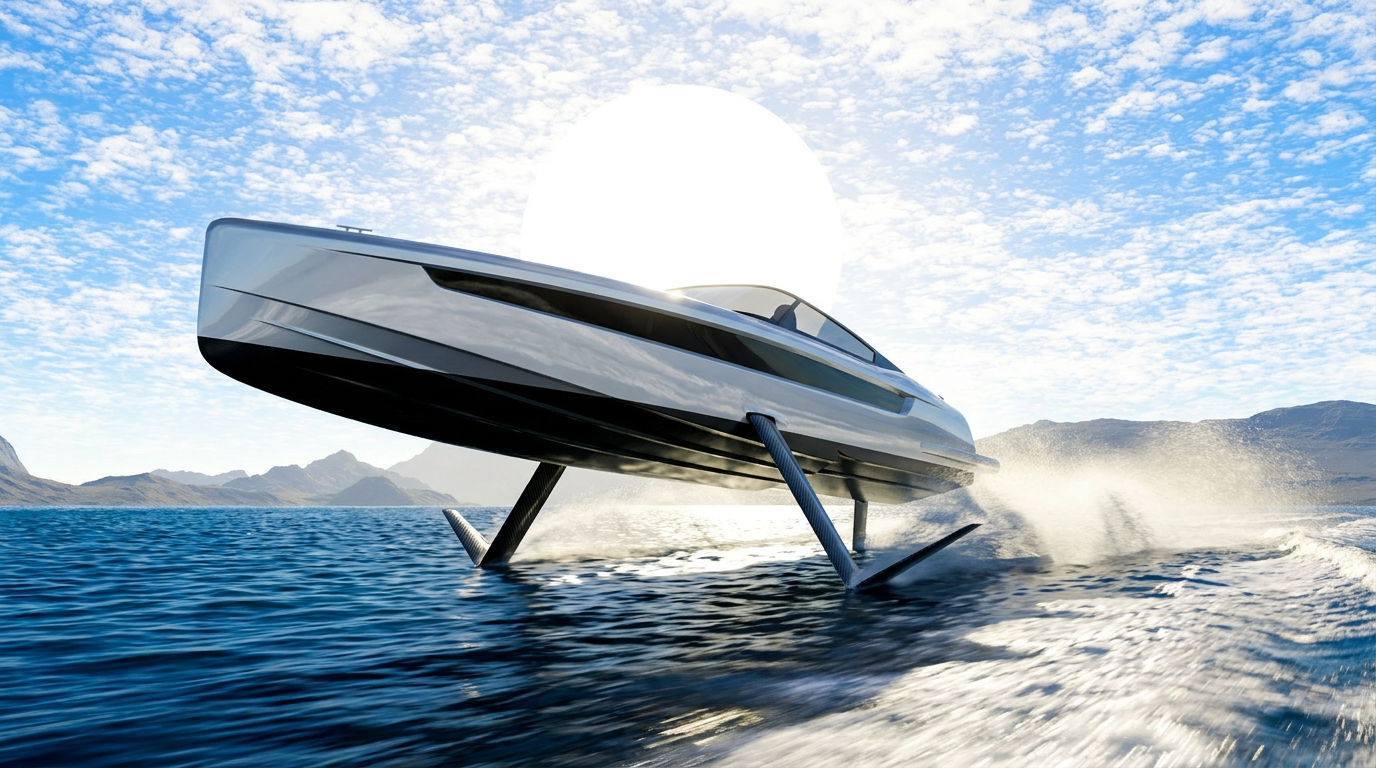
A hydrofoil is essentially an underwater wing attached to the hull by vertical struts. As the boat accelerates, water flows over the curved surface of the submerged wing, creating an upward force identical to the lift generated by an airplane wing in the sky.
Once the vessel reaches a critical takeoff speed—typically around 14 to 16 knots—the lift from the hydrofoils exceeds the weight of the boat. The entire hull rises above the surface, severing its contact with the water.
The moment the hull clears the surface, the physics of the journey fundamentally change. According to a 2022 study by Chalmers University of Technology, hydrofoiling reduces water friction and overall energy consumption by up to 80 percent compared to traditional hulls.[6]
This drastic reduction in drag is the unlock for marine electrification. Because the boat is no longer fighting the density of water, it can achieve high speeds and long ranges using relatively small, lightweight battery packs.

But balancing a boat on submerged wings is inherently unstable. Early mechanical hydrofoils were notoriously difficult to control in choppy water. The modern breakthrough relies entirely on software. Today's electric hydrofoils utilize advanced flight control systems that process data from gyroscopes, accelerometers, and height sensors.
But balancing a boat on submerged wings is inherently unstable.
These onboard computers adjust the angle of attack of the underwater wings up to 100 times per second. This rapid micro-adjustment keeps the vessel perfectly level, absorbing the impact of waves and virtually eliminating the pounding and seasickness associated with traditional boating.
The real-world viability of this technology was recently proven in one of the world's busiest and most treacherous shipping lanes. In May 2025, a Swedish crew piloted a Candela C-8 electric hydrofoil across the Strait of Gibraltar, completing the first-ever intercontinental journey by an electric vessel.[3]
The 24-nautical-mile crossing from Europe to North Africa took just over an hour, matching the speed of conventional fast ferries. More importantly, the Candela consumed a mere 40 kilowatt-hours of electricity—costing roughly €8. A similarly sized gasoline-powered chase boat required 50 liters of fuel, costing nearly €90 for the exact same trip.[3]
While recreational vessels like the Candela C-8 and the American-made Navier N30 are capturing the luxury market, the most profound impact of hydrofoiling will be in public transit. Globally, ferries move over four billion passengers a year. In Europe alone, ferries account for just 3 percent of the maritime fleet but generate 10 percent of its emissions.[6]

Transitioning these heavy, diesel-burning ferries to electric power has historically been unfeasible due to range limitations. Hydrofoils change the math. In the United Kingdom, Artemis Technologies is preparing to launch the EF-24, a 150-passenger electric foiling ferry that will operate between Southampton and the Isle of Wight starting in 2026.[4]
By flying above the Solent, the Artemis ferry is projected to save up to 3,700 tonnes of carbon dioxide emissions annually compared to the conventional high-speed diesel ferries it replaces. Furthermore, because the hull does not displace water, the vessel produces virtually no wake, protecting fragile coastlines from erosion and allowing high-speed travel closer to shore.[4]
The economic incentives are aligning rapidly with the environmental benefits. While the upfront capital expenditure for an electric hydrofoil remains high—driven by carbon fiber construction and aerospace-grade electronics—the operational costs are a fraction of traditional vessels.
Electric motors require virtually no maintenance compared to combustion engines, and the 90 percent reduction in fuel costs means commercial operators can achieve a return on investment in just a few years. Recognizing this shift, the U.S. Federal Transit Administration recently allocated $300 million to modernize domestic ferry systems, heavily incentivizing zero-emission technologies.[7]

Despite the rapid commercialization, uncertainties remain. The marine environment is notoriously harsh on delicate electronics and composite materials. Long-term data on battery degradation under constant high-discharge foiling conditions is still being gathered.
Additionally, while flight controllers can handle moderate chop, extreme sea states and submerged debris pose unique risks to vessels traveling at 30 knots on carbon-fiber stilts. Widespread adoption will also require a massive buildout of high-voltage marine charging infrastructure at ports and marinas.
Nevertheless, the trajectory of the marine industry has irrevocably shifted. The electric hydrofoil market, valued at $0.8 billion in 2025, is projected to surge to $4.6 billion by 2034. By solving the fundamental physics problem of water resistance, hydrofoils have not just made electric boats viable; they have made them vastly superior to the vessels they are replacing.[2]
How we got here
1906
Alexander Graham Bell and Casey Baldwin begin experimenting with early hydrofoil designs.
1970s
Boeing develops the Jetfoil, a gas-turbine powered passenger hydrofoil ferry.
2019
Candela launches the C-7, the world's first production electric hydrofoil boat.
2024
The U.S. Federal Transit Administration allocates $300 million to modernize and electrify ferry systems.
May 2025
A Candela C-8 completes the first intercontinental electric boat crossing over the Strait of Gibraltar.
2026
Artemis Technologies prepares to launch the EF-24, a 150-passenger electric foiling ferry in the UK.
Viewpoints in depth
Marine Technologists
Engineers view hydrofoiling primarily as a software and efficiency triumph rather than just a hull redesign.
For marine technologists, the true breakthrough isn't the physical wing, but the flight control software. Traditional boating relies on brute force to overcome water resistance, whereas hydrofoiling relies on continuous algorithmic adjustments. Technologists argue that by treating the boat as a low-flying aircraft, they have permanently decoupled vessel speed from exponential energy consumption, solving the battery weight penalty that previously doomed electric marine propulsion.
Commercial Ferry Operators
Transit operators are focused on the transformative economics of 90 percent lower operational costs.
While the zero-emission profile helps operators meet strict new government mandates, the financial math is what drives commercial adoption. Ferry operators point out that fuel is their largest recurring expense. By slashing energy costs by up to 90 percent and eliminating the complex maintenance required by massive marine diesel engines, electric hydrofoils offer a rapid return on investment, even with higher initial purchase prices. The lack of wake also allows them to operate high-speed routes closer to shore without damaging infrastructure.
Traditional Boaters
Legacy boating enthusiasts remain cautious about the complexity, cost, and durability of foiling vessels.
Many traditional boaters view hydrofoils as overly complex machines that introduce new points of failure into an already harsh marine environment. They express concern over the high upfront costs, the reliance on proprietary software, and the vulnerability of submerged carbon-fiber wings to floating debris or shallow reefs. For this camp, the simplicity and ruggedness of a conventional fiberglass hull and a combustion outboard motor still outweigh the efficiency gains of 'flying' over the water.
Environmental Advocates
Conservationists champion hydrofoils for eliminating emissions, noise pollution, and destructive wakes.
Environmental groups highlight that the maritime industry is a disproportionate contributor to global emissions and local air pollution. Beyond eliminating greenhouse gases, advocates stress the secondary ecological benefits of electric hydrofoils. The silent electric motors drastically reduce underwater noise pollution, which disrupts marine life communication, while the foiling action eliminates the destructive wakes that erode coastlines and damage fragile estuarine habitats.
What we don't know
- How well the delicate carbon-fiber foils and aerospace-grade sensors will hold up to decades of saltwater corrosion and marine biofouling.
- Whether the global marina infrastructure can scale up high-voltage DC fast charging quickly enough to support widespread commercial adoption.
- How the automated flight control systems will handle extreme, unpredictable sea states or collisions with large submerged debris at high speeds.
Key terms
- Hydrofoil
- An underwater wing that generates lift to raise a boat's hull out of the water.
- Displacement Hull
- A traditional boat design that pushes through the water, creating significant drag.
- Flight Controller
- An onboard computer system that rapidly adjusts the angle of the hydrofoils to maintain stability.
- Angle of Attack
- The angle at which the hydrofoil meets the oncoming water, determining the amount of lift generated.
- Wake
- The waves created by a boat's hull displacing water as it moves.
Frequently asked
Do electric hydrofoil boats cause seasickness?
Generally, no. Because the hull flies above the surface and the flight controller actively stabilizes the vessel, hydrofoils glide smoothly over waves, eliminating the pounding motion that causes seasickness.
What happens if a hydrofoil hits submerged debris?
Striking a large submerged object at high speed can damage the foils. Manufacturers are developing impact-breakaway systems and advanced forward-looking sonar to mitigate this risk.
Are electric hydrofoils more expensive than regular boats?
The upfront purchase price is significantly higher due to carbon fiber construction and advanced electronics. However, operational costs are up to 90 percent lower because they use cheap electricity instead of expensive marine fuel.
How fast do electric hydrofoils go?
Most recreational models cruise comfortably between 20 and 25 knots, with top speeds exceeding 30 knots, matching the performance of traditional combustion-engine boats.
Sources
Source coverage
7 outlets
4 viewpoints surfaced







[1]Factlen Editorial TeamMarine Technologists
Synthesis by Factlen editorial team
Read on Factlen Editorial Team →[2]Market Research FutureTraditional Boaters
Electric Hydrofoil Boat Market Research Report 2034
Read on Market Research Future →[3]CandelaEnvironmental Advocates
Electric boat makes historic first crossing from Europe to Africa
Read on Candela →[4]Artemis TechnologiesCommercial Ferry Operators
Hydrofoil Technology and its Future in Zero-Emission Transport
Read on Artemis Technologies →[5]NavierMarine Technologists
Navier's Breakthrough Shows What the Future of Recreational Boating Could Look Like
Read on Navier →[6]Curbing CarbonEnvironmental Advocates
Electric Hydrofoils: Redefining Sustainable Maritime Transport
Read on Curbing Carbon →[7]Federal Transit AdministrationCommercial Ferry Operators
FTA Announces $300 Million to Modernize Ferry Systems
Read on Federal Transit Administration →
Every angle. Every day.
Get automotive stories with full source coverage and perspective breakdowns delivered to your inbox.