
The New Efficacy of AI Tutors: How Generative Models Are Reshaping Online Learning
Recent randomized controlled trials reveal that AI-powered tutors are matching or exceeding traditional classroom outcomes, democratizing one-on-one learning at scale.
By Factlen Editorial Team
- EdTech Platforms
- Focuses on scaling personalized learning and democratizing access to tutoring.
- Empirical Researchers
- Prioritizes measurable learning transfer and rigorous randomized controlled trials.
- Policy & Implementation
- Examines how AI tools integrate into existing classrooms and augment human teachers.
What's not represented
- · Students without reliable home internet access
- · Teachers' unions navigating the integration of AI tools
- · Data privacy advocates concerned about student data collection
Why this matters
For decades, personalized one-on-one tutoring was a luxury available only to the wealthy. The proven efficacy of generative AI tutors means that highly adaptive, patient, and effective instruction is becoming accessible to millions of students at a fraction of the historical cost.
Key points
- Recent randomized controlled trials show AI tutors outperforming traditional in-class learning by up to 1.3 standard deviations.
- Students using AI tutors reached mastery in a median time of 49 minutes, compared to 60 minutes for traditional learners.
- Modern platforms use a 'teach, not tell' Socratic method, improving students' ability to transfer knowledge to novel problems.
- Cost-effectiveness analyses estimate AI tutoring interventions at just $48 per pupil, yielding 1.5 to 2 years of learning gains.
- The most successful deployments use AI as a 'co-pilot' to assist human educators, raising the baseline quality of instruction.
For forty years, educators have chased an impossible metric. In 1984, educational psychologist Benjamin Bloom found that students receiving one-on-one tutoring performed two standard deviations better than those in traditional classrooms. The problem was cost: scaling individualized human tutoring to every student on Earth was economically unfeasible.[1]
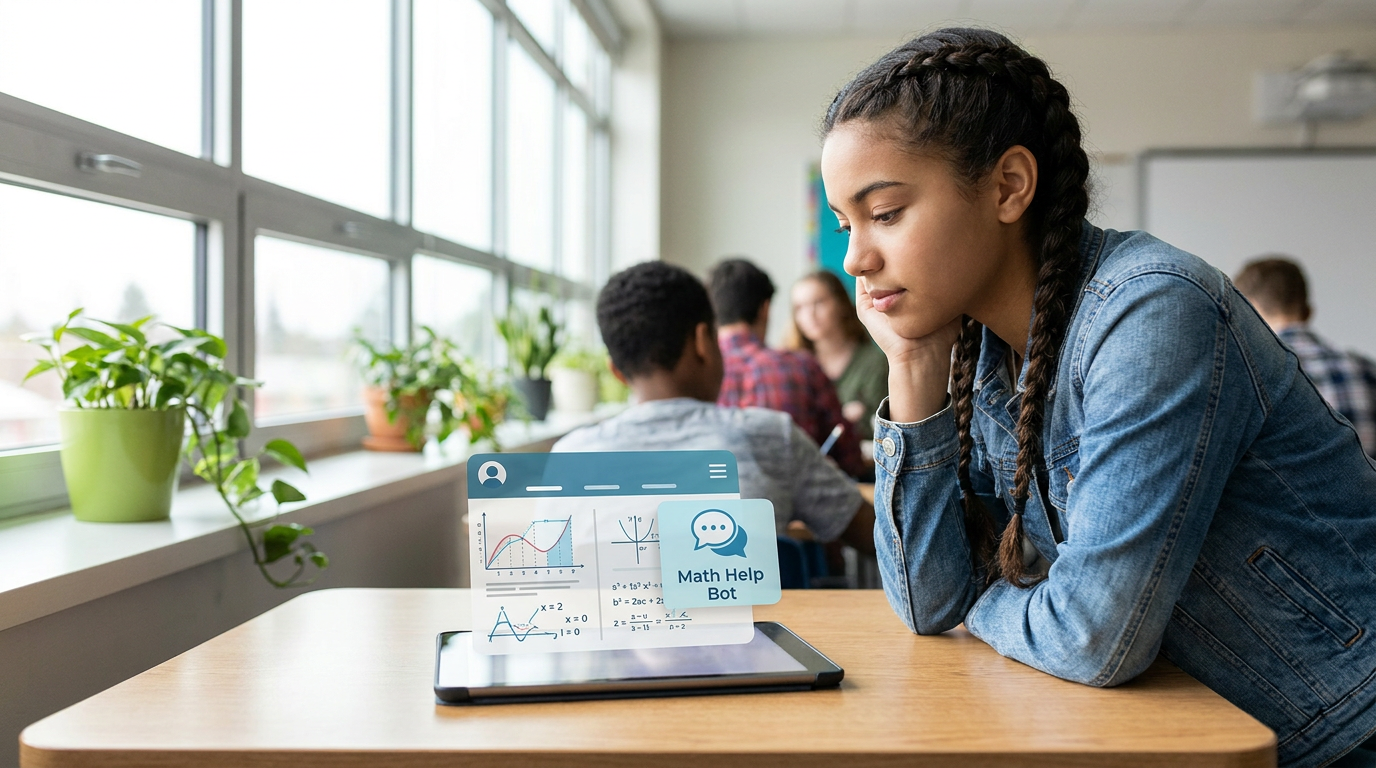
Today, that economic barrier is collapsing. The integration of generative artificial intelligence into online learning platforms is transforming the theoretical promise of universal tutoring into a measurable reality. Rather than acting as glorified answer keys, modern AI tutors are designed to emulate expert human pedagogues, utilizing Socratic questioning to guide students toward their own epiphanies.[7][2]
The empirical evidence for this shift is mounting rapidly. A landmark 2025 randomized controlled trial published in Scientific Reports demonstrated that students using an AI tutor outperformed those in traditional active-learning classrooms. The study recorded an effect size between 0.73 and 1.3 standard deviations—bringing the industry closer to Bloom's elusive two-sigma benchmark than any previous technological intervention.[6]
Crucially, these gains are not coming at the expense of student time. In fact, the opposite is true. The same trial found that the median time on task for students in the AI group was just 49 minutes, compared to 60 minutes for their peers in traditional classroom settings. Students are achieving deeper mastery, and they are doing it faster.[6][7]

The mechanism behind this success lies in pedagogical design. Early educational technology often relied on 'drill and kill' memorization or static hints. Today's generative AI platforms are explicitly programmed to 'teach, not tell.' When a student inputs a wrong answer, the AI does not simply provide the correct one; it breaks down the cognitive load, asking targeted questions to help the student identify their own misconception.[3][1]
This Socratic approach is yielding significant dividends in learning transfer—the ability of a student to apply knowledge to a completely new problem. In a recent trial conducted in United Kingdom classrooms by Google and Eedi Labs, researchers tested an AI model known as LearnLM. The results highlighted a distinct advantage in cognitive retention.[3][5]
Students who were guided by the LearnLM AI tutor were 5.5 percentage points more likely to successfully solve novel problems on subsequent topics than those who received tutoring exclusively from human educators. The AI's infinite patience allows students to work through their confusion without the social anxiety or embarrassment that often accompanies asking questions in a crowded classroom.[3][1]
The scale of these deployments is already massive. Khan Academy's AI tutor, Khanmigo, has reached over 200,000 students and 170,000 teachers across four states in India in less than a year. A cost-effectiveness analysis of such platforms estimates the per-pupil cost at approximately $48, yielding learning gains equivalent to 1.5 to 2 years of standard schooling.[2][1]

Khan Academy's AI tutor, Khanmigo, has reached over 200,000 students and 170,000 teachers across four states in India in less than a year.
Achieving this scale requires relentless technical optimization. Khan Academy researchers found that even fractions of a second matter for student engagement. By switching to faster models and instructing the AI to produce more concise responses, developers reduced response latency by 0.3 seconds across millions of tutoring threads, which measurably improved the natural flow of the conversation and kept students focused.[2]
Despite these breakthroughs, the technology is not replacing human educators; it is augmenting them. A massive Stanford University study involving 1,800 students and 900 human tutors examined the efficacy of a human-AI hybrid model. The AI acted as a co-pilot, drafting responses and suggesting pedagogical strategies for the human tutors to review and approve.[1][3]
The Stanford findings revealed that the AI co-pilot disproportionately benefited less-experienced educators. Students working with lower-rated human tutors who were assisted by AI experienced a 9-percentage-point improvement in mastery relative to a control group. The AI effectively raised the baseline quality of instruction across the board.[1][7]

Universities are taking note of this hybrid potential. At Michigan State University, researchers are piloting Khanmigo across diverse academic programs, including introductory math classes and support centers for students with disabilities. The goal is to understand how instructor integration of the tool impacts student usage and outcomes.[4]
Early feedback from the university level suggests that AI tutors offer a vital accessibility bridge. Because the AI can adapt its explanations to various cognitive styles and reading levels, it provides students with disabilities a broader range of options for engaging with complex course materials.[4]
However, the technology is not without limitations. Industry analysts note that while AI excels at efficiency and availability, human tutors remain vastly superior at complex reasoning and empathy-driven learning. When a student is fundamentally unmotivated or dealing with external emotional barriers to learning, an algorithm cannot replace the mentorship and accountability of a human teacher.[5]
Furthermore, the risk of AI 'hallucinations'—where the model confidently presents incorrect information—requires ongoing vigilance. This is why the most successful deployments currently rely on supervised models, where human educators fine-tune the AI's outputs or set strict parameters on the source material the AI can draw from.[1][3]
As generative AI continues to evolve, the focus is shifting from proving its basic efficacy to refining its integration into daily curricula. With the ability to deliver highly personalized, infinitely patient, and cost-effective tutoring to millions of students, AI is not just a new tool for the classroom; it is a fundamental restructuring of how knowledge is acquired.[7]
How we got here
1984
Educational psychologist Benjamin Bloom identifies the '2 sigma problem', proving 1-on-1 tutoring is vastly superior but too expensive to scale.
Early 2023
The release of advanced Large Language Models sparks the first wave of generative AI educational prototypes.
March 2023
Khan Academy launches Khanmigo, one of the first dedicated generative AI tutors, in partnership with OpenAI.
Mid 2025
Major randomized controlled trials, including a landmark Stanford study, begin publishing empirical data proving the efficacy of AI-assisted tutoring.
Early 2026
AI tutoring platforms reach mass scale, with deployments serving hundreds of thousands of students across global public school systems.
Viewpoints in depth
The EdTech Platforms' View
Focuses on scaling personalized learning and democratizing access to tutoring.
Platform developers emphasize the unprecedented scale that generative AI unlocks. By driving down the marginal cost of a tutoring session to mere cents, they argue that high-quality, one-on-one instruction is no longer a luxury reserved for wealthy school districts. Their primary focus is on optimizing user experience—reducing latency, improving conversational flow, and building guardrails that keep students engaged without simply handing them the answers.
The Empirical Researchers' View
Prioritizes measurable learning transfer and rigorous randomized controlled trials.
Academic researchers are looking past the hype to measure actual cognitive gains. They focus on 'learning transfer'—whether a student can apply a concept taught by an AI to a completely novel problem. This camp is highly encouraged by recent RCTs showing effect sizes approaching Bloom's two-sigma benchmark, but they remain cautious about AI hallucinations. They advocate for 'teach, not tell' pedagogical models where the AI acts strictly as a Socratic guide rather than an answer engine.
The Policy & Implementation View
Examines how AI tools integrate into existing classrooms and augment human teachers.
For institutional adopters and policy analysts, the technology is only as good as its implementation. They view AI not as a replacement for human educators, but as a 'co-pilot' that can raise the baseline quality of instruction. This perspective highlights the importance of hybrid models, where AI drafts tutoring responses for human review, and emphasizes the technology's potential to provide vital accessibility bridges for students with learning disabilities.
What we don't know
- The long-term developmental impacts of students relying heavily on AI for academic support over multiple years.
- How effectively AI tutors can adapt to highly nuanced emotional or behavioral barriers to learning.
- The full extent of data privacy risks as these platforms ingest massive amounts of student interaction data.
Key terms
- 2 Sigma Problem
- The educational phenomenon where students receiving one-on-one tutoring perform two standard deviations better than those in traditional classrooms.
- Socratic Method
- A pedagogical approach where a teacher asks guiding questions to help the student reach the answer themselves, rather than just providing facts.
- Learning Transfer
- A student's ability to take a concept learned in one context and successfully apply it to a completely new, unfamiliar problem.
- Randomized Controlled Trial (RCT)
- A rigorous scientific study design that randomly assigns participants to an experimental group or a control group to measure the true effect of an intervention.
- Response Latency
- The amount of time a student waits between submitting a question and receiving a reply from the AI tutor.
Frequently asked
Will AI tutors replace human teachers?
No. Current research shows that AI is most effective when used as a 'co-pilot' to augment human educators, handling routine questions so teachers can focus on complex reasoning and emotional support.
How do AI tutors prevent students from just cheating?
Modern AI tutors are explicitly programmed with a 'teach, not tell' directive. Instead of providing the final answer, they use Socratic questioning to guide the student through the problem-solving process.
Are these platforms expensive for schools to implement?
Cost-effectiveness analyses indicate that AI tutoring is highly affordable at scale, with some deployments costing as little as $48 per pupil while delivering the equivalent of 1.5 to 2 years of learning gains.
What happens if the AI gives the wrong information?
AI 'hallucinations' remain a risk. To mitigate this, many platforms use supervised models where human tutors review the AI's drafts, or they restrict the AI to only draw from approved curriculum materials.
Sources
Source coverage
7 outlets
3 viewpoints surfaced







[1]Brookings InstitutionEmpirical Researchers
Generative AI as tutor: The evidence for effectiveness
Read on Brookings Institution →[2]Khan AcademyEdTech Platforms
How We Study What Works: Improving Khanmigo
Read on Khan Academy →[3]arXivEmpirical Researchers
LearnLM: Pedagogical Instruction and Learning Transfer
Read on arXiv →[4]The State NewsPolicy & Implementation
MSU researchers examine impacts of AI tutor Khanmigo
Read on The State News →[5]TuritoEdTech Platforms
Is an online AI tutor as effective as a human tutor?
Read on Turito →[6]EngageliEdTech Platforms
AI in Education Statistics: The Impact on Learning Outcomes
Read on Engageli →[7]Factlen Editorial TeamPolicy & Implementation
Synthesis by Factlen editorial team
Read on Factlen Editorial Team →
Every angle. Every day.
Get education stories with full source coverage and perspective breakdowns delivered to your inbox.