
The Deep Energy Retrofit: How Older Homes Are Getting a High-Tech Makeover
Homeowners are increasingly turning to "deep energy retrofits" to modernize older houses, combining advanced air sealing, insulation, and heat-pump electrification to slash utility bills.
By Factlen Editorial Team
- Building Scientists & Researchers
- Focus on the envelope-first approach and whole-system building performance.
- Remodeling & Electrical Contractors
- Focus on the practical challenges, sequencing, and electrical infrastructure required for retrofits.
- Cost-Conscious Homeowners
- Focus on the balance between high upfront capital costs and long-term utility savings.
What's not represented
- · Utility Companies
- · Historic Preservation Boards
Why this matters
As energy costs rise and extreme weather strains the grid, weatherizing and electrifying older housing stock is becoming the most effective way to future-proof residential properties, improve indoor comfort, and access thousands in federal rebates.
Key points
- Deep energy retrofits treat the home as a single system, aiming to cut energy use by 50% to 80%.
- For older homes, air sealing and insulation must be completed before installing a heat pump to avoid oversized equipment.
- Modern heat pumps provide both heating and cooling by transferring heat, making them highly efficient even in cold climates.
- Federal and state rebates are offsetting the steep upfront costs, saving some households thousands of dollars annually.
In 2026, the most sought-after home remodeling project isn't a marble kitchen island or a spa bathroom. It is a hidden, high-tech overhaul known as a "deep energy retrofit." As utility rates climb and extreme weather events test the limits of aging electrical grids, homeowners are shifting their renovation budgets toward performance, resilience, and electrification.[5][6]
A deep energy retrofit treats the house as a single, interconnected system rather than a collection of isolated parts. The goal is to reduce the home's total energy consumption by 50% to 80% while simultaneously improving indoor air quality and thermal comfort. This represents a major departure from traditional remodeling, which often focuses purely on aesthetics without addressing the underlying building science.[2][6]
This trend is particularly vital for older housing stock. Homes built before 1950 were constructed in an era of cheap heating oil and nonexistent insulation codes. According to building scientists, a pre-1950 home typically carries a heating load 40% to 60% higher than a modern, code-built house of the exact same size.[3]

The cornerstone of this modernization is the air-source heat pump. Unlike traditional gas or oil furnaces that burn fossil fuels to generate heat, heat pumps use electricity to transfer heat from the outside air into the home during winter. In the summer, they simply reverse the process to act as a highly efficient air conditioner.[1]
Modern heat pumps are engineering marvels that can deliver up to three times more heat energy to a home than the electrical energy they consume. However, experts warn that simply bolting a state-of-the-art heat pump onto a drafty, century-old house is a costly mistake that will fail to deliver the promised utility savings.[1][3]
The critical first step in any successful retrofit is "air sealing." Older homes often lack a continuous air barrier, allowing the "stack effect" to pull cold air in through the basement and push warm air out through the attic. This invisible leakage can account for up to 40% of an older home's total heating load.[3]
Once the leaks are sealed, the next phase is insulation. Upgrading the building envelope—often by blowing dense-pack cellulose into empty wall cavities and heavily insulating the attic floor—drastically reduces the amount of energy required to keep the home comfortable year-round.[3]

Only after the envelope is secured should the heat pump be sized and installed. Skipping the weatherization steps means the home will require an oversized, more expensive heat pump that will cycle inefficiently, wear out faster, and struggle to maintain a consistent indoor temperature.[3][6]
Only after the envelope is secured should the heat pump be sized and installed.
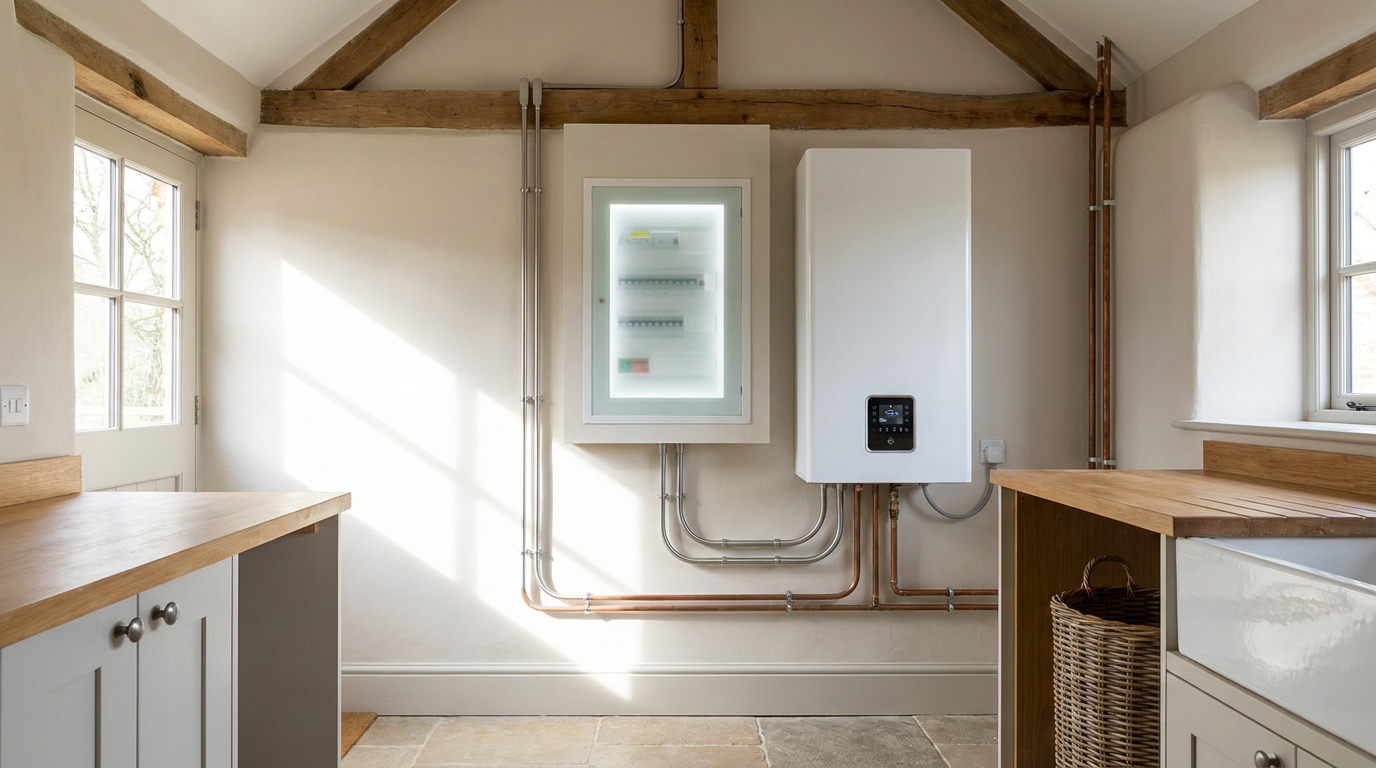
Electrifying a home's heating system often triggers another necessary upgrade: the electrical panel. With the addition of heat pumps, induction stoves, and electric vehicle chargers, older 100-amp panels are frequently pushed well beyond their intended capacity.[5]
To handle this increased load, homeowners are either upgrading to 200-amp service or installing smart electrical panels. These intelligent systems manage power distribution dynamically, pausing the EV charger when the heat pump kicks on, which can sometimes save the homeowner the thousands of dollars required for a heavy-up from the utility company.[5]
The financial calculus of deep energy retrofits has been fundamentally altered by federal and state incentives. Under the Home Efficiency Rebates program, qualifying households can receive up to $8,000 off projects that significantly reduce their overall energy use.[1]

State-level implementation of these funds is already showing tangible results. In Georgia, for example, rebate programs covering heat pumps, insulation, and air sealing have served over 2,600 households, yielding an average annual energy savings of $1,500 per home.[4]
Despite the long-term savings, the upfront sticker shock remains a significant barrier for many families. A comprehensive, whole-home deep retrofit can easily exceed $25,000, and sometimes much more if it is combined with aesthetic renovations like a new kitchen or exterior siding.[2]
To mitigate these costs, building researchers at the Lawrence Berkeley National Laboratory are actively developing standardized, archetypal retrofit packages. These templates aim to optimize cost reductions for different climates and housing types, making the process more predictable for both contractors and consumers.[2]

Many homeowners are also choosing to phase their retrofits over several years to manage cash flow. They might start with air sealing and attic insulation in year one, upgrade the electrical panel in year two, and finally install the heat pump when their old gas furnace reaches the end of its lifespan.[6]
How we got here
1970s
Energy crises prompt the first major push for residential insulation and weatherization standards in the US.
2010s
Air-source heat pumps achieve technological breakthroughs, making them efficient even in sub-freezing climates.
August 2022
The US passes the Inflation Reduction Act, allocating billions for residential electrification and efficiency rebates.
2024–2026
State energy offices roll out localized rebate programs, driving a surge in whole-home deep energy retrofits.
Viewpoints in depth
Building Scientists
Focus on the envelope-first approach and whole-system building performance.
Researchers emphasize that a home is an interconnected system. They argue that simply swapping a gas furnace for a heat pump without addressing the building's thermal envelope is a missed opportunity. By prioritizing air sealing and insulation, building scientists note that homeowners can downsize their HVAC equipment, reducing both upfront capital costs and long-term grid strain.
Remodeling Contractors
Focus on the practical challenges, sequencing, and electrical infrastructure required for retrofits.
Industry professionals highlight the logistical hurdles of modernizing pre-1950s housing stock. They point out that hidden issues—like outdated knob-and-tube wiring or insufficient 100-amp electrical panels—often complicate electrification efforts. Contractors advocate for smart panels and phased renovations to help homeowners manage the steep upfront costs while safely accommodating new high-draw appliances.
Cost-Conscious Homeowners
Focus on the balance between high upfront capital costs and long-term utility savings.
For many homeowners, the primary motivation is economic rather than environmental. While they value the improved indoor air quality and comfort, the sticker shock of a $25,000+ whole-home retrofit remains a significant barrier. This group relies heavily on state and federal rebates to make the math work, often prioritizing upgrades that offer the fastest return on investment, such as basic air sealing and attic insulation.
What we don't know
- How quickly the residential remodeling workforce can scale up to meet the surging demand for complex, whole-home retrofits.
- Whether future administrations will maintain or modify the current structure of federal electrification rebates.
Key terms
- Deep Energy Retrofit (DER)
- A whole-home renovation approach that aims to reduce on-site energy consumption by 50% or more through extensive weatherization and efficient equipment.
- Air-Source Heat Pump
- An electric system that provides both heating and cooling by transferring heat between the indoor and outdoor air, rather than burning fuel.
- Air Sealing
- The process of finding and closing gaps, cracks, and holes in a building's envelope to prevent conditioned air from escaping.
- Building Envelope
- The physical separator between the conditioned and unconditioned environment of a building, including the roof, walls, windows, and foundation.
- Smart Electrical Panel
- An advanced circuit breaker box that dynamically monitors and manages a home's power distribution to prevent overloading the electrical service.
Frequently asked
Can I install a heat pump without replacing my old radiators?
Yes. While traditional heat pumps work best with low-temperature underfloor heating, modern high-temperature heat pumps are designed to integrate with existing cast-iron radiators in older homes.
What is the most cost-effective energy upgrade for an old house?
Air sealing. Stopping drafts and leaks in the attic and basement offers the highest return on investment and is crucial before installing a new heating system.
Do I need to upgrade my electrical panel to install a heat pump?
Often, yes. Older homes with 100-amp service may need an upgrade to 200 amps, or the installation of a smart panel to manage the electrical load of a heat pump alongside other appliances.
Are replacement windows a good first step for energy savings?
No. While new windows improve comfort, building scientists note that dollar-for-dollar, air sealing and wall/attic insulation provide three to five times more energy savings.
Sources
Source coverage
6 outlets
3 viewpoints surfaced






[1]Department of EnergyBuilding Scientists & Researchers
Heat Pump Systems
Read on Department of Energy →[2]Lawrence Berkeley National LaboratoryBuilding Scientists & Researchers
Home Retrofits - Residential Building Systems
Read on Lawrence Berkeley National Laboratory →[3]NuWatt EnergyRemodeling & Electrical Contractors
Heat Pumps for Older Homes (Pre-1950): Upgrade Sequence That Works
Read on NuWatt Energy →[4]WABECost-Conscious Homeowners
Georgia's home energy rebates program powers efficient apartment development
Read on WABE →[5]Best Version MediaRemodeling & Electrical Contractors
Top 10 Electrical Trends for 2026
Read on Best Version Media →[6]Factlen Editorial TeamBuilding Scientists & Researchers
Synthesis by Factlen editorial team
Read on Factlen Editorial Team →

Every angle. Every day.
Get home stories with full source coverage and perspective breakdowns delivered to your inbox.