
How AI and Smart Feeders Are Gamifying Birdwatching and Fueling Conservation
Artificial intelligence is transforming birdwatching from a niche hobby into a gamified, accessible experience, generating massive datasets that researchers use to track global biodiversity.
By Factlen Editorial Team
- Citizen Scientists & Novices
- Value the gamification and instant identification that makes birding accessible without decades of study.
- Conservation Researchers
- View the massive influx of crowdsourced data as a revolutionary tool for tracking biodiversity and climate impacts.
- Traditional Birders
- Appreciate the technology but worry that reliance on AI skips the vital apprenticeship phase of learning field identification skills.
- Industry Analysts
- Focus on the rapid commercial growth of smart outdoor hardware driven by consumer interest in nature tech.
What's not represented
- · Wildlife rehabilitators dealing with increased human-wildlife interaction
- · Privacy advocates concerned about internet-connected cameras pointing at neighboring yards
Why this matters
Artificial intelligence is democratizing a hobby once reserved for dedicated experts, turning millions of casual backyard observers into active citizen scientists. The massive influx of crowdsourced data is giving researchers an unprecedented, real-time map of global biodiversity, which is critical for tracking climate impacts and species decline.
Key points
- AI-powered apps like Merlin use machine learning to identify bird species by their songs and photos in real-time.
- Smart bird feeders equipped with cameras and motion sensors are bringing automated wildlife identification to backyards.
- The technology has attracted a younger demographic, turning casual observation into a gamified, accessible experience.
- Millions of crowdsourced observations are fed into global databases like eBird, creating the largest environmental monitoring network in history.
- Researchers are using this massive dataset to track micro-habitat failures and map severe bird population declines.
- Some veteran birders worry that instant AI identification bypasses the traditional field craft of learning bird behavior and habitat.
The demographic of the average birdwatcher is undergoing a rapid and highly visible transformation. A hobby once stereotypically associated with retirees, heavy binoculars, and dense field guides has found a new audience among twenty-somethings on TikTok and professional athletes. Instead of quietly paging through encyclopedias, this new generation of nature enthusiasts is holding smartphones up to the forest canopy, waiting for digital confetti to drop on their screens.[1]
The catalyst for this demographic shift is artificial intelligence. A wave of smart applications and internet-connected devices has effectively eliminated the steep learning curve of avian identification. By turning backyard observation into a gamified, real-time experience akin to Pokémon Go, technology is making wildlife appreciation instantly accessible to anyone with a smartphone.[1][7]
At the forefront of this revolution is the Merlin Bird ID app, developed by the Cornell Lab of Ornithology. By simply opening the app and tapping record, users can capture the ambient sounds of a forest or backyard. Within seconds, the software isolates individual bird calls from the background noise and identifies the species with startling accuracy, alerting the user to a Scarlet Tanager or a Tufted Titmouse hidden high in the branches.[1]
The mechanism behind Merlin relies on advanced machine learning models trained on massive datasets. The AI does not simply "listen" to the audio; it converts the sound into a visual spectrogram—a graph of acoustic frequencies over time. It then compares the unique shape of these sound waves against millions of verified recordings submitted by veteran birders over decades, finding a match in milliseconds.[4][7]

This technology has effectively bypassed what veteran birders call the "apprenticeship stage." Historically, learning to distinguish the subtle trill of a Pine Warbler from a Chipping Sparrow required years of dedicated field study and patience. Today, a novice can identify spring warblers by their song with greater accuracy than someone who has spent a lifetime memorizing vocalizations.[4]
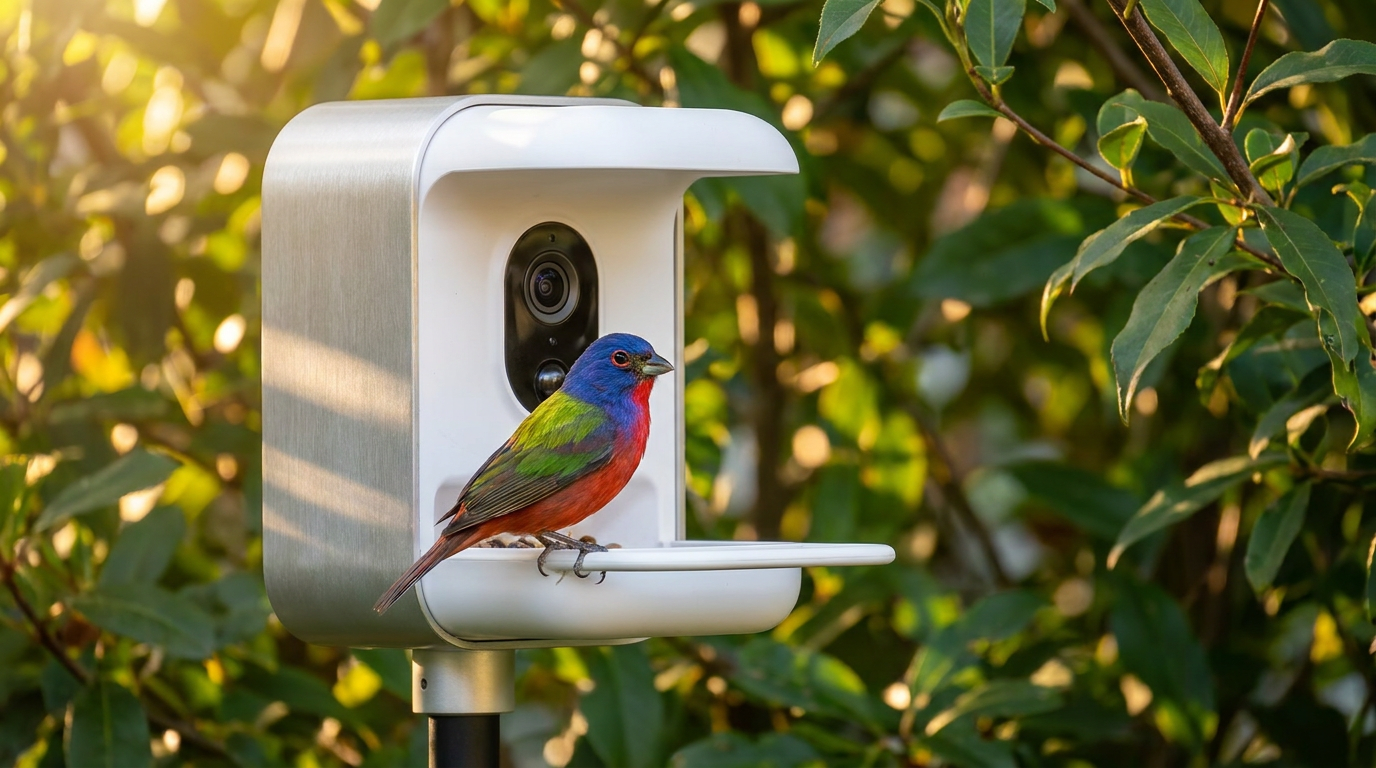
Beyond mobile applications, the physical hardware of birding has undergone a massive upgrade. Smart bird feeders have transformed the traditional wooden seed box into an interactive, internet-connected wildlife camera, bringing the birds directly to the user's digital ecosystem.[5][6]
These devices incorporate motion sensors, high-definition cameras, and solar panels. When a bird lands on the perch, the sensor triggers the camera to capture photos and video. The feeder then uses onboard or cloud-based AI to analyze the bird's plumage, beak shape, and size, sending a push notification directly to the user's phone with the species' name and a close-up portrait.[6]
These devices incorporate motion sensors, high-definition cameras, and solar panels.
The market for these smart feeders is exploding as consumers look to blend technology with nature. Industry analysts project the global smart bird feeder market will grow at a compound annual growth rate of 15%, reaching approximately $500 million by 2033. The appeal lies in capturing fleeting moments—a ten-second visit from a Blue Jay that would otherwise go unnoticed is now recorded, identified, and saved to a digital collection.[5][6]

However, the technology is not without its limitations. AI recognition systems can still be confused by poor lighting, awkward camera angles, or the muted, inconsistent plumage of juvenile birds. In the audio realm, species like the Northern Mockingbird—which naturally mimics the songs of other birds—frequently trick the algorithms into reporting false positives.[1][6]
This occasional inaccuracy fuels a philosophical debate within the traditional birding community. Some purists wonder if the reliance on digital identification is eroding fundamental field skills. If an app instantly provides the answer, new birders may never learn to puzzle over the subtle morphological differences of difficult species or appreciate the broader context of a bird's habitat and behavior.[4]
Yet, most experts and ornithologists view the technology as a massive net positive, primarily because of its contribution to citizen science. Every time a user confirms a bird sighting on Merlin or submits a checklist to its sister platform, eBird, that data point is anonymized and added to a global database, creating a real-time map of avian life.[2][4]
The scale of this data collection is unprecedented. On events like Global Big Day, tens of thousands of users worldwide upload real-time sightings simultaneously. eBird now boasts over 900,000 users who have submitted millions of checklists, providing researchers with a high-resolution picture of global bird populations that would be impossible to gather through traditional academic fieldwork.[2]

This crowdsourced data is proving critical for modern conservation efforts. Recent studies utilizing eBird data have revealed startling ecological trends, such as the fact that 83% of North American bird species are experiencing severe population declines even in areas where they are currently most abundant.[3]
By combining millions of citizen-science observations with high-resolution satellite imagery, researchers can now track population changes across highly specific 27-square-kilometer grids. This granular data allows conservationists to pinpoint micro-habitats that are failing and deploy targeted emergency response plans to protect vulnerable species before they disappear entirely.[3]
Ultimately, the gamification of birdwatching is serving a powerful dual purpose. It provides an uplifting, accessible connection to nature for a generation that is increasingly digitally native, while simultaneously building the largest and most active environmental monitoring network in history.[2][7]
As algorithms improve and smart hardware becomes more affordable, the barrier to entry for wildlife appreciation will continue to drop. The digital confetti that drops on a smartphone screen when a new species is identified is more than just a dopamine hit—it is a vital data point in the ongoing fight to understand and preserve the natural world.[1][7]
How we got here
2002
The eBird platform is launched by the Cornell Lab of Ornithology to collect basic citizen science checklists.
2014
The Merlin Bird ID app is released, initially focusing on answering simple questions to identify birds.
2021
Merlin introduces its revolutionary Sound ID feature, using AI spectrogram analysis to identify birds by their calls.
2023
Smart bird feeders surge in popularity, bringing AI computer vision directly to backyard feeding stations.
2025
Researchers publish landmark studies using crowdsourced eBird data to map severe population declines across North America.
Viewpoints in depth
Citizen Scientists & Novices
Focuses on accessibility and the joy of instant discovery.
For a new generation of nature enthusiasts, AI apps and smart feeders remove the intimidation factor of birding. Instead of flipping through dense field guides while a bird flies away, users get instant gratification and a gamified experience. This camp argues that lowering the barrier to entry fosters a broader public appreciation for wildlife, turning casual observers into active participants in nature.
Conservation Researchers
Focuses on the massive scale of crowdsourced data.
To ornithologists and data scientists, the AI birding boom is primarily a massive data-collection engine. By crowdsourcing millions of audio recordings and photographs, researchers can map migration patterns and population declines with unprecedented granularity. This camp emphasizes that the sheer volume of data generated by casual app users is essential for creating targeted conservation strategies in an era of rapid climate change.
Traditional Birders
Focuses on the preservation of field craft and deep ecological understanding.
Veteran birdwatchers acknowledge the utility of AI but express concern over the loss of traditional field craft. This camp values the apprenticeship phase of birding—spending years learning to identify species by subtle behavioral cues, habitat context, and complex vocalizations. They argue that over-reliance on an app can flatten the birding experience, reducing a deep, observational connection with nature to a simple digital transaction.
What we don't know
- Whether the surge in casual, app-based birding will translate into long-term political or financial support for conservation.
- How accurately AI models will be able to adapt to changing bird vocalizations and migration routes caused by climate change.
- The extent to which false positives generated by AI (such as misidentifying mockingbirds) might skew highly localized citizen science data.
Key terms
- Spectrogram
- A visual representation of the spectrum of frequencies of a sound as it varies with time, used by AI to 'see' bird calls.
- Citizen Science
- Scientific research conducted in whole or in part by amateur, non-professional participants contributing data.
- Life List
- A cumulative list of all the bird species a birder has successfully identified in their lifetime.
- Empidonax flycatchers
- A genus of small, notoriously difficult-to-distinguish birds that traditionally test a birder's identification skills.
Frequently asked
Do smart bird feeders require a subscription?
Most smart feeders offer basic live-streaming and AI identification for free, but some require a premium subscription for high-resolution video cloud storage or advanced species history.
Can AI identify birds in the dark?
Many smart bird feeders are equipped with infrared night vision, allowing the camera to capture and identify nocturnal visitors like owls or mammals.
How accurate is the Merlin Bird ID app?
While highly accurate for common species, the app can occasionally be tricked by birds that mimic others, such as Northern Mockingbirds, or by excessive background noise.
What happens to the data collected by these apps?
Sightings confirmed by users are anonymized and added to global databases like eBird, which researchers use to track population trends and migration patterns.
Sources
Source coverage
7 outlets
4 viewpoints surfaced






[1]Fast CompanyCitizen Scientists & Novices
Are you a bird person now? How AI can take your birdwatching to the next level
Read on Fast Company →[2]WVTFConservation Researchers
Global Big Day turns birders into citizen scientists
Read on WVTF →[3]ScienceDailyConservation Researchers
North American bird populations declining where they should be thriving
Read on ScienceDaily →[4]This Week in BirdingTraditional Birders
Is Field ID Dead?
Read on This Week in Birding →[5]Market Report AnalyticsIndustry Analysts
Smart Bird Feeder Market Analysis
Read on Market Report Analytics →[6]Peck PerkCitizen Scientists & Novices
What Is a Smart Bird Feeder?
Read on Peck Perk →[7]Factlen Editorial TeamConservation Researchers
Synthesis by Factlen editorial team
Read on Factlen Editorial Team →


Every angle. Every day.
Get lifestyle stories with full source coverage and perspective breakdowns delivered to your inbox.