
How Live Music is Decarbonizing: Kinetic Dance Floors, Battery Arrays, and the End of Diesel
Major artists like Coldplay, Massive Attack, and Billie Eilish are proving that stadium-scale tours can drastically cut carbon emissions without sacrificing the fan experience.
By Factlen Editorial Team
- Stadium Artists & Innovators
- Argue that massive tours have a responsibility to act as R&D labs for green technology, forcing supply chains to adapt.
- Climate Scientists
- Emphasize that rigorous data verification is required to prevent greenwashing, prioritizing systemic changes over symbolic gestures.
- Independent Venues
- Point out that without industry subsidies, the high upfront costs of battery arrays and custom flooring remain out of reach for working-class acts.
What's not represented
- · Local municipal grid operators
- · Independent touring musicians
Why this matters
The live events industry has historically been a massive polluter, relying on diesel generators and heavy air freight. By proving that zero-emission technologies can power stadium-scale spectacles, these tours are forcing global supply chains to adapt, making green technology cheaper and more accessible for other industries.
Key points
- Major artists are replacing diesel generators with portable battery arrays and kinetic energy systems.
- Kinetic dance floors convert the physical movement of fans into usable, zero-emission electricity.
- Massive Attack's recent battery-powered festival achieved a 98% reduction in power emissions.
- Tours are tackling audience travel—which accounts for 70% of emissions—via public transit incentives.
- MIT verified that Coldplay successfully reduced their direct tour emissions by 59%.
The traditional stadium tour is an environmental behemoth. For decades, bringing a massive pop spectacle to a city required dozens of diesel-guzzling semi-trucks, chartered cargo jets, and a small army of industrial diesel generators roaring backstage to power the amplifiers and laser arrays.[6]
But a quiet revolution is replacing the hum of those generators. The live music industry is undergoing a structural shift, moving away from the symbolic gesture of buying "carbon offsets" and toward fundamentally re-engineering the physical mechanics of how a show operates.[6]
Leading the charge are global acts like Coldplay, Massive Attack, and Billie Eilish. By leveraging their massive budgets and cultural influence, these artists have effectively turned their world tours into high-stakes research and development labs for green technology, proving that sustainability can scale.[1][2][3]
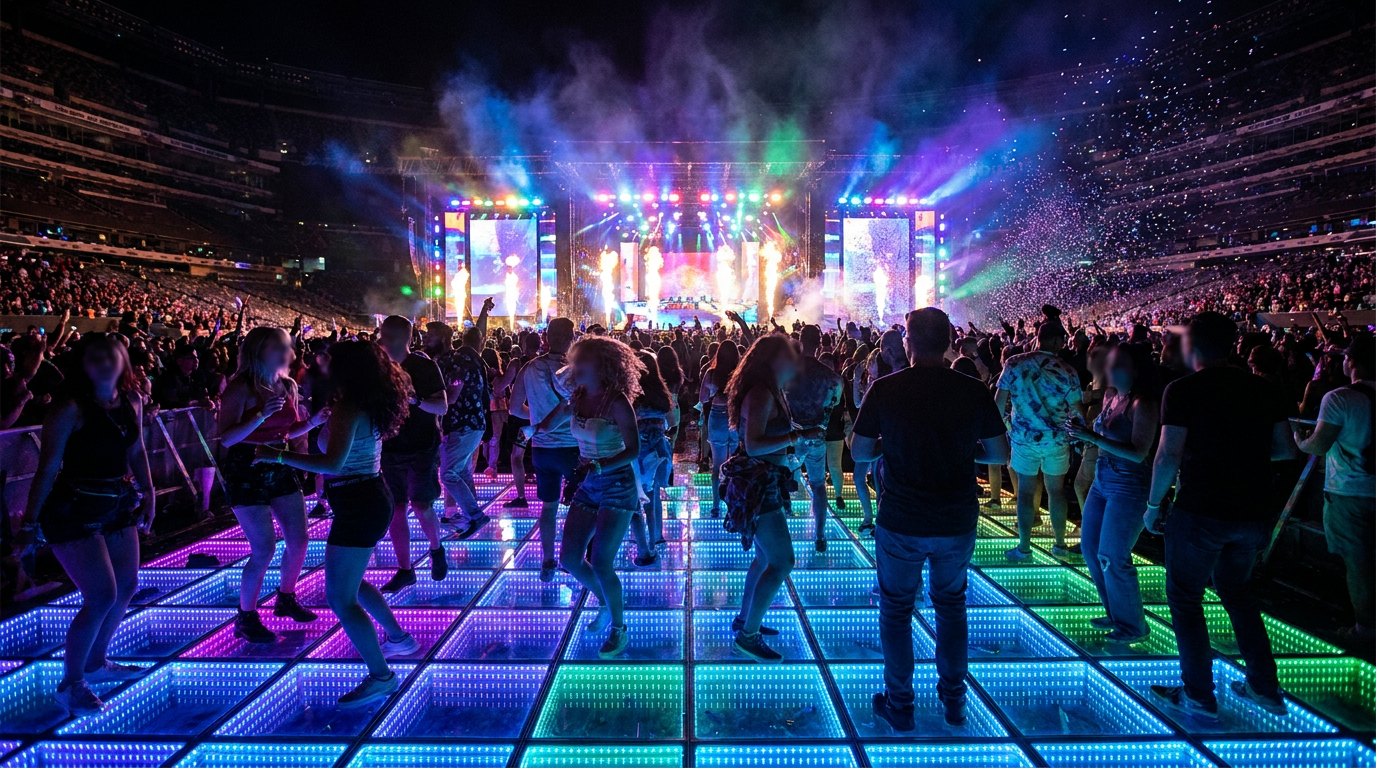
The most visible and interactive of these innovations is happening right under the fans' feet. Kinetic dance floors are transforming the raw enthusiasm of a jumping crowd into usable, zero-emission electricity.[4]

Designed by engineering firms like the Netherlands-based Energy Floors, these custom tiles depress by a fraction of an inch when stepped on. This microscopic downward movement drives a small internal micro-generator, instantly converting the kinetic energy of a dancing fan into an electrical current.[1][4]
During Coldplay's "Music of the Spheres" world tour, the band installed 44 of these kinetic tiles alongside 15 stationary power bikes. Together, the fans generated an average of 17 kilowatt-hours per show—enough to entirely power the band's acoustic "C-stage" performance using nothing but human movement.[1][5]
While kinetic floors provide a highly visible proof of concept, the heavy lifting of decarbonization happens out of sight. Historically, outdoor festivals relied heavily on diesel generators because local municipal power grids simply could not handle the sudden, massive electrical draw required by stadium lighting and audio rigs.[2]
To sever this reliance on fossil fuels, modern tours are deploying massive, portable battery arrays. Coldplay successfully powered 18 of their stadium shows entirely using a mobile system built from recycled BMW i3 batteries, which were charged via renewable solar and wind sources before the gig.[1][5]
To sever this reliance on fossil fuels, modern tours are deploying massive, portable battery arrays.
The British electronic group Massive Attack pushed this concept even further during their "Act 1.5" festival in Bristol. Working in tandem with the Tyndall Centre for Climate Change Research, they ran the entire 32,000-person event on battery power, eliminating diesel backup entirely.[2]

The results of that experiment, rigorously verified by climate scientists, were staggering. The Bristol show achieved a 98% reduction in power emissions and an 89% drop in catering emissions compared to a standard outdoor festival of the same size.[2]
Yet, powering the amplifiers is only a fraction of the battle. Logistics and freight—moving hundreds of tons of steel scaffolding, LED screens, and instruments across oceans—traditionally make up the bulk of a tour's direct operational footprint.[1][6]
To combat this massive logistical footprint, artists are optimizing their routing and partnering with shipping giants to utilize Sustainable Aviation Fuel (SAF) for cargo flights. SAF, derived from renewable waste materials, can reduce the lifecycle carbon emissions of air freight by over 80%.[1]
Then there is the "Scope 3" elephant in the room: audience travel. Industry data reveals that up to 70% of a concert's total carbon footprint comes from the thousands of fans driving or flying to the venue.[3]

Billie Eilish's "Hit Me Hard and Soft" tour tackled this head-on by integrating directly with Google Maps to route fans via public transit or fuel-efficient driving paths. Massive Attack took a more infrastructural approach, chartering post-show trains and deploying fleets of free electric buses to get fans home without cars.[2][3]
Inside the venue, the focus shifts to waste reduction and circular consumption. Disposable glow sticks have been replaced by reusable LED wristbands—with return rates hitting an impressive 86%—while mandatory plant-based catering options drastically lower the agricultural footprint of feeding a stadium.[1][5]
The data proves that this comprehensive model works. The Massachusetts Institute of Technology (MIT) independently verified that Coldplay successfully reduced their direct carbon emissions by 59% compared to their previous tour, shattering their initial 50% reduction target.[1][5]

The lingering challenge for the industry is democratization. While stadium-filling pop stars can afford bespoke battery arrays and the premium cost of SAF, independent artists and mid-sized venues still operate on razor-thin margins, making these upfront green investments difficult to scale downward.[6]
Nonetheless, the blueprint has been drawn. By proving that sustainable touring is not only technologically possible but actively enhances the communal fan experience, the music industry's biggest acts are setting a new, uncompromising baseline for the future of live entertainment.[6]
How we got here
2008
The first sustainable kinetic dance floor debuts at Club Watt in Rotterdam.
2019
Massive Attack commissions the Tyndall Centre to create a roadmap for super-low carbon live music.
2021
Coldplay announces their 12-point sustainability plan, pledging to cut tour emissions by 50%.
August 2024
Massive Attack hosts 'Act 1.5' in Bristol, a 100% battery-powered festival that slashes power emissions by 98%.
June 2025
MIT verifies that Coldplay's ongoing world tour has successfully reduced direct carbon emissions by 59%.
Viewpoints in depth
Stadium Artists & Innovators
Massive tours have a responsibility to act as R&D labs for green technology.
Artists operating at the stadium level argue that their massive budgets and cultural influence give them a unique responsibility to force supply chains to adapt. By demanding sustainable aviation fuel, battery arrays, and kinetic floors, they create economies of scale that eventually make these technologies cheaper and more accessible for smaller venues and independent artists.
Climate Scientists
Rigorous data verification is required to prevent greenwashing.
Researchers from institutions like MIT and the Tyndall Centre emphasize that the live music industry must prioritize systemic, measurable changes over symbolic gestures. While kinetic dance floors are excellent for fan engagement and awareness, scientists point out that the true decarbonization victories lie in unglamorous logistical shifts, such as eliminating diesel generators and optimizing freight routing.
Independent Venues
High upfront costs remain a barrier for working-class acts.
Promoters and independent venue operators caution that the "green touring" model currently only works for the top 1% of artists. Without industry-wide subsidies or municipal investments in venue infrastructure, the high upfront costs of portable battery arrays, custom flooring, and premium sustainable fuels remain entirely out of reach for working-class bands operating on razor-thin margins.
What we don't know
- When portable battery arrays will become affordable enough for mid-sized independent venues to adopt.
- Whether the broader aviation industry can scale up Sustainable Aviation Fuel production to meet growing demand from global tours.
Key terms
- Kinetic Dance Floor
- A specialized flooring system that converts the downward physical movement of dancers into electrical current using internal micro-generators.
- Scope 3 Emissions
- Indirect greenhouse gas emissions that occur in an organization's value chain, such as the carbon footprint of fans traveling to a concert.
- Carbon Insetting
- Investing in emission reduction projects within a company's own supply chain—like buying sustainable fuel for tour freight—rather than buying external offset credits.
- Sustainable Aviation Fuel (SAF)
- An alternative to fossil jet fuel produced from renewable materials, significantly lowering the net carbon emissions of air freight.
Frequently asked
How much power does a kinetic dance floor generate?
During Coldplay's tour, fans dancing on 44 kinetic tiles and riding 15 stationary bikes generated an average of 17 kilowatt-hours per show, enough to power a smaller secondary stage.
What is Sustainable Aviation Fuel (SAF)?
SAF is a liquid fuel made from renewable sources like waste oils or agricultural residues. It can reduce the lifecycle carbon emissions of cargo flights by up to 80% compared to traditional jet fuel.
Why is audience travel such a big deal for concerts?
Fan transportation typically accounts for up to 70% of a live event's total carbon footprint, making it the single largest source of emissions for any major tour.
Sources
Source coverage
6 outlets
3 viewpoints surfaced






[1]Energy FloorsStadium Artists & Innovators
Coldplay's Music of the Spheres Tour: The 2024 Sustainability Results
Read on Energy Floors →[2]Tyndall CentreClimate Scientists
Roadmap to Super Low Carbon Live Music: Massive Attack ACT 1.5 Results
Read on Tyndall Centre →[3]REVERB
Billie Eilish: Hit Me Hard and Soft Tour Sustainability Initiatives
Read on REVERB →[4]ForbesIndependent Venues
People Power: Kinetic Dance Floors To Power Clubs And Concerts
Read on Forbes →[5]The GuardianStadium Artists & Innovators
Coldplay say they have reduced tour carbon footprint by 59%
Read on The Guardian →[6]Factlen Editorial TeamClimate Scientists
Synthesis by Factlen editorial team
Read on Factlen Editorial Team →

Every angle. Every day.
Get entertainment stories with full source coverage and perspective breakdowns delivered to your inbox.