
Stratospheric Balloons Bring Michelin-Starred Dining and Silence to the Edge of Space
A new wave of aerospace companies is launching commercial stratospheric balloon flights in 2026, offering travelers a gentle, zero-emission journey to the edge of space without rockets or astronaut training.
By Factlen Editorial Team
- Aerospace Innovators
- Focus on the technological achievement and sustainable democratization of space access.
- Luxury Travel Curators
- Emphasize the high-end hospitality, exclusivity, and transformational nature of the experience.
- Industry Realists
- Highlight the financial volatility, regulatory hurdles, and weather dependencies of the business model.
What's not represented
- · Environmental scientists evaluating the lifecycle footprint of the helium and hydrogen extraction required for the balloons.
- · Aviation regulators tasked with integrating slow-moving balloons into increasingly crowded commercial airspace.
Why this matters
As commercial stratospheric flights launch in 2026, space tourism is shifting from a high-G rocket ride for thrill-seekers to a serene, accessible luxury experience. This zero-emission approach opens the perspective-altering 'Overview Effect' to anyone healthy enough to fly on a commercial jet, redefining the ultimate frontier of high-end travel.
Key points
- Stratospheric balloon flights are set to begin commercial operations in 2026, offering a gentle alternative to rocket-based space tourism.
- Passengers will ascend to altitudes of up to 19 miles in pressurized, climate-controlled luxury capsules.
- The six-hour journeys require no astronaut training or physical preparation, ascending at a leisurely 12 miles per hour.
- French operator Zephalto is offering flights with Michelin-starred dining for approximately $190,000 per seat.
- Following financial struggles, US-based Space Perspective was acquired by European rival Eos X Space to continue its development.
- The balloons are virtually zero-emission, appealing to luxury travelers seeking sustainable, transformational experiences.
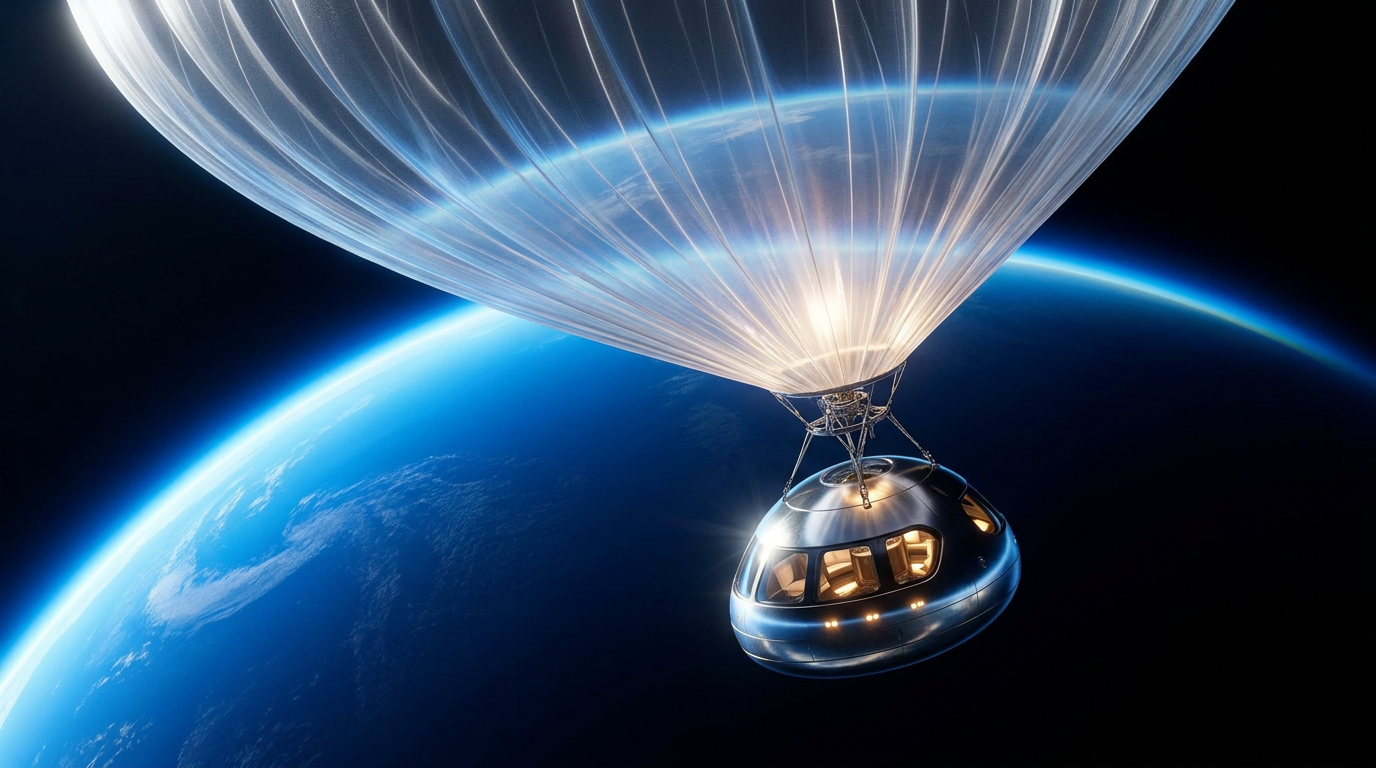
For decades, the public imagination surrounding space tourism was defined by roaring rockets, crushing G-forces, and utilitarian spacesuits worn by adrenaline-seeking billionaires. But as the 2026 travel season unfolds, a radically different vision of upper-atmosphere exploration is finally taking flight. A new cohort of aerospace companies is trading volatile rocket fuel for the quiet buoyancy of helium and hydrogen, offering ultra-wealthy travelers a silent, gentle ascent to the edge of space. This emerging sector, often dubbed "stratospheric ballooning," replaces the violent ten-minute parabolic thrill ride of suborbital rockets with the serene, deliberate pacing of a luxury cruise. Passengers embark on a six-hour journey inside a pressurized, climate-controlled capsule suspended beneath a massive high-altitude balloon, redefining what it means to leave the Earth behind.[2][4]
The mechanism behind this novel travel experience relies entirely on buoyancy rather than explosive aerodynamic thrust. The stratospheric balloons, which expand to the staggering size of a football stadium as atmospheric pressure drops at higher altitudes, ascend at a leisurely pace of roughly twelve miles per hour. This gentle, elevator-like climb means that passengers do not require the rigorous physical training, centrifuge testing, or specialized medical clearances demanded by traditional spaceflight. According to industry executives and aerospace engineers, anyone who is healthy enough to board a standard commercial airliner is fit to travel to the stratosphere. The cabin maintains a comfortable, sea-level atmospheric pressure throughout the entire journey, allowing guests to move freely without the constraints of heavy harnesses or oxygen masks.[2][7]
The target cruising altitude for these vessels sits between 15.5 and 19 miles—roughly 25 to 30 kilometers—above sea level. While this falls short of the Kármán line, the internationally recognized boundary of space located at 62 miles, it is more than double the cruising altitude of commercial passenger jets. At this extreme height, the capsule sits above 98 percent of Earth's atmosphere. The sky transitions from a familiar daytime blue to the absolute, star-studded blackness of the cosmos, even in the middle of the day. More importantly, the altitude offers passengers an unobstructed, panoramic view of the planet's glowing blue curvature, a visual spectacle previously reserved exclusively for career astronauts and a handful of private spaceflight participants.[4][7]

French aerospace company Zephalto is leading the commercial charge in 2026 with its highly anticipated Céleste capsule. Founded by aerospace engineer Vincent Farret d'Astiès, the company has deliberately positioned its offering at the intersection of advanced science and the pinnacle of French luxury. For a ticket price of approximately €170,000, or roughly $190,000, six passengers and two pilots will launch from a dedicated spaceport in France. The meticulously planned flight profile includes a 90-minute ascent, three full hours of cruising at peak altitude, and a gentle 90-minute descent back to the surface. By extending the time spent at the edge of space, Zephalto aims to offer a contemplative experience rather than a fleeting rush of adrenaline.[4][5][7]
Zephalto has heavily emphasized the high-end hospitality aspect of the journey, ensuring the interior matches the exclusivity of the ticket price. The cabin of the Céleste capsule, designed by renowned Parisian architect Joseph Dirand, features minimalist, cocoon-like lounges equipped with massive panoramic windows that wrap around the vessel. Rather than strapping into utilitarian, military-style seats, passengers are encouraged to walk around the cabin, socialize, and relax in plush armchairs. The onboard service includes pouring fine French wine and serving Michelin-starred cuisine prepared specifically for the flight's unique environment. The goal is to create an atmosphere that feels less like a scientific expedition and more like a private suite in a world-class boutique hotel, suspended in the heavens.[4][5][7]
The psychological centerpiece of these stratospheric flights is the phenomenon known as the "Overview Effect." Originally coined by space philosopher Frank White in the 1980s, the term describes the profound, permanent cognitive shift reported by astronauts when they view the Earth from the outside. Seeing the planet as a fragile, borderless sphere suspended in a vast, hostile void often triggers a deep sense of interconnectedness and a renewed commitment to environmental stewardship. Luxury travel curators and trend forecasters predict that this perspective-altering experience will quickly become the ultimate status symbol for high-net-worth individuals, shifting the paradigm of luxury travel from mere consumption to profound personal transformation.[2][6]

However, the path to commercializing the stratosphere has not been without significant financial and operational turbulence. Florida-based Space Perspective, which had been developing its Spaceship Neptune capsule for a highly publicized $125,000 price point, encountered severe financial headwinds in early 2025. Despite successfully completing an uncrewed test flight of its Excelsior capsule to 100,000 feet the previous September, the company burned through its capital reserves. It faced eviction from its Florida airport facilities over unpaid rent and was forced to furlough nearly its entire workforce, casting doubt on the viability of the American stratospheric market.[1][3]
However, the path to commercializing the stratosphere has not been without significant financial and operational turbulence.
The financial strain at Space Perspective highlighted the immense capital requirements, long development cycles, and strict regulatory hurdles inherent in aerospace innovation. Yet, the setback proved temporary and ultimately catalyzed a major industry consolidation. In July 2025, European rival Eos X Space acquired Space Perspective, throwing the struggling American firm a vital financial lifeline. The merger created a formidable transatlantic aerospace powerhouse. Eos X Space announced ambitious plans to integrate the two companies' technologies and operate flights from both NASA's Kennedy Space Center in Florida and a newly established research and development facility in California's Silicon Valley.[1][3]
The rapid consolidation of Eos X Space and Space Perspective underscores the high stakes and intense competition within the stratospheric tourism market. Other well-funded competitors, such as Spain's Halo Space, are also aggressively pursuing their own 2026 launch targets, signaling that the industry is finally moving out of the conceptual prototyping phase and into genuine commercial operations. As these companies race to secure the necessary certifications from aviation authorities, the market is expected to expand rapidly, with some analysts projecting that stratospheric ballooning could capture a significant share of the broader space tourism sector by the end of the decade.[1][2]
Safety and mechanical redundancy remain paramount concerns for both government regulators and prospective passengers paying six-figure sums. Because the capsules are fully pressurized to maintain a breathable atmosphere, ensuring structural integrity in the near-vacuum of the stratosphere is absolutely critical. To mitigate these extreme risks, operators have designed comprehensive, multi-layered safety systems. If a lifting balloon were to suffer a catastrophic tear or pressure failure, the passenger capsules are equipped with backup parachute systems. These parachutes are designed to deploy automatically, stabilizing the capsule and guiding it to a safe, controlled splashdown in the ocean or a terrestrial landing.[2][7]

Environmental sustainability serves as another major competitive advantage for stratospheric operators over their rocket-powered counterparts. Traditional suborbital rocket launches emit significant amounts of black carbon, soot, and greenhouse gases directly into the fragile upper layers of the atmosphere, raising concerns about the long-term ecological impact of space tourism. In stark contrast, balloon flights are virtually zero-emission, relying entirely on renewable lifting gases and natural stratospheric wind currents to navigate. This low-carbon footprint aligns perfectly with the shifting priorities of the modern luxury travel market, where high-net-worth consumers are increasingly demanding eco-conscious alternatives that do not compromise on comfort or exclusivity.[4][6]
Despite the widespread optimism surrounding the 2026 commercial launch windows, several logistical uncertainties continue to linger over the industry. Stratospheric ballooning is highly dependent on precise, predictable weather conditions. This means that launch schedules could face frequent, frustrating delays due to high-altitude wind shear, unpredictable thermal currents, or surface-level storms. Furthermore, the complex regulatory frameworks governing commercial passenger balloon flights are still actively evolving. Operators must maintain close, ongoing coordination with the Federal Aviation Administration in the United States and the European Union Aviation Safety Agency to ensure all safety protocols meet the rigorous standards required for human spaceflight.[2][4]
As the first commercial passengers prepare to board these remarkable vessels, the very definition of space tourism is fundamentally expanding. It is no longer solely the domain of daredevils willing to endure extreme physical stress, nor is it limited to the brief, chaotic weightlessness of a rocket trajectory. By seamlessly combining cutting-edge aerospace engineering with the refined aesthetics and bespoke service of high-end hospitality, stratospheric balloons are poised to make the edge of space the most exclusive, transformative, and elegant travel destination of the decade.[4][5][6][7]
How we got here
2020–2023
Startups like Space Perspective and Zephalto unveil concepts for luxury stratospheric balloon flights.
Sept 2024
Space Perspective successfully completes an uncrewed test flight of its Excelsior capsule to 100,000 feet.
Early 2025
Space Perspective faces financial hurdles and eviction, highlighting the capital-intensive nature of aerospace development.
July 2025
European operator Eos X Space acquires Space Perspective, creating a transatlantic balloon tourism company.
May 2026
Zephalto plans to launch its first commercial passenger flights from a spaceport in France.
Viewpoints in depth
Aerospace Innovators
Companies building the balloons argue that slow, gentle ascents democratize access to the edge of space.
Operators like Zephalto and Eos X Space view stratospheric balloons as the most viable path to scaling space tourism. By eliminating the need for explosive rocket propulsion and intense physical training, they argue they are opening the "Overview Effect" to a much broader demographic of travelers. They emphasize that their zero-emission, helium-lifted platforms offer a sustainable alternative to the heavy carbon footprint of traditional rocket launches, making space exploration compatible with modern ecological values.
Luxury Travel Curators
High-end travel agencies view stratospheric flights as the ultimate evolution of experiential luxury.
For trend forecasters and luxury travel advisors, the appeal of balloon flights lies in the hospitality rather than just the altitude. They point out that ultra-wealthy clients are increasingly seeking transformational, perspective-altering experiences over traditional material luxury. By incorporating Michelin-starred dining, bespoke interior design by renowned architects, and a serene, contemplative environment, curators argue that these flights elevate space tourism from a brief adrenaline rush into a profound, status-defining journey.
Industry Realists
Skeptics highlight the immense financial and logistical hurdles of maintaining profitable aerospace operations.
While the concept is romantic, aerospace analysts and industry realists point to the recent financial struggles of companies like Space Perspective as proof of the sector's volatility. Developing pressurized capsules and securing regulatory approval requires massive, sustained capital investment before a single ticket is flown. Furthermore, realists caution that the business model is highly vulnerable to weather-related launch delays and the inherent risks of operating in the hostile environment of the stratosphere, which could complicate reliable commercial scheduling.
What we don't know
- How frequently weather conditions and high-altitude winds will force the delay or cancellation of scheduled commercial flights.
- The exact timeline for final regulatory certification from aviation authorities like the FAA and EASA for passenger operations.
- Whether the high capital costs of aerospace development will allow ticket prices to eventually drop below the six-figure mark.
Key terms
- Stratosphere
- The second major layer of Earth's atmosphere, extending from about 6 to 30 miles above the surface, where the curvature of the Earth becomes clearly visible.
- Overview Effect
- A profound cognitive shift reported by astronauts when viewing Earth from space, characterized by a deep sense of planetary interconnectedness.
- Pressurized Capsule
- A sealed cabin that maintains a safe, breathable atmosphere and normal air pressure for passengers while traveling through extreme altitudes.
- Kármán Line
- The internationally recognized boundary of space, located approximately 62 miles (100 kilometers) above mean sea level.
Frequently asked
Do passengers experience zero gravity on these flights?
No. Because the balloon ascends slowly and does not enter orbit, passengers experience normal Earth gravity throughout the entire flight.
Do you need astronaut training to fly?
No. The gentle ascent and pressurized cabin mean anyone healthy enough to fly on a commercial airliner can participate without specialized training.
What happened to Space Perspective?
After facing financial difficulties and eviction in early 2025, the Florida-based company was acquired by European rival Eos X Space to continue its operations.
Sources
Source coverage
7 outlets
3 viewpoints surfaced







[1]Space.comAerospace Innovators
Eos X Space acquires Space Perspective in stratospheric balloon tourism merger
Read on Space.com →[2]Jetset MagazineAerospace Innovators
Space Balloons Will Carry Tourists Into The Stratosphere
Read on Jetset Magazine →[3]Travel WeeklyIndustry Realists
Space Perspective evicted from Florida airport
Read on Travel Weekly →[4]ObserverLuxury Travel Curators
Zephalto Is Bringing Michelin-Starred Dining to the Edge of Space
Read on Observer →[5]Original TravelLuxury Travel Curators
2026 Travel Trends: Celestial Vision
Read on Original Travel →[6]Hans Travel & LifestyleLuxury Travel Curators
Top Luxury Travel Trends for 2026
Read on Hans Travel & Lifestyle →[7]Exclusive Elite TravelLuxury Travel Curators
Capsule Céleste – when French design meets space exploration
Read on Exclusive Elite Travel →
Every angle. Every day.
Get travel stories with full source coverage and perspective breakdowns delivered to your inbox.