
How Mauricio Pochettino’s Fluid 3-2-5 System Transformed the USMNT for the 2026 World Cup
The United States has embraced a high-intensity, shape-shifting tactical identity under Mauricio Pochettino. By transitioning between a defensive 4-4-2 and an attacking 3-2-5, the hosts are aiming to overwhelm opponents on home soil.
By Factlen Editorial Team
- National Team Optimists
- Emphasizes the attacking dominance, psychological shift, and Pulisic's elite form.
- Tactical Purists
- Focuses on the structural ingenuity of the fluid 3-2-5 shape and build-up mechanics.
- Pragmatic Realists
- Highlights the defensive risks of overlapping fullbacks and the lack of elite squad depth.
What's not represented
- · Opposing CONMEBOL/UEFA Managers
- · USMNT Bench Players
Why this matters
Understanding the USMNT's tactical evolution provides crucial context for how the host nation plans to compete against the world's elite. For fans watching the 2026 World Cup, recognizing these on-field shape shifts reveals the sophisticated strategy driving America's deepest tournament run ambitions.
Key points
- The USMNT utilizes a shape-shifting tactical system under Mauricio Pochettino, defending in a 4-4-2 and attacking in a 3-2-5.
- The asymmetrical build-up allows fullbacks to push high while a right-sided defender tucks in to form a back three.
- This structure frees central midfielders to make late attacking runs and press aggressively without exposing the defense.
- While highly effective offensively, the system leaves wide spaces that elite teams could exploit in transition.
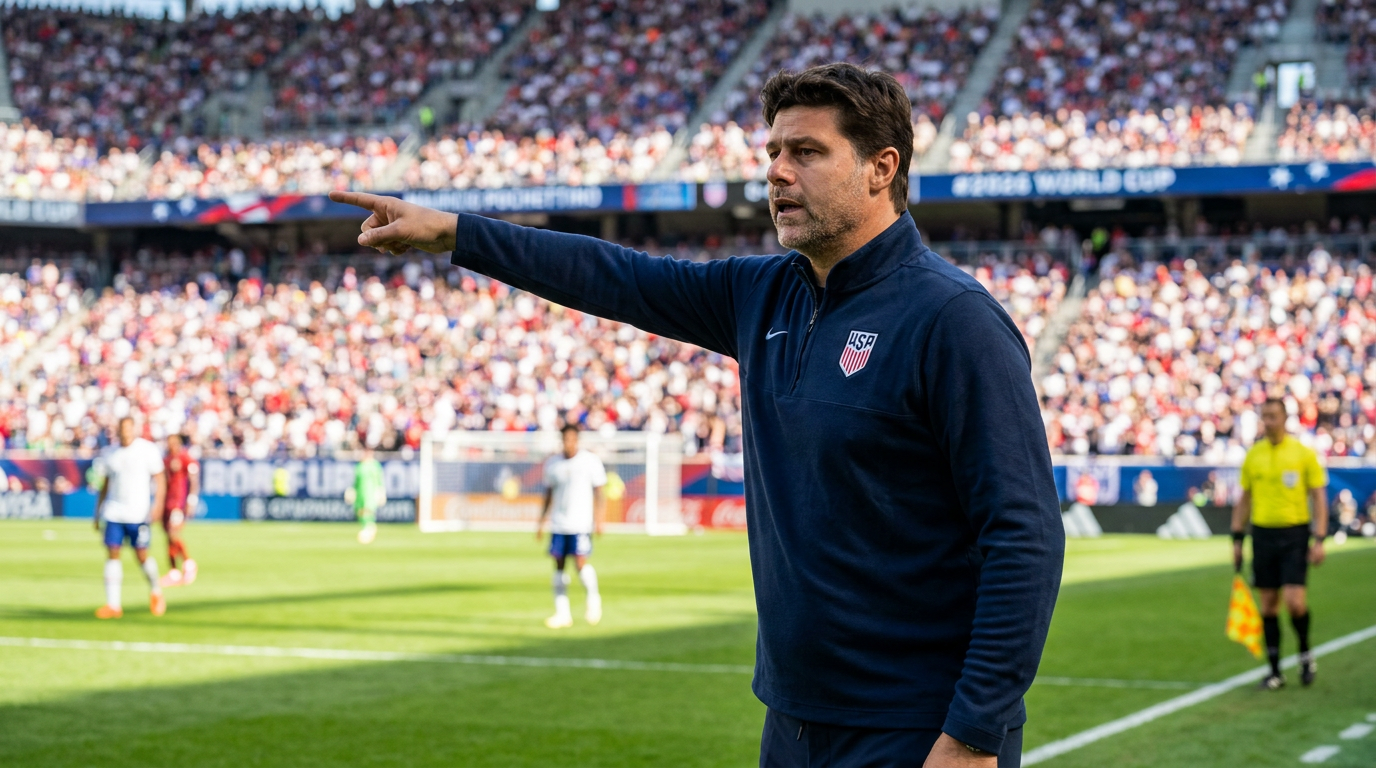
The United States men's national team has arrived at the 2026 FIFA World Cup not just as a host nation, but with a defined, aggressive identity. Under the guidance of manager Mauricio Pochettino, the USMNT has shed its historical underdog complex in favor of a high-octane, front-foot tactical system. This evolution was on full display during their tournament opener on June 12, where they dismantled a defensively stubborn Paraguay side in a dominant 4-1 victory. The performance signaled that the Americans are no longer just hoping to survive the group stage; they are actively dictating the terms of engagement on home soil.[2][3]
Pochettino’s overarching philosophy demands high physical output, tactical discipline, and a ruthless mentality. He has worked to instill a psychological shift within the squad, urging the team to view themselves as genuine contenders rather than plucky outsiders. On the pitch, this translates into a man-oriented pressing system designed to force turnovers high up the field and launch rapid attacking transitions. The team hunts for the ball collectively, compressing space and demanding constant off-the-ball movement from every player.[1][3]
The central debate surrounding the USMNT’s setup heading into the tournament has been a structural one: is Pochettino utilizing a traditional back four or a back three? The reality, as tactical analysts have noted, is that the system fluidly shifts between both depending on the phase of play. It is a hybrid approach that maximizes the specific athletic profiles of the American roster while masking some of its defensive deficiencies.[4][6]

Out of possession, the United States typically organizes into a structured 4-4-2 or 4-2-3-1 defensive block. In this phase, defensive midfielder Tyler Adams drops deep to shield the center backs, acting as a destroyer to win the ball back and immediately trigger counter-attacks. The wingers may also drop back to match the opposition's shape, creating a compact unit that is difficult to play through centrally.[1][4][6]
However, when the USMNT wins the ball and enters controlled possession, the shape undergoes a radical transformation into a 3-2-5 or 3-4-2-1. Left back Antonee Robinson pushes high up the flank to operate as an attacking wingback, providing crucial width. On the opposite side, Sergiño Dest is granted even greater freedom to drive into advanced areas and combine with the forwards. To balance this forward movement, the right-sided defender tucks inside alongside center backs Tim Ream and Mark McKenzie, forming a makeshift back three.[1][4][6]
However, when the USMNT wins the ball and enters controlled possession, the shape undergoes a radical transformation into a 3-2-5 or 3-4-2-1.
This asymmetrical build-up structure solves several problems for the Americans. By committing the fullbacks high and wide, the system stretches the opposition's defense and creates central overloads. Crucially, it liberates central midfielders Weston McKennie and Malik Tillman from strict positional responsibilities. Operating essentially as dual playmakers, they are free to make late, penetrating runs into the penalty area and press relentlessly without leaving the midfield completely exposed.[2][6]

At the heart of this attacking machine is Christian Pulisic, who remains the undeniable focal point of the American offense. Operating primarily as an inverted winger, Pulisic excels at dropping into pockets of space, receiving the ball on the half-turn, and driving past retreating defenders. His elite production—boasting 32 goals and 21 assists in 84 national team appearances—was evident in the opening match, where he glided past double-teams to score and assist.[1][2]
The build-up play relies heavily on the passing range of the defensive line, particularly Tim Ream. While the defense has historically been viewed as a vulnerability, Ream's ability to operate as a ball-playing center back adds a vital dimension to the attack. Against Paraguay, Ream consistently bypassed the midfield with accurate long balls into the final third, directly feeding the forwards and allowing the US to register 27 touches in the opponent's penalty area during the first half alone.[2]

Pochettino’s meticulous approach extends beyond pre-match preparation. During a pre-tournament friendly against Senegal, the Argentine manager utilized a mandatory FIFA hydration break to pull out a laptop and show his players mid-game video analysis. This innovative tactic, designed to provide immediate visual feedback on structural adjustments, highlights the granular level of detail Pochettino is demanding from his squad on the world's biggest stage.[5]
Despite the overwhelming optimism surrounding the team's attacking output, the high-intensity system carries inherent risks. The aggressive, overlapping runs of the fullbacks inevitably leave vast spaces in wide areas during defensive transitions. Advanced opponents with strong technical security and elite wingers can exploit these gaps if the initial counter-press is bypassed.[1]

Furthermore, while the starting XI boasts significant talent from Europe's top leagues, a lack of elite squad depth remains a looming hurdle. The physical toll of a high-pressing system in a condensed tournament format means that fatigue will eventually become a factor. Ultimately, while the USMNT possesses the firepower to overwhelm group-stage opponents, overcoming battle-tested European or South American heavyweights in the knockout rounds will require near-perfect tactical execution.[1]
How we got here
Sept 2024
Mauricio Pochettino is officially appointed as the USMNT head coach, bringing elite European tactical experience.
Oct 2024
The USMNT debuts the hybrid 3-2-5 in-possession shape during Pochettino's first match against Panama.
June 2026
Pochettino goes viral for using a laptop during a hydration break to show tactical video to players against Senegal.
June 12, 2026
The USMNT executes the high-pressing system flawlessly in a dominant 4-1 opening World Cup victory over Paraguay.
Viewpoints in depth
Tactical Purists
Focuses on the structural ingenuity of the fluid 3-2-5 shape and build-up mechanics.
Analysts in this camp praise Pochettino for modernizing the USMNT's tactical blueprint. By implementing an asymmetrical build-up where one fullback pushes high and the opposite-side defender tucks in, the US can create numerical overloads in the final third without sacrificing central stability. They view the shape-shifting nature of the team as a sign of growing tactical maturity that mirrors elite European club sides.
National Team Optimists
Emphasizes the attacking dominance, psychological shift, and Pulisic's elite form.
For optimists, the tactical nuances are secondary to the overwhelming shift in mentality. Pochettino has successfully eradicated the 'underdog' complex, replacing it with a ruthless, front-foot approach that treats the US as a genuine contender. This camp points to the 4-1 thrashing of Paraguay and the sheer volume of touches in the opposition penalty area as proof that the system is unlocking the golden generation's true offensive potential.
Pragmatic Realists
Highlights the defensive risks of overlapping fullbacks and the lack of elite squad depth.
Realists acknowledge the entertainment value of the high-octane press but remain deeply concerned about its sustainability against top-tier nations. They argue that committing so many bodies forward leaves the center backs exposed in transition. Furthermore, they question whether the roster has the depth to maintain such extreme physical output over a grueling month-long tournament, warning that a single missed pressing trigger against a heavyweight like France or Brazil could prove fatal.
What we don't know
- Whether the USMNT's lack of elite squad depth will lead to fatigue late in the tournament.
- How the high-pressing system will hold up against a top-tier European or South American heavyweight.
- If FIFA will officially permit Pochettino's mid-game laptop tactical analysis during hydration breaks.
Key terms
- Rest Defense
- The structural organization of a team's defensive players while their team has possession of the ball, designed to stop counter-attacks if possession is lost.
- Inverted Winger
- An attacking player stationed on the flank who naturally cuts inside onto their stronger foot rather than staying wide to cross the ball.
- Ball-Playing Center Back
- A central defender whose primary role includes initiating attacks from deep areas through accurate, progressive passing.
- Double Pivot
- A midfield structure utilizing two central defensive midfielders who operate closely together to shield the defense and distribute the ball.
Frequently asked
Why does the USMNT formation change during the game?
Under Mauricio Pochettino, the team uses a fluid system that shifts based on possession. They defend in a compact 4-4-2 to deny space, but expand into a 3-2-5 when they have the ball to overwhelm the opponent's defense.
What is Christian Pulisic's tactical role in this system?
Pulisic operates as an inverted winger with the freedom to drift inside. He receives the ball in pockets of space between the midfield and defense, acting as the primary creative spark for the team.
Are there weaknesses to Pochettino's aggressive style?
Yes. By sending both fullbacks high up the pitch to join the attack, the system leaves large spaces on the wings. Elite opponents can exploit these areas during rapid counter-attacks if the US loses the ball.
Sources
Source coverage
6 outlets
3 viewpoints surfaced






[1]World Soccer TalkPragmatic Realists
USMNT World Cup 2026 tactical analysis Pochettino
Read on World Soccer Talk →[2]The RingerNational Team Optimists
After years of false starts and disappointments, the stars (and stripes) are aligning
Read on The Ringer →[3]ForbesNational Team Optimists
Pochettino imports that experience to the USMNT
Read on Forbes →[4]BackheeledTactical Purists
Back three? Here's how Pochettino's USMNT actually sets up.
Read on Backheeled →[5]Sports IllustratedPragmatic Realists
Mauricio Pochettino Breaks Out Laptop During USMNT Hydration Break
Read on Sports Illustrated →[6]Six One Five SoccerTactical Purists
EA FC 26 USMNT Tactics: Recreating Pochettino's System
Read on Six One Five Soccer →
More in sports
See all 9 stories →Injury
Major League Returns: Skubal, Ohtani, and Seager Headline Mid-June Injury Comebacks
6 sources

Standings
Global Baseball Races Heat Up: LG Twins Dominate KBO as SoftBank Hawks Seize NPB Interleague
6 sources
Injury
The Long Road Back: Kristian Fletcher Makes Triumphant Return From ACL Injury
6 sources
Standings
San Diego Wave Seize Top Spot in Historically Tight NWSL Standings at Summer Break
8 sources

Every angle. Every day.
Get sports stories with full source coverage and perspective breakdowns delivered to your inbox.