
The Slowtech Revolution: Why Consumers Are Paying $600 for Phones That Do Less
A growing movement of digital minimalists is driving a surge in premium 'dumbphones' designed to break the dopamine loop and rescue fractured attention spans.
By Factlen Editorial Team
- Intentional Tech Advocates
- Advocates who prioritize mental clarity and intentionality over constant connectivity.
- Behavioral Researchers
- Analysts and sociologists tracking the psychological and market impacts of digital fatigue.
- Privacy & Sovereignty Advocates
- Users drawn to slowtech primarily for its resistance to surveillance and data harvesting.
What's not represented
- · App Developers and Platform Ecosystems
- · Accessibility Advocates (users who rely on smartphone features for disabilities)
Why this matters
As the psychological toll of constant connectivity becomes undeniable, the slowtech movement offers a tangible escape hatch. Understanding this hardware shift reveals how consumers are increasingly willing to pay a premium to buy back their attention span and mental clarity.
Key points
- The 'slowtech' movement is driving a surge in premium minimalist phones designed to curb digital addiction.
- Devices like the Light Phone III and Mudita Kompakt cost up to $600 but intentionally omit web browsers and social media.
- E-ink and e-paper displays introduce physical friction, using slow refresh rates to make doomscrolling uncomfortable.
- Driven largely by Gen Z, the feature phone market saw a 4% year-over-year sales increase in Western Europe.
- Many users adopt a hybrid approach, using a minimalist device as a 'weekend phone' to disconnect from the digital ecosystem.
The smartphone was designed to be a universal remote for modern life, but for a growing number of users, it has become an inescapable trap of constant stimulation. By mid-2026, the cultural exhaustion with endless notifications and algorithmic doomscrolling has birthed a counter-movement. Dubbed the "slowtech" revolution, this shift is characterized by consumers actively seeking to kill their phone addiction and rescue their fractured attention spans. It is not a rejection of technology itself, but a rejection of the engagement-at-all-costs business model that dominates Silicon Valley.[1]
The defining hardware of this movement is no longer the cheap, plastic flip phone of the early 2000s. Instead, 2026 has seen the rise of "premium minimalist devices" or "intentional phones." These devices cost as much as mid-range smartphones—often ranging from $300 to $600—but are engineered specifically to do less. They strip away the app stores, the social media feeds, and the colorful dopamine triggers, leaving only the essential tools required to navigate the modern world.[2][3]
Leading the charge is the Light Phone III, a $599 device that has been described as the flagship of the intentional tech movement. Built with a metal frame and a matte AMOLED screen, it offers calls, texts, GPS navigation, a podcast player, and a basic camera. It deliberately omits a web browser and any form of social media. The hardware feels premium, justifying its price tag to a demographic that views digital detox not as a punishment, but as a luxury.[2][3][6]

Another prominent player is the Mudita Kompakt, which approaches the problem through the lens of extreme privacy and sensory reduction. Priced around $439, it features a 4.3-inch E-ink display and runs a custom, de-Googled version of Android. It handles offline navigation, calls, and texts, but completely blocks surveillance and tracking. For users who want to ensure their device is truly silent, it includes a physical hardware switch that instantly kills all radios, microphones, and cameras.[2][3][5]
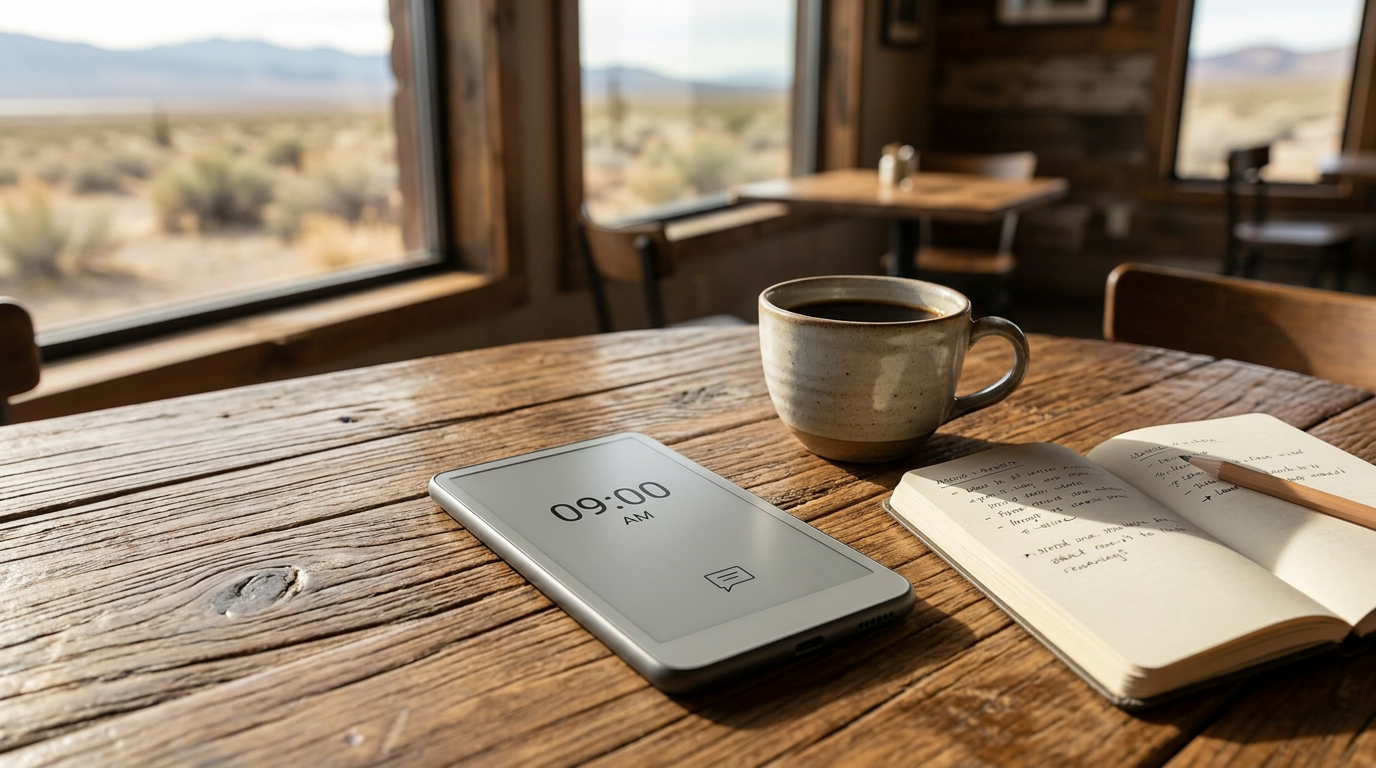
The mechanism that makes these devices effective is the deliberate reintroduction of friction. Modern smartphones are frictionless by design; their 120Hz OLED screens and infinite scrolling interfaces are optimized to keep users engaged for hours. Slowtech devices break this loop at the hardware level. E-ink and E-paper displays, like those used on the Mudita Kompakt and the Minimal Phone, have slow refresh rates—often taking 300 to 500 milliseconds to completely clear a pixel state.[8]
This slight lag makes rapid scrolling physically uncomfortable and visually jarring. It is a feature, not a bug. When the screen flashes and ghosts during a fast scroll, the user is subtly discouraged from continuing. The monochrome, grayscale interfaces further reduce the psychological reward of checking the device, stripping away the bright red notification dots and vibrant images that trigger dopamine release in the brain.[2][8]
The software on these devices is equally restrictive. While some, like the Minimal Phone, run a stripped-down version of Android 14 that allows users to whitelist specific apps like Spotify or Uber, the e-paper screen renders visually heavy apps like Instagram or TikTok virtually unusable. The goal is to provide the utility of a smartphone—such as hailing a ride or scanning a boarding pass—without the addictive pitfalls of the broader internet.[1][2]
The goal is to provide the utility of a smartphone—such as hailing a ride or scanning a boarding pass—without the addictive pitfalls of the broader internet.
The demographics driving this shift are surprising. While one might expect older generations to champion basic phones, the "Analog 2026" movement is heavily fueled by Generation Z and younger millennials. Having grown up entirely in the smartphone era, these cohorts are acutely aware of the toll constant connectivity takes on their mental health. For many, carrying a minimalist phone has become a status symbol—a visible declaration of self-control and intentional living.[4]

Market data reflects this cultural pivot. Counterpoint Research notes that the market for feature phones and minimalist devices is experiencing a measurable resurgence. In Western Europe alone, sales of these devices increased by 4% year-over-year, reaching millions of units. While still a fraction of the global smartphone market, the growth curve suggests that digital minimalism has moved from a fringe internet subculture to a viable consumer electronics category.[4]
The psychological benefits reported by users are substantial. Early adopters consistently report improved focus, better sleep quality, and a return to long-form thinking. Sherry Turkle, a prominent MIT researcher who studies the intersection of technology and society, has long warned that digital connections offer the illusion of companionship without the demands of true friendship. Slowtech advocates argue that by removing the constant pull of the screen, users are forced to look up and re-engage with their immediate physical surroundings.[3][7][8]
However, the transition to a minimalist device is rarely seamless. The modern world is increasingly hostile to those without a fully featured smartphone. Group chats on WhatsApp or iMessage, QR code menus at restaurants, mobile banking apps, and two-factor authentication systems often assume the user has a high-powered iOS or Android device in their pocket. Navigating these logistical hurdles requires patience and, occasionally, frustrating workarounds.[3]

Because of these friction points, many users adopt a hybrid approach. Rather than abandoning their iPhone or Galaxy entirely, they purchase a device like the Light Phone III or a $95 Nokia 3210 revival to serve as a "weekend phone." They swap their SIM card on Friday evening, effectively clocking out of the digital ecosystem until Monday morning. This allows them to experience the mental clarity of a digital detox without sacrificing the professional and logistical necessities of the workweek.[2][3]
There is also a valid critique regarding the accessibility of the slowtech movement. Paying $600 for a phone that intentionally does less is a luxury that only a specific socioeconomic demographic can afford. While budget options like the Nokia flip phones exist, they lack the premium build quality, reliable GPS, and tethering capabilities that make the higher-end minimalist phones viable daily drivers. Digital silence, it seems, has become a premium commodity.[3]
Despite these challenges, the slowtech revolution represents a crucial inflection point in consumer technology. For the last two decades, the tech industry's primary metric of success has been "time on device." Engineers and designers have deployed every psychological trick available to maximize user engagement. The rise of intentional phones proves that a growing segment of the population is willing to pay a premium to buy their time back.[1][8]

As 2026 progresses, the influence of this movement is beginning to bleed into mainstream tech. Major smartphone manufacturers are expanding their built-in digital wellbeing tools, offering more aggressive "focus modes" and grayscale screen options. Yet, for the true slowtech convert, software limits on a device designed for distraction are never enough. True focus, they argue, requires hardware that physically refuses to participate in the noise.[8]
How we got here
2019
The Light Phone 2 launches, popularizing the concept of a premium secondary 'weekend phone' with an e-ink display.
2024
HMD revives the classic Nokia 3210, sparking a viral trend among Gen Z users seeking retro 'dumbphones'.
Early 2026
The 'Analog 2026' movement gains mainstream traction, driving a 4% increase in feature phone sales in Western Europe.
June 2026
A new class of premium minimalist devices, including the Light Phone III and Mudita Kompakt, hit the market with mid-range smartphone pricing.
Viewpoints in depth
Intentional Tech Advocates
Advocates who prioritize mental clarity and intentionality over constant connectivity.
This camp argues that the modern smartphone is fundamentally broken by its business model, which relies on maximizing user engagement to serve ads. They view the high price tags of devices like the Light Phone III not as a rip-off, but as an investment in their own attention span. For minimalists, the friction of an e-ink screen or the lack of a web browser is the entire point—it forces the user to be present in their physical environment rather than escaping into a digital one.
Behavioral Researchers
Analysts and sociologists tracking the psychological and market impacts of digital fatigue.
This camp, comprising market analysts and sociologists, observes the slowtech trend as a natural market correction to the attention economy. Researchers note that while the psychological benefits of disconnecting are well-documented, the actual adoption curve is hindered by the logistical realities of modern life. They track how the movement is shifting from a fringe aesthetic choice to a measurable consumer electronics category, driven largely by younger demographics seeking a physical barrier against algorithmic fatigue.
Privacy & Sovereignty Advocates
Users drawn to slowtech primarily for its resistance to surveillance and data harvesting.
For this group, the appeal of devices like the Mudita Kompakt lies in what they don't track. They emphasize that standard smartphones are essentially pocket-sized surveillance tools that constantly ping location data, microphone audio, and behavioral metrics back to major tech conglomerates. By running de-Googled operating systems and featuring physical hardware kill-switches for radios and microphones, slowtech devices offer a rare refuge for data sovereignty in an increasingly monitored world.
What we don't know
- Whether major smartphone manufacturers like Apple and Google will eventually release their own stripped-down hardware to capture this market.
- How the phase-out of older cellular networks will impact the longevity of budget feature phones currently used for digital detoxes.
- If the high price point of premium minimalist devices will prevent the slowtech movement from reaching lower-income demographics.
Key terms
- Slowtech
- A movement focused on designing and using technology that encourages intentionality, presence, and reduced screen time, rather than maximizing engagement.
- E-ink / E-paper
- A display technology that mimics the appearance of ordinary ink on paper, reflecting light rather than emitting it, which reduces eye strain and battery use.
- Doomscrolling
- The act of spending an excessive amount of time reading large quantities of negative or highly stimulating news and content online.
- De-Googled Android
- A version of the Android operating system that has been stripped of Google's proprietary apps, services, and background tracking mechanisms.
- Refresh Rate
- The speed at which a display updates its image; slow refresh rates on e-ink screens create a physical lag that discourages rapid scrolling.
Frequently asked
Can I still use WhatsApp or Spotify on a minimalist phone?
It depends on the device. Pure dumbphones like the Light Phone III do not support these apps, while hybrid devices like the Minimal Phone run a stripped-down version of Android that allows users to whitelist specific utility apps.
Why are these phones so expensive if they do less?
Premium minimalist phones use high-quality materials, such as metal frames and custom e-ink displays, and are produced in much smaller batches than mass-market smartphones, which drives up the manufacturing cost per unit.
Do these phones have GPS navigation?
Most premium models released in 2026, including the Light Phone III and Mudita Kompakt, include basic, offline turn-by-turn navigation tools to ensure users aren't stranded without a map.
How long does the battery last?
Because they lack power-hungry OLED screens and background app refreshing, e-ink minimalist phones typically last 4 to 7 days on a single charge, depending on cellular usage.
Sources
Source coverage
8 outlets
3 viewpoints surfaced








[1]TechCrunchIntentional Tech Advocates
The slowtech revolution is here to kill your phone addiction and rescue your attention span
Read on TechCrunch →[2]The GadgeteerIntentional Tech Advocates
The 2026 class of minimalist phones: E-ink, QWERTY, and the end of doomscrolling
Read on The Gadgeteer →[3]Analog BagIntentional Tech Advocates
Minimalist phones solve a simple problem: your smartphone is too good at stealing your attention
Read on Analog Bag →[4]Counterpoint ResearchBehavioral Researchers
Global Feature Phone Market Outlook 2026: The Analog Resurgence
Read on Counterpoint Research →[5]MuditaPrivacy & Sovereignty Advocates
Mudita Kompakt: The privacy-first minimalist phone
Read on Mudita →[6]LightIntentional Tech Advocates
Light Phone III: Designed to be used as little as possible
Read on Light →[7]MITBehavioral Researchers
Reclaiming Conversation: The Power of Talk in a Digital Age
Read on MIT →[8]Factlen Editorial TeamIntentional Tech Advocates
Synthesis by Factlen editorial team
Read on Factlen Editorial Team →

Every angle. Every day.
Get technology stories with full source coverage and perspective breakdowns delivered to your inbox.