
Office-to-Residential Conversions Hit Record High as Cities Reimagine Empty Downtowns
Driven by persistent office vacancies and severe housing shortages, the U.S. pipeline for office-to-apartment conversions has surged to over 90,000 units in 2026. Cities are increasingly deploying zoning reforms and tax incentives to transform obsolete commercial towers into mixed-use neighborhoods.
By Factlen Editorial Team
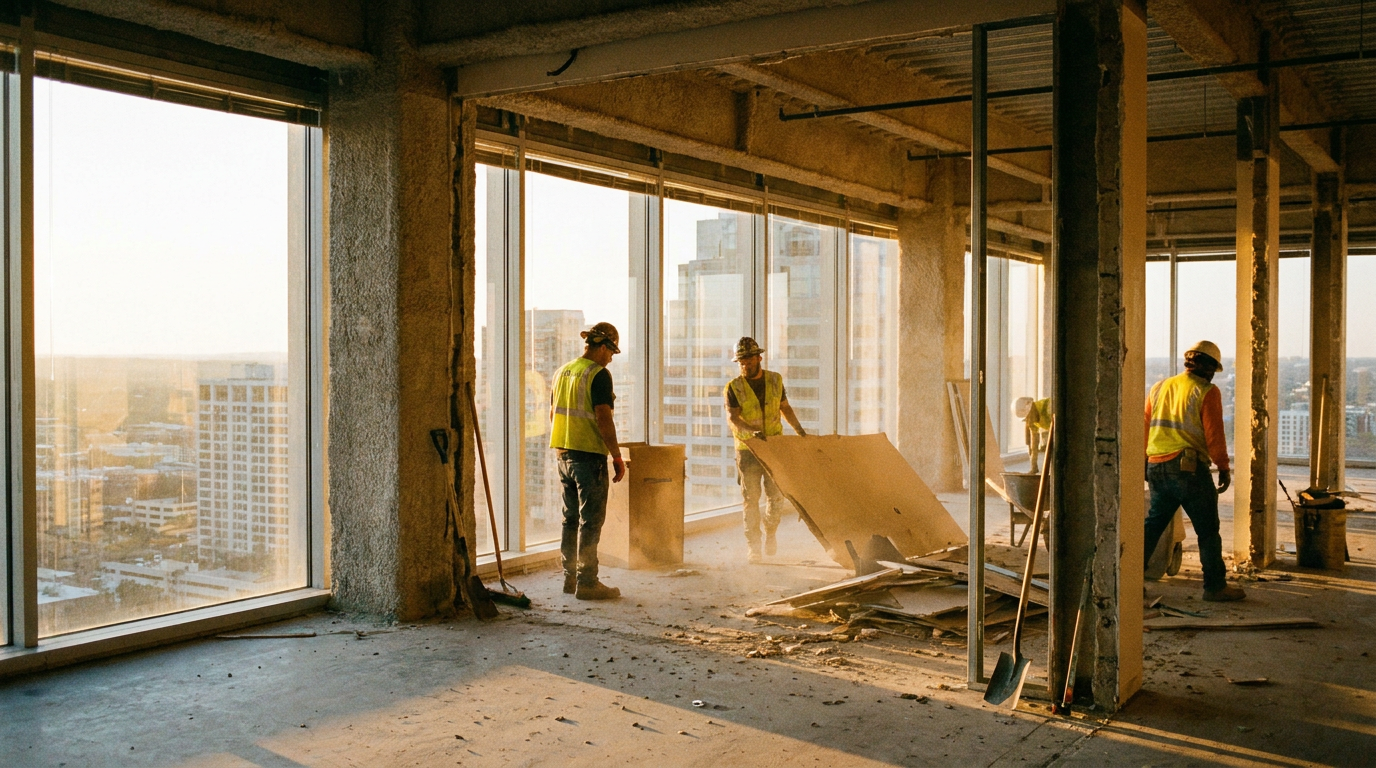
- Commercial Real Estate Owners
- Focuses on asset rescue, financing viability, and architectural feasibility to salvage value from underperforming office towers.
- Urban Planners & Analysts
- Views conversions as a dual-solution to empty downtowns and housing shortages, advocating for flexible zoning to create 24/7 mixed-use neighborhoods.
- Housing Advocates
- Supports the conversion trend but demands that any public subsidies or tax abatements include strict affordable housing carve-outs.
What's not represented
- · Construction Trade Unions
- · Existing Commercial Tenants
Why this matters
The transformation of empty office buildings into housing offers a rare dual-solution to two of America's biggest urban challenges: hollowed-out downtowns and skyrocketing rent. As cities rewrite zoning laws to encourage these projects, the traditional 9-to-5 central business district is permanently shifting toward 24/7 residential neighborhoods.
Key points
- The U.S. office-to-residential conversion pipeline has reached a record 90,300 units in early 2026, up 28% year-over-year.
- Office conversions now account for nearly half of all adaptive reuse projects nationwide, outpacing hotel and industrial transformations.
- New York City, Washington D.C., and Chicago lead the nation in active conversion projects.
- Municipalities are accelerating the trend by overhauling zoning laws and offering tax abatements for projects that include affordable housing.
- While conversions will not single-handedly solve the housing shortage, they are vital for transitioning empty business districts into mixed-use neighborhoods.
The dual crisis of the 2020s—empty downtown office buildings and a severe national housing shortage—has catalyzed a structural shift in American real estate. Once considered a niche architectural challenge, the conversion of obsolete office towers into residential apartments has accelerated into a mainstream urban regeneration strategy by 2026.[1][8]
The scale of this transformation is expanding rapidly. According to early 2026 data from RentCafe and Yardi Matrix, there are currently 90,300 apartment units in the active conversion pipeline nationwide. This represents a 28 percent year-over-year increase and is nearly four times higher than the conversion volume seen in 2022.[1][3]
Office-to-residential projects now account for 47 percent of all future adaptive reuse developments in the United States, outpacing hotel and industrial conversions. New York City leads the nation with over 16,000 units in development, followed closely by Washington, D.C., Chicago, and Los Angeles.[2][3]

The primary driver of this trend is not simply office distress, but intense underlying demand for housing. A comprehensive 2025 analysis by the Brookings Institution found that successful conversions are overwhelmingly dictated by regional housing shortages rather than local incentivization alone. Where pent-up demand exists, developers are finding ways to make the math work.[5][8]
However, the architectural reality of converting spaces designed for cubicles into comfortable homes presents significant hurdles. Modern office buildings often feature massive, deep floorplates that leave interior spaces far from natural light—a critical requirement for legal bedrooms and livable spaces.[4][6]
To assess physical viability, industry analysts utilize tools like the Conversion Feasibility Index. This weighted scoring system evaluates building age, depth, ceiling height, and transit accessibility. Current estimates suggest that approximately 1.9 billion square feet of U.S. office space possesses the structural characteristics suitable for residential adaptation.[2]
To assess physical viability, industry analysts utilize tools like the Conversion Feasibility Index.
In Manhattan, a targeted study by CBRE identified 44 highly viable office buildings containing 10 million square feet of stock. Converting just these prime candidates could yield 10,000 new housing units while simultaneously removing excess supply from the struggling commercial market, thereby stabilizing remaining office assets.[4]

Recognizing the mutual benefits of these conversions, municipal governments are aggressively overhauling zoning codes. Los Angeles recently updated its pioneering Adaptive Reuse Ordinance—originally focused exclusively on downtown—to apply citywide, allowing administrative approval for converting commercial buildings as young as 15 years old.[2]
Financial interventions are also bridging the gap where construction costs threaten viability. Chicago has deployed $260 million in tax increment financing for downtown conversions, while Boston offers tax abatements of up to 75 percent for projects that meet specific affordability thresholds.[6]
These public subsidies frequently come with strict equity mandates. In Chicago's subsidized projects, 30 percent of the new units must be designated as affordable for residents earning 60 percent of the area median income. Housing advocates argue these carve-outs are essential to ensure downtown revitalization does not exclusively serve luxury renters.[6][7]
Beyond economics, adaptive reuse offers profound environmental benefits. Repurposing an existing structure preserves the "embodied carbon" trapped in its steel and concrete foundation, avoiding the massive emissions associated with demolition and new ground-up construction.[6][8]

Despite the momentum, evidence suggests that conversions are a targeted tool rather than a panacea. CBRE researchers caution that adaptive reuse alone cannot entirely solve either the commercial office glut or the national housing deficit. The pipeline of projects will likely materialize as a steady stream over the next decade rather than a sudden flood.[4][8]
Financing remains a persistent headwind. Elevated interest rates and cautious lending environments complicate the capital stack required for complex renovations. Developers must navigate a labyrinth of permitting, environmental remediation, and structural retrofitting before a single tenant can move in.[5][6]
Yet, the trajectory is clear. The era of the monocultural, 9-to-5 central business district is ending. As obsolete commercial towers are reborn as vertical neighborhoods, American downtowns are slowly transforming into mixed-use, 24-hour communities—proving that the most sustainable and resilient building is often the one that already exists.[5][8]
How we got here
1999
Los Angeles passes its original Adaptive Reuse Ordinance, pioneering large-scale office-to-residential conversions in its downtown area.
2020–2022
The pandemic triggers a massive shift to remote work, causing commercial office vacancies to spike in major urban centers.
2024
Office-to-residential conversions begin accelerating, with over 70,000 units entering the development pipeline.
Early 2026
The conversion pipeline hits a record 90,300 units, making up nearly half of all adaptive reuse projects in the United States.
Viewpoints in depth
Commercial Real Estate Owners
Emphasizes the financial and architectural hurdles of retrofitting deep floorplates.
Property owners and developers emphasize that converting an office building is rarely as simple as erecting drywall. They point to the immense capital required to core out deep floorplates for light wells, upgrade commercial HVAC systems to individual residential units, and completely overhaul plumbing stacks. Without significant tax abatements and streamlined zoning approvals, they argue the math simply does not work in a high-interest-rate environment.
Urban Planners & Municipalities
Views conversions as a dual-solution to empty downtowns and housing shortages.
City planners view adaptive reuse as a generational opportunity to correct the urban planning mistakes of the 20th century, which created monocultural central business districts that empty out at 5:00 PM. By aggressively rewriting zoning codes—such as Los Angeles's expanded Adaptive Reuse Ordinance—municipalities hope to transition these hollowed-out cores into vibrant, 24/7 mixed-use neighborhoods that generate consistent foot traffic and stabilize local tax bases.
Housing Advocates
Supports the conversion trend but warns against publicly subsidizing luxury apartments.
While broadly supportive of increasing the housing supply, advocacy groups warn that downtown conversions risk becoming exclusive enclaves for high-income earners. They demand that any city offering tax increment financing or property tax abatements to developers must attach strict affordability covenants. Their goal is to ensure that 20 to 30 percent of newly converted units are permanently reserved for lower- and middle-income residents.
What we don't know
- Whether interest rate environments will stabilize enough to make complex, capital-intensive conversions viable in secondary markets.
- The long-term impact of these conversions on municipal tax revenues, as residential properties are typically taxed at lower rates than commercial buildings.
- How many of the proposed 90,000 units will actually reach completion, given the high attrition rate of complex construction projects.
Key terms
- Adaptive Reuse
- The process of repurposing an existing building for a use other than what it was originally designed for.
- Floorplate
- The total leasable square footage of a single floor in a commercial building; deep floorplates are harder to convert to residential use due to a lack of natural light.
- Embodied Carbon
- The total greenhouse gas emissions generated during the manufacturing, transportation, and assembly of building materials.
- Tax Increment Financing (TIF)
- A public financing method used as a subsidy for redevelopment, infrastructure, and other community-improvement projects.
Frequently asked
What makes an office building a good candidate for conversion?
Ideal candidates are older buildings (often built before 1990) with smaller, narrower floorplates, high ceilings, and operable windows, which allow natural light to reach interior residential spaces.
Will converting offices solve the housing crisis?
No. While it adds crucial supply to dense urban cores, analysts note the scale of the housing shortage far exceeds what office conversions alone can provide.
Why don't developers just tear down empty offices and build new apartments?
Demolition is expensive and environmentally taxing. Adaptive reuse preserves the 'embodied carbon' of the existing structure and can significantly shorten the timeline from project start to move-in.
Sources
Source coverage
8 outlets
3 viewpoints surfaced








[1]Multifamily ExecutiveHousing Advocates
Office-to-Apartment Conversions Continue to Grow
Read on Multifamily Executive →[2]ConstructConnectCommercial Real Estate Owners
Office-to-Residential Conversions Dominate Adaptive Reuse
Read on ConstructConnect →[3]RentCafeHousing Advocates
Adaptive Reuse Report: Office Conversions Hit Record Highs
Read on RentCafe →[4]CBRECommercial Real Estate Owners
Slow and Steady: A New Era of Office-to-Residential Conversions Reshape Manhattan
Read on CBRE →[5]Brookings InstitutionUrban Planners & Analysts
Optimizing office-to-residential policy and practice
Read on Brookings Institution →[6]JPMorgan ChaseUrban Planners & Analysts
What to know about office-to-residential conversion
Read on JPMorgan Chase →[7]The Pew Charitable TrustsHousing Advocates
Overcoming Barriers to Adaptive Reuse of Office Space
Read on The Pew Charitable Trusts →[8]Factlen Editorial TeamUrban Planners & Analysts
Synthesis by Factlen editorial team
Read on Factlen Editorial Team →
Every angle. Every day.
Get real estate stories with full source coverage and perspective breakdowns delivered to your inbox.