
The Science of Cozy Gaming: Why Low-Stakes Play is 2026's Biggest Mental Health Trend
As digital fatigue peaks, millions are turning to non-competitive 'cozy games'—a viral trend that psychologists say actively lowers cortisol and repairs overstimulated nervous systems.
By Factlen Editorial Team
- Clinical Psychologists
- Mental health professionals studying the physiological impact of low-stakes digital environments.
- Cozy Content Creators
- Streamers and influencers who cultivate safe, inclusive digital communities.
- Industry Analysts
- Market researchers tracking the financial and demographic shifts in the gaming sector.
- Traditional Gamers
- Players accustomed to competitive, high-stakes gaming who are increasingly adopting cozy titles to unwind.
What's not represented
- · Parents and Educators navigating screen time rules when the screen time is actively therapeutic.
- · Game Developers balancing the demand for cozy experiences with the financial pressure of industry monetization.
Why this matters
In an era defined by algorithmic burnout and digital anxiety, understanding how to use technology to regulate—rather than overstimulate—the nervous system is becoming a vital self-care skill. The rise of cozy gaming proves that screens don't have to be a source of stress; when designed intentionally, they can be a sanctuary.
Key points
- Cozy gaming has evolved from a niche aesthetic into a recognized digital wellness tool used by millions to combat algorithmic fatigue.
- Clinical studies show that low-stakes, non-competitive games actively reduce cortisol levels and lower heart rates.
- The genre's visual design—featuring pastel colors and rounded shapes—is scientifically proven to reduce activation in the brain's threat-detection center.
- The global cozy game market is projected to reach $1.47 billion by 2032, driven by a demographic that is 63% female.
- Streamers are using cozy games to create 'digital third places,' offering safe, inclusive communities away from toxic competitive gaming.
In the hyper-connected, algorithm-driven landscape of 2026, a quiet rebellion is taking place across social media. Millions of users are actively turning away from doomscrolling and competitive digital environments in favor of something softer: "cozy gaming." Across TikTok and Twitch, the trend has exploded, with creators broadcasting themselves playing low-stakes, aesthetically pleasing video games. On Twitch alone, the "chill" stream tag was applied to more than 3.4 million broadcasts in early 2025, making it one of the platform's fastest-growing categories. But what began as a niche aesthetic has evolved into a recognized digital wellness tool.[1]
Cozy games—titles like Stardew Valley, Animal Crossing, and Tiny Glade—are defined by what they lack. There are no ticking clocks, no high-stakes combat, and no punishing fail states. Instead, players are invited to farm, decorate, explore, or simply exist in a virtual space at their own pace. The objective is not to dominate an opponent, but to gently inhabit a world. As digital fatigue peaks and the broader "Slow Social" movement gains traction across the internet, these games are offering a much-needed refuge from the relentless, demanding pace of modern digital life.[1][2][6]
Psychologists and mental health professionals are increasingly pointing to the neurological benefits of these digital sanctuaries. According to Dr. Josh Littleton, a licensed mental health counselor, traditional tabletop and video games provide the brain with structured interaction—clear rules and predictable boundaries that offer a break from real-world chaos. Cozy games amplify this regulating effect by entirely removing "social threat." Without the pressure of elimination or aggressive competition, the nervous system is allowed to genuinely exhale and reset.[4]

This physiological response is highly measurable. Clinical studies have demonstrated that engaging in low-intensity, casual gameplay can actively reduce levels of cortisol, the body's primary stress hormone. Researchers at the University of Central Florida found that playing low-stress puzzle games had a direct, quantifiable impact on improving players' emotional states, lowering heart rates and blood pressure to levels comparable to light meditation. The brain registers the activity not as a challenge to be overcome, but as a safe harbor.[1]
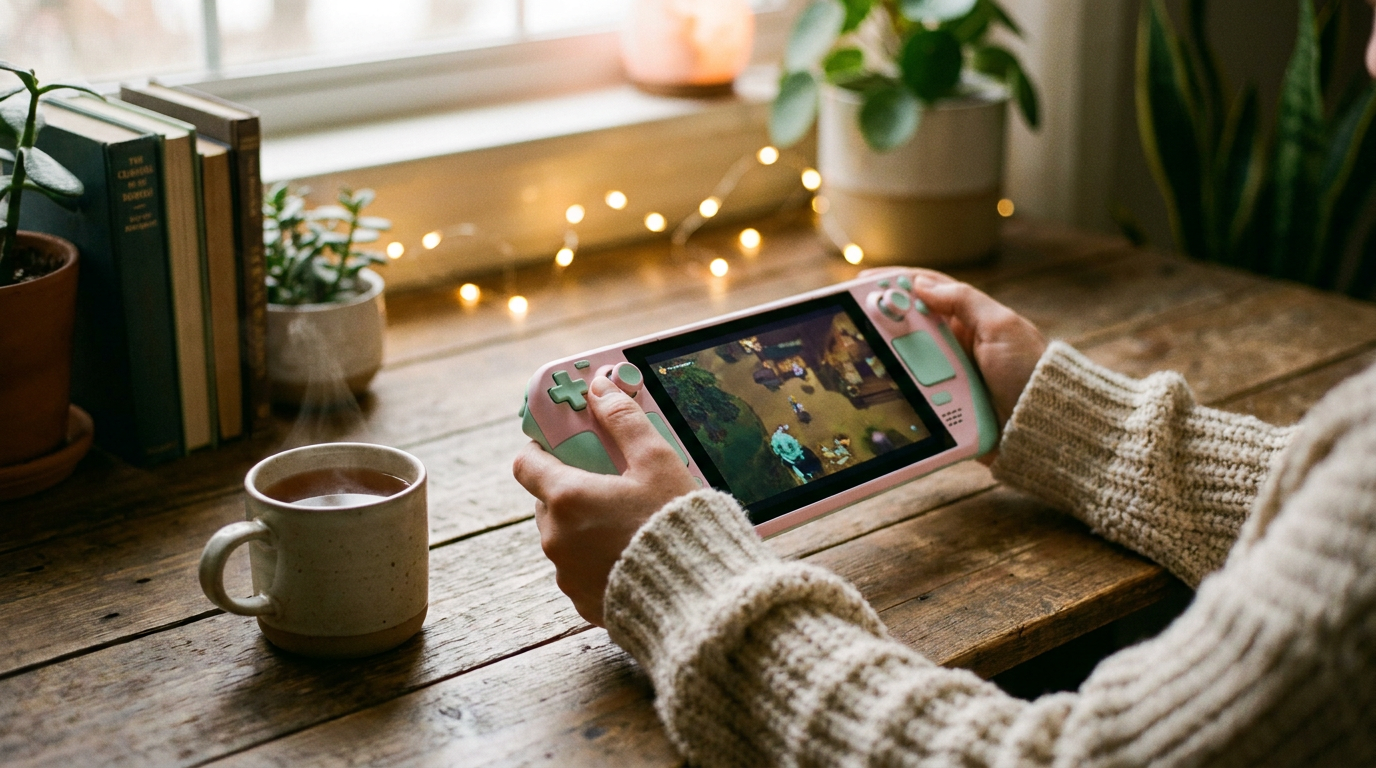
The visual design of cozy games plays a crucial role in this stress reduction. Developers intentionally utilize pastel color palettes, warm lighting, and rounded shapes to evoke comfort. Research in affective psychology indicates that these specific visual cues actively reduce activation in the amygdala, the brain's threat-detection center. When the brain processes soft, low-saturation hues and gentle environments, it signals to the body that it is safe to lower its guard, facilitating emotional recovery after a highly stimulating or stressful day.[1][4]
The visual design of cozy games plays a crucial role in this stress reduction.
Beyond aesthetics, the mechanics of cozy gaming are engineered to induce a "flow state." Psychologists define flow as the sweet spot between skill and challenge—a task engaging enough to hold attention, but not so difficult that it causes frustration. In a cozy game, players might spend an hour organizing a virtual garden or sorting inventory. This gentle, repetitive focus increases dopamine production while continuing to suppress cortisol, creating a deeply soothing psychological loop that repairs fractured attention spans.[4]
The demographic appeal of this genre has fundamentally reshaped the gaming industry. According to Intel Market Research, the global online cozy game market is projected to reach $1.47 billion by 2032, driven by a 27% increase in Western market penetration since 2022. Unlike traditional competitive titles, which historically skewed male, the cozy gaming player base is approximately 63% female. This shift highlights a massive, previously underserved audience seeking therapeutic, non-combative digital experiences rather than adrenaline-fueled action.[3]

The trend is also redefining how people socialize online. As public social media feeds become increasingly noisy and algorithmically driven, users are seeking out "digital third places"—virtual environments where they can hang out without the pressure of performance or the exhaustion of debate. Cozy multiplayer games and the Twitch streams that broadcast them serve exactly this function. Viewers aren't just watching a game; they are participating in a shared, low-pressure community experience that prioritizes connection over content consumption.[1][5][6]
"It's not just about de-stressing, it's actually about finding commonality among other people... that understand and empathize," notes one prominent Twitch streamer. In these spaces, the chat moves slower, the conversation is gentler, and the shared focus on a calming activity flattens social hierarchies. For many, especially within marginalized or queer gaming communities, this atmosphere provides a vital sense of belonging without the toxicity and gatekeeping often associated with traditional competitive gaming culture.[1][4]
The origins of this massive cultural shift can be traced back to the early days of the COVID-19 pandemic. When Animal Crossing: New Horizons launched in March 2020, it offered millions of people a vibrant, controllable microcosm in stark contrast to the terrifying unpredictability of the real world. Dr. Rachel Kowert, a research psychologist studying video games, notes that this moment permanently changed the cultural conversation around gaming, shifting the focus from the supposed dangers of screen time to the tangible benefits of digital play.[2]

However, mental health experts do note a necessary distinction between emotional regulation and pure escapism. While cozy games are excellent tools for decompressing and resetting the nervous system, they are most effective when used as a bridge back to real-world engagement, rather than a permanent retreat from it. The goal of a digital sanctuary is to restore a player's capacity to handle offline stressors, not to replace their offline life entirely.
Recognizing the permanence of this shift, major gaming studios are now adapting. Franchises that once focused exclusively on action and combat are beginning to introduce "cozy modes"—optional settings that remove enemies and allow players to simply explore the world and enjoy the scenery. It is a tacit industry acknowledgment that sometimes, players don't want to save the universe. Sometimes, they just want to plant a garden, listen to the rain, and let their minds rest.
How we got here
March 2020
Nintendo releases Animal Crossing: New Horizons just as global pandemic lockdowns begin, introducing millions to the concept of digital sanctuaries.
2022
The 'cozy gaming' aesthetic begins going viral on TikTok, shifting from a niche gaming subculture to a mainstream wellness trend.
2024
The 'chill' stream tag becomes the most-watched category on Twitch, signaling a massive shift in how audiences consume gaming content.
2026
Major traditional gaming studios begin retrofitting 'cozy modes' into existing action franchises to capture the booming low-stakes market.
Viewpoints in depth
Clinical Psychologists
Mental health professionals studying the physiological impact of low-stakes digital environments.
Psychologists argue that the modern nervous system is chronically overstimulated by the demands of the digital age. From this perspective, cozy games are not merely entertainment, but active therapeutic tools. By removing the 'social threat' of competition and utilizing specific visual cues like pastel colors and rounded shapes, these games bypass the brain's threat-detection centers. This allows players to enter a restorative 'flow state' that actively lowers cortisol and provides a safe harbor for emotional processing.
Cozy Content Creators
Streamers and influencers who cultivate safe, inclusive digital communities.
For creators on platforms like Twitch and TikTok, the cozy gaming trend is fundamentally about community building. They view these games as the foundation for 'digital third places'—environments where marginalized groups, particularly queer and female gamers, can socialize without the toxicity often found in competitive gaming. To this camp, the slow pace of the games facilitates genuine human connection, allowing the chat to become a supportive, empathetic space rather than a chaotic feed.
Industry Analysts
Market researchers tracking the financial and demographic shifts in the gaming sector.
Analysts view the cozy gaming boom as a massive, previously untapped market opportunity. With the player base skewing 63% female and the market projected to reach $1.47 billion by 2032, they argue that the traditional definition of a 'gamer' is obsolete. However, they also note a tension: the traditional gaming industry relies heavily on microtransactions and high-engagement loops, monetization strategies that often clash with the non-competitive, stress-free ethos that cozy gamers demand.
What we don't know
- Long-term clinical data on whether the stress-reduction benefits of cozy gaming translate to permanent improvements in offline emotional regulation.
- How the broader gaming industry will successfully monetize the genre without introducing the stressful microtransactions that players are actively trying to escape.
Key terms
- Cozy Game
- A video game subgenre focused on non-competitive, low-stakes activities like farming or decorating, designed to evoke comfort and relaxation.
- Flow State
- A psychological state of deep immersion where a person is fully absorbed in an activity, perfectly balancing skill and challenge without causing frustration.
- Amygdala
- The region of the brain primarily responsible for processing emotions and detecting environmental threats.
- Digital Third Place
- A virtual environment where people can gather and socialize informally, separate from the demands of work (first place) or home (second place).
- Doomscrolling
- The act of spending excessive time consuming negative or highly stimulating content on algorithmic social media feeds.
Frequently asked
Do cozy games actually reduce stress?
Yes. Clinical studies show that low-stakes, non-competitive games can lower heart rates, reduce cortisol levels, and improve emotional regulation similarly to light meditation.
What makes a game 'cozy'?
Cozy games typically lack ticking clocks, high-stakes combat, and punishing fail states. They utilize pastel colors, soothing music, and focus on activities like farming, building, or exploring.
Is cozy gaming only for casual players?
Not anymore. While it attracts many new players, traditional competitive gamers increasingly use cozy titles as 'palate cleansers' to unwind and decompress after intense matches.
Can cozy gaming replace therapy?
No. While it is an effective tool for daily emotional regulation and decompression, mental health professionals advise that it should complement, not replace, professional care for clinical anxiety or depression.
Sources
Source coverage
6 outlets
4 viewpoints surfaced






[1]MashableCozy Content Creators
Cozy games can help your mental health. Here's how.
Read on Mashable →[2]Epic Games StoreTraditional Gamers
The Rise of Cozy Games
Read on Epic Games Store →[3]Intel Market ResearchIndustry Analysts
Online Cozy Game Market Outlook 2025-2032
Read on Intel Market Research →[4]The QueernessClinical Psychologists
Cozy Gaming is What Your Nervous System Needs
Read on The Queerness →[5]Forum OneIndustry Analysts
2026 Will Reward Human, Not Hype
Read on Forum One →[6]Aston DigitalIndustry Analysts
We're Entering The Era of Slow Social
Read on Aston Digital →



Every angle. Every day.
Get entertainment stories with full source coverage and perspective breakdowns delivered to your inbox.