
How Invisible Watermarks and C2PA Are Solving the Deepfake Crisis
As AI-generated media becomes indistinguishable from reality, a combination of cryptographic metadata and invisible watermarking has emerged as the definitive solution for digital authenticity.
By Factlen Editorial Team
- Authentication Advocates
- Tech giants and standard bodies pushing for universal cryptographic provenance.
- Regulatory Bodies
- Government entities mandating transparency to protect consumers and democratic processes.
- Open-Source Developers
- Independent researchers concerned about the enforceability and centralization of watermarking.
What's not represented
- · Independent creators relying on older, non-compliant software
- · Privacy advocates concerned about excessive digital tracking
Why this matters
With the ability to generate convincing fake audio and video now widely accessible, verifying what is real is critical for elections, financial markets, and personal security. Understanding how these new 'digital nutrition labels' work is essential for navigating the modern internet.
Key points
- Generative AI output is now functionally indistinguishable from reality, requiring cryptographic verification.
- C2PA acts as a digital nutrition label, providing a secure history of a file's creation and edits.
- SynthID embeds invisible, machine-readable watermarks directly into pixels to survive screenshots.
- Major tech companies are combining both methods to create a resilient 'gold standard' for authenticity.
- The EU AI Act mandates machine-readable marking for AI content starting in August 2026.
The era of relying on human intuition to spot a deepfake is officially over. By mid-2026, generative artificial intelligence has advanced to a point where it can produce text, audio, and high-definition video that is functionally indistinguishable from reality to the human eye and ear. The old advice of looking for extra fingers, mismatched earrings, or unnatural blinking simply no longer applies to state-of-the-art foundation models. As these capabilities have become widely accessible to the public, the potential for mass deception—from political disinformation to sophisticated financial fraud—has grown exponentially, demanding a systemic, machine-level solution.[6]
For years, this capability fueled intense anxiety about a post-truth internet, where nothing seen or heard online could be trusted. But behind the scenes, a massive, coordinated counter-offensive by the technology industry has quietly reached production scale. Rather than trying to build better AI to detect fake content after the fact—an arms race that retroactive detection tools were steadily losing against increasingly sophisticated generators—the industry shifted its fundamental approach. The new strategy focuses on proving what is real at the exact moment of creation, embedding trust directly into the files themselves before they ever reach a social media feed.[1]
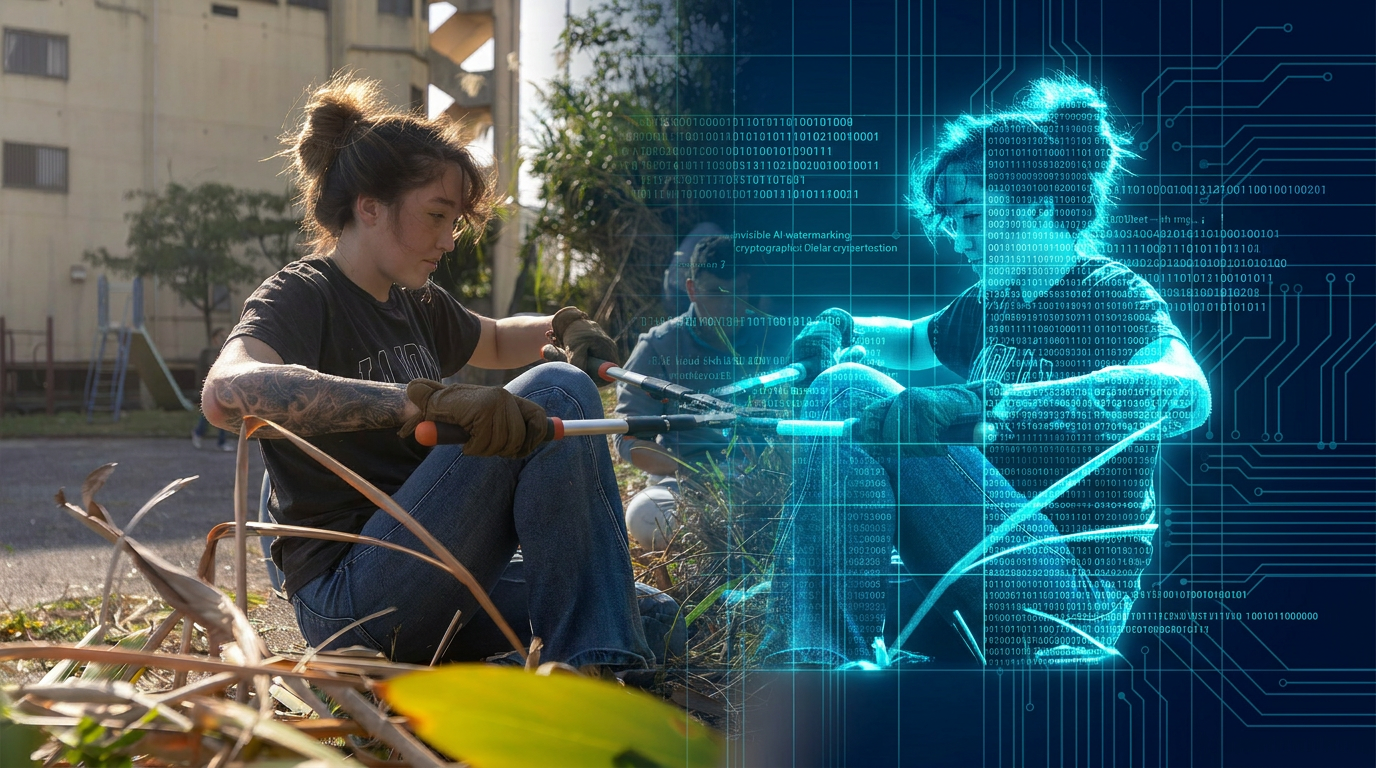
Rather than relying on humans to spot visual anomalies, the modern solution relies entirely on cryptography and invisible mathematics. Two distinct but highly complementary technologies—C2PA and SynthID—have emerged as the definitive framework for digital provenance in 2026. Together, they form a layered defense system designed to track the origin, creation method, and subsequent alteration of digital media across the internet. This shift moves the burden of verification away from the end user and places it squarely on the software and hardware ecosystems that generate and distribute the content.[2]
The first major pillar of this authentication framework is C2PA, which stands for the Coalition for Content Provenance and Authenticity. Think of C2PA as a highly secure, tamper-evident "nutrition label" for digital media. It is an open technical standard designed to provide publishers, creators, and everyday consumers with the ability to definitively trace the origin of a photograph, video, or audio clip. Instead of guessing where an image came from, a user can simply click an icon to reveal a verified, cryptographic history of the file's entire lifecycle.[2]
When a piece of content is created or altered by a compliant tool, C2PA embeds a cryptographic manifest directly alongside the file. This manifest is signed with X.509 certificates, creating a verifiable record of who created the content, what software tools were used, and whether artificial intelligence was involved in the generation process. Because it relies on standard cryptographic principles, any attempt to alter the file without authorization immediately invalidates the signature, alerting the viewer that the content has been tampered with.[2]

The momentum behind this standard has been staggering over the past two years. By early 2026, the C2PA coalition has grown to include over 6,000 members and affiliates, encompassing nearly every major player in the global technology, camera manufacturing, and news media landscapes. Industry heavyweights like Adobe, Microsoft, Google, Sony, and the BBC have all committed to integrating these cryptographic standards into their core products. This unprecedented level of cross-industry collaboration has successfully transformed C2PA from a theoretical whitepaper concept into a ubiquitous, production-scale reality.[1]
The practical implementation of this standard is already visible across millions of workflows. Adobe has integrated C2PA credentials automatically across its entire Creative Cloud suite, including Photoshop, Lightroom, and Firefly, ensuring that professional edits are securely logged. Similarly, Microsoft began adding this metadata to Microsoft 365 content in early 2026. The result is the richest authenticity signal currently available to the public. You don't just know that a file is AI-generated; you know exactly which AI tool generated it, when it was created, what specific parameters were used, and the full chronological history of any subsequent human or machine edits.[1][2]
However, despite its cryptographic strength, C2PA has a significant structural vulnerability: the metadata can be easily stripped away by everyday actions. If a user takes a simple screenshot of a C2PA-protected image, the operating system creates a brand new file to capture the screen. This new file leaves the original cryptographic manifest behind. Similarly, many older social media platforms aggressively compress media and scrub metadata upon upload to save server space. When this happens, the rich provenance data is destroyed, rendering the image completely untethered from its verified history and making it indistinguishable from an unauthenticated file.[2]
This is exactly where the second pillar of the authentication framework, invisible watermarking, steps in to close the gap. Google's SynthID has rapidly become the dominant standard in this space, designed to embed a persistent, machine-readable signal directly into the content itself. Rather than attaching a separate metadata file or cryptographic manifest that can be easily detached, SynthID weaves its identification markers directly into the fundamental fabric of the media. This ensures that the authentication signal travels wherever the content goes, regardless of how it is saved, shared, or transmitted.[3]
This is exactly where the second pillar of the authentication framework, invisible watermarking, steps in to close the gap.
The technology represents a massive leap forward from older digital rights management tools. Unlike traditional watermarks that overlay a visible, distracting logo or text across an image, SynthID modifies pixel values, audio waveforms, or text tokens at a level entirely below human perception. A person looking at a watermarked image or listening to a watermarked audio clip will perceive absolutely no difference in quality or appearance. However, a specialized detection algorithm can instantly read the hidden mathematical patterns embedded within the file to confirm, with high confidence, that the media was generated by an artificial intelligence model.[2]
Because the SynthID signal is baked into the actual pixel or audio data of the file, it is highly resilient to common digital manipulations. It is specifically engineered to survive aggressive re-encoding, heavy file compression, color adjustments, cropping, and even the dreaded screenshot vulnerability that defeats C2PA. By May 2026, Google reported that over 20 billion pieces of content had been successfully watermarked using SynthID across its various platforms, including Gemini, Imagen, and YouTube Shorts. This massive deployment proved definitively that invisible watermarking technology can operate flawlessly at a global scale without slowing down generation times.[2][4]

Crucially, this technology has expanded far beyond Google's own proprietary ecosystem. Recognizing the urgent need for a unified, industry-wide approach to synthetic media, other major artificial intelligence developers have adopted SynthID for their foundation models. Nvidia announced it is utilizing SynthID in its Cosmos models, while OpenAI has integrated the technology into its own image generation pipelines. This unprecedented collaboration is creating a powerful, cross-vendor front for content identification, ensuring that the vast majority of high-quality AI generation tools on the market are embedding the exact same invisible safety signals.[3]
Industry experts and cybersecurity analysts now consider the combination of C2PA and SynthID to be the absolute "gold standard" for digital authenticity. Neither technology is perfect on its own, but together they effectively cover each other's blind spots. C2PA provides the rich, detailed, cryptographic history required for true transparency and professional auditing. Meanwhile, SynthID acts as a durable safety net, ensuring that a basic, undeniable identification signal persists even if the C2PA metadata is maliciously stripped by a bad actor or accidentally lost during a routine platform transfer.[2]
OpenAI explicitly embraced this dual-layer strategy in May 2026, implementing a comprehensive system that combines C2PA conformance with SynthID watermarking across its supported media outputs. By attaching detailed cryptographic metadata to provide rich context, and simultaneously embedding invisible watermarks to guarantee durability, they have made the verification process significantly more resilient against deliberate tampering. This multi-layered approach is no longer just a theoretical best practice; it is rapidly becoming the baseline technical expectation for any enterprise-grade artificial intelligence platform operating in the public sphere.[1]

This rapid technological rollout is not merely a voluntary industry initiative driven by corporate goodwill; it is being heavily accelerated by strict, impending global regulation. Governments around the world have recognized the severe threat posed by untraceable synthetic media to elections, financial markets, and personal privacy. In response, they are utilizing their legislative power to force the mandatory adoption of these authentication standards, transforming watermarking from an optional feature into a strict legal requirement for doing business.[6]
The most significant regulatory catalyst driving this shift is Article 50 of the European Union's comprehensive AI Act. Under this landmark piece of legislation, the machine-readable marking of AI-generated content becomes a strict, enforceable legal obligation starting on August 2, 2026. Providers of generative artificial intelligence systems must ensure their outputs are marked in a format that can be reliably detected by downstream platforms and users. This mandate effectively forces the universal use of technologies like SynthID and C2PA for any company wishing to operate within the massive European market.[5]
The financial stakes for compliance with these new laws are massive. Companies that fail to adhere to the transparency obligations outlined in the EU AI Act face severe, business-threatening penalties, with fines reaching up to €15 million or 3% of their global annual turnover, whichever figure is higher. Furthermore, similar legislation is rapidly taking root globally. California's SB 942, which took effect earlier in 2026, extends parallel provenance and watermarking requirements to covered artificial intelligence systems operating in the United States market, ensuring that the tech industry cannot simply geofence its compliance efforts.[1]
Despite these massive strides in both technology and regulation, experts caution that the authentication system is not entirely bulletproof. Security researchers frequently point out the persistent vulnerability known as the "analog hole"—the simple act of taking a physical photograph of a computer screen with a smartphone camera. This analog transition completely destroys C2PA metadata and can severely degrade the mathematical patterns of invisible watermarks. While detection algorithms are constantly improving their ability to read warped, compressed, or photographed watermarks, bridging the security gap between the digital and physical worlds remains an ongoing technical challenge.[6]
Furthermore, public education remains a significant hurdle in the fight against digital deception. It is crucial for consumers to understand that the absence of a C2PA credential does not automatically prove that a file is a deepfake. Billions of older, authentic photographs taken on traditional digital cameras, or processed through non-compliant legacy software, completely lack this modern cryptographic signature. A bad actor using an older, unwatermarked open-source AI model can still produce synthetic content that lacks credentials, making it indistinguishable from a legitimate, unsigned photograph to a casual observer.[1]
Nevertheless, the widespread deployment of C2PA and SynthID represents a monumental, uplifting shift in how society interacts with digital media. By building verifiable trust directly into the fundamental architecture of the internet, the technology industry is finally providing the robust tools necessary to protect objective truth. While the arms race between digital deception and detection will undoubtedly continue to evolve, these invisible cryptographic safeguards ensure that reality remains verifiable in the age of generative AI. They empower everyday users, journalists, and institutions to navigate the modern digital landscape with renewed confidence and security.[6]
How we got here
Late 2025
Adobe extends C2PA credentials across its Creative Cloud enterprise tools.
Feb 2026
Microsoft begins adding C2PA metadata to Microsoft 365 content.
May 2026
Google announces over 20 billion pieces of content have been watermarked with SynthID.
Aug 2026
EU AI Act Article 50 enforcement begins, mandating machine-readable marking for AI content.
Viewpoints in depth
Authentication Advocates
Tech giants and standard bodies pushing for universal cryptographic provenance.
This camp, led by the C2PA coalition and major AI developers, argues that the only scalable defense against synthetic media is a 'zero-trust' approach to digital files. They believe that by combining rich metadata with durable invisible watermarks, platforms can automatically flag or verify content before it reaches the end user, shifting the burden of verification away from the consumer and onto the software ecosystem.
Regulatory Bodies
Government entities mandating transparency to protect consumers and democratic processes.
Regulators in the European Union and California view AI watermarking not just as a technical feature, but as a fundamental consumer right. Their focus is on enforcement and liability. By implementing massive fines for non-compliance, they aim to force the entire AI supply chain—from foundation model developers to social media platforms—to adopt these standards, ensuring that synthetic content cannot be weaponized at scale.
Open-Source Developers
Independent researchers concerned about the enforceability and centralization of watermarking.
While generally supportive of transparency, this community points out the structural limitations of mandatory watermarking. They argue that bad actors can simply use open-source, locally hosted models with the watermarking code stripped out. Furthermore, they express concern that complex cryptographic requirements could centralize power among a few massive tech corporations that control the C2PA infrastructure, potentially locking out grassroots innovation.
What we don't know
- How effectively open-source and decentralized AI models can be forced to adopt watermarking standards.
- Whether the 'analog hole' (taking a physical photo of a screen) can ever be fully secured against metadata loss.
- How quickly consumers will learn to actively check for C2PA credentials before trusting digital media.
Key terms
- C2PA
- The Coalition for Content Provenance and Authenticity, an open standard for embedding cryptographic history into media files.
- SynthID
- Google's invisible watermarking technology that embeds machine-readable signals directly into the pixels or audio waveforms of AI-generated content.
- Manifest
- A secure, tamper-evident digital record attached to a file that logs its origins and edit history.
- Provenance
- The chronological history of a digital file's creation, origin, and subsequent alterations.
Frequently asked
Can I see the SynthID watermark on an AI image?
No, the watermark is embedded at the pixel level and is completely invisible to the human eye. It requires specialized detection tools to read the mathematical patterns.
What happens if someone screenshots a C2PA-protected image?
A standard screenshot creates a brand new file, which strips away the C2PA metadata. This is why invisible watermarking is used as a durable backup.
Does the absence of a C2PA label mean an image is a deepfake?
Not necessarily. Most authentic photographs taken on older cameras or processed through non-compliant software also lack C2PA credentials.
Sources
Source coverage
6 outlets
3 viewpoints surfaced






[1]AI BuzzRegulatory Bodies
AI Watermarking vs Fingerprinting: Tracking Fake Content (2026)
Read on AI Buzz →[2]MediumAuthentication Advocates
C2PA vs Watermarking vs AI Detection: Full Comparison (2026)
Read on Medium →[3]Google Cloud PressAuthentication Advocates
Google Expands SynthID Adoption for AI Watermarking, Previews Content Detection API
Read on Google Cloud Press →[4]Google I/O 2026Authentication Advocates
SynthID & C2PA: How Google Marks ALL AI Content Now
Read on Google I/O 2026 →[5]EU AI Act PortalRegulatory Bodies
Article 50: Transparency obligations for providers and deployers of certain AI systems
Read on EU AI Act Portal →[6]Factlen Editorial Team
Synthesis by Factlen editorial team
Read on Factlen Editorial Team →

More in ai
See all 5 stories →

Every angle. Every day.
Get ai stories with full source coverage and perspective breakdowns delivered to your inbox.