
The Biochemistry of Flavor: How Umami Synergy is Transforming Plant-Based Cooking
By understanding the molecular interactions between glutamates and nucleotides, chefs are unlocking deep, savory flavors in plant-based foods without relying on meat or dairy.
By Factlen Editorial Team
- Food Biochemists
- Focuses on the molecular mechanics of the T1R1/T1R3 receptor and enzymatic breakdown.
- Plant-Based Chefs
- Focuses on practical culinary applications, flavor layering, and recipe development.
- Sustainability Advocates
- Views umami mastery as the critical tool for reducing global meat consumption.
- Fermentation Artisans
- Focuses on the traditional craft and biological power of koji and mold-based transformations.
What's not represented
- · Industrial Food Manufacturers
- · Traditional Meat Producers
Why this matters
The transition toward sustainable, plant-heavy diets often fails because the food feels less satisfying than meat. By mastering the biochemistry of umami, home cooks and chefs can bridge this sensory gap, making environmentally friendly eating genuinely craveable.
Key points
- Umami is a biochemical reaction triggered by the amino acid glutamate binding to specific receptors on the tongue.
- Plant-based foods like tomatoes, miso, and soy sauce are naturally rich in free glutamates.
- Combining glutamates with nucleotides (found in dried mushrooms) creates 'umami synergy,' amplifying the savory taste up to 15-fold.
- Koji fermentation uses mold enzymes to break down plant proteins into free amino acids, naturally generating intense umami.
- Mastering these biochemical interactions allows chefs to create deeply satisfying plant-based meals without relying on meat.
The transition to plant-based eating often hits a culinary wall. Home cooks meticulously balance salt, fat, acid, and heat, yet find their vegetable-centric dishes tasting inexplicably "flat" or hollow compared to meat-based counterparts. The missing dimension is rarely a lack of skill or seasoning. Instead, it is a deficit of umami—the elusive fifth basic taste that provides a deep, lingering sense of savory satisfaction.[4]
For decades, umami was inextricably linked in the Western culinary imagination with animal proteins: dry-aged steaks, cured anchovies, and long-simmered bone broths. But umami is not a meat phenomenon; it is a biochemical reaction. By understanding the specific molecular triggers that create this sensation, modern chefs and food scientists are proving that the plant kingdom contains all the necessary compounds to build profound, resonant flavors without a single animal product.[2][5]
The science of umami begins on the human tongue. In 2002, researchers identified the specific taste receptor responsible for detecting umami: a G-protein-coupled heterodimer known as T1R1/T1R3. Unlike the receptors for sweet or bitter, which respond to a wide variety of molecules, the umami receptor is highly specialized. It is primarily activated by glutamate, a naturally occurring amino acid that serves as a crucial building block of proteins.[1]
From an evolutionary perspective, our sensitivity to glutamate is no accident. Because glutamate is abundant in protein-rich foods, our umami receptors evolved as a biological detection system, signaling to the brain that we are consuming valuable, life-sustaining nutrients. This hardwired reward mechanism explains why humans universally crave savory foods. However, the glutamate must be "free"—unbound from its protein chain—to bind to the T1R1/T1R3 receptor and trigger the taste sensation.[2][3]
In the plant world, free glutamates are abundant but often locked away. Ripe tomatoes, particularly when slow-roasted or sun-dried, are naturally rich in free glutamates. Fermented soy products, seaweed, and certain aged vegetables also carry high baseline levels. Yet, simply adding a glutamate-rich ingredient to a dish only unlocks a fraction of umami's true potential. The real secret to professional-level plant-based cooking lies in a phenomenon known as "umami synergy."[4][5]

Umami synergy occurs when glutamate interacts with a second class of molecules called nucleotides—specifically inosinate (IMP) and guanylate (GMP). On their own, nucleotides produce virtually no umami flavor. But when they are introduced to a palate already experiencing glutamate, a remarkable molecular mechanical shift happens.[1]
Structural biology reveals that the T1R1/T1R3 receptor features a "Venus flytrap" domain. When glutamate binds to this domain, the trap closes partially, sending a baseline savory signal to the brain. When a nucleotide like GMP subsequently binds to an adjacent site on the same receptor, it acts as a molecular padlock, snapping the trap shut tightly and holding the glutamate in place for much longer.[1]
The sensory result of this dual-binding is exponential, not additive. Human taste tests and molecular modeling have demonstrated that combining glutamates with nucleotides can amplify the perceived intensity of the umami flavor by up to 15-fold. The taste becomes richer, more complex, and significantly longer-lasting on the palate.[1][5]
The sensory result of this dual-binding is exponential, not additive.
In omnivorous cooking, this synergy is achieved instinctively: a cheeseburger pairs the glutamates of cheese with the inosinate of beef. In plant-based cooking, achieving synergy requires intentional pairing. While inosinate is primarily found in animal tissues, guanylate (GMP) is abundant in the plant kingdom, most notably in dried mushrooms like shiitake and porcini.[4]
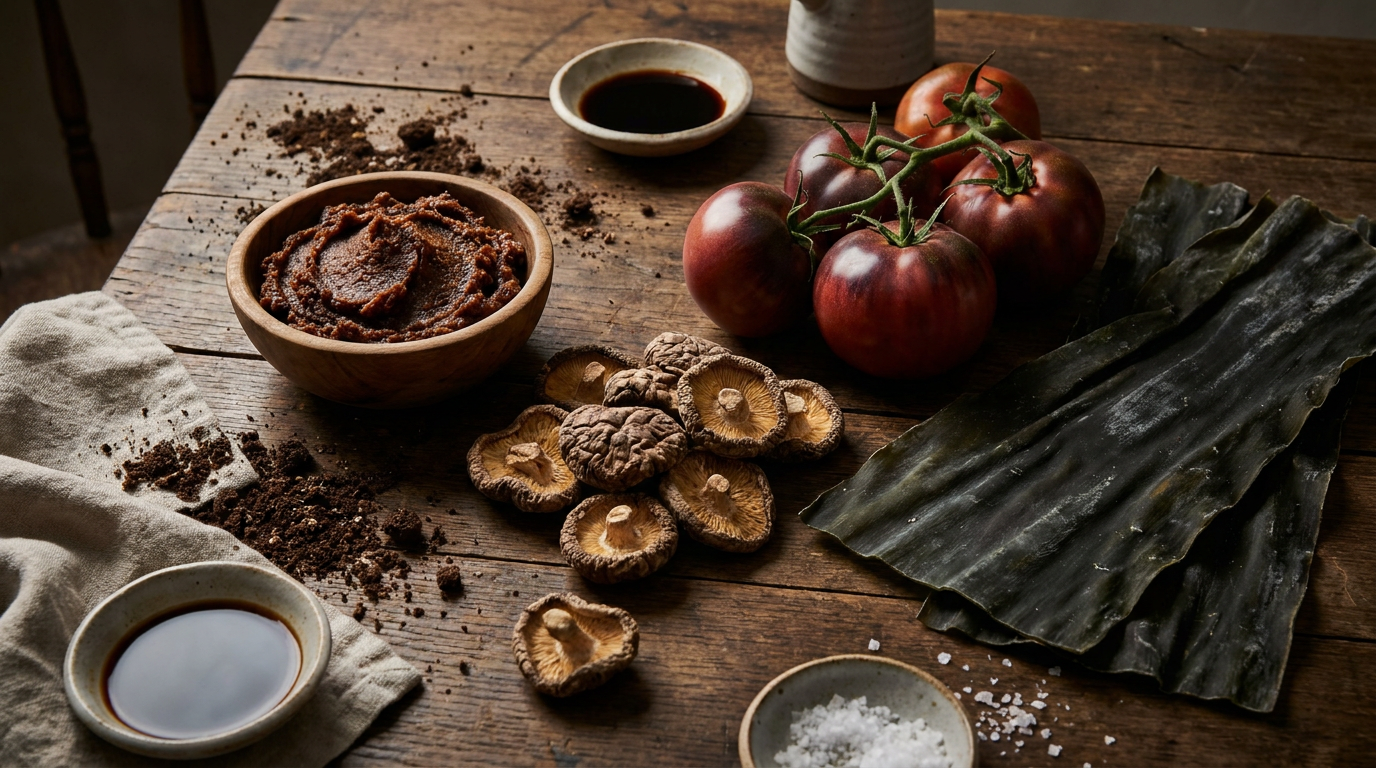
By combining a glutamate source (like tomatoes or soy sauce) with a guanylate source (like dried shiitake mushrooms), plant-based cooks can trigger the exact same 15-fold umami explosion as a beef stew. This synergistic pairing is the architectural foundation of traditional Japanese dashi, which marries glutamate-rich kombu (kelp) with guanylate-rich dried mushrooms to create a profoundly savory broth using only water and plants.[4][5]
But pairing ingredients is only half the equation. To maximize the baseline levels of free glutamates in plant foods, culinary science turns to the ancient technology of fermentation. Fermentation is essentially pre-digestion, utilizing microbes to break down complex, flavorless macromolecules into smaller, highly flavorful compounds.[3][6]
In the realm of umami, no microbe is more powerful than Aspergillus oryzae, a filamentous fungus known as koji. Designated as the "national mold" of Japan, koji is the biological engine behind miso, soy sauce, and sake. When koji spores are inoculated onto steamed rice or soybeans, the mold grows by secreting a vast array of powerful enzymes into the substrate.[3][6]

The most critical of these enzymes for flavor development are proteases. As koji ferments, its proteases systematically dismantle the complex proteins in the grains or legumes, cleaving the peptide bonds and liberating massive quantities of free amino acids—chief among them, glutamate. This enzymatic proteolysis is what transforms a bland mixture of soybeans and salt into the intensely savory, deeply complex paste known as miso.[3][6]
Modern chefs are increasingly utilizing raw koji preparations, such as shio koji (a fermented mixture of koji rice, salt, and water), as a universal flavor enhancer. When plant-based proteins or vegetables are marinated in shio koji, the active proteases continue their work, depositing free glutamates directly into the surface of the food.[3][6]
Furthermore, the enzymatic breakdown produced by koji yields high levels of reducing sugars and free amino acids—the exact chemical precursors required for the Maillard reaction. When a koji-marinated vegetable is subjected to high heat, it browns faster and develops a complex, roasted, "meaty" crust that is virtually impossible to achieve with raw vegetables alone.[3][4]
Mastering plant-based umami therefore requires a shift in culinary philosophy. It moves cooking away from the simple application of salt and toward the strategic layering of biochemical compounds. A chef might build a vegan broth by starting with a base of miso (fermented glutamates), adding a body of dried shiitake stock (guanylate for synergy), and finishing with a splash of soy sauce (additional amino acids).[4][5]
This scientific approach to flavor has profound implications for the future of sustainable food systems. Researchers at the University of Copenhagen note that the primary barrier to reducing global meat consumption is not nutritional, but sensory. Humans are biologically driven to seek out the deep satisfaction of umami.[2]

If plant-based meals fail to trigger the T1R1/T1R3 receptors effectively, they will always feel like a sacrifice or a dietary compromise to the omnivorous palate. By leveraging the science of umami synergy and enzymatic fermentation, the culinary world can bridge this sensory gap.[2][7]
Ultimately, the craving for a steak or a piece of aged cheese is simply the brain's request for a specific molecular interaction. As our understanding of food biochemistry deepens, it becomes clear that the plant kingdom, when paired with the right microbes and the right culinary techniques, is more than capable of answering that call.[2][7]
How we got here
1908
Kikunae Ikeda identifies glutamate as the source of savory flavor in kombu broth, naming it 'umami'.
1913
Shintaro Kodama discovers that nucleotides in dried bonito flakes also contribute to umami, hinting at synergy.
1960s
Akira Kuninaka scientifically proves 'umami synergy,' showing how glutamates and nucleotides multiply flavor intensity.
2002
Scientists identify the specific T1R1/T1R3 taste receptor on the human tongue responsible for detecting umami.
2020s
High-end plant-based cooking widely adopts koji fermentation and umami synergy to replicate the satisfaction of meat.
Viewpoints in depth
Food Biochemists
Focuses on the molecular mechanics of the T1R1/T1R3 receptor and enzymatic breakdown.
For researchers, umami is fundamentally a story of molecular geometry and evolutionary biology. They emphasize that the T1R1/T1R3 receptor's 'Venus flytrap' mechanism is a highly specialized evolutionary adaptation designed to detect protein. By mapping exactly how glutamates and nucleotides bind to this receptor, biochemists have provided the empirical data that proves umami synergy is a measurable, quantifiable phenomenon rather than just a subjective culinary opinion.
Plant-Based Chefs
Focuses on practical culinary applications, flavor layering, and recipe development.
In the kitchen, the science of umami translates into the architecture of flavor. Plant-based chefs view umami as a structural requirement for a successful dish, moving beyond the simple addition of salt. They advocate for the strategic layering of ingredients—such as combining a miso base with a mushroom stock—to intentionally trigger the 15-fold synergistic amplification that makes vegan food feel as hearty and satisfying as traditional meat dishes.
Sustainability Advocates
Views umami mastery as the critical tool for reducing global meat consumption.
Environmental researchers argue that the green transition cannot rely on ethics or environmental warnings alone; the food must actually taste good. Because humans are biologically hardwired to crave the umami found in meat, sustainability advocates see the widespread education of plant-based umami techniques as a vital public health and environmental strategy. If plant foods can trigger the same neurological reward centers as beef, dietary shifts become significantly easier to maintain.
Fermentation Artisans
Focuses on the traditional craft and biological power of koji and mold-based transformations.
For traditional makers, the recent scientific validation of umami synergy simply explains what artisans have known for centuries. They focus on the biological power of Aspergillus oryzae, viewing fermentation not just as a preservation method, but as an active culinary technique that uses enzymes to unlock the hidden potential of humble ingredients like soybeans and rice.
What we don't know
- Whether individual genetic differences significantly alter how intensely different people perceive umami synergy.
- The full extent to which other, yet-undiscovered plant compounds might interact with the T1R1/T1R3 receptor to further modulate flavor.
Key terms
- Glutamate
- An amino acid that serves as the primary trigger for the umami taste receptor on the human tongue.
- Nucleotides
- Compounds like IMP and GMP that produce no umami on their own but exponentially amplify the effect of glutamate when combined.
- Koji
- Steamed grains inoculated with the mold Aspergillus oryzae, used as the fermentation starter for miso, soy sauce, and sake.
- Proteolysis
- The enzymatic breakdown of complex proteins into smaller, highly flavorful free amino acids.
- Maillard Reaction
- A chemical reaction between amino acids and reducing sugars under heat that gives browned food its distinctive roasted flavor.
Frequently asked
Is umami just another word for salty?
No. While salty is one of the five basic tastes triggered by sodium ions, umami is a distinct savory taste triggered by amino acids like glutamate.
Do I need to use MSG powder to get umami?
Not necessarily. While pure MSG is an effective way to add glutamate, you can achieve the exact same effect naturally using tomatoes, miso, soy sauce, or fermented vegetables.
Why do dried mushrooms taste meatier than fresh ones?
The drying process concentrates the mushroom's natural compounds and increases the levels of guanylate (GMP), a nucleotide that triggers umami synergy.
Is koji safe to eat if it is a mold?
Yes. Aspergillus oryzae is a domesticated, beneficial mold that has been safely used in Japanese fermentation for over two thousand years.
Sources
Source coverage
7 outlets
4 viewpoints surfaced







[1]Proceedings of the National Academy of SciencesFood Biochemists
Molecular mechanism of the synergy between glutamate and IMP in activating the umami taste receptor
Read on Proceedings of the National Academy of Sciences →[2]University of CopenhagenSustainability Advocates
We think we crave meat, but it is the umami taste that we desire
Read on University of Copenhagen →[3]UmamiScienceFood Biochemists
The Biology: What Koji Actually Is
Read on UmamiScience →[4]Savory KitchinPlant-Based Chefs
Maximizing Umami in Plant-Based Cooking
Read on Savory Kitchin →[5]Vegan Asian KitchenPlant-Based Chefs
Vegan Umami: The Science of Layering Flavor
Read on Vegan Asian Kitchen →[6]The House of UmamiFermentation Artisans
Japanese fermentation: What is Koji?
Read on The House of Umami →[7]Factlen Editorial TeamSustainability Advocates
Synthesis by Factlen editorial team
Read on Factlen Editorial Team →

Every angle. Every day.
Get food drink stories with full source coverage and perspective breakdowns delivered to your inbox.