
The Rise of Local AI: How Small Language Models Are Putting Privacy First
Tech giants are pivoting from massive cloud servers to Small Language Models (SLMs) that run directly on your smartphone, offering zero latency and absolute data privacy.
By Factlen Editorial Team

- Efficiency & Edge Developers
- Focus on the dramatic cost reductions and zero-latency benefits of running AI locally.
- On-Device Privacy Advocates
- Argue that the future of AI must be local to protect sensitive user data from cloud surveillance.
- Open-Source AI Community
- Value SLMs as a democratizing force that prevents a few tech giants from monopolizing AI.
What's not represented
- · Hardware Manufacturers
- · Regulatory Bodies
Why this matters
By moving AI processing from distant cloud servers directly onto your phone and laptop, Small Language Models guarantee absolute data privacy, eliminate subscription costs, and work instantly without an internet connection.
Key points
- Small Language Models (SLMs) run directly on consumer devices without internet access.
- On-device processing ensures sensitive personal data never leaves the smartphone or laptop.
- Techniques like quantization and high-quality training data allow SLMs to rival much larger models.
- Tech giants are adopting hybrid architectures, using SLMs for daily tasks and secure clouds for complex reasoning.
For the past three years, the artificial intelligence industry has been locked in a race to build the biggest brain. Tech giants poured billions into massive data centers, training Large Language Models (LLMs) with trillions of parameters to achieve unprecedented reasoning capabilities.[7]
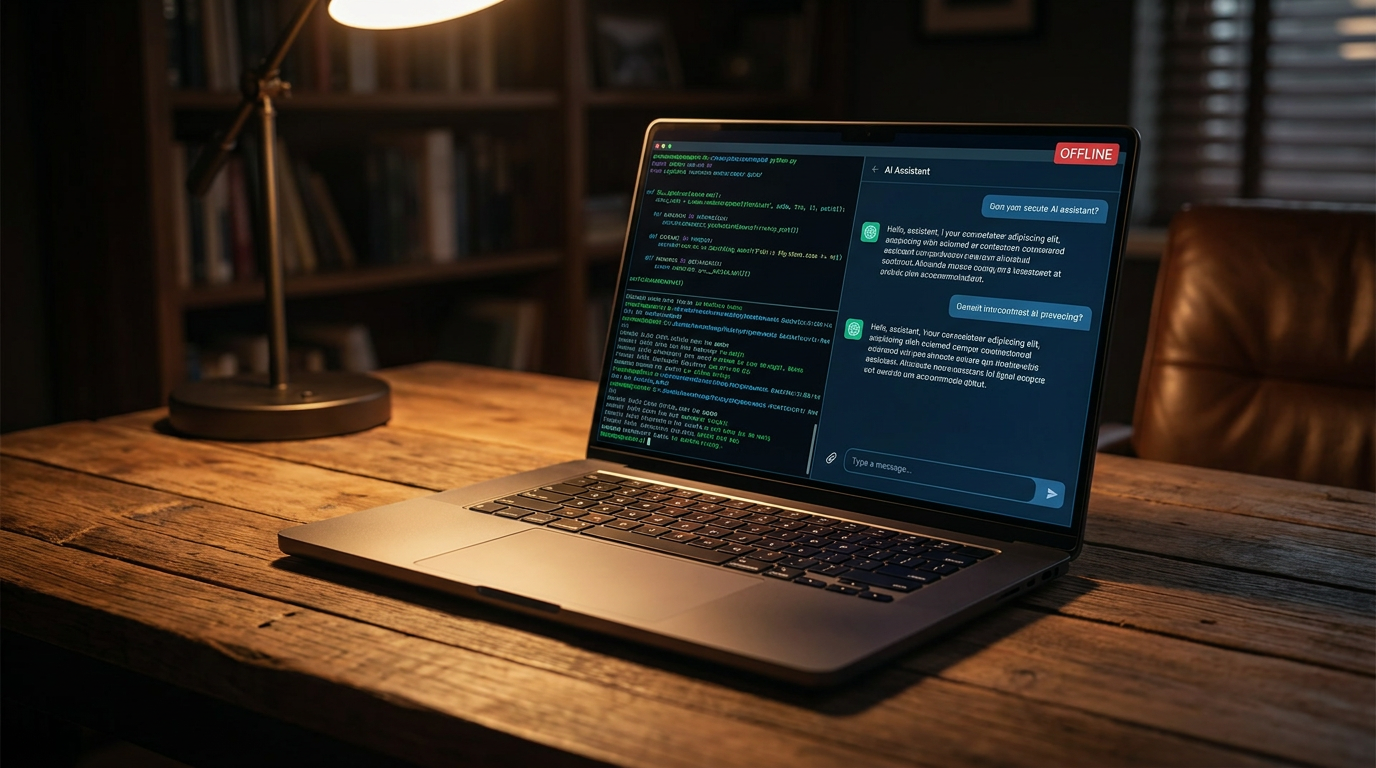
But in 2026, the most significant AI revolution is happening quietly in your pocket. The industry is pivoting toward Small Language Models (SLMs)—highly efficient, hyper-focused AI systems designed to run locally on smartphones, laptops, and edge devices without ever connecting to the internet.[6]
This shift from the cloud to the device is fundamentally changing how we interact with artificial intelligence. By bringing the processing power directly to the user, SLMs are solving the three biggest bottlenecks of cloud-based AI: privacy, latency, and cost.[5]
To understand the shift, it helps to look at the numbers. A frontier model like GPT-4 is estimated to use over a trillion parameters—the internal mathematical weights that dictate how the AI processes language. Running it requires massive server farms and constant internet connectivity.[7]

In contrast, Small Language Models typically range from 1 billion to 8 billion parameters. Microsoft’s Phi-3 Mini, for example, operates with just 3.8 billion parameters, yet benchmarks show it rivaling the performance of models ten times its size. Google’s Gemini Nano is similarly optimized to run natively within Android’s AICore system.[1][3]
How does a smaller model compete with a giant? The secret lies in the training data. Instead of scraping the entire unfiltered internet, researchers train SLMs on highly curated, "textbook quality" data. Microsoft researchers likened the approach to teaching a child: using clear, high-quality examples rather than overwhelming them with noise.[1]
Getting these models to fit on a smartphone requires a technical breakthrough known as quantization. This process compresses the model's mathematical weights—often reducing them from 16-bit to 4-bit precision—drastically shrinking the memory footprint with minimal loss in accuracy.[4]
Paired with the Neural Processing Units (NPUs) now standard in modern smartphone and laptop chips, quantization allows a device to run complex AI inference locally without draining the battery in minutes or melting the hardware.[5]

The most immediate benefit of this local execution is absolute privacy. When you ask a cloud-based AI to summarize a sensitive work document or analyze your financial spending, that data must travel to a corporate server.[6]
The most immediate benefit of this local execution is absolute privacy.
With on-device SLMs, the data never leaves your hardware. Apple has made this the cornerstone of its Apple Intelligence architecture, ensuring that personal context—like reading your emails to prioritize notifications—is processed entirely on the iPhone or Mac.[2]
Google’s Android ecosystem utilizes a similar philosophy with Gemini Nano. Developers can build apps that parse voice notes, categorize transactions, or suggest replies, all while keeping the user's private data strictly on the device.[3]
Beyond privacy, local AI eliminates the "cloud tax" and network latency. Because the model lives on the device, responses are generated in milliseconds. There is no waiting for a server to wake up, process the prompt, and beam the answer back.[5]
This zero-latency environment is crucial for real-time applications like live translation, autonomous agents, and voice assistants. It also means the AI works flawlessly in airplane mode, in subway tunnels, or in remote areas with zero cellular reception.[4]
For businesses, the economics of SLMs are equally transformative. Hosting massive LLMs in the cloud incurs continuous API costs and requires expensive infrastructure. Deploying an SLM locally or on-premise can reduce total AI operational costs by up to 90%.[6]
However, the transition to small models is not without trade-offs. SLMs are specialists, not generalists. While they excel at summarization, coding assistance, and drafting emails, they lack the vast, encyclopedic world knowledge of a trillion-parameter model.[7]
If pushed outside their specific training domains, small models are more prone to hallucination—confidently inventing facts. They are designed to process the data you give them, rather than acting as an omniscient search engine.[1]
To bridge this gap, companies are adopting hybrid architectures. Apple’s system, for instance, relies on the on-device model for everyday tasks. If a request requires more compute power, it securely hands the task off to "Private Cloud Compute," a server environment designed to process the data without storing it.[2]

Google employs a similar tiered strategy, using Gemini Nano for offline, on-device tasks, while seamlessly routing complex reasoning queries to its larger cloud models when necessary.[3]
Ultimately, the rise of Small Language Models democratizes artificial intelligence. It shifts power away from centralized cloud oligopolies and places highly capable, private, and efficient AI directly into the hands of users.[5]
As hardware continues to improve and training techniques become more refined, the definition of "small" will evolve. But the core philosophy—that AI should be personal, private, and present on the devices we use every day—is here to stay.[7]

How we got here
2023
The AI boom is dominated by massive, cloud-dependent Large Language Models.
Early 2024
Microsoft releases the Phi-3 family, proving that highly curated data can make small models exceptionally smart.
Late 2024
Apple and Google deeply integrate on-device SLMs into their mobile operating systems.
2026
SLMs become the default architecture for consumer AI, prioritizing privacy and zero-latency performance.
Viewpoints in depth
On-Device Privacy Advocates
Argue that the future of AI must be local to protect sensitive user data from cloud surveillance.
Companies like Apple and Google emphasize that true personal intelligence requires access to highly sensitive data—emails, text messages, and financial records. Sending this data to a cloud server introduces unacceptable privacy risks. By processing prompts locally via SLMs, these advocates argue that users can enjoy the benefits of generative AI without compromising their digital sovereignty.
Efficiency & Edge Developers
Focus on the dramatic cost reductions and zero-latency benefits of running AI locally.
For developers and enterprise IT leaders, the cloud-based LLM model is financially unsustainable for everyday tasks. API calls are expensive, and network latency ruins real-time user experiences. This camp champions models like Microsoft's Phi-3 because they allow businesses to deploy AI features directly onto consumer hardware, slashing operational costs by up to 90% while delivering instant, offline responses.
Open-Source AI Community
Value SLMs as a democratizing force that prevents a few tech giants from monopolizing AI.
Open-source platforms and independent researchers view small models as the key to AI democratization. When models require massive data centers to run, only a handful of trillion-dollar companies can control the technology. SLMs, which can be downloaded and run on a standard laptop via tools like Ollama, ensure that developers, researchers, and hobbyists worldwide can build, fine-tune, and experiment with AI without paying a 'cloud tax.'
What we don't know
- How quickly SLMs will overcome their tendency to hallucinate when pushed outside their specialized domains.
- Whether open-source SLMs will eventually match the reasoning capabilities of proprietary cloud models.
Key terms
- Small Language Model (SLM)
- A compact AI system designed to run efficiently on consumer hardware rather than massive cloud servers.
- Quantization
- A compression technique that shrinks an AI model's memory footprint by reducing the precision of its mathematical weights.
- Parameters
- The internal mathematical variables a neural network learns during training, representing its 'knowledge'.
- Neural Processing Unit (NPU)
- A specialized hardware chip designed specifically to accelerate artificial intelligence calculations efficiently.
Frequently asked
Do I need an internet connection to use an SLM?
No. Because the model is downloaded and stored directly on your device, it can generate text, summarize documents, and answer questions entirely offline.
Are Small Language Models as smart as ChatGPT?
They are highly capable in specific domains like coding or summarization, but they lack the broad, encyclopedic world knowledge of massive cloud models.
Will running an SLM drain my phone's battery?
Modern smartphones use dedicated Neural Processing Units (NPUs) to run these models efficiently, minimizing the impact on battery life.
How does this improve my privacy?
Since the AI processes your prompts locally, your sensitive data—like emails, health records, or financial documents—is never transmitted to a corporate server.
Sources
Source coverage
7 outlets
3 viewpoints surfaced







[1]MicrosoftEfficiency & Edge Developers
Phi-3: Introducing Microsoft's Small Language Model
Read on Microsoft →[2]AppleOn-Device Privacy Advocates
Apple Intelligence and privacy on iPhone
Read on Apple →[3]GoogleOn-Device Privacy Advocates
ML Kit's GenAI APIs, powered by Gemini Nano
Read on Google →[4]Hugging FaceOpen-Source AI Community
Small Language Models (SLM): A Comprehensive Overview
Read on Hugging Face →[5]RedditEfficiency & Edge Developers
Why 2026 is officially the year of Small Language Models
Read on Reddit →[6]Ruh AIEfficiency & Edge Developers
Small Language Models (SLMs): The Efficient Future of AI in 2026
Read on Ruh AI →[7]Factlen Editorial TeamOn-Device Privacy Advocates
Synthesis by Factlen editorial team
Read on Factlen Editorial Team →

More in ai
See all 9 stories →Agentic AI
Agentic AI: How Autonomous Agents Are Automating Everyday Digital Tasks
7 sources
Local AI
The Rise of Local AI: How Small Language Models Are Putting Privacy First
7 sources
Global Regulation
The 2026 AI Policy Fracture: Evidence Pack on Global Regulation, Copyright, and Enforcement
13 sources

Drug Discovery
AI Model 'TITO' Accelerates Drug Discovery Simulations by 10,000x in Major Medical Breakthrough
8 sources

Every angle. Every day.
Get ai stories with full source coverage and perspective breakdowns delivered to your inbox.