
The Science of High-Altitude Trekking: How Your Body Adapts to the Death Zone
As trekkers push higher into the mountains, dropping barometric pressure triggers a cascade of biological upgrades. Understanding the science of acclimatization is the key to preventing altitude sickness and reaching the summit safely.
By Factlen Editorial Team
- Wilderness Medicine Practitioners
- Focuses on conservative ascent profiles and symptom management to prevent life-threatening illnesses.
- Evolutionary Geneticists
- Studies how prolonged exposure to hypoxia has permanently altered the DNA of high-altitude populations.
- Expedition Guides
- Prioritizes practical logistics, pacing, and client monitoring to ensure successful summits.
What's not represented
- · Local Porter Communities
- · High-Altitude Rescue Helicopter Pilots
Why this matters
Understanding the biology of acclimatization is the difference between a successful summit and a life-threatening medical emergency. For anyone planning a high-altitude trek, knowing how to support the body's invisible adaptations dictates how to pace, what to eat, and when to turn around.
Key points
- Barometric pressure drops at high altitudes, resulting in fewer oxygen molecules per breath and triggering hypobaric hypoxia.
- The body immediately responds by increasing breathing and heart rates, followed by a molecular adaptation orchestrated by the HIF pathway.
- Acclimatization involves producing more red blood cells and shifting metabolism to burn oxygen-efficient carbohydrates instead of fat.
- Trekkers must ascend slowly, gaining no more than 300 to 500 meters of sleeping elevation per day, to prevent Acute Mountain Sickness.
- Indigenous populations like Tibetans and Sherpas possess unique genetic mutations that allow them to thrive in thin air without thickening their blood.
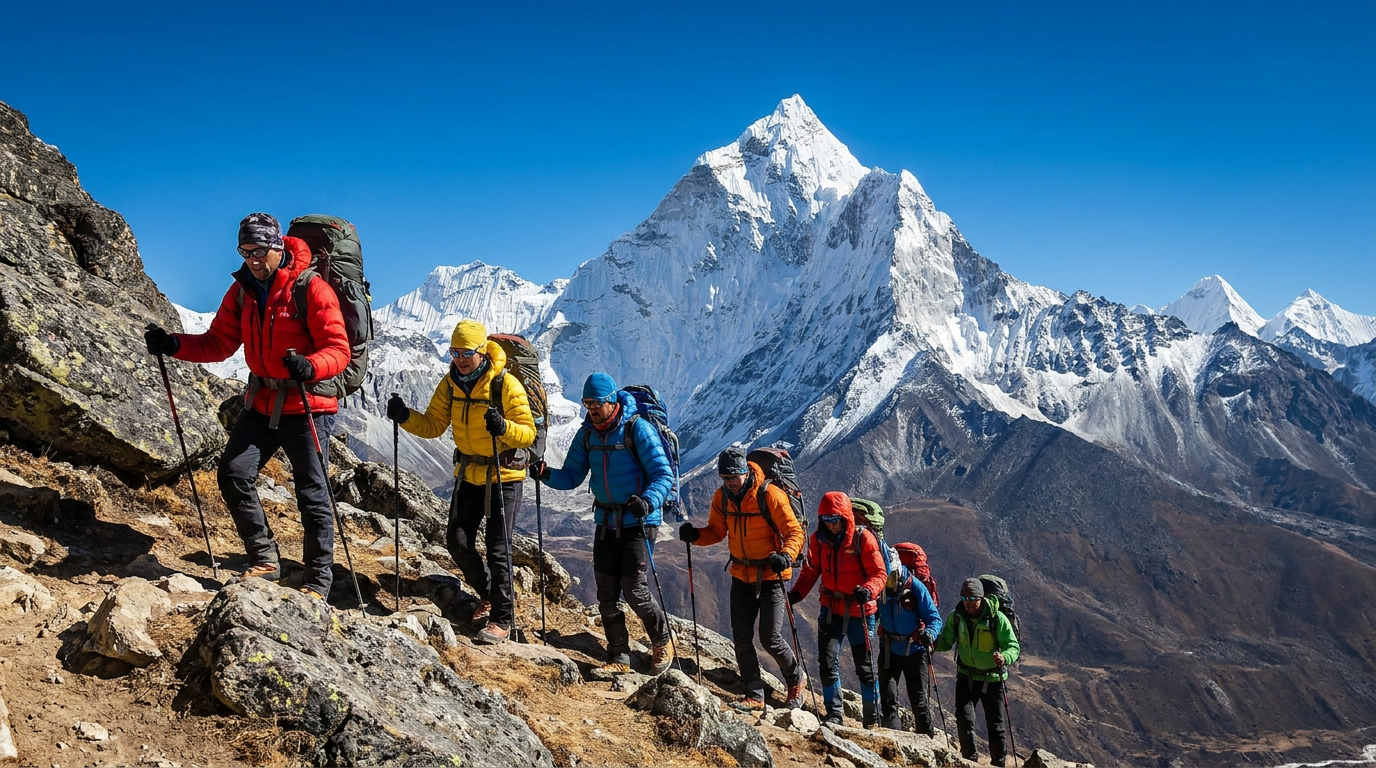
Every year, thousands of trekkers leave the comforts of sea level to tackle iconic routes like the Everest Base Camp trail, Mount Kilimanjaro, and the high passes of the Andes. The physical exertion of climbing is only half the battle; the true challenge is invisible. As elevation increases, the air undergoes a fundamental physical change that forces the human body to execute a rapid, complex biological upgrade.[1]
A common misconception is that high-altitude air contains a lower percentage of oxygen. In reality, the atmosphere remains roughly 21 percent oxygen all the way to the summit of Mount Everest. The difference lies in barometric pressure. At sea level, the weight of the atmosphere compresses air molecules closely together. At 10,000 feet, that pressure drops significantly, meaning the molecules spread out, resulting in fewer oxygen molecules per breath—a condition known as hypobaric hypoxia.[4][5]
The body's response to this sudden oxygen deficit begins the moment a trekker crosses the 8,000-foot threshold. Specialized sensors in the carotid arteries detect the drop in blood oxygen and immediately trigger the hypoxic ventilatory response. The trekker begins to breathe deeper and faster, attempting to pull more oxygen into the lungs. Simultaneously, the heart rate spikes, pumping the limited oxygen to vital organs as quickly as possible.[4][5]
This rapid breathing, while necessary, creates a secondary problem: it expels too much carbon dioxide, making the blood unusually alkaline. To restore the blood's delicate pH balance, the kidneys kick into overdrive, dumping bicarbonate into the urine. This process, known as altitude diuresis, explains why trekkers need to urinate frequently during their first few days at elevation. It is a healthy, necessary sign that the body is actively adjusting to the environment.[1][5]

While hyperventilation and an elevated heart rate serve as an emergency response, they are too energetically expensive to maintain long-term. To survive and thrive in the mountains, the body must transition from panic to efficiency. This transition is the essence of acclimatization, a molecular cascade orchestrated by a family of proteins known as hypoxia-inducible factors, or HIFs.[2][4]
Discovered by researchers who later won the Nobel Prize, the HIF pathway acts as a master genetic switch. In oxygen-rich environments at sea level, HIF proteins are constantly produced and immediately destroyed. But when oxygen levels plummet at altitude, these proteins stabilize and accumulate in the cells. Once active, they travel to the cell nucleus and turn on hundreds of survival genes designed to optimize oxygen delivery and utilization.[2]
One of the most critical genes activated by the HIF pathway signals the kidneys to release erythropoietin (EPO). This hormone travels to the bone marrow, instructing it to manufacture a massive influx of new red blood cells. Over the course of several days, the blood becomes thicker and richer in hemoglobin, significantly increasing its capacity to carry oxygen from the lungs to the muscles.[2][4]
One of the most critical genes activated by the HIF pathway signals the kidneys to release erythropoietin (EPO).
However, carrying more oxygen is only part of the equation; the body also changes how it uses that oxygen to generate energy. At high altitudes, burning fat for fuel becomes a liability because it requires more oxygen per unit of energy produced than burning carbohydrates. The HIF pathway triggers a metabolic shift, upregulating glycolysis—the breakdown of glucose—allowing trekkers to extract more energy from less oxygen.[3][4]

This metabolic reality dictates the high-altitude diet. Wilderness medicine experts and expedition guides universally recommend a diet heavy in complex carbohydrates—pasta, rice, and oats—while minimizing heavy fats and proteins that slow digestion and demand excess oxygen. Trekkers are also urged to consume four to five liters of water daily, as the combination of rapid breathing in dry mountain air and altitude-induced diuresis can lead to severe dehydration, which dangerously thickens the newly red-blood-cell-rich blood.[6][7]
To facilitate these biological upgrades safely, mountaineers rely on the golden rule of acclimatization: 'climb high, sleep low.' By ascending to a new high point during the day, trekkers expose their bodies to a strong hypoxic stimulus, triggering the HIF pathway. By descending a few hundred meters to sleep, they provide their systems with a slightly thicker atmosphere in which to recover and build new red blood cells overnight.[5][6]
Medical guidelines dictate that once above 3,000 meters (roughly 10,000 feet), trekkers should not increase their sleeping elevation by more than 300 to 500 meters per day. Furthermore, for every 1,000 meters gained, a mandatory rest day is required. Pushing past these limits overwhelms the body's ability to adapt, leading to Acute Mountain Sickness (AMS), characterized by throbbing headaches, nausea, profound fatigue, and insomnia.[5][7]
If a trekker ignores the symptoms of AMS and continues to ascend, the condition can rapidly deteriorate into life-threatening emergencies. High Altitude Cerebral Edema (HACE) occurs when oxygen-starved blood vessels in the brain begin to leak fluid, causing severe swelling, confusion, and loss of coordination. High Altitude Pulmonary Edema (HAPE) involves fluid leaking into the lungs, effectively drowning the victim from the inside. In both cases, immediate descent is the only definitive cure.[4][7]

To assist the acclimatization process, many trekkers turn to pharmaceutical prophylaxis. Acetazolamide, commonly known by the brand name Diamox, is frequently prescribed by travel clinics. Originally developed as a glaucoma medication, acetazolamide forces the kidneys to excrete bicarbonate, artificially acidifying the blood. This tricks the brain into thinking it is suffocating, prompting deeper and faster breathing even during sleep, which accelerates the natural acclimatization timeline.[5][7]
While recreational trekkers rely on slow ascents and medications, indigenous populations who have lived at extreme altitudes for millennia showcase the ultimate endpoints of human adaptation. Evolutionary geneticists have discovered that Tibetans, Andeans, and Sherpas have developed entirely distinct genetic strategies to thrive in chronic hypoxia, representing some of the fastest evolutionary divergences in human history.[2]
Tibetans, for example, possess unique mutations in the EPAS1 and EGLN1 genes, which regulate the HIF pathway. Unlike lowlanders whose blood dangerously thickens with red blood cells at altitude, Tibetans maintain relatively normal hemoglobin levels. Instead, their bodies have adapted to breathe faster and utilize nitric oxide to dilate blood vessels, ensuring efficient oxygen delivery without the cardiovascular strain of pumping thick, sludgy blood.[2]

Conversely, indigenous Andean populations adapted by developing higher hemoglobin concentrations than lowlanders, paired with specialized cardiovascular adaptations that allow their red blood cells to carry more oxygen per volume. Meanwhile, the Himalayan Sherpas exhibit profound metabolic adaptations. Research indicates that Sherpas possess a variant of the PPARA gene that optimizes their cellular mitochondria, allowing them to produce more adenosine triphosphate (ATP)—the cellular energy currency—with significantly less oxygen.[2][3]
For the sea-level dweller venturing into the mountains, these permanent genetic traits remain out of reach. Yet, the temporary acclimatization process is a remarkable testament to human biological resilience. By understanding the invisible molecular machinery at work, pacing their ascents, and respecting the limits of their physiology, trekkers can safely navigate the thin air and stand atop the world's most breathtaking summits.[1][5]
How we got here
Minutes to Hours
The body detects lower oxygen pressure; breathing and heart rates immediately increase to compensate.
Days 1 to 3
Kidneys increase urination to balance blood pH, while the HIF pathway begins signaling for new red blood cells.
Days 4 to 7
Bone marrow ramps up red blood cell production, and cellular metabolism shifts to favor oxygen-efficient carbohydrates.
Millennia
Over thousands of years, indigenous populations develop permanent genetic mutations to thrive in chronic hypoxia.
Viewpoints in depth
Wilderness Medicine Practitioners
Focuses on conservative ascent profiles and symptom management to prevent life-threatening illnesses.
For wilderness doctors and rescue teams, altitude is a predictable stressor that becomes dangerous only through human error. They emphasize that acute mountain sickness (AMS) is entirely preventable with patience. Their primary directive is the 'golden rule' of altitude: never ascend to sleep at a higher elevation if experiencing symptoms. They advocate for prophylactic medications like acetazolamide only as a supplement to, not a replacement for, a conservative ascent profile of no more than 300 to 500 meters per day.
Evolutionary Geneticists
Studies how prolonged exposure to hypoxia has permanently altered the DNA of high-altitude populations.
Researchers studying Tibetans, Andeans, and Sherpas view high-altitude adaptation as one of the fastest and most profound examples of human evolution. Rather than looking at short-term acclimatization, they focus on permanent genetic shifts—such as the EPAS1 gene mutation in Tibetans that prevents the dangerous overproduction of red blood cells. To geneticists, these distinct evolutionary paths offer a roadmap for understanding and potentially treating hypoxia-related diseases, such as heart failure and chronic obstructive pulmonary disease, in sea-level populations.
Expedition Guides
Prioritizes practical logistics, pacing, and client monitoring to ensure successful summits.
Professional mountain guides operate at the intersection of physiology and psychology. They know that clients often hide symptoms out of a desire to reach the summit. Guides enforce the 'climb high, sleep low' strategy through carefully planned itineraries and mandate strict hydration and high-carbohydrate diets. For them, successful acclimatization is about managing the trekker's daily energy expenditure, ensuring they walk slowly enough ('pole pole' in Swahili on Kilimanjaro) to keep their heart rates manageable while the invisible biological adaptations take place.
What we don't know
- Why certain individuals are genetically highly susceptible to severe altitude sickness while others of similar fitness levels are not.
- The exact mechanisms by which the brain's blood-brain barrier breaks down to cause High Altitude Cerebral Edema (HACE).
- Whether the specific metabolic adaptations seen in Sherpas can be temporarily replicated in lowlanders through targeted pharmaceuticals.
Key terms
- Hypobaric Hypoxia
- A condition where low barometric pressure at high altitudes results in fewer oxygen molecules available per breath.
- Hypoxia-Inducible Factor (HIF)
- A family of proteins that act as genetic switches, turning on survival genes when the body detects low oxygen levels.
- Erythropoietin (EPO)
- A hormone produced by the kidneys that stimulates the bone marrow to produce more red blood cells.
- Acute Mountain Sickness (AMS)
- The mildest and most common form of altitude illness, characterized by headaches, nausea, and fatigue due to rapid ascent.
- High Altitude Pulmonary Edema (HAPE)
- A severe, life-threatening condition where fluid leaks into the lungs due to extreme oxygen deprivation.
Frequently asked
How long does it take to acclimatize to high altitude?
It generally takes one to three days for the body to adjust to a new elevation. However, full acclimatization to extreme altitudes can take weeks.
Does physical fitness prevent altitude sickness?
No. While being fit makes the physical exertion of climbing easier, it does not speed up the biological acclimatization process. Even elite athletes can suffer from acute mountain sickness if they ascend too quickly.
Why do I have to drink so much water at high altitude?
The combination of rapid breathing in dry mountain air and altitude-induced increased urination (diuresis) causes rapid fluid loss. Dehydration thickens the blood, making it harder for the heart to pump oxygen.
Can I drink alcohol while acclimatizing?
It is highly discouraged. Alcohol acts as a respiratory depressant, slowing your breathing rate, especially during sleep, which directly counteracts the body's efforts to take in more oxygen.
Sources
Source coverage
7 outlets
3 viewpoints surfaced







[1]Factlen Editorial TeamExpedition Guides
Synthesis by Factlen editorial team
Read on Factlen Editorial Team →[2]National Institutes of HealthEvolutionary Geneticists
Human high-altitude adaptation: Forward genetics meets the HIF pathway
Read on National Institutes of Health →[3]Proceedings of the National Academy of SciencesEvolutionary Geneticists
Metabolic basis to Sherpa altitude adaptation
Read on Proceedings of the National Academy of Sciences →[4]MDPIEvolutionary Geneticists
High-Altitude Hypoxic Adaptation and Physiological Biochemical Characteristics
Read on MDPI →[5]Princeton UniversityWilderness Medicine Practitioners
High Altitude: Acclimatization and Illnesses
Read on Princeton University →[6]BackpackerExpedition Guides
Altitude Sickness Prevention Tips
Read on Backpacker →[7]HealthlineWilderness Medicine Practitioners
Top 7 Tips for Altitude Sickness Prevention
Read on Healthline →

Every angle. Every day.
Get travel stories with full source coverage and perspective breakdowns delivered to your inbox.