
Optical Metasurfaces Enable Zero-Power AI Vision Processing on Edge Devices
A new breakthrough in optical computing embeds core computer vision operations directly into microscopic lenses, allowing devices to process images at the speed of light with near-zero energy consumption.
By Factlen Editorial Team
- Optical Computing Researchers
- Argue that light-based processing is the only viable path to overcome the energy and latency limits of digital Moore's Law.
- Edge Hardware Developers
- Value the technology primarily for its ability to shrink device footprints and extend battery life in commercial wearables and sensors.
- Hybrid Systems Advocates
- Emphasize that optical hardware is too rigid to stand alone, arguing that the future lies in pairing optical front-ends with programmable digital back-ends.
What's not represented
- · Cloud Computing Providers
- · Semiconductor Foundries
Why this matters
As augmented reality glasses, drones, and autonomous vehicles become more common, their battery life is severely limited by the energy required to process video. This technology offloads that heavy computation to the lens itself, paving the way for lighter, cooler devices that can run all day.
Key points
- A new Nature study demonstrates optical metasurfaces that perform computer vision tasks at the speed of light.
- The technology uses nanoscale silicon structures to bend light, executing mathematical convolutions without digital processors.
- Optical neural networks offer a 1,000-fold improvement in energy efficiency compared to traditional GPUs.
- While highly efficient, current metasurfaces are physically fixed and lack the software programmability of digital chips.
The proliferation of artificial intelligence in edge devices—from autonomous drones to augmented reality glasses—has collided with a hard physical limit: battery life. Modern computer vision relies on power-hungry digital processors that constantly convert photons into electrical signals, only to burn massive amounts of energy performing mathematical operations on that data.[7]
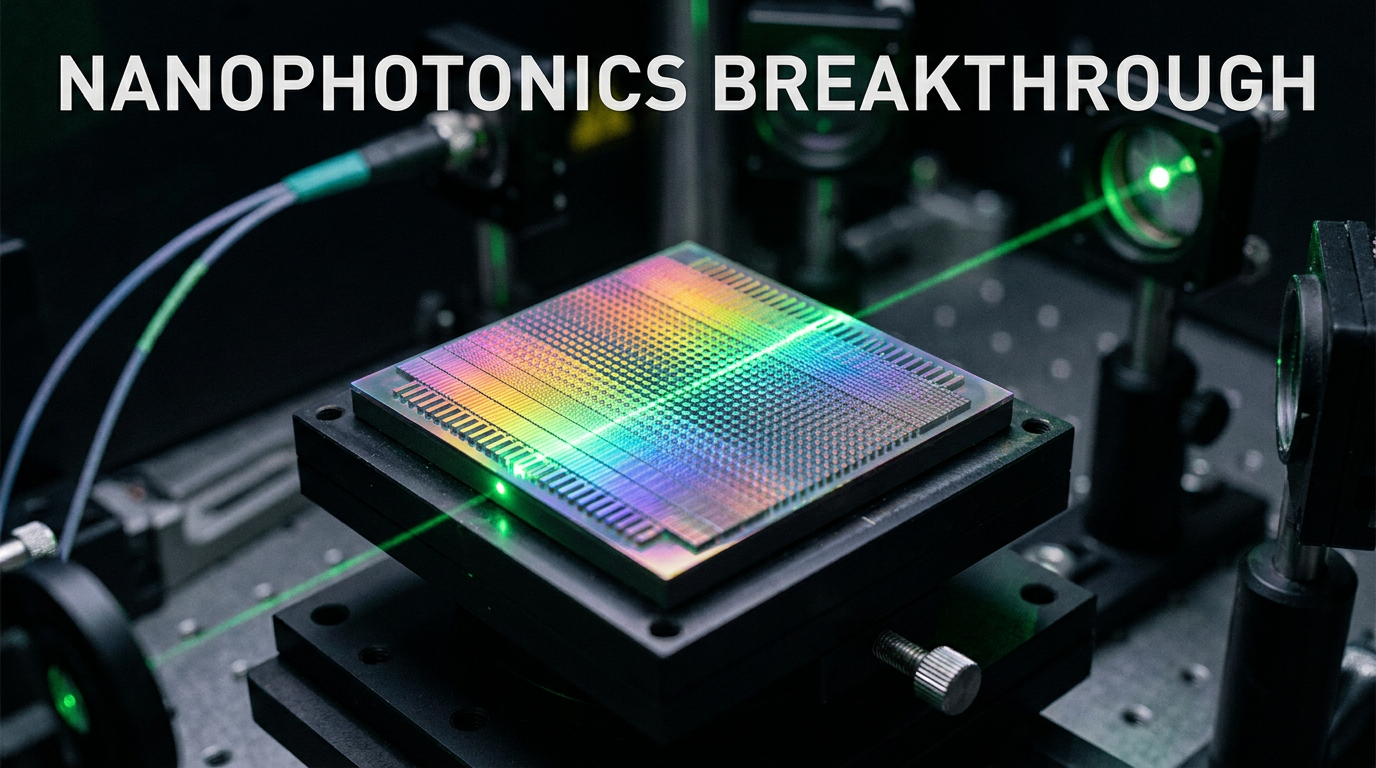
A newly published study in the journal Nature proposes a radical bypass to this bottleneck: performing the computations using light itself, before the image ever reaches a digital sensor. By embedding core computer vision principles directly into a microscopic, light-manipulating material known as an optical metasurface, researchers have demonstrated a system that processes visual information at the speed of light with near-zero energy consumption.[1]
The primary claim advanced by the researchers is that metasurfaces can natively perform complex AI convolutions without digital intervention. The core mechanism relies on ultrathin, planar optical components covered in millions of nanoscale silicon structures. These "meta-atoms" are precisely engineered to alter the phase, amplitude, and polarization of incoming light waves.[1][6]
According to the Nature findings, these structures can be arranged to physically execute mathematical convolutions—the foundational operation of digital neural networks used for edge detection and feature extraction. Instead of a GPU calculating the gradient of an image pixel by pixel, the metasurface bends the incoming light so that only the edges of the object are projected onto the sensor.[1]

The evidence supporting this capability is robust, grounded in physical prototypes rather than mere simulation. The research demonstrates that a single-layer metasurface can integrate over 41 million photonic neurons. When tested on benchmark image classification tasks, this optical system, paired with a highly simplified digital backend, achieved accuracy rates exceeding 99%, matching the performance of massive digital models like ResNet.[1][2]
A secondary, yet highly consequential claim is that optical computing offers orders-of-magnitude improvements in energy efficiency and latency. Because the computation occurs passively as light passes through the lens, the energy cost of the feature extraction is effectively zero.[7]
Data presented at the IEEE OptoElectronics and Communications Conference corroborates this efficiency metric, showing that metasurface-based optical neural networks can process visual data with a 1,000-fold improvement in energy efficiency compared to state-of-the-art digital GPUs. Furthermore, because the processing happens simultaneously across the entire optical field, the latency is limited only by the speed of light, effectively eliminating the frame-rate limits of traditional digital cameras.[2]

Beyond academic laboratories, industry analysts assert that the technology is rapidly moving toward commercial viability in edge devices. The transition from laboratory physics to consumer hardware is driven by the urgent need to reduce the physical footprint and power draw of multi-camera systems in wearables and vehicles.[4]
Beyond academic laboratories, industry analysts assert that the technology is rapidly moving toward commercial viability in edge devices.
Industry tracking by the Edge AI and Vision Alliance provides strong evidence for this commercial shift, noting that simple meta-optics have already entered mass production. Millions of units are currently deployed in smartphones for biometric face-unlock systems, proving that metasurfaces can be reliably manufactured at scale using standard semiconductor foundries.[4]
Hardware startups are now pushing toward full optical image processing. Imagia, an edge-computing developer, recently demonstrated a metasurface system capable of detecting hand gestures entirely in the optical domain. According to reports in EE Times, their prototype replicates an incoming image multiple times through a metasurface array, performing different convolutions simultaneously without relying on digital matrix multiplication.[3]
Despite these staggering efficiency gains, researchers maintain transparent uncertainty regarding the technology's reconfigurability. A digital GPU is a blank slate that can run any software model; an optical metasurface is a physical piece of hardware permanently etched with a specific algorithm.[7]
If a developer wants to update the AI model to recognize a new set of features, they cannot simply push a software patch—they would theoretically need to swap out the physical lens. This physical rigidity currently limits metasurfaces to highly specific, fixed tasks, such as initial edge detection or specific object recognition, rather than general-purpose computing.[5][7]

To bridge this gap, the consensus among optical engineers points toward hybrid systems. The Nature study highlights an architecture where the metasurface acts as an ultra-efficient front-end filter, compressing the visual data and extracting key features optically. The heavily reduced data is then passed to a small, programmable digital neural network that makes the final classification.[1]
This hybrid approach drastically reduces the workload on the digital processor while maintaining enough flexibility to update the final decision-making software. A recent review of optical edge detection technologies in the journal MDPI confirms that this synergy between passive optical front-ends and lightweight digital back-ends is the most viable path to near-term commercialization.[5]
Looking further ahead, the ultimate goal is the creation of dynamically reconfigurable metasurfaces. Materials scientists are experimenting with phase-change materials—such as vanadium dioxide—that can alter their optical properties in real-time when a small voltage or thermal pulse is applied.[6]

If perfected, these active metasurfaces would allow the optical algorithms to be updated on the fly, effectively creating a programmable optical GPU. However, as noted in recent academic reviews, the evidence for dynamic systems remains strictly confined to the laboratory phase, with significant hurdles remaining in switching speed, energy consumption, and integration.[6]
For now, the integration of fixed optical computing into edge devices represents a paradigm shift in machine vision. By offloading the most computationally expensive parts of visual perception to the physical realm of light, engineers are unlocking new possibilities for devices that must see the world clearly without draining their batteries.[7]
How we got here
2022
The first commercial metasurfaces enter mass markets, deployed primarily for biometric sensing in smartphones.
2024
Hardware startups demonstrate the ability to perform complex image processing and gesture detection entirely in the optical domain.
March 2026
Researchers unveil a highly scalable metasurface-based optical learning machine capable of 99% accuracy on benchmark vision tasks.
June 2026
A breakthrough paper in Nature details a general-purpose optical metasurface system that embeds core computer vision operations directly into the lens.
Viewpoints in depth
Optical Computing Researchers
Argue that light-based processing is the only viable path to overcome the energy and latency limits of digital Moore's Law.
This camp, primarily composed of academic physicists and photonics engineers, views the current reliance on digital GPUs for visual processing as fundamentally inefficient. They point out that converting photons to electrons inherently creates a bottleneck in both speed and power. By performing computations in the optical domain, they argue we can achieve processing speeds limited only by the speed of light, which is essential for time-critical applications like autonomous driving and robotic navigation.
Edge Hardware Developers
Value the technology primarily for its ability to shrink device footprints and extend battery life in commercial wearables.
For consumer electronics manufacturers and startup founders, the appeal of metasurfaces is highly pragmatic. Devices like augmented reality glasses and smartwatches simply do not have the battery capacity or thermal headroom to support continuous digital video processing. This camp focuses on using passive optical filters to 'dumb down' the data before it hits the digital processor, allowing them to build lighter, cooler, and longer-lasting devices without sacrificing advanced features like gesture recognition.
Hybrid Systems Advocates
Emphasize that optical hardware is too rigid to stand alone, arguing that the future lies in pairing optical front-ends with programmable digital back-ends.
Computer scientists and AI software developers often express skepticism about pure optical computing due to its lack of reconfigurability. Once a metasurface is manufactured, its algorithm is physically etched into the silicon. This camp argues that because AI models evolve rapidly, relying entirely on fixed hardware is a dead end. Instead, they advocate for hybrid architectures where the metasurface handles the heavy, repetitive lifting of initial feature extraction, while a small, programmable digital chip makes the final, updateable decisions.
What we don't know
- Whether dynamic, phase-change metasurfaces can be stabilized for commercial use outside the laboratory.
- How quickly semiconductor foundries can scale the production of complex, multi-layer optical neural networks.
- The exact timeline for when fully optical image processing will replace digital cameras in consumer wearables.
Key terms
- Optical Metasurface
- An ultrathin, planar material engineered with nanoscale structures to manipulate the phase, amplitude, and polarization of light.
- Optical Computing
- Performing mathematical computations using photons (light) instead of electrons, enabling processing at the speed of light with minimal energy loss.
- Edge Computing
- Processing data locally on the device where it is generated, such as a drone or smart glass, rather than sending it to a cloud server.
- Photonic Neuron
- The optical equivalent of a digital artificial neuron, using light interactions to process and transmit information.
- Phase-Change Material
- A substance that can rapidly alter its physical and optical properties when exposed to heat or electricity, potentially allowing for programmable lenses.
Frequently asked
How does optical computing save battery life?
Traditional cameras convert light to data, which a processor then analyzes. Metasurfaces perform the analysis optically as the light passes through them, requiring zero electrical power for the computation itself.
Can optical metasurfaces replace digital GPUs entirely?
No. Metasurfaces are highly efficient for fixed tasks like edge detection, but they lack the flexible programmability of GPUs needed for general-purpose computing.
When will this technology reach consumer devices?
Simple meta-optics are already used in smartphones for biometric face unlock. More complex optical AI processors are expected in wearables and drones within the next few years.
What is a mathematical convolution in this context?
It is a core operation in computer vision where an algorithm scans an image to extract specific features, like the edges of an object or a specific texture.
Sources
Source coverage
7 outlets
3 viewpoints surfaced







[1]NatureOptical Computing Researchers
Optical metasurfaces for general vision processing on the edge
Read on Nature →[2]IEEE XploreOptical Computing Researchers
Scalable Optical Metasurface for on-Edge Visual Intelligence
Read on IEEE Xplore →[3]EE TimesEdge Hardware Developers
Imagia Processes Images with Zero Power Using Metasurfaces
Read on EE Times →[4]Edge AI and Vision AllianceEdge Hardware Developers
Get Ready to Be Submerged by the New Optics Revolution
Read on Edge AI and Vision Alliance →[5]MDPIHybrid Systems Advocates
Research Progress on Applications of Metasurface-Based Optical Image Edge Detection Technology
Read on MDPI →[6]Science AdvancesOptical Computing Researchers
Metaoptics merging computational optics and optical computing toward intelligent visual perception
Read on Science Advances →[7]Factlen Editorial TeamHybrid Systems Advocates
Synthesis by Factlen editorial team
Read on Factlen Editorial Team →
Every angle. Every day.
Get science stories with full source coverage and perspective breakdowns delivered to your inbox.