
The 2026 Renaissance of Europe's Night Trains: How Citizen Co-ops and New Tech Are Replacing Flights
Driven by climate consciousness and citizen-funded startups, Europe's sleeper train network is undergoing a massive expansion in 2026, featuring new cross-continent routes and high-tech solo sleeping pods.
By Anaya Sharma

In short
- European Sleeper is launching a new Paris-to-Berlin night train in March 2026, replacing a canceled state-run service.
- The citizen-funded cooperative will run 12 to 14 coaches per journey, carrying up to 700 passengers.
- A new generation of Siemens-built Nightjet trains is rolling out with en-suite showers and solo 'Mini Cabin' pods.
Across Europe, a quiet revolution is unfolding on the rails while the continent sleeps. After decades of steady decline and route closures, the European night train network is experiencing a massive, highly visible renaissance in 2026.
This revival is not just a nostalgic nod to the past; it is a modern infrastructure movement driven by intense climate consciousness, innovative citizen-funded startups, and a brand-new generation of high-tech rolling stock. From the Alps to the Baltics, overnight rail is rapidly transitioning from a niche novelty back into a mainstream, highly practical mode of international transit.[4]
For years, the prevailing logic of European travel was dictated entirely by the aggressive expansion of budget airlines. On paper, a flight from Paris to Berlin takes just 90 minutes in the air. However, when factoring in the reality of modern aviation—transit to remote airports, lengthy security lines, boarding procedures, and baggage claim—the journey easily consumes five to six hours of waking time. This door-to-door hassle has left many travelers exhausted before their vacation or business trip even begins.
Sleeper trains fundamentally flip that equation by turning transit time into productive downtime. By traveling overnight, passengers save a full day of active transit and effectively eliminate the cost of a hotel night. More importantly, night trains deliver passengers directly from one city center to another. Travelers can fall asleep in France and wake up refreshed in the heart of Germany, stepping off the platform and immediately into their day without the need for expensive airport express trains or lengthy taxi rides.
The flagship symbol of this 2026 resurgence is the dramatic revival of the Paris-to-Berlin night train. The route hit a major, highly publicized roadblock in late 2025 when Austria's state rail operator, ÖBB, abruptly canceled its Nightjet service between the two capitals. The state-run operator cited the withdrawal of crucial financial subsidies by the French government, a move that dealt a severe blow to the night-train renaissance and left thousands of eco-conscious travelers stranded without a viable overnight option.[1]
But where state monopolies retreated, grassroots citizen action stepped in to fill the void. European Sleeper, a dynamic Belgian-Dutch cooperative funded by more than 6,000 private citizen investors, announced it would officially take over the abandoned route starting March 26, 2026. Founded by rail enthusiasts, the cooperative has already proven its model by carrying over 230,000 passengers on other routes, demonstrating that overnight rail can survive without relying entirely on the fickle nature of government subsidies.[1][2]
Operating three times a week, the new European Sleeper service departs Paris Gare du Nord at 5:45 p.m. and arrives at Berlin Hauptbahnhof just before 10:00 a.m. the following morning. Crucially, unlike the previous state-run iteration which bypassed Belgium, European Sleeper routes the journey directly through Brussels. This strategic intermediate stop creates a seamless, highly convenient connection for UK travelers arriving on the Eurostar, opening up a massive new market of car-free and flight-free journeys from London to Central Europe.[1][3]
The citizen cooperative is also scaling up the operation significantly to meet surging demand. While ÖBB previously ran a modest 12 coaches from Paris that eventually split between Vienna and Berlin, European Sleeper will run 12 to 14 coaches dedicated entirely to the German capital. This operational shift drastically boosts the route's capacity, allowing the train to carry roughly 600 to 700 passengers per journey and ensuring that more travelers can secure a berth during peak summer months.[1]
The renaissance is not just about drawing new lines on a map; it is fundamentally about a massive hardware upgrade. For decades, night train expansion across Europe was severely bottlenecked by a lack of modern rolling stock, forcing operators to rely on aging, uncomfortable 1980s carriages. This lack of investment made it difficult to convince travelers accustomed to modern amenities to choose the train over a cheap, fast flight. Now, a wave of fresh capital is finally replacing these outdated relics with state-of-the-art engineering.[1]
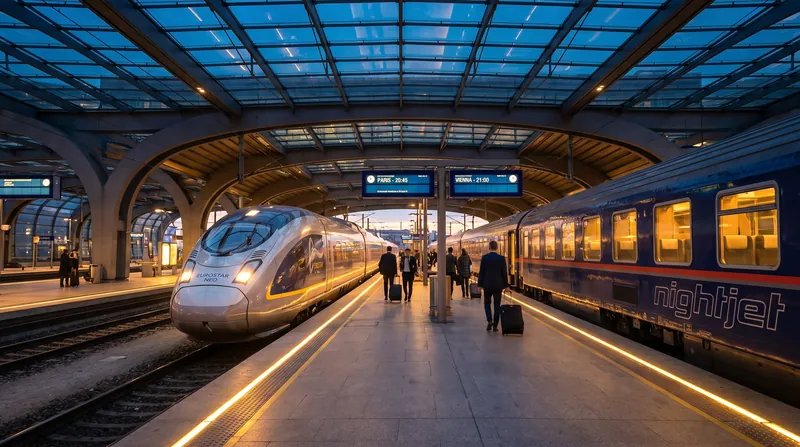
Leading this hardware revolution is ÖBB, which has invested heavily in a brand-new generation of Nightjet trains. Built by Siemens between 2023 and 2025, these cutting-edge trains are now rolling out across major routes connecting Amsterdam, Vienna, Hamburg, and Rome. They feature contemporary design, improved suspension for a smoother ride, radio-transparent windows for better mobile reception, and modern comforts specifically engineered to make overnight rail travel appealing to a 21st-century demographic.
The most celebrated and widely discussed innovation on these new Nightjet trains is the introduction of the 'Mini Cabin.' Designed specifically to cater to the growing demographic of solo travelers, these compact, lockable sleeping pods closely resemble Japanese capsule hotels. Each individual pod features a comfortable bed, a folding table, a reading light, a mirror, and dedicated power sockets. They offer a perfect middle ground, providing total privacy and security without the premium price tag associated with booking a full private cabin.
For those willing to spend more, the new Nightjets have completely revolutionized the premium sleeper class. The outdated, cramped shared corridor bathrooms of the past are being entirely replaced. Top-tier cabins now feature private, en-suite showers and toilets, effectively creating a rolling hotel room. Passengers booking these premium sleeper cabins also receive à la carte breakfast delivered directly to their door, elevating the journey from a mere transit option into a genuine luxury hospitality experience.
Meanwhile, the network continues to stretch into exciting new territories. In June 2026, European Sleeper will launch an unprecedented north-south route connecting Amsterdam and Brussels directly to Milan. The train will traverse the legendary Simplon Pass, offering passengers spectacular, panoramic Alpine views at dawn before rolling into northern Italy. This route is particularly significant as it provides the first scheduled overnight rail link connecting Eurostar terminus points directly to the Mediterranean.[2][3]
Eastern Europe is also seeing unprecedented leaps in rail connectivity. The highly anticipated Adriatic Express is slated to connect Warsaw to Rijeka, Croatia, passing through five different countries—Poland, the Czech Republic, Austria, Slovenia, and Croatia—in a single night. This monumental route transforms a journey that previously required three separate trains and an overnight hotel stay into a seamless, single-seat ride, opening up the Adriatic coast to a massive new demographic of northern travelers.[3]
The environmental stakes of this rapid expansion cannot be overstated. Night trains emit a tiny fraction of the carbon dioxide produced by equivalent short-haul flights. For eco-conscious travelers and policymakers aiming to meet strict European climate targets, shifting passengers from the sky to the rails is a cornerstone of the continent's push toward sustainable tourism. Choosing a 14-hour train ride over a 90-minute flight is increasingly viewed not as a sacrifice, but as a necessary and highly impactful climate action.
Yet, despite the overwhelming optimism, the night train revival remains a highly fragile ecosystem. Operating overnight rail is notoriously complex and financially punishing. Trains incur high track access charges in every single country they cross, and coordinating timetables across multiple national infrastructure managers is a logistical nightmare. Without standardized European regulations, operators are forced to navigate a patchwork of different technical standards, safety rules, and fee structures.[1][4]
These severe financial and logistical hurdles have already claimed some highly ambitious projects. Midnight Trains, a heavily publicized French startup that promised to launch a network of luxury 'hotels on rails,' was forced to completely abandon its plans in 2024 due to a lack of sustained funding. Their failure serves as a stark reminder that passenger enthusiasm alone is not enough to overcome the brutal economics of international rail operation.[2]
Despite these lingering challenges, 2026 marks a definitive and exciting turning point for European travel. With brand-new hardware finally hitting the tracks, agile citizen cooperatives proving their financial viability, and travelers increasingly prioritizing comfort, convenience, and climate over sheer speed, the momentum is undeniable. After years of decline, the golden age of the European sleeper train has officially returned, offering a slower, greener, and infinitely more romantic way to see the continent.[4]
Key terms
- Couchette
- A basic sleeping compartment on a European train, typically featuring four to six bunk beds and shared bathroom facilities.
- Mini Cabin
- A compact, lockable sleeping pod designed for solo travelers, featuring a bed, reading light, and charging ports.
- Rolling Stock
- The locomotives, carriages, and other vehicles used on a railway system.
- Track Access Charges
- Fees paid by train operators to national infrastructure managers for the right to run trains on their rail networks.
Frequently asked
Are night trains cheaper than flying?
Not always on paper, but they save the cost of a hotel night and expensive airport transfer fees, making them highly competitive overall.
Do I get my own bathroom?
Premium sleeper cabins on new trains feature en-suite showers and toilets, while budget couchettes and solo pods use shared facilities in the corridor.
How far in advance can I book tickets?
Tickets are typically released up to six months in advance on operator websites, and popular routes often sell out quickly.
What is a Mini Cabin?
A new solo sleeping pod introduced on ÖBB Nightjet trains, similar to a Japanese capsule hotel, offering privacy and charging ports for single travelers.
Viewpoints in depth
Citizen Cooperatives
Argue that night trains shouldn't rely solely on fickle state subsidies, favoring agile, community-funded models.
Organizations like European Sleeper argue that the traditional model of relying on national governments to subsidize cross-border rail is fundamentally broken. When political winds shift—as seen with the French government's withdrawal of funding for the Paris-Berlin route—vital infrastructure collapses overnight. By crowdsourcing funding directly from thousands of citizen investors, these cooperatives believe they can build a more resilient, demand-driven network that answers to passengers rather than politicians.
State Rail Operators
Emphasize that true modernization requires massive capital investment in custom rolling stock to lure travelers from airlines.
Legacy carriers like Austria's ÖBB maintain that while startups generate good publicity, only state-backed entities have the sheer capital required to modernize the industry. They point to their multi-million-euro investments in custom Siemens rolling stock as proof. In their view, the only way to permanently lure travelers away from cheap flights is to offer a genuinely premium experience—such as en-suite showers and high-tech solo pods—which requires a scale of investment that citizen cooperatives simply cannot match.
Eco-Conscious Travelers
View the night train renaissance as a practical necessity to drastically reduce the carbon footprint of European tourism.
For climate advocates and environmentally conscious travelers, the resurgence of sleeper trains is less about nostalgia and more about planetary survival. They point out that swapping a 90-minute flight for a 14-hour train ride is one of the most impactful individual choices a traveler can make to reduce their carbon footprint. This camp actively lobbies for higher taxes on aviation fuel and lower track access charges for trains, arguing that the true environmental cost of flying must be reflected in ticket prices.
- Citizen Cooperatives
- Argue that night trains shouldn't rely solely on fickle state subsidies, favoring agile, community-funded models.
- State Rail Operators
- Emphasize that true modernization requires massive capital investment in custom rolling stock to lure travelers from airlines.
- Eco-Conscious Travelers
- View the night train renaissance as a practical necessity to drastically reduce the carbon footprint of European tourism.
Perspectives this story doesn't cover
- Budget Airlines
- Aviation Industry Lobbyists
Sources
Source coverage
4 outlets
3 viewpoints surfaced




- [1]The GuardianState Rail Operators
Jürgen Klopp reaches agreement to take over as Germany head coach
Read on The Guardian → - [2]PixidiaCitizen Cooperatives
10 night trains you absolutely need to try in 2026
Read on Pixidia → - [3]Byway TravelEco-Conscious Travelers
New European train routes launching in 2026
Read on Byway Travel → - [4]Factlen Editorial Team
Synthesis by Factlen editorial team
Read on Factlen Editorial Team →
More in World
See all →European Integration
France Says EU 'Absolutely Ready' for UK Return as Post-Brexit Negotiations Begin
6 sources

Right to Repair
How the EU's New 'Right to Repair' Law Will Change the Way We Fix Our Devices
5 sources

Rail Infrastructure
Europe's Rail Renaissance: Inside the €345 Billion Masterplan to Replace Short-Haul Flights
3 sources
Snap Election
Spanish Prime Minister Pedro Sánchez Calls Snap General Election for November 29 Following Defeat on Housing Decrees
6 sources

Comments
Every angle. Every day.
Get World stories with full source coverage and perspective breakdowns, free every day.