
SpaceX's Historic $75 Billion IPO Rewrites Wall Street Rules as Retail Investors Flood In
SpaceX's record-breaking public debut allocated an unprecedented 20% of shares to everyday investors, pushing its valuation past $2 trillion and forcing a rethink of the 'Magnificent Seven'.
By Factlen Editorial Team
- Retail Investors & Brokerages
- Views the 20% allocation as a historic victory for everyday traders, democratizing access to mega-cap wealth generation.
- Market Strategists
- Focuses on the structural shift in market leadership, arguing the 'Magnificent Seven' must be replaced by AI and space-focused groupings like the 'FAB 10'.
- Fundamental Analysts
- Urges caution regarding the $2 trillion valuation, pointing to the company's 2025 financial losses and the capital drain from other tech sectors.
What's not represented
- · Institutional Hedge Funds
- · Semiconductor Industry Executives
Why this matters
Historically, the most lucrative tech IPOs have been gated behind Wall Street's institutional walls. SpaceX's decision to reserve a massive block of shares for everyday retail investors democratizes access to mega-cap growth, fundamentally shifting who gets to profit from the next decade of space and AI infrastructure.
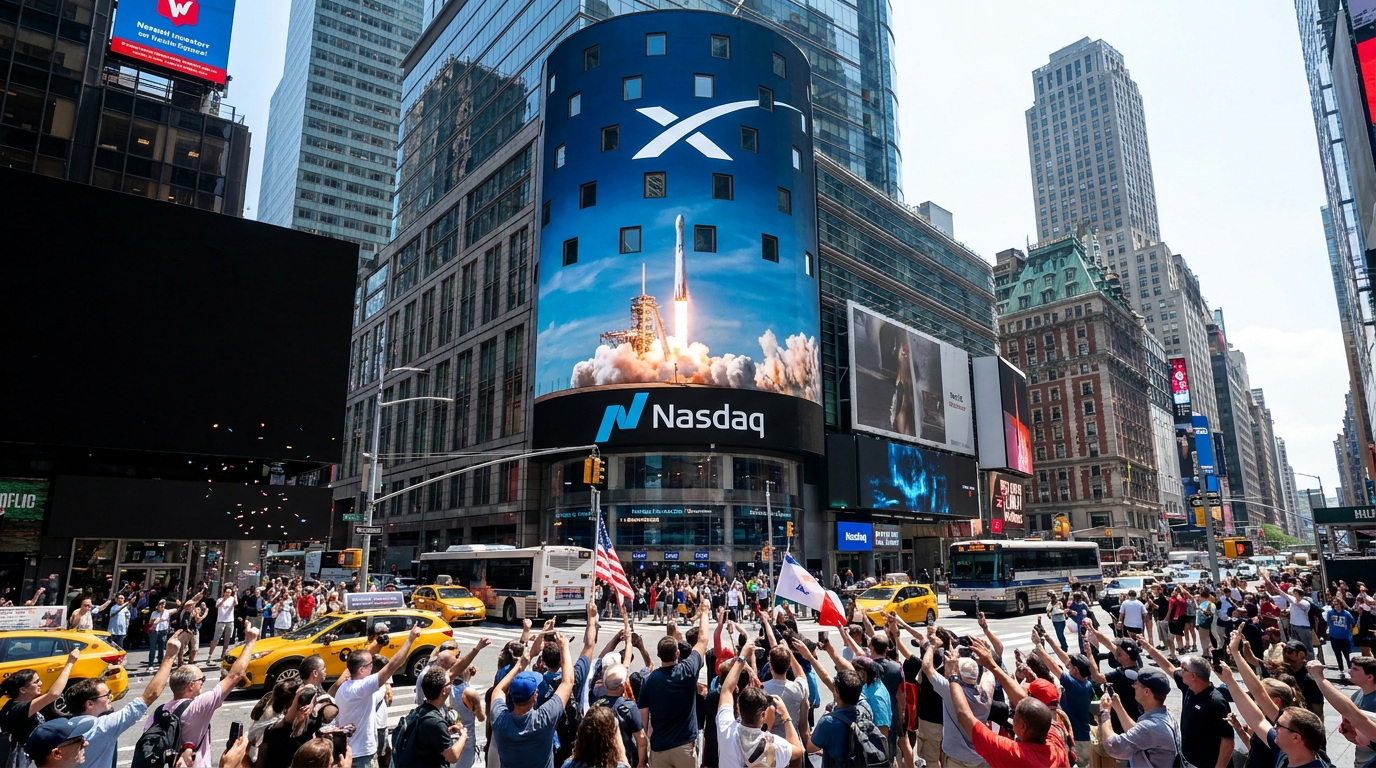
On June 12, 2026, the financial world witnessed the largest public market debut in history as Space Exploration Technologies Corp.—better known as SpaceX—listed its shares on the Nasdaq. Priced at $135 per share, the initial public offering raised a staggering $75 billion and instantly valued the aerospace giant at approximately $1.75 trillion. The sheer scale of the offering eclipsed all previous records, cementing the company's transition from a closely guarded private enterprise into a public market behemoth. For years, the commercial space economy and the Starlink satellite internet network were accessible only to venture capitalists and elite institutional funds. Now, the floodgates have opened to the public, and the market's reaction was nothing short of explosive.[2]
The appetite for SpaceX shares proved insatiable the moment the opening bell rang. By the end of its first trading session, the stock had surged nearly 19% to close at $160.95. That immediate pop propelled the company's market capitalization past the $2 trillion threshold, making it the seventh-largest stock in the Nasdaq index. The historic surge also triggered a massive wealth-creation event internally, turning thousands of current and former SpaceX employees into millionaires overnight. At the top of the cap table, the soaring valuation pushed founder Elon Musk's personal net worth into unprecedented territory, officially making him the world's first trillionaire.[2][4]
Yet, the most revolutionary aspect of the SpaceX IPO was not its size, but its distribution. Historically, the most lucrative tech listings have been heavily gated, with investment banks reserving 90% to 95% of the shares for their largest institutional clients, hedge funds, and private wealth accounts. Everyday retail investors are typically left to buy on the open market after the initial price spike. SpaceX explicitly flipped this script. The company mandated that a record 20% of the total offering be allocated directly to retail buyers and online brokerages, effectively democratizing access to one of the most anticipated wealth-generation vehicles of the decade.[3][4]

Major brokerages scrambled to accommodate the unprecedented retail mandate. Fidelity Investments, for instance, lowered its usual barriers to entry, allowing any customer with a retail brokerage account balance of just $2,000 to participate in the allocation process. This was a stark departure from standard industry practices, which often require hundreds of thousands of dollars in assets to even request IPO shares. The increased supply meant that a vast swath of everyday traders received their requested allocations, fundamentally altering the demographics of the company's initial shareholder base.[3]
When secondary market trading commenced, retail investors who missed the initial allocation rushed in with historic force. According to data from Vanda Research, SpaceX attracted $117 million in net retail buying on its very first day. To put that figure into perspective, it accounted for a staggering 56% of all retail stock purchases across the entire United States market that day. The concentration of capital was so intense that overall retail trading volume in other sectors hit its lowest level since March 2020, as everyday traders liquidated other positions to fund their entry into the space economy.[5]
The sheer volume of retail enthusiasm quickly outpaced the established titans of the tech sector. Market data revealed that in the first three days of trading, retail investors net bought more SpaceX shares than all of the "Magnificent Seven" stocks combined. This aggressive rotation signaled a clear preference among everyday traders for frontier technology and future infrastructure over the mature, cash-generating business models of established software and hardware giants. The retail bid effectively established a new floor for the stock, defying institutional skeptics who had warned of post-IPO volatility.[1]
The sheer volume of retail enthusiasm quickly outpaced the established titans of the tech sector.
The retail windfall was not confined to the United States. In the United Kingdom, brokerages like Interactive Investor reported massive participation, with roughly 100,000 UK-based retail investors securing shares. British investors poured a combined £271 million into the stock at the opening price. Because the allocation was so generous, those who applied for up to £2,013 received their full requested amount. By the time the closing bell rang in New York, those everyday international investors were sitting on immediate paper profits, further fueling the global narrative of retail empowerment.[4]
The sudden arrival of a $2 trillion aerospace giant has triggered an existential crisis for Wall Street's taxonomy. For years, the "Magnificent Seven"—Apple, Microsoft, Alphabet, Amazon, Nvidia, Meta, and Tesla—have served as the undisputed shorthand for market leadership, accounting for the lion's share of index weighting and overall market returns. But with SpaceX instantly leapfrogging both Tesla and Meta in market capitalization, strategists are realizing that the old moniker is mathematically and thematically obsolete. You cannot have a definitive list of market leaders that excludes one of the most valuable and heavily traded companies in the world.[6]

In response, research firms are rushing to coin the next defining acronym. Vanda Research has formally proposed the "FAB 10" (Frontier AI & Big Tech 10). This new framework suggests replacing the Magnificent Seven with a ten-company cohort that includes the original giants alongside SpaceX and the highly anticipated, yet-to-be-public AI firms OpenAI and Anthropic. The FAB 10 thesis argues that the next decade of equity market returns will be driven not just by consumer software and advertising, but by the physical infrastructure of the future: orbital logistics, satellite communications, and frontier artificial intelligence models.[5]
Other market strategists have floated alternative groupings, such as "MANGOS"—an acronym encompassing Meta, Anthropic, Nvidia, Google, OpenAI, and SpaceX. While the letters vary, the underlying consensus is identical: Wall Street is aggressively repricing the market to favor companies building the next generation of computing and physical infrastructure. This shift in narrative is forcing portfolio managers to rethink their long-term weightings, as the gravitational pull of these new mega-cap entrants demands inclusion in any serious growth-oriented fund.[6]
However, this massive capital migration is not occurring in a vacuum; it is actively draining liquidity from other previously hot sectors. Analysts note that semiconductor stocks, which enjoyed a historic run-up over the past two years, have become a primary funding source for the SpaceX rotation. Retail and institutional investors alike are trimming their positions in chipmakers to free up cash for the aerospace giant. This dynamic has sparked concerns that the broader tech sector could face a significant re-rating if the capital drain continues, leaving older tech darlings vulnerable to multiple compression.[7]

Amid the euphoria, fundamental analysts are urging caution, pointing to the stark disconnect between SpaceX's astronomical valuation and its current financial realities. At a $2.1 trillion market capitalization, the company is being priced for flawless execution over the next several decades. Yet, recent disclosures reveal that SpaceX lost $4.9 billion in 2025 on revenues of $18.7 billion. While its top-line growth is undeniable, the valuation implies a multiple that dwarfs even the most optimistic software companies, requiring the Starlink and Starship programs to achieve near-monopoly status in their respective domains to justify the price tag.[4][7]
Furthermore, brokerages are actively working to prevent the IPO from turning into a short-term casino. Firms like Fidelity have instituted strict rules regarding "flipping"—the practice of selling IPO shares within 15 days of the debut. Retail investors who cash out their SpaceX allocations too quickly face penalties, including being barred from participating in future high-profile offerings. These restrictions are designed to foster a stable, long-term shareholder base, but they also mean that retail investors are now locked into the stock's inevitable early-stage volatility.[3]
Ultimately, the SpaceX IPO will be remembered as a watershed moment in financial history. It shattered capital-raising records, minted a trillionaire, and forced the retirement of the stock market's most famous acronym. But more importantly, it proved that when the gates are opened, everyday investors have the capital and the conviction to stand shoulder-to-shoulder with Wall Street's largest institutions. As the market digests this new $2 trillion reality, the era of the Magnificent Seven has officially ended, making way for a new frontier of space and artificial intelligence.[1][2][6]
How we got here
2002
Elon Musk founds Space Exploration Technologies Corp. with the goal of reducing space transportation costs.
Dec 2025
Secondary market transactions value the private aerospace company at roughly $150 billion.
June 4, 2026
Major brokerages open applications for the highly anticipated IPO, lowering minimum account requirements to accommodate retail demand.
June 11, 2026
SpaceX prices its IPO at $135 per share, successfully raising a record-breaking $75 billion.
June 12, 2026
Shares begin trading on the Nasdaq, surging 19% on the first day and pushing the company's valuation past $2 trillion.
Viewpoints in depth
Retail Empowerment Advocates
Views the IPO structure as a necessary democratization of wealth generation.
For decades, retail investors have complained that the most explosive growth in the tech sector happens while companies are still private, leaving everyday traders to buy in only after institutional investors have already multiplied their capital. Advocates argue that SpaceX's mandate to allocate 20% of its offering to retail brokerages shatters this exclusionary wall. By lowering the barrier to entry to just $2,000, brokerages like Fidelity allowed a new generation of investors to participate in the ground floor of the commercial space economy, fundamentally shifting the balance of power on Wall Street.
Index & Taxonomy Strategists
Focuses on the obsolescence of the 'Magnificent Seven' and the rotation into frontier tech.
Market strategists are less focused on the retail frenzy and more concerned with the structural mechanics of index weighting. With SpaceX instantly becoming one of the most valuable companies on Earth, the old shorthand of the 'Magnificent Seven' no longer accurately describes market leadership. Strategists proposing the 'FAB 10' or 'MANGOS' argue that capital is permanently rotating away from mature consumer software and advertising models toward the physical infrastructure of the future—specifically space logistics and artificial intelligence compute. This requires a total recalibration of growth-oriented portfolios.
Valuation Skeptics
Warns that the $2 trillion price tag ignores current financial realities and relies on flawless future execution.
Fundamental analysts are sounding the alarm over the sheer scale of the IPO's pricing. While acknowledging SpaceX's engineering triumphs and top-line revenue growth, skeptics point out that the company posted a $4.9 billion loss in 2025. A $2.1 trillion market capitalization implies a valuation multiple that dwarfs even the most profitable software monopolies. These analysts warn that the retail-driven euphoria is pulling vital liquidity out of fundamentally sound sectors like semiconductors, creating a fragile market dynamic where any operational misstep by SpaceX could trigger a massive correction.
What we don't know
- Whether the massive retail shareholder base will hold through early volatility or trigger a sell-off once the 15-day flipping penalty period expires.
- How quickly SpaceX can transition its $18.7 billion revenue base into consistent profitability to justify its $2 trillion valuation.
- Which semiconductor or legacy tech stocks will suffer the most permanent capital drain as institutional funds rebalance to include SpaceX.
Key terms
- Initial Public Offering (IPO)
- The process by which a private company offers shares to the public for the first time, transitioning to a publicly traded entity.
- Magnificent Seven
- A group of mega-cap tech stocks (Apple, Microsoft, Alphabet, Amazon, Nvidia, Meta, Tesla) that dominated market returns in the early 2020s.
- Flipping
- The practice of buying IPO shares and selling them immediately (usually within 15 days) for a quick profit, which brokerages often penalize to encourage long-term holding.
- Market Capitalization
- The total dollar market value of a company's outstanding shares of stock, calculated by multiplying the share price by the total number of shares.
Frequently asked
Can I still buy SpaceX shares at the IPO price?
No, the initial allocation phase has closed. Shares are now trading on the open market under the ticker SPCX at current market prices.
Why is the 20% retail allocation significant?
Most high-profile IPOs reserve only 5% to 10% of shares for everyday investors, keeping the bulk for institutional clients. SpaceX doubled that standard, allowing unprecedented public access.
What is the 'FAB 10'?
A proposed new grouping of market-leading tech stocks that includes the original Magnificent Seven plus SpaceX, OpenAI, and Anthropic, reflecting a shift toward frontier technology.
Sources
Source coverage
7 outlets
3 viewpoints surfaced







[1]MarketWatchFundamental Analysts
Retail investors have been buying more SpaceX shares than all of the ‘Magnificent Seven’ combined
Read on MarketWatch →[2]Zacks Investment ResearchFundamental Analysts
SpaceX IPO Breaks Records, Creating World's First Trillionaire
Read on Zacks Investment Research →[3]Fidelity InvestmentsRetail Investors & Brokerages
Who is eligible to participate in the SpaceX initial public offering (IPO)?
Read on Fidelity Investments →[4]Interactive InvestorRetail Investors & Brokerages
SpaceX IPO: how records fell on market debut
Read on Interactive Investor →[5]Vanda ResearchMarket Strategists
SpaceX's Debut and the Rise of the FAB 10
Read on Vanda Research →[6]BNN BloombergMarket Strategists
MANGOS? SpaceX forces name rethink on Wall Street's tech-stock moniker
Read on BNN Bloomberg →[7]TechFlowFundamental Analysts
SpaceX IPO Sparks Massive Capital Migration; Wall Street Bids Farewell to 'Magnificent Seven'
Read on TechFlow →
Every angle. Every day.
Get finance stories with full source coverage and perspective breakdowns delivered to your inbox.