
How AI Tutors Are Finally Solving Education's 'Two Sigma' Problem
Four decades after researchers proved that one-on-one tutoring dramatically improves student performance, guardrailed AI platforms are finally delivering personalized mastery learning at a global scale.
By Factlen Editorial Team
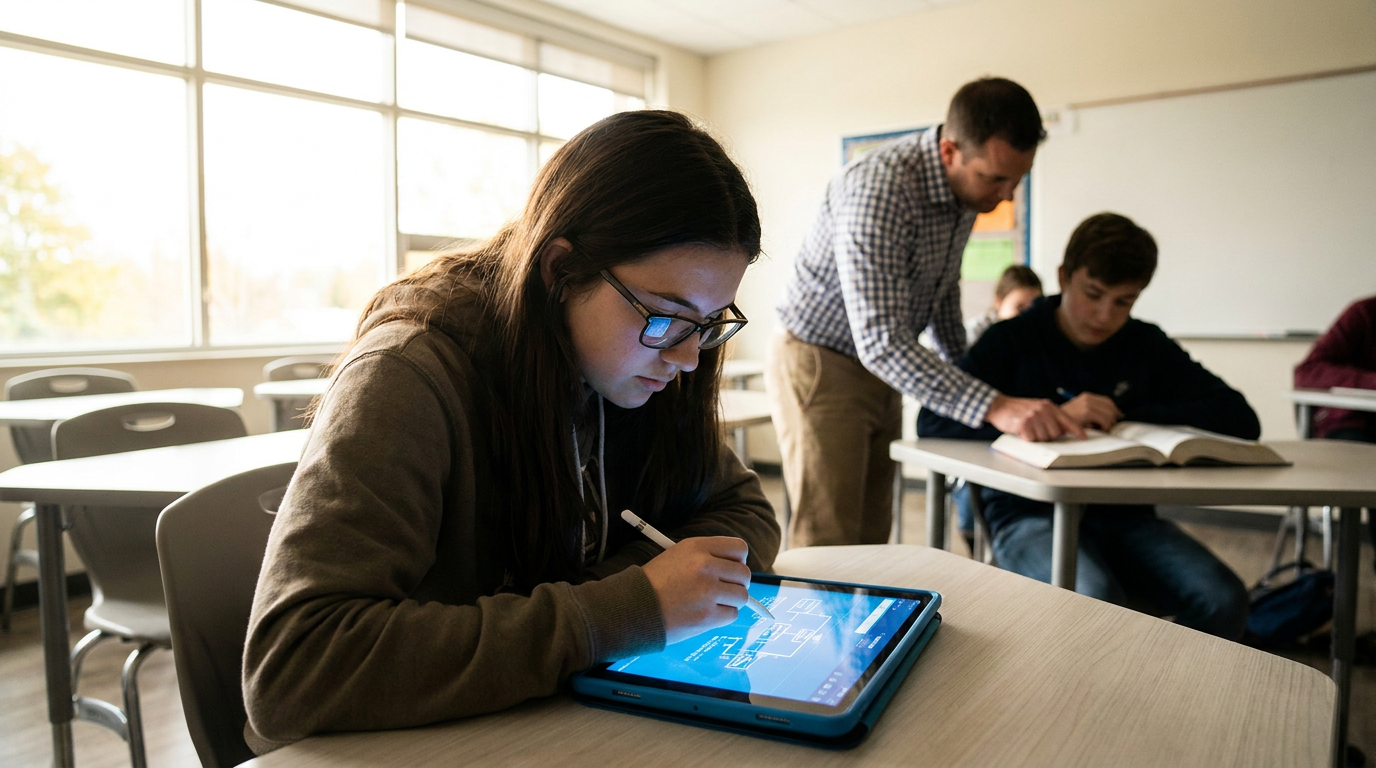
- Pedagogical Optimists
- Argue that guardrailed AI tutors finally solve the Two Sigma problem, democratizing elite education at scale.
- Cognitive Realists
- Emphasize that raw AI harms learning via cognitive offloading, requiring strict pedagogical guardrails to be effective.
- Human-Centric Educators
- Believe AI is merely scaffolding and that human relational touch, mentorship, and collaborative problem-solving remain irreplaceable.
What's not represented
- · Student privacy advocates
- · Low-income district administrators
Why this matters
By democratizing access to elite-level, personalized tutoring, guardrailed AI systems have the potential to permanently close global learning gaps and elevate baseline human capability.
Key points
- Benjamin Bloom's 1984 research showed 1:1 tutoring improves performance by two standard deviations, but it was historically too expensive to scale.
- Raw, unguarded AI harms learning by encouraging 'cognitive offloading,' leading to a 17% drop in test scores.
- Guardrailed AI tutors that use Socratic methods to encourage 'productive struggle' have been shown to double learning gains.
- The collapse in AI computing costs allows this elite-level tutoring to be deployed globally for pennies per query.
In 1984, educational psychologist Benjamin Bloom published a paper that would haunt educators for four decades. He discovered that students who received one-on-one tutoring using mastery learning techniques performed two standard deviations better than those in a traditional classroom.[2]
The "Two Sigma" problem, as it became known, meant that an average tutored student could outperform 98 percent of their conventionally taught peers. The tragedy was purely economic: society simply could not afford to provide a dedicated human tutor for every single child.[2]
For years, digital learning platforms chased this holy grail with video playlists and multiple-choice quizzes, but the outcomes barely moved the needle. Now, in 2026, the convergence of collapsing computing costs and specialized artificial intelligence has finally unlocked the missing ingredient.[1][7]
We are witnessing the birth of the "Two-Sigma Machine." AI-powered adaptive learning platforms are deploying tireless, personalized tutors that listen, probe misconceptions, and guide students in plain language—delivering elite-level educational scaffolding at the cost of a few cents per query.[4]

The shift is being driven by a transition from general-purpose chatbots to Specialized Educational Intelligence (SEI). Early in the generative AI boom, educators rightly feared that tools like ChatGPT would simply do the work for students, leading to a crisis of academic integrity.[6]
Those fears were validated by early data. A landmark 2025 study published in the Proceedings of the National Academy of Sciences (PNAS) by researchers at the University of Pennsylvania tested high school students using raw, unguarded AI. The results were alarming.[3]
Students using raw ChatGPT solved 48 percent more practice problems, but when tested without the AI, they scored 17 percent lower than students who used no AI at all. The mechanism at play was "cognitive offloading"—when the machine carries the cognitive burden, the human brain fails to encode the information.[3][8]
However, the same study revealed the breakthrough. When students were given a "guardrailed" AI tutor—one strictly programmed to act as a Socratic coach that only provides hints and refuses to give direct answers—learning gains doubled compared to traditional active-learning classrooms.[3][8]

This distinction is the foundation of 2026's educational technology landscape. The machine must be harnessed correctly. Effective AI tutors do not optimize for engagement or speed; they optimize for "productive struggle," managing a student's cognitive load to prevent burnout while ensuring the brain does the actual heavy lifting.[8]
This distinction is the foundation of 2026's educational technology landscape.
The economic implications of this technological leap are staggering, particularly in developing nations. In India, where the student-to-teacher ratio is often double that of Western countries, the billion-dollar offline tuition market is facing massive disruption.[4]
Venture capital analysts note that the cost of running large language models has collapsed by a factor of twenty since 2023. This allows platforms to deliver personalized, vernacular-language tutoring to millions of students who previously had no access to individualized academic support.[4]
At the university level, elite institutions are already proving the model. Stanford University's "AI in Coursework" initiative, which moved past its experimental phase this year, utilizes AI to generate unique, project-based assessments tailored to individual student interests.[6]
By ensuring every student receives a distinct, personalized problem set, Stanford virtually eliminated plagiarism. More importantly, the university reported a 40 percent increase in student engagement, as learners tackled challenges that felt personally relevant rather than standardized.[6]
But the rise of the AI tutor does not render the human teacher obsolete. Instead, it fundamentally redefines the educator's role. If the machine handles the rote mechanics of individualized mastery learning, the human is freed to focus on higher-order development.[2][9]

Educational theorists refer to this as the "co-pilot" model. Teachers are shifting their focus toward mentoring, fostering collaborative problem-solving, guiding ethical reasoning, and managing the complex social dynamics of a classroom—elements that technology cannot replicate.[9]
The International Journal of Applied Resilience and Sustainability recently highlighted that while AI excels at cognitive scaffolding, it lacks the relational touch and contextual judgment required to help a child develop a personal vision for the world.[5]
A machine can teach a student the mechanics of calculus or the grammar of a foreign language with infinite patience. But it takes a human mentor to inspire that student to apply those skills toward solving climate change, engineering a new medical device, or writing a compelling novel.[1][5]
As we move deeper into 2026, the challenge for school districts and policymakers is no longer whether to adopt AI, but how to implement it equitably. The focus is shifting toward ensuring that all students, regardless of socioeconomic status, have access to these guardrailed, high-quality adaptive systems.[1]
How we got here
1984
Benjamin Bloom publishes his findings on the Two Sigma problem, establishing the benchmark for educational outcomes.
2023
The release of advanced LLMs triggers an initial wave of students using general AI to bypass homework, raising integrity concerns.
2025
Landmark studies reveal that raw AI harms learning, while guardrailed AI acting as a Socratic coach doubles learning gains.
2026
Specialized Educational Intelligence (SEI) platforms achieve widespread adoption, fundamentally shifting the role of the classroom teacher.
Viewpoints in depth
The Pedagogical Optimists' View
Advocates who believe AI is the definitive solution to scaling elite education.
This camp, which includes economists and EdTech developers, views the collapse in LLM computing costs as a historic inflection point. They argue that for the first time in human history, the economic barrier to Bloom's Two Sigma problem has been shattered. By delivering personalized, vernacular-language tutoring for pennies per query, they believe AI will permanently close the learning gap between wealthy and underfunded school districts, ultimately driving massive gains in global economic productivity.
The Cognitive Realists' View
Researchers focused on the mechanics of how the human brain actually encodes information.
Cognitive scientists and academic researchers warn that the technology is a double-edged sword. Citing studies from institutions like the University of Pennsylvania, they point out that raw AI acts as a cognitive crutch, actively harming a student's ability to retain information. This camp insists that AI in education is only effective if it is strictly guardrailed to force 'productive struggle'—acting as a Socratic coach that refuses to give direct answers.
The Human-Centric Educators' View
Teachers and administrators who emphasize the irreplaceable nature of human mentorship.
While acknowledging the power of AI to handle the rote mechanics of personalized pacing, this camp argues that education is fundamentally a social and emotional endeavor. They view the AI tutor as a 'co-pilot' that frees human teachers to focus on what machines cannot do: fostering collaborative problem-solving, guiding ethical reasoning, and inspiring students to apply their knowledge to real-world challenges. To them, the relational touch remains the core of true education.
What we don't know
- Whether the long-term retention rates of AI-tutored students match those of students tutored by human experts over a multi-year period.
- How the widespread adoption of individualized AI learning paths will impact the social and collaborative skills traditionally developed in group classroom settings.
- Whether the cost of premium, highly specialized AI models will create a new digital divide between wealthy and underfunded districts.
Key terms
- Bloom's Two Sigma Problem
- The educational phenomenon where students receiving one-on-one mastery tutoring perform two standard deviations better than students in a traditional classroom.
- Cognitive Offloading
- The reliance on external tools (like raw AI) to solve problems, which prevents the brain from doing the heavy lifting required to actually learn and retain information.
- Specialized Educational Intelligence (SEI)
- AI models built and guardrailed specifically for learning, designed to guide students through a pedagogical process rather than simply generating text or answers.
- Mastery Learning
- An instructional strategy where students must achieve a high level of understanding in a prerequisite topic before moving on to learn subsequent information.
Frequently asked
Will AI tutors replace human teachers?
No. Educators and researchers agree that AI acts as a 'co-pilot,' handling rote mechanics and personalized pacing so teachers can focus on mentorship, collaborative problem-solving, and emotional support.
Why does raw ChatGPT lower test scores?
Using unguarded AI leads to 'cognitive offloading.' Because the machine does the thinking and provides direct answers, the student's brain fails to encode the information, resulting in poorer performance on independent tests.
What is a guardrailed AI tutor?
It is an AI system strictly programmed to act as a Socratic coach. Instead of giving answers, it provides hints, probes misconceptions, and forces the student to engage in 'productive struggle.'
How does this affect educational inequality?
Because the cost of running large language models has plummeted, high-quality, personalized tutoring can now be delivered globally for pennies per query, potentially closing the gap between underfunded schools and elite institutions.
Sources
Source coverage
9 outlets
3 viewpoints surfaced









[1]Factlen Editorial TeamHuman-Centric Educators
Synthesis by Factlen editorial team
Read on Factlen Editorial Team →[2]Adept EconomicsPedagogical Optimists
Could AI Solve Education's “Two-Sigma Problem”?
Read on Adept Economics →[3]Proceedings of the National Academy of SciencesCognitive Realists
Generative AI Without Guardrails Can Harm Learning
Read on Proceedings of the National Academy of Sciences →[4]Elevation CapitalPedagogical Optimists
AI in the Classroom: Turning Two Sigma Gains into India-Scale Impact
Read on Elevation Capital →[5]International Journal of Applied Resilience and SustainabilityCognitive Realists
Generative AI Adoption in Adaptive Learning Systems
Read on International Journal of Applied Resilience and Sustainability →[6]TutorFlowHuman-Centric Educators
The Shift from General AI to Specialized Educational Intelligence
Read on TutorFlow →[7]eLearning CollegePedagogical Optimists
Why 2026 is a pivotal year for elearning tools
Read on eLearning College →[8]Yiuno InstituteCognitive Realists
The Two-Sigma Machine: How to Build AI Systems That Actually Teach
Read on Yiuno Institute →[9]Beyond the AI Inflection PointHuman-Centric Educators
School Year 2025–2026: A Breakthrough Idea
Read on Beyond the AI Inflection Point →
Every angle. Every day.
Get education stories with full source coverage and perspective breakdowns delivered to your inbox.