
The Evidence Pack: Do Crowdsourced Fact-Checks Actually Stop Political Misinformation?
Academic research reveals that decentralized fact-checking tools match expert accuracy and cut engagement with false claims by nearly half, though algorithmic delays remain a critical vulnerability.
By Factlen Editorial Team
- Decentralization Advocates
- Supporters who emphasize the scalability and bias-neutralizing power of the crowd.
- Professional Fact-Checkers
- Experts who maintain that trained analysts are necessary for complex claims.
- Algorithmic Skeptics
- Critics who focus on the fatal delays caused by the consensus requirement.
What's not represented
- · Social media platform executives
- · Authors of flagged political content
Why this matters
As synthetic media and hyper-partisan claims flood the 2026 election cycle, understanding which fact-checking tools actually work is crucial. This research proves that community-driven corrections not only match expert accuracy but actively degrade the reach of viral lies, offering a scalable blueprint for protecting the global information ecosystem.
Key points
- Academic studies reveal that crowdsourced fact-checking matches the accuracy of professional analysts.
- The public display of a community note reduces a post's reposts by 46% and likes by 44%.
- Authors are 80% more likely to voluntarily delete their misleading posts when corrected by their peers.
- The system relies on a 'bridging algorithm' that requires cross-partisan consensus to publish a note.
- Despite high accuracy, the consensus requirement causes significant delays, allowing some misinformation to go viral before intervention.
The 2026 political landscape is saturated with synthetic media, hyper-partisan framing, and algorithmic amplification. For years, the primary defense against this deluge has been professional fact-checking—a centralized, labor-intensive process that struggles to scale against the sheer volume of daily uploads.[6]
In response, platforms have increasingly turned to decentralized, crowdsourced models, most notably X's Community Notes and Meta's recent pilot programs. These systems rely on the "wisdom of the crowd," allowing everyday users to append context or corrections to misleading posts.[6]
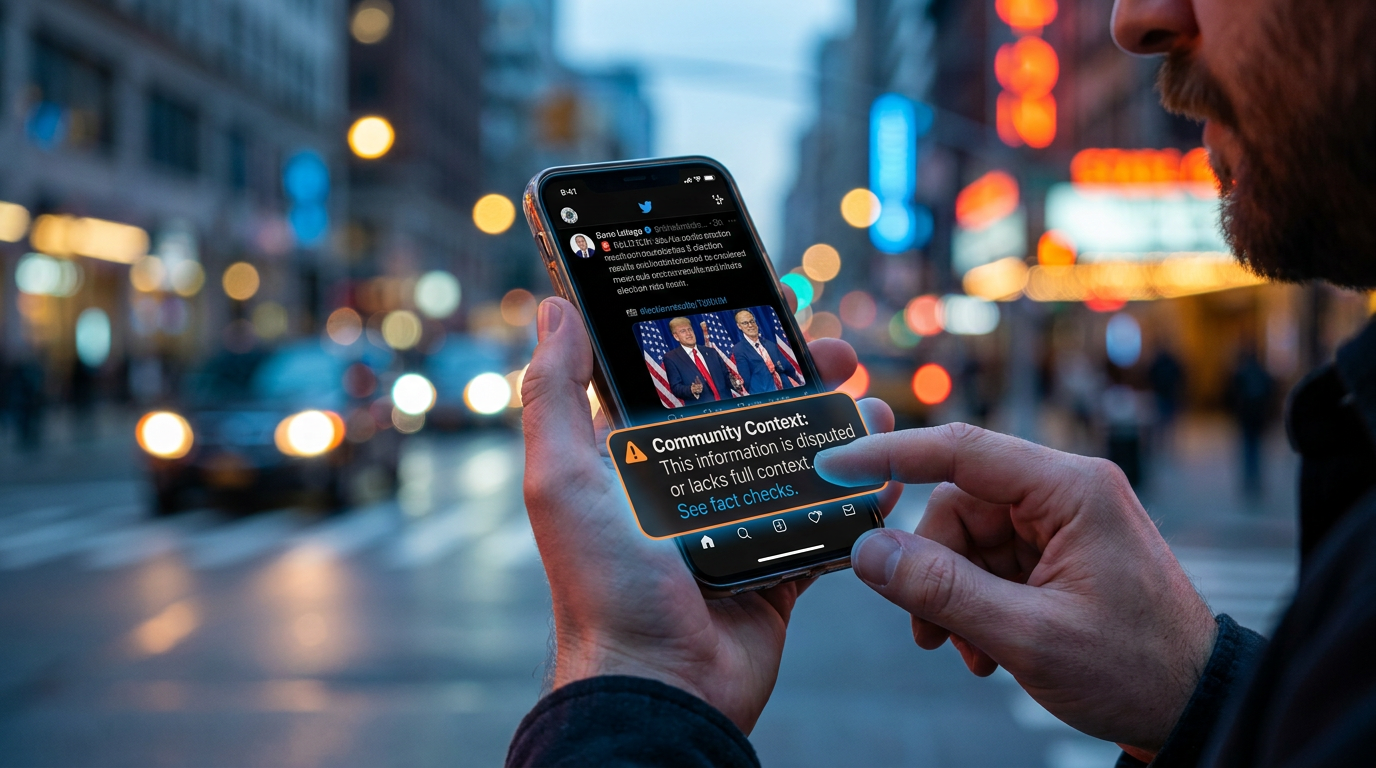
But as these tools become the frontline defense for global elections, a critical question emerges: Does crowdsourced fact-checking actually stop the spread of political misinformation, or is it merely a cosmetic feature?[6]
A robust body of academic research published between 2021 and 2026 provides a clear, evidence-backed answer: crowdsourced fact-checking is remarkably effective at changing user behavior, though it suffers from critical vulnerabilities in speed.[6]
The most surprising finding across multiple studies is the sheer accuracy of laypeople. A landmark study from the MIT Sloan School of Management demonstrated that a crowd of just 10 to 15 regular readers, evaluating only headlines and lead sentences, could match the accuracy of professional fact-checkers.[2]

This phenomenon relies on collective intelligence. While individual users may possess strong partisan biases, aggregating their judgments neutralizes those extremes, producing a highly reliable consensus.[2]
A 2026 peer-reviewed study published in PLOS ONE reinforced this, finding that crowdsourced fact-checks are just as effective as expert interventions at reducing a reader's confidence in false claims and lowering their willingness to share them.[5]
The mechanism powering the most prominent of these systems is the "bridging algorithm." Rather than relying on a simple majority vote—which could easily be hijacked by partisan mobs—the algorithm requires consensus among users who historically disagree on the platform.[1]
If a proposed correction receives "helpful" ratings from users across the political spectrum, it is appended to the post. This cross-partisan agreement is what gives the note its credibility and triggers its algorithmic impact.[1]
If a proposed correction receives "helpful" ratings from users across the political spectrum, it is appended to the post.
When a note successfully clears this hurdle, the effect on virality is immediate and severe. A 2025 study led by the University of Washington and published in the Proceedings of the National Academy of Sciences analyzed over 40,000 posts to measure this exact impact.[1]
The researchers found that in the 48 hours after a community note was attached, engagement plummeted. Reposts dropped by 46%, likes fell by 44%, and overall views decreased by 14% compared to similar posts without visible notes.[1]

Crucially, the study revealed that the notes alter the actual diffusion network of the misinformation. While a poster's immediate followers might still engage, users who are more distant in the social graph become significantly less likely to interact with the debunked content.[1]
Beyond suppressing algorithmic reach, crowdsourced fact-checks exert intense social pressure on the original authors. A 2025 study published in Information Systems Research utilized a regression discontinuity design to track how authors responded to being publicly corrected by their peers.[3]
The data showed that the public display of a community note increased the probability of the author voluntarily deleting or retracting the misleading post by 80%. The researchers attributed this massive spike to reputational concern and perceived social pressure.[3]
Despite these overwhelming successes, the system has a glaring vulnerability: the very consensus algorithm that ensures accuracy also guarantees delay.[4]
A 2026 study from the Universidad Internacional de La Rioja analyzed the temporal evolution of these notes, finding that the requirement for cross-cutting consensus severely limits early intervention.[4]

Because misinformation typically achieves its maximum virality in the first few hours after publication, a note that takes 12 to 24 hours to reach consensus often arrives after the damage is done.[4]
Furthermore, only a small fraction of proposed notes ever see the light of day. Data indicates that only around 6% to 7% of submitted notes achieve the required consensus to become visible to the public, leaving a vast amount of misleading content unchecked.[4]
Professional fact-checkers argue that this is where expert intervention remains vital. While the crowd excels at debunking obvious falsehoods, highly ambiguous political language or complex policy claims often fail to reach a consensus among laypeople.[6]
Ultimately, the evidence suggests that crowdsourced fact-checking is not a standalone cure for political misinformation. However, as a scalable, decentralized layer of defense, it has proven to be an empirically successful tool that empowers citizens to actively degrade the reach of synthetic media and partisan lies.[6]
How we got here
2021
Twitter launches 'Birdwatch' as a pilot program for crowdsourced moderation.
Late 2022
Following an ownership change, Twitter scales back professional moderation and rebrands the system as Community Notes.
2023 - 2024
Academic researchers begin publishing large-scale data confirming the crowd's ability to match expert accuracy.
March 2025
Meta begins testing its own Community Notes feature across Facebook, Instagram, and Threads.
June 2026
New studies highlight the 'consensus bottleneck,' revealing that while accurate, the system is often too slow to catch viral misinformation.
Viewpoints in depth
Decentralization Advocates
Supporters of crowdsourced models who emphasize scalability and the neutralization of bias.
This camp argues that traditional fact-checking is fundamentally unscalable in the era of generative AI and synthetic media. By decentralizing the process, platforms can evaluate exponentially more claims. Furthermore, they point to the bridging algorithm as a triumph of collective intelligence, arguing that requiring cross-partisan consensus produces corrections that are inherently more trusted by the general public than decrees from centralized authorities.
Professional Fact-Checkers
Experts who maintain that trained analysts are necessary for complex or ambiguous claims.
While acknowledging the utility of the crowd for obvious falsehoods, professional fact-checkers warn that laypeople struggle with nuance. They argue that political figures frequently use ambiguous language or cherry-picked statistics that require deep investigative journalism to unpack. In these cases, the crowd often fails to reach a consensus, leaving dangerous but subtle misinformation unchecked on the platform.
Algorithmic Skeptics
Critics who focus on the fatal delays caused by the consensus requirement.
This perspective highlights the temporal vulnerability of crowdsourced systems. Because misinformation achieves its maximum virality within the first few hours of publication, a system that takes 12 to 24 hours to generate a visible warning is fundamentally flawed. Skeptics argue that platforms use these systems as a cost-saving smokescreen, outsourcing their moderation responsibilities while allowing viral lies to inflict their damage before the crowd can effectively respond.
What we don't know
- How effectively crowdsourced systems can adapt to highly coordinated, AI-driven bot swarms designed to manipulate the consensus algorithm.
- Whether the behavioral changes observed on X (formerly Twitter) will replicate identically on platforms like Meta and TikTok as they roll out similar features.
- How to accelerate the consensus process without sacrificing the cross-partisan agreement that gives the notes their credibility.
Key terms
- Crowdsourced Fact-Checking
- A moderation system where everyday users, rather than professional staff, propose and vote on corrections to misleading posts.
- Bridging Algorithm
- A system that requires users who typically disagree politically to reach a consensus before a fact-check is published.
- Regression Discontinuity Design
- A statistical method used by researchers to measure the exact impact of an intervention—in this case, the moment a warning label appears.
- Diffusion Network
- The pathway and speed at which a piece of information spreads from the original poster to distant users across a social platform.
Frequently asked
Does crowdsourced fact-checking actually change minds?
Yes. Studies show that community-driven corrections are just as effective as expert fact-checks at reducing a reader's confidence in false claims.
Can partisan groups hijack the voting system?
It is highly difficult. The bridging algorithm requires consensus from users with diverse viewpoints, preventing a single ideological group from forcing a note through.
Why do some false posts never get a warning note?
Because the consensus threshold is so high, only about 7% of proposed notes receive enough cross-partisan agreement to become visible to the public.
Does this replace professional fact-checkers?
No. Experts are still necessary for highly complex or ambiguous policy claims where laypeople struggle to reach a definitive consensus.
Sources
Source coverage
6 outlets
3 viewpoints surfaced






[1]Proceedings of the National Academy of SciencesDecentralization Advocates
Community Notes reduce engagement and alter diffusion of misinformation
Read on Proceedings of the National Academy of Sciences →[2]MIT SloanDecentralization Advocates
Crowdsourcing fact-checking of news stories can work about as effectively as using professional fact-checkers
Read on MIT Sloan →[3]Information Systems ResearchDecentralization Advocates
The Efficacy of Crowdsourced Fact-Checking: Evidence from Community Notes
Read on Information Systems Research →[4]Universidad Internacional de La RiojaAlgorithmic Skeptics
From Fact-Checking to Community Notes: Structural Shifts in the Fight Against Disinformation
Read on Universidad Internacional de La Rioja →[5]PLOS ONEDecentralization Advocates
Trust the crowd: Crowdsourced fact-checking is as effective at reducing confidence in misinformation as expert fact-checking
Read on PLOS ONE →[6]Factlen Editorial TeamProfessional Fact-Checkers
Synthesis by Factlen editorial team
Read on Factlen Editorial Team →

More in news politics
See all 11 stories →U.S.-Iran MOU
U.S. and Iran Agree to 60-Day Ceasefire MOU Featuring Immediate Oil Waivers and $300 Billion Investment Framework
8 sources

Cognitive Science
The Science of 'Pre-Bunking': How Psychologists Are Vaccinating the Mind Against Misinformation
6 sources

U.S.-Iran Relations
U.S. and Iran Unveil Sweeping Memorandum of Understanding on Nuclear and Economic Framework
8 sources

US-Iran Deal
US and Iran Unveil 14-Point Memorandum of Understanding to Halt Hostilities and Reopen Strait of Hormuz
8 sources
Every angle. Every day.
Get news politics stories with full source coverage and perspective breakdowns delivered to your inbox.