
Beyond Chatbots: How Agentic AI Workflows Are Automating Complex Tasks
Artificial intelligence is shifting from passive assistants to autonomous agents capable of planning, executing, and self-correcting multi-step workflows.
By Factlen Editorial Team
- Enterprise Integrators
- Focus on deploying agents to replace rigid RPA and drive operational efficiency.
- AI Security Practitioners
- Emphasize zero-trust governance, role-based access, and human-in-the-loop safeguards.
- Agent-Native Developers
- Prioritize multi-agent orchestration, open protocols, and cost-performance optimization.
What's not represented
- · Frontline workers whose daily tasks are being automated
- · Regulatory bodies drafting AI compliance frameworks
Why this matters
As AI agents gain the ability to autonomously operate software and make decisions, businesses are unlocking new levels of productivity. Understanding this shift is crucial for professionals adapting to a workplace where AI acts as an independent collaborator rather than just a tool.
Key points
- Agentic workflows enable AI to autonomously plan, execute, and self-correct multi-step tasks without continuous human oversight.
- The technology is replacing rigid Robotic Process Automation (RPA) by successfully navigating unstructured data and ambiguous situations.
- Modern architectures rely on Multi-Agent Systems (MAS), where specialized AI models collaborate to complete complex objectives efficiently.
- Enterprise adoption requires strict zero-trust security frameworks, including Role-Based Access Control (RBAC) for machine identities.
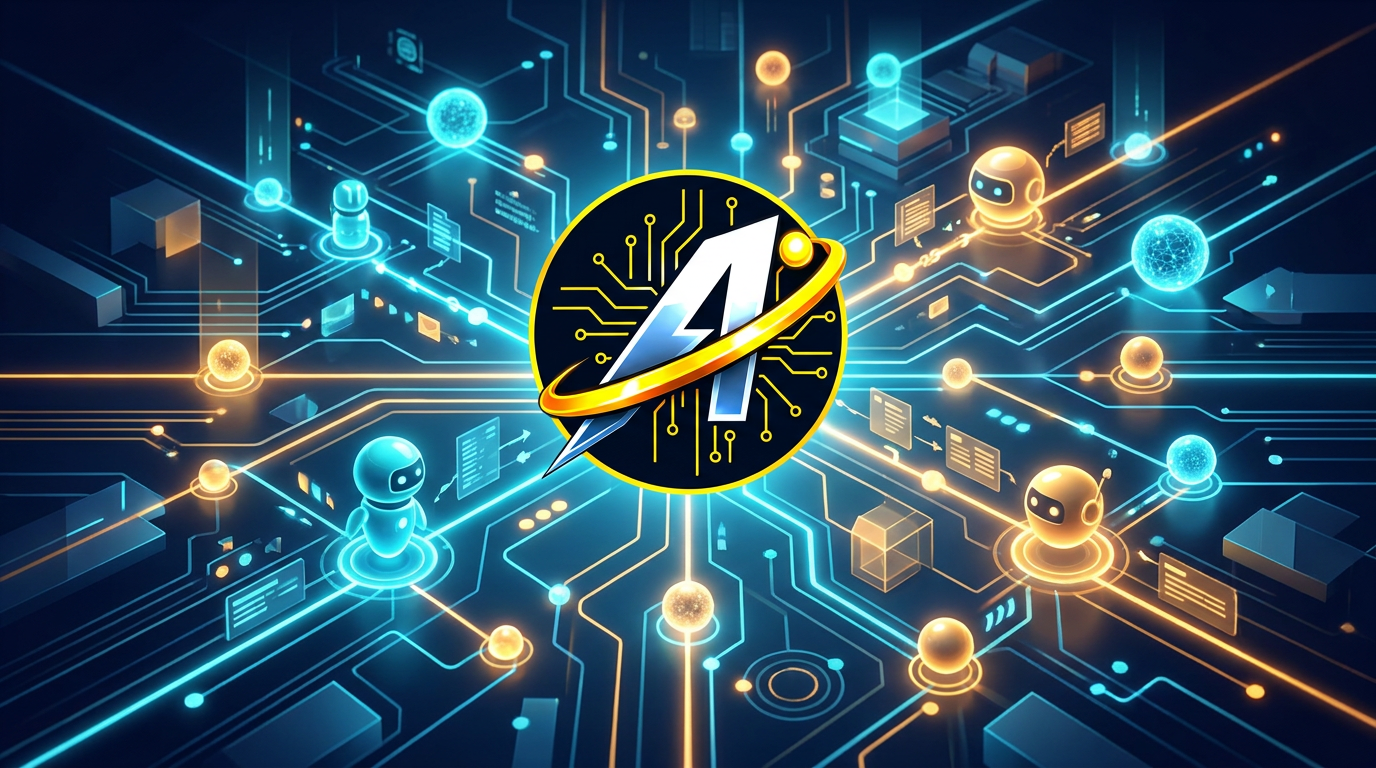
For the past three years, the defining image of artificial intelligence has been a blinking cursor in a chat window. Users typed a prompt, and the machine generated text, code, or images in return. But in 2026, the technology has crossed a critical threshold, moving from passive assistants that wait for instructions to autonomous systems that execute complex, multi-step tasks. This shift is driven by "agentic workflows," a new architecture where AI models are granted access to software tools, memory, and decision-making frameworks to accomplish broad objectives without continuous human oversight.[1][5]
The transition represents a fundamental change in how businesses approach automation. Traditional Robotic Process Automation (RPA) has long been the standard for handling repetitive digital chores, but it relies on rigid, rules-based scripts. If an RPA bot encounters an unstructured email or an unexpected software error, the pipeline breaks and a human must intervene. Agentic workflows, by contrast, are designed to handle ambiguity. They evaluate the situation at each stage, determine the appropriate action, and adapt when circumstances change.[2][6][7]
Industry analysts project that this capability will reshape enterprise software. According to Gartner, 40% of enterprise applications will embed AI agents by the end of 2026, a massive leap from less than 5% in 2025. The market for agentic AI in specific sectors, such as cybersecurity, is already forecast to exceed $320 billion by the next decade. For organizations looking to scale operations, the appeal is clear: agentic systems promise to handle the messy, unpredictable middle ground of knowledge work that traditional software could never touch.[3][4][5]
To understand how these systems operate, it is helpful to look at the "agentic loop," the core mechanism that separates an autonomous agent from a standard language model. When given a goal, an agentic workflow does not simply generate a single output. Instead, it cycles through four distinct phases: perceive, plan, act, and reflect. In the perception phase, the agent gathers context by reading emails, querying databases, or scanning documents.[2][6][7]

Next comes the planning phase, where the system's underlying Large Language Model (LLM) breaks the high-level goal into a sequence of granular steps. The agent then moves to execution, utilizing integrated tools—such as API connections to a Customer Relationship Management (CRM) platform or a financial database—to carry out the plan. Crucially, the workflow includes a reflection phase. After taking an action, the agent observes the result. If an API call fails or a search returns irrelevant data, the agent recognizes the error, adjusts its strategy, and tries a different approach.[1][5][7]
This capacity for self-correction is what makes agentic workflows viable in real-world environments. Early AI implementations often relied on a single, massive prompt fed into a frontier model—an approach developers colloquially called the "God Model." While impressive in demonstrations, this single-prompt architecture frequently suffered from high latency, logic failures, and hallucinations when deployed in complex enterprise settings.[7]
The solution that has emerged as the standard in 2026 is the Multi-Agent System (MAS). Rather than forcing one model to handle every aspect of a workflow, developers now orchestrate teams of specialized agents. In a multi-agent ecosystem, responsibilities are divided. For example, in an insurance claims process, one agent might be responsible solely for ingesting and classifying unstructured documents. A second agent verifies the policy coverage against a database, while a third drafts the customer-facing communication.[3][5][6]
The solution that has emerged as the standard in 2026 is the Multi-Agent System (MAS).
This orchestrated, component-based approach acts as a "microservices moment" for artificial intelligence. By isolating tasks, organizations can ensure that each agent is optimized for its specific role. A routing agent can quickly triage incoming requests, passing complex reasoning tasks to a highly capable frontier model, while delegating routine data extraction to a smaller, faster, and cheaper model.[3][5]

The economic implications of this architecture are profound. As organizations deploy fleets of agents that make thousands of API calls daily, the cost of computing has become a primary engineering constraint. This has given rise to a new discipline: FinOps for AI agents. Treating cost optimization as a core architectural concern, developers are utilizing the "Plan-and-Execute" pattern. In this setup, a sophisticated model creates the strategy, but cheaper, specialized models execute the individual steps, potentially reducing operational costs by up to 90% compared to using frontier models for the entire workflow.[3]
However, granting autonomous software the ability to take action introduces significant security and governance challenges. When AI agents are empowered to modify production databases, send emails on behalf of a company, or authorize transactions, the risk profile changes dramatically. The era of unchecked API access for experimental AI tools has ended, replaced by strict, zero-trust governance frameworks.[4][7]
Security teams in 2026 are treating AI agents much like human employees when it comes to system access. This means implementing Role-Based Access Control (RBAC) specifically for machine identities. An agent designed for customer support is cryptographically restricted from accessing financial ledgers or human resources data. Every tool and database connection is governed by strict authentication scopes, ensuring that even if an agent is compromised by a malicious prompt injection, the potential damage is contained.[4][7]

Furthermore, organizations are establishing clear boundaries for autonomous action through "Human-in-the-Loop" (HITL) architectures. While low-stakes, repetitive tasks may be fully automated, high-stakes decisions—such as approving a large financial payout or altering a critical system configuration—require an agent to pause and request explicit human authorization. This supervised autonomy allows businesses to capture the efficiency gains of agentic workflows while maintaining accountability for critical outcomes.[3][7]
The software infrastructure supporting these workflows is also maturing rapidly. Developers are increasingly relying on "agent harnesses"—frameworks that manage tool execution, memory persistence, and state management across long-running sessions. These harnesses ensure that an agent remembers the context of a task even if the process takes hours or days to complete, bridging the gap between isolated AI interactions and continuous operational support.[5]
Another critical development is the integration of live web data access. By allowing agents to query real-time information rather than relying solely on their static training data, organizations are significantly reducing the rate of AI hallucinations. This live connectivity is essential for workflows in dynamic fields like supply chain logistics, financial auditing, and e-commerce, where decisions must be based on the most current market conditions.[1][5]
Despite these advancements, the transition from experimental pilots to scaled production remains a hurdle for many enterprises. Building a reliable multi-agent system requires specialized engineering skills that blend traditional software development with prompt engineering and AI orchestration. Organizations must also navigate the cultural shift of trusting autonomous systems to execute tasks that were previously the exclusive domain of human workers.[3]
Ultimately, the rise of agentic workflows represents a maturation of artificial intelligence. The technology is moving beyond the novelty of generating text and images, embedding itself into the operational fabric of the digital economy. By combining the reasoning capabilities of large language models with the execution power of integrated tools, agentic systems are poised to automate the complex, multi-step processes that have long resisted traditional software solutions, fundamentally expanding what machines can accomplish.[1][3][7]
How we got here
2022–2023
Generative AI enters the mainstream primarily as passive chatbots requiring constant human prompting.
2024
Early experimental AI agents demonstrate the ability to use basic web search and API tools, though reliability remains low.
2025
The industry shifts toward multi-agent systems, moving away from single 'God Models' to improve accuracy and reduce costs.
2026
Agentic workflows reach enterprise maturity, with integrated governance frameworks and widespread commercial deployment.
Viewpoints in depth
Enterprise Integrators
Focus on deploying agents to replace rigid RPA and drive operational efficiency.
For enterprise leaders, the appeal of agentic workflows lies in their ability to handle the 'messy middle' of business operations. Traditional automation breaks down when faced with unstructured data or slight process variations, requiring costly human intervention. Integrators view multi-agent systems as the solution, allowing businesses to automate complex processes like supply chain logistics and customer support triage from end to end. Their primary metric for success is the reduction of manual oversight and the measurable return on investment from increased throughput.
AI Security Practitioners
Emphasize zero-trust governance, role-based access, and human-in-the-loop safeguards.
Security professionals view the shift toward autonomous action with cautious pragmatism. Giving an AI model the ability to modify databases or send external communications introduces severe risks, including prompt injection attacks and unauthorized privilege escalation. This camp advocates for treating AI agents exactly like human employees in identity management systems. They mandate strict Role-Based Access Control (RBAC), limited API scopes, and mandatory human authorization for any high-stakes or irreversible actions.
Agent-Native Developers
Prioritize multi-agent orchestration, open protocols, and cost-performance optimization.
The engineering community building these systems is focused on architectural efficiency. They argue that relying on massive, general-purpose 'frontier' models for every task is economically unsustainable. Instead, developers are championing the 'Plan-and-Execute' pattern, where a highly capable model drafts a strategy and delegates the execution to smaller, cheaper, specialized models. This camp is actively building the open-source 'agent harnesses' and protocols that allow different AI systems to communicate and collaborate seamlessly.
What we don't know
- How quickly legacy enterprise systems can be upgraded to support the API integrations required for autonomous agents.
- The long-term impact of agentic automation on entry-level knowledge worker employment and skill development.
- Which open-source agent communication protocols will ultimately become the industry standard for interoperability.
Key terms
- Agentic Workflow
- An automated process where AI agents autonomously plan, execute, and adapt multi-step tasks to achieve a goal.
- Robotic Process Automation (RPA)
- Traditional software bots that follow rigid, pre-programmed rules to complete repetitive digital tasks.
- Multi-Agent System (MAS)
- An architecture where multiple specialized AI models collaborate, dividing complex workflows into manageable components.
- Human-in-the-Loop (HITL)
- A safeguard requiring explicit human approval before an autonomous system can execute high-stakes decisions.
Frequently asked
How is an AI agent different from a chatbot?
While a chatbot passively answers prompts, an AI agent actively plans and executes multi-step tasks across different software tools without continuous human guidance.
Will agentic workflows replace traditional automation?
They are largely replacing rigid Robotic Process Automation (RPA) for complex tasks, as agents can handle unstructured data and adapt to unexpected errors.
Are autonomous AI agents secure?
Security requires strict Role-Based Access Control (RBAC) and human-in-the-loop checkpoints to ensure agents cannot take unauthorized actions or leak sensitive data.
Sources
Source coverage
7 outlets
3 viewpoints surfaced






[1]TechTargetEnterprise Integrators
Agentic AI workflows: Trends, examples and best practices
Read on TechTarget →[2]Weights & BiasesAgent-Native Developers
Agentic workflows: Getting started with AI Agents
Read on Weights & Biases →[3]Machine Learning MasteryAgent-Native Developers
7 Agentic AI Trends to Watch in 2026
Read on Machine Learning Mastery →[4]KnowBe4AI Security Practitioners
Agentic AI Security in 2026: What to Know
Read on KnowBe4 →[5]AiseraEnterprise Integrators
What are Agentic Workflows? Key Benefits and Challenges in 2026
Read on Aisera →[6]NotchEnterprise Integrators
Agentic AI Workflows Explained for Insurance
Read on Notch →[7]Factlen Editorial TeamAgent-Native Developers
Synthesis by Factlen editorial team
Read on Factlen Editorial Team →

More in ai
See all 6 stories →AI Security
Evidence Pack: The National Security Stakes of Open-Weight AI and the US Policy Shift
8 sources

On-Device AI
How Small Language Models and Quantization Brought AI to the Smartphone
6 sources

Local AI
The Rise of Local LLMs: How Powerful AI Moved from the Cloud to Your Laptop
9 sources
Scientific Automation
How 'Self-Driving' Labs Are Automating Scientific Discovery
8 sources

Every angle. Every day.
Get ai stories with full source coverage and perspective breakdowns delivered to your inbox.