
How Community Solar Gardens Are Democratizing Clean Energy
Community solar projects are decoupling renewable energy from homeownership, allowing renters and low-income households to save on their utility bills by subscribing to shared local arrays.
By Factlen Editorial Team
- Energy Equity Advocates
- Focusing on democratizing access to renewable energy for renters and low-income households.
- Clean Energy Industry
- Prioritizing rapid deployment, land-use efficiency, and grid decarbonization.
- Market Analysts
- Tracking the economic viability and growth hurdles of the shared solar model.
- State Policymakers
- Emphasizing the role of government grants and regulatory frameworks in subsidizing participation.
What's not represented
- · Traditional fossil fuel utilities facing revenue shifts
- · Local zoning boards managing land-use disputes
Why this matters
By removing the thousands of dollars in upfront costs required for rooftop panels, community solar transforms renewable energy from a luxury good into an accessible community utility, directly lowering monthly bills for those who need it most.
Key points
- Community solar allows renters and homeowners to subscribe to a shared local solar farm and receive credits on their utility bills.
- The model eliminates the need for upfront capital and homeownership, making renewable energy accessible to a broader demographic.
- Subscribers typically save between 10% and 20% on their annual electricity costs through Virtual Net Metering.
- The U.S. community solar sector recently surpassed 10 gigawatts of capacity, with an 8.2 gigawatt pipeline under development.
- Developers are increasingly building arrays on 'brownfields' like capped landfills, repurposing unusable land for clean energy.
- Growth faces headwinds from grid interconnection delays and the high administrative costs of acquiring and managing subscribers.
For years, the transition to renewable energy has come with a glaring structural prerequisite: owning a roof. Traditional residential solar panels require homeownership, thousands of dollars in upfront capital, and a roof with the precise structural integrity and sun exposure necessary to support a heavy array. This physical and financial reality has historically locked out roughly three-quarters of the American population. Renters, apartment dwellers, and low-to-moderate-income households have largely been sidelined from the financial benefits of the green transition, effectively turning clean energy generation into a luxury good accessible only to those with significant property assets.[9]
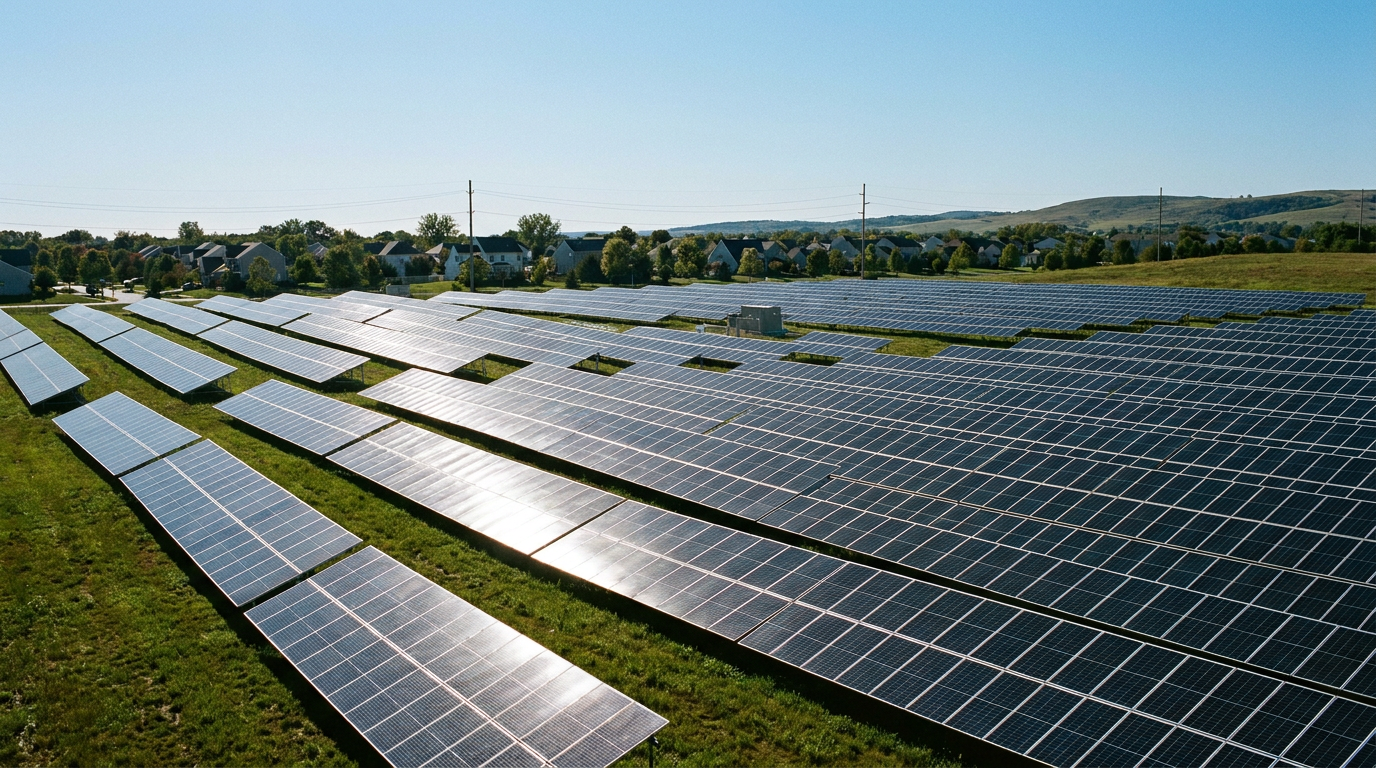
But a rapidly scaling model known as "community solar" is actively dismantling that barrier. Rather than installing panels on individual homes, community solar projects—often referred to interchangeably as solar gardens, solar farms, or roofless solar—are large, centralized arrays built on shared spaces. These installations are typically erected on unused land, commercial rooftops, or capped municipal landfills. By centralizing the infrastructure, developers can achieve economies of scale that drastically lower the cost per watt of generated electricity, while entirely bypassing the logistical headaches of residential roof inspections and individual homeowner financing.[1][9]
The mechanism that makes this possible is remarkably straightforward for the end user. The electricity generated by these centralized arrays is fed directly into the local power grid, mixing with the region's broader energy supply. Instead of purchasing the physical panels, local residents, municipalities, and businesses simply subscribe to a specific portion of the solar farm's total output. In return for their subscription, participants receive financial credits on their standard monthly utility bills for the exact amount of clean energy their specific share of the farm produces.[1][2]
The financial engine behind this model relies on a billing arrangement known as Virtual Net Metering (VNM). When a subscriber's designated portion of the solar farm generates electricity, the local utility company calculates the market value of that power. The utility then applies that value as a direct deduction to the subscriber's standard electric bill. Because the power is metered virtually, the subscriber does not need to live adjacent to the solar farm; they simply need to reside within the same utility territory to reap the financial rewards of the energy generation.[1][9]

Subscribers typically pay a monthly fee to the community solar developer to lease their share of the array, but state regulatory programs and market competition are specifically designed to ensure that the fee is always lower than the utility credit received. The result is a guaranteed net savings for the household. Most subscribers see between a 10% and 20% reduction in their annual electricity costs. Crucially, this financial relief comes with zero upfront investment, no property alterations, and no maintenance responsibilities, making it a highly attractive proposition for budget-conscious households.[1][8]
This accessible model has fundamentally transformed the demographics of renewable energy adoption across the United States. Organizations like GRID Alternatives have championed community solar as a vital tool for energy equity, ensuring that the financial dividends of the green transition reach the communities most burdened by volatile utility costs. By decoupling clean energy from property ownership, the model provides a lifeline to low-income families who spend a disproportionate percentage of their monthly income on basic electricity needs, offering them a reliable buffer against rising fossil fuel prices.[5]
Recognizing this immense potential, state and federal policymakers have increasingly tailored their regulations to protect and aggressively expand access for low-to-moderate-income (LMI) households. In 2022, the U.S. Department of Housing and Urban Development (HUD) issued landmark guidance to resolve a critical bureaucratic hurdle. The agency ensured that residents of federally assisted housing could receive community solar credits without those savings triggering an automatic increase in their rent or a reduction in their federal utility allowances, clearing the way for 4.5 million affordable housing residents to participate.[6]
Department of Housing and Urban Development (HUD) issued landmark guidance to resolve a critical bureaucratic hurdle.
State-level legislative mandates are also driving equitable adoption by forcing developers to prioritize marginalized communities in their business models. In June 2026, Maryland Governor Wes Moore announced $43 million in state grants for new community solar projects, attaching strict equity requirements to the funding. The state now requires developers to allocate at least 15% of their generated electricity to low-income households to qualify for the grants. In many of these heavily subsidized state programs, LMI subscribers see their energy bills discounted by 25% or more, turning a modest environmental initiative into a highly effective, localized poverty-alleviation tool.[4]
Beyond the immediate household economics, community solar offers unique land-use and environmental benefits that traditional utility-scale solar cannot easily match. Because developers do not need to negotiate with individual homeowners or secure massive tracts of pristine wilderness, they can strategically site their solar arrays on what urban planners call "brownfields." These are abandoned industrial sites, capped municipal landfills, and other heavily contaminated or underutilized spaces that are entirely unsuitable for residential housing or commercial real estate development. Repurposing these blighted areas turns a community liability into a productive clean energy asset.[2][8]
Transforming these toxic brownfields into productive "brightfields" allows municipalities to generate massive amounts of clean power without encroaching on preserved green spaces, vital agricultural land, or dense residential neighborhoods. Furthermore, the land beneath these ground-mounted solar panels is increasingly being seeded with native vegetation to create pollinator-friendly habitats. This dual-use approach supports local agriculture by boosting bee and butterfly populations, prevents soil erosion, and maximizes the ecological utility of land that would otherwise sit fenced off and dormant, proving that industrial infrastructure and ecological restoration can successfully coexist.[2][8]
The sector's rapid growth over the past half-decade reflects its broad appeal among both budget-conscious consumers and profit-driven developers. According to recent data compiled by the Solar Energy Industries Association (SEIA) and Wood Mackenzie, the United States officially surpassed 10 gigawatts (GW) of installed community solar capacity in late 2025. This milestone represents a massive scaling up of a concept that was largely experimental just a decade ago, cementing shared solar as a foundational pillar of the modern American energy grid and proving the viability of decentralized power generation.[2][3]

While the industry experienced a brief 25% year-over-year contraction in 2025—largely due to market maturation, saturated grids, and policy shifts in early-adopter states like New York and Maine—energy analysts forecast a robust and immediate rebound. Wood Mackenzie projects a 12% growth rate for the sector in 2026, driven by aggressive legislative expansion and new project approvals in Illinois and the broader Mid-Atlantic region. In these emerging markets, consumer demand for utility bill relief remains exceptionally high, providing a fertile landscape for developers eager to deploy new capital.[3][7]
The near-term future of the community solar industry is anchored by a massive project development pipeline that now exceeds 8.2 GW of planned capacity. Developers across the country have been racing to secure equipment, finalize land leases, and begin construction to qualify for lucrative federal Investment Tax Credits (ITC) before planned phaseouts alter the financial landscape later in the decade. Nearly a third of this massive pipeline is already reported to be under construction, promising a steady stream of new capacity coming online over the next 24 months.[2][3]
However, the path forward is not without significant friction. The primary bottleneck for new community solar gardens is no longer consumer demand or project financing, but rather outdated grid infrastructure. Developers face severe interconnection delays as local utility companies struggle to process the massive backlog of new renewable energy projects waiting to be physically hooked up to the regional power grids. These administrative and engineering delays can stall fully funded, shovel-ready projects for years, trapping vital clean energy in regulatory limbo while communities continue to rely on fossil fuels.[3][7]

Additionally, the sheer cost of acquiring and managing individual subscribers remains a persistent hurdle for developers operating on tight margins. Industry analysts note that subscriber acquisition costs can hover around $100 per kilowatt, particularly for LMI households that require more targeted, community-based outreach to overcome skepticism about complex energy contracts. Consolidating utility billing—where the solar subscription fee and the energy credit appear seamlessly on a single, simplified utility bill—is widely viewed by the industry as the essential next step to lowering these administrative costs, reducing subscriber churn, and improving the overall customer experience.[3][8]
Despite these infrastructural and administrative growing pains, community solar represents a fundamental, permanent shift in how society distributes the dividends of the energy transition. By successfully decoupling clean energy generation from property ownership, the model ensures that the financial and environmental benefits of a decarbonized grid are available to the entire community, rather than just a privileged few. As the sector pushes past its 10 GW milestone and expands into new states, it is definitively proving that renewable energy can evolve from an exclusionary luxury into an accessible, empowering public utility that actively fights both climate change and economic inequality.[8]
How we got here
July 2022
HUD issues guidance ensuring community solar savings do not negatively impact rent or utility allowances for residents in federally assisted housing.
Late 2025
The United States officially surpasses 10 gigawatts of installed community solar capacity, according to industry analysts.
June 2026
State programs, such as Maryland's $43 million grant initiative, expand mandates requiring developers to allocate energy to low-income households.
Viewpoints in depth
Energy Equity Advocates
Focusing on democratizing access to renewable energy for renters and low-income households.
Organizations in this camp view community solar primarily as a tool for economic justice. They argue that traditional rooftop solar inherently favors the wealthy and property owners, leaving marginalized communities to bear the brunt of fossil fuel pollution and volatile utility rates. By advocating for low-to-moderate-income (LMI) carve-outs and policies that protect federal housing allowances, these groups aim to ensure the green transition actively reduces the energy burden on the working class.
Clean Energy Developers
Prioritizing rapid deployment, land-use efficiency, and grid decarbonization.
For the solar industry, community arrays offer a highly efficient way to scale clean energy without the friction of door-to-door residential sales. Developers emphasize the environmental dual-benefits of the model, particularly the ability to transform contaminated brownfields and capped landfills into productive 'brightfields.' However, they frequently cite outdated grid infrastructure and slow utility interconnection queues as the primary barriers preventing them from deploying their massive 8.2 GW project pipeline.
Market Analysts
Tracking the economic viability and growth hurdles of the shared solar model.
Financial and energy analysts focus on the underlying economics that make community solar viable. While they celebrate the recent 10 GW capacity milestone, they caution that the sector's long-term health depends on lowering subscriber acquisition costs and navigating shifting federal tax credits. Analysts argue that widespread adoption of 'consolidated billing'—where utility companies handle the complex math of credits and subscription fees on a single invoice—is essential to reducing developer overhead and preventing market stagnation.
What we don't know
- How quickly local utility companies can upgrade their infrastructure to clear the massive backlog of solar projects waiting in interconnection queues.
- Whether the planned phaseout of federal Investment Tax Credits later this decade will significantly slow the development of new community solar farms.
- How effectively developers can reduce the $100-per-kilowatt subscriber acquisition costs to make low-income outreach more financially sustainable.
Key terms
- Virtual Net Metering (VNM)
- A billing system that allows utility customers to receive financial credits on their electricity bill for power generated by a solar array located off-site.
- Brownfield
- A property whose redevelopment is complicated by the presence of hazardous substances or pollutants, such as an abandoned factory or capped landfill, which are increasingly being repurposed for solar farms.
- Interconnection Queue
- The waiting list and approval process required by local utility companies before a newly built power project can be physically connected to the regional electricity grid.
- Investment Tax Credit (ITC)
- A federal policy that allows individuals or businesses to deduct a percentage of the cost of installing a solar energy system from their federal taxes, driving industry growth.
Frequently asked
Do I need to own my home to use community solar?
No. Community solar is specifically designed for renters, apartment dwellers, and homeowners whose roofs are shaded or unsuitable for traditional solar panels.
Does it cost money to sign up?
Most community solar programs require no upfront investment. Subscribers pay a monthly fee for their share of the solar farm, but the utility bill credits they receive are designed to exceed that fee, resulting in net savings.
How does the electricity get to my house?
The solar farm feeds electricity directly into the local power grid, mixing with other energy sources. You don't receive the exact electrons produced by the panels; instead, you receive financial credit for adding clean energy to the overall system.
What happens if I move?
If you move within the same utility territory, you can typically take your community solar subscription with you. If you move out of the area, most contracts allow you to cancel without severe penalties, though terms vary by provider.
Sources
Source coverage
9 outlets
4 viewpoints surfaced









[1]U.S. Department of EnergyState Policymakers
Community Solar Market Trends
Read on U.S. Department of Energy →[2]Solar Energy Industries AssociationClean Energy Industry
U.S. Solar Market Insight Q2 2026
Read on Solar Energy Industries Association →[3]Wood MackenzieMarket Analysts
US community solar clears 10 GW
Read on Wood Mackenzie →[4]Maryland Energy AdministrationState Policymakers
Governor Wes Moore Announces 69 New Grants for Community Solar
Read on Maryland Energy Administration →[5]GRID AlternativesEnergy Equity Advocates
Community Solar for Affordable Housing
Read on GRID Alternatives →[6]U.S. Department of Housing and Urban DevelopmentEnergy Equity Advocates
HUD Guidance on Community Solar and Utility Allowances
Read on U.S. Department of Housing and Urban Development →[7]PV TechClean Energy Industry
US community solar capacity passes 10GW despite 2025 slowdown
Read on PV Tech →[8]Factlen Editorial TeamState Policymakers
Synthesis by Factlen editorial team
Read on Factlen Editorial Team →[9]Perch EnergyClean Energy Industry
Community Solar Explained: Ultimate Guide
Read on Perch Energy →
Every angle. Every day.
Get community stories with full source coverage and perspective breakdowns delivered to your inbox.