
Global Markets Reprice Geopolitical Risk as U.S.-Iran Peace Deal Unlocks Trade
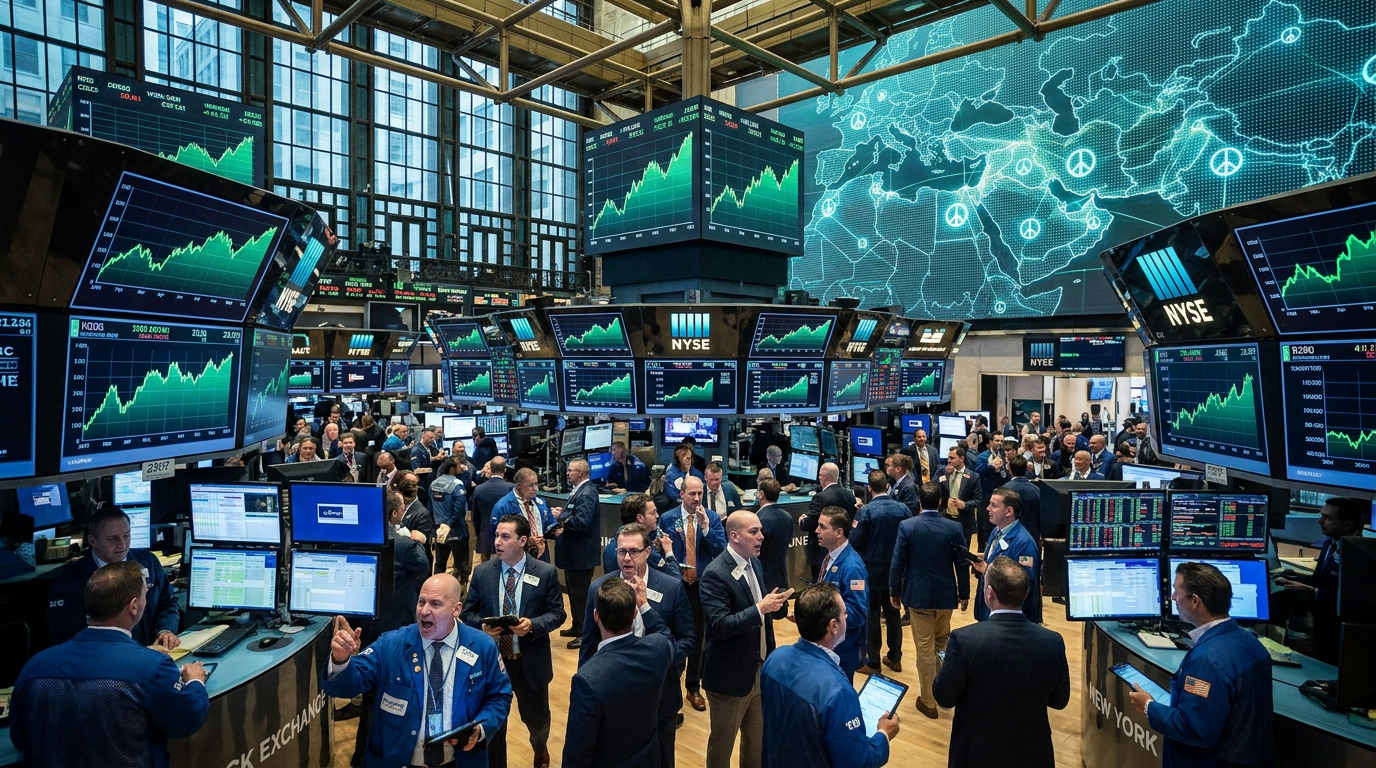
The sudden resolution of the U.S.-Iran conflict has sent oil prices tumbling and sparked a bond market rally, fundamentally altering the macroeconomic outlook for the second half of 2026.
By Factlen Editorial Team
- Macro Bulls
- Believe the peace dividend will permanently lower inflation expectations and fuel a sustained market rally.
- Energy Sector Realists
- Note that while crude prices are down, structural global demand and U.S. shale efficiency will prevent a total collapse.
- Geopolitical Skeptics
- Warn that the deal defers core issues, leaving the market vulnerable to sudden shocks if the agreement fractures.
What's not represented
- · Middle Eastern regional allies
- · Consumer advocacy groups tracking retail gas prices
Why this matters
A sustained drop in oil prices and easing inflation expectations directly lower borrowing costs for consumers and businesses, while the unwinding of sanctions opens new avenues for international trade and investment.
Key points
- The U.S.-Iran peace deal has erased the geopolitical risk premium, sending global oil prices sharply lower.
- U.S. shale producers remain profitable despite the drop in crude prices due to optimized extraction costs.
- Falling energy costs are lowering inflation expectations, triggering a massive rally in the bond market.
- The U.S. Justice Department has begun unwinding sanctions enforcement, evidenced by the dismissal of the Halkbank case.
- Analysts warn the market rally assumes the peace deal holds, despite deferring several intractable geopolitical issues.
The ink is barely dry on the U.S.-Iran peace deal, but global financial markets have already executed a historic repricing. For the past year, a heavy geopolitical risk premium sat on everything from crude oil to sovereign debt. Now, with the sudden cessation of hostilities, that premium is evaporating, fundamentally altering the macroeconomic landscape for the remainder of 2026.[1][6]
The most immediate and visible mechanism of this repricing is playing out in global energy markets. Brent crude, which had been elevated by fears of supply disruptions in the Strait of Hormuz, has experienced a sharp downward correction as traders price out the threat of a regional conflagration.[7]
Yet, the mechanics of the oil market are proving more resilient than a simple crash. U.S. shale producers, who have spent the last decade ruthlessly optimizing their extraction costs, remain highly profitable even at these newly lowered price bands.[2]
Buyers in Europe and Asia are still actively seeking alternatives to Middle Eastern barrels to permanently diversify their supply chains, ensuring that American crude exports maintain a strong floor. The narrative of an oil collapse is quickly being replaced by one of stabilization at a lower, more consumer-friendly equilibrium.[2][7]

This stabilization in energy costs is the first domino in a broader macroeconomic chain reaction. Lower oil prices directly feed into lower headline inflation, which in turn alters the calculus for central banks worldwide that have spent years battling sticky price increases.[9]
Fixed-income markets are already front-running this shift. Analysts are declaring the arrival of a "summer of the bond market," driven by the expectation that the Federal Reserve and the European Central Bank will finally have the breathing room required to ease monetary policy.[4]
As inflation expectations cool, bond yields are falling, smoothing the way for a sustained rally in fixed income. This dynamic lowers borrowing costs across the broader economy, from corporate debt issuance to consumer mortgages, acting as a de facto stimulus without requiring government spending.[4][9]
Beyond the macroeconomic shifts, the peace deal is triggering a massive unwinding of the complex sanctions architecture that has isolated the Iranian economy for years. This unwinding is not just theoretical; it is already playing out in federal courts.[3]
Beyond the macroeconomic shifts, the peace deal is triggering a massive unwinding of the complex sanctions architecture that has isolated the Iranian economy for years.
In a landmark move signaling the rapid normalization of financial channels, a U.S. federal judge allowed the Justice Department to formally drop its long-running criminal case against Turkiye Halk Bankasi AS.[3]
The Turkish state-owned lender had been accused of helping Iran move billions of dollars in violation of U.S. sanctions. The dismissal of the case, at the direct request of the DOJ, serves as a clear legal green light to global markets that the era of maximum financial pressure is officially paused.[3][8]

However, the resumption of trade is not without friction. While Western financial institutions are cautiously evaluating the legal frameworks for re-engaging with Iranian markets, Tehran is already moving quickly to secure assets from non-Western partners.[5][8]
Reports indicate that Iran has immediately leveraged its newly unfrozen capital to purchase a fleet of 20 Russian helicopters, ostensibly for its Red Crescent Society's logistics and aerial rescue operations.[5]
This rapid procurement underscores the complex geopolitical reality of the peace deal: while U.S. sanctions are lifting, Iran's established trade networks with nations like Russia remain deeply entrenched and are being activated first.[5][8]
For equity investors, the removal of the war overhang has shifted focus back to underlying corporate fundamentals and structural growth trends. Chief among these is the historic capital expenditure boom driven by artificial intelligence and computing infrastructure.[1]
With the distraction of a major Middle Eastern conflict removed, institutional capital is pouring back into the tech sector and the massive energy grids required to power next-generation data centers, unhindered by fears of a sudden energy shock.[1][6]

Yet, beneath the surface of this market exuberance, significant uncertainties remain. The current peace agreement is widely acknowledged by analysts to be a pragmatic compromise that defers many of the conflict's thorniest and most intractable issues.[1]
Geopolitical experts warn that the deal functions more as a heavily monitored ceasefire than a comprehensive, permanent resolution. If the verification mechanisms fail, or if domestic political pressures in either Washington or Tehran force a withdrawal, the geopolitical risk premium could snap back with violent speed.[1][8]
For now, however, the market has made its decision. Capital is flowing toward the assumption of sustained peace, lower inflation, and a revitalized global trade environment. The challenge for policymakers and investors alike will be navigating the fragile reality upon which this new financial consensus is built.[6][9]
How we got here
Early 2026
Geopolitical risk premium peaks as U.S.-Iran tensions threaten Strait of Hormuz shipping lanes.
June 2026
A comprehensive peace deal is reached, deferring core issues but ceasing hostilities.
Mid-June 2026
Global oil prices slide as the risk of supply disruption evaporates.
June 17, 2026
The DOJ formally drops the sanctions-evasion case against Turkiye Halk Bankasi AS, signaling a return to normalized trade.
Viewpoints in depth
Macro Bulls
Believe the peace dividend will permanently lower inflation expectations and fuel a sustained market rally.
For macroeconomic optimists, the peace deal is the ultimate catalyst for a 'Goldilocks' economic scenario. By instantly removing the threat of an energy shock, the deal virtually guarantees a faster deceleration of headline inflation. This gives central banks, particularly the Federal Reserve, the political and economic cover to begin aggressively cutting interest rates. The resulting drop in borrowing costs is expected to act as a massive stimulus for corporate earnings, real estate, and consumer spending, effectively extending the current economic expansion well into the late 2020s.
Energy Sector Realists
Note that while crude prices are down, structural global demand and U.S. shale efficiency will prevent a total collapse.
Energy analysts caution against interpreting the drop in oil prices as a structural collapse of the sector. They point out that U.S. shale producers have spent the last several years enforcing strict capital discipline and lowering their breakeven costs. Even with the geopolitical premium removed, global baseline demand for crude remains robust, particularly as emerging markets expand. Furthermore, Western buyers remain hesitant to fully pivot back to Middle Eastern reliance, ensuring that North American energy exports will maintain a strong, profitable floor regardless of the peace deal.
Geopolitical Skeptics
Warn that the deal defers core issues, leaving the market vulnerable to sudden shocks if the agreement fractures.
Security analysts and geopolitical skeptics argue that financial markets are dangerously front-running a fragile diplomatic agreement. They emphasize that the current deal is largely a ceasefire that kicks the most difficult issues—such as long-term nuclear enrichment limits and regional proxy funding—down the road. By pricing in a permanent peace dividend, markets are leaving themselves highly exposed to a sudden, violent correction if verification protocols break down or if domestic hardliners in either country successfully sabotage the agreement in the coming months.
What we don't know
- How quickly Western financial institutions will actually resume lending and trade with Iranian entities despite the lifting of sanctions.
- Whether the deferred 'thorny issues' in the peace deal will resurface and threaten the agreement before the end of the year.
- Exactly how much the Federal Reserve will adjust its rate-cut timeline in response to the sudden drop in energy-driven inflation.
Key terms
- Geopolitical Risk Premium
- The additional price built into assets, like oil or gold, to compensate investors for the risk of war, political instability, or supply chain disruptions.
- Brent Crude
- A major trading classification of sweet light crude oil that serves as a benchmark price for purchases of oil worldwide.
- Fixed Income Rally
- A period where the prices of bonds increase (and their yields decrease), typically driven by expectations of lower inflation or falling interest rates.
- Capital Expenditure (Capex)
- Funds used by a company to acquire, upgrade, and maintain physical assets such as property, plants, buildings, technology, or equipment.
Frequently asked
Why did oil prices drop after the peace deal?
The resolution of the conflict removed the 'geopolitical risk premium'—the extra cost traders added to oil prices due to fears that a war could disrupt supply routes in the Middle East.
Will the drop in oil prices hurt U.S. energy companies?
Largely, no. U.S. shale producers have heavily optimized their operations over the last decade and remain profitable even at these lower price levels.
What does the Halkbank case dismissal mean?
The U.S. dropping charges against the Turkish bank signals that the Justice Department is actively unwinding the legal enforcement of previous sanctions, clearing the way for normalized financial flows.
How does this affect the bond market?
Lower oil prices reduce overall inflation. When inflation falls, central banks are more likely to cut interest rates, which makes existing bonds more valuable and drives down yields.
Sources
Source coverage
9 outlets
3 viewpoints surfaced






[1]BloombergEnergy Sector Realists
Morgan Stanley's Wilson Says Investors Looking Past War
Read on Bloomberg →US Shale Stays in the Money Despite Oil Price Drop
Read on Bloomberg →Halkbank Iran Sanctions Case Tossed as Judge Grants DOJ Request
Read on Bloomberg →We're Entering a 'Summer of the Bond Market,' Goncalves Says
Read on Bloomberg →[5]ForbesGeopolitical Skeptics
Iran Buys 20 Russian Helicopters After U.S. Peace Deal
Read on Forbes →[6]CNBCMacro Bulls
Global Equities Surge as Middle East Risk Premium Evaporates
Read on CNBC →[7]ReutersEnergy Sector Realists
Brent Crude Slides Following U.S.-Iran Accord
Read on Reuters →[8]Financial TimesGeopolitical Skeptics
Sanctions Relief Sparks Scramble for Iranian Assets, But Risks Remain
Read on Financial Times →[9]Wall Street JournalMacro Bulls
The Fed's New Math: How Peace in the Middle East Alters the Rate Path
Read on Wall Street Journal →
Every angle. Every day.
Get business stories with full source coverage and perspective breakdowns delivered to your inbox.