
SpaceX Surpasses $2.8 Trillion Valuation Following Record-Breaking IPO and Options Debut
SpaceX's historic $85.7 billion IPO has pushed its market capitalization past Amazon, making Elon Musk the world's first trillionaire as retail and institutional investors flood the newly public stock.
By Factlen Editorial Team
- Growth Investors
- Focus on the massive $28.5 trillion addressable market of space internet and orbital AI infrastructure.
- Retail Speculators
- View the IPO as a generational wealth-building event, utilizing call options to maximize leverage on the stock's momentum.
- Market Skeptics
- Warn that the $2.85 trillion valuation is detached from fundamentals, citing the 4% public float and the risk of a severe correction.
What's not represented
- · Legacy aerospace competitors
- · Regulatory agencies overseeing space commercialization
Why this matters
The largest public offering in history opens the commercial space economy and orbital AI infrastructure to everyday investors, fundamentally reshaping the U.S. equity market and setting a new benchmark for late-stage startup exits.
Key points
- SpaceX raised a record $85.7 billion in its IPO, pricing shares at $135.
- The company's valuation surged past $2.85 trillion, briefly overtaking Amazon and Microsoft.
- Elon Musk became the world's first trillionaire following the stock's 19% first-day pop.
- Options trading launched with a record 1.8 million contracts exchanged on the first day.
- Retail investors received an unusually high 30% allocation of the offering.
- SpaceX plans to use the funds for Starship development and orbital AI infrastructure.
SpaceX has fundamentally rewritten the record books of the U.S. equity market, completing an $85.7 billion initial public offering that has propelled the aerospace and artificial intelligence giant past Amazon in total market capitalization. Trading under the ticker SPCX on the Nasdaq, the Elon Musk-led company has seen its valuation surge from a pre-debut $1.77 trillion to an astonishing $2.85 trillion in a matter of days. The listing not only marks the largest public offering in global financial history, eclipsing Saudi Aramco's 2019 debut, but it has also crowned Musk as the world's first trillionaire.[3][4][8]
The mechanics of the offering were as unconventional as the company itself. After confidentially filing with the Securities and Exchange Commission in April 2026, SpaceX bypassed the traditional price-range roadshow, instead offering a take-it-or-leave-it price of $135 per share. Investor demand was overwhelming, with the order book reportedly oversubscribed by a factor of four, drawing over $250 billion in institutional and retail interest. To accommodate the frenzy, underwriters exercised their greenshoe option, expanding the total capital raised to nearly $86 billion.[3][4][8]
When the opening bell rang on June 12, the stock immediately popped. Shares opened at $150 and climbed steadily to close at $160.95, a 19.2% premium over the IPO price. The immediate surge validated the immense pre-market hype and instantly minted thousands of new millionaires among SpaceX's current and former employees. For the broader market, it signaled a ravenous appetite for mega-cap technology listings, particularly those sitting at the intersection of space infrastructure and artificial intelligence.[3][4]

A key differentiator of the SpaceX IPO was its unprecedented allocation to everyday investors. Typically, retail traders are granted a meager 5% to 10% of a highly anticipated offering, leaving the lion's share for institutional whales. However, Musk mandated that up to 30% of the SPCX float be reserved for retail accounts. This structural decision democratized access to the commercial space economy but also injected a highly volatile, momentum-driven retail base directly into the stock's first days of trading.[6][8]
Institutional heavyweights were equally aggressive in securing their stakes. Cathie Wood's ARK Invest, a long-time backer of Musk's ventures in the private markets, executed a massive $529.7 million purchase on the stock's opening day. Across four of its actively managed exchange-traded funds—including the flagship ARK Innovation ETF—the firm acquired nearly 3.3 million shares. To fund the acquisition, ARK trimmed its positions in other tech darlings, including Tesla, Advanced Micro Devices, and Roku, signaling a high-conviction pivot toward SpaceX's orbital ambitions.[1][7]
The market frenzy entered a new stratosphere on Tuesday, June 16, when options trading for SpaceX officially launched. The debut shattered all existing records for a newly listed company. Within the first session, traders exchanged roughly 1.8 million options contracts, representing an estimated $2.8 billion in options premium. This volume obliterated the previous first-day record of 364,000 contracts set by Meta during its 2012 market debut.[5][8]
The options activity was overwhelmingly bullish, characterized by a massive influx of call options. Traders aggressively targeted strike prices of $300 and $380, betting that the stock's meteoric rise was only just beginning. The put-call ratio hovered around 0.7, indicating that volume in bearish put options was 30% lower than activity in calls. This speculative fervor quickly made SPCX the third most actively traded single-stock options contract in the U.S., trailing only Nvidia and Tesla.[2][5]
The options activity was overwhelmingly bullish, characterized by a massive influx of call options.
This explosion in derivatives trading had an immediate, compounding effect on the underlying stock price. As retail and institutional traders bought up out-of-the-money call options, the market makers and dealers taking the other side of those trades were forced to buy actual SpaceX shares to hedge their risk. This dynamic, known as a gamma squeeze, accelerated the stock's upward momentum, pushing shares past the $220 mark and briefly lifting SpaceX's valuation above Microsoft's $2.92 trillion market cap.[6][8]

Amplifying the volatility is SpaceX's exceptionally small public float. Despite the record-breaking size of the capital raise, only about 4% to 5% of the company's total outstanding shares are currently available for public trading. The vast majority of the equity remains locked up by Musk, early venture capital backers, and employees. With such a limited supply of shares circulating in the open market, the massive influx of passive ETF flows, retail buying, and options-driven hedging has created a severe supply-demand imbalance, driving the price action to extremes.[5][6]
Beyond the trading mechanics, the fundamental bull case for SpaceX rests on its near-monopoly in commercial launch services and the explosive growth of its Starlink satellite internet division. Starlink, which currently accounts for an estimated 58% of the company's total revenue, has proven the viability of low-Earth orbit broadband. The IPO prospectus outlined an addressable market of $28.5 trillion across broadband, mobile connectivity, and enterprise applications, painting a picture of a company that intends to be the backbone of global communications.[4][8]
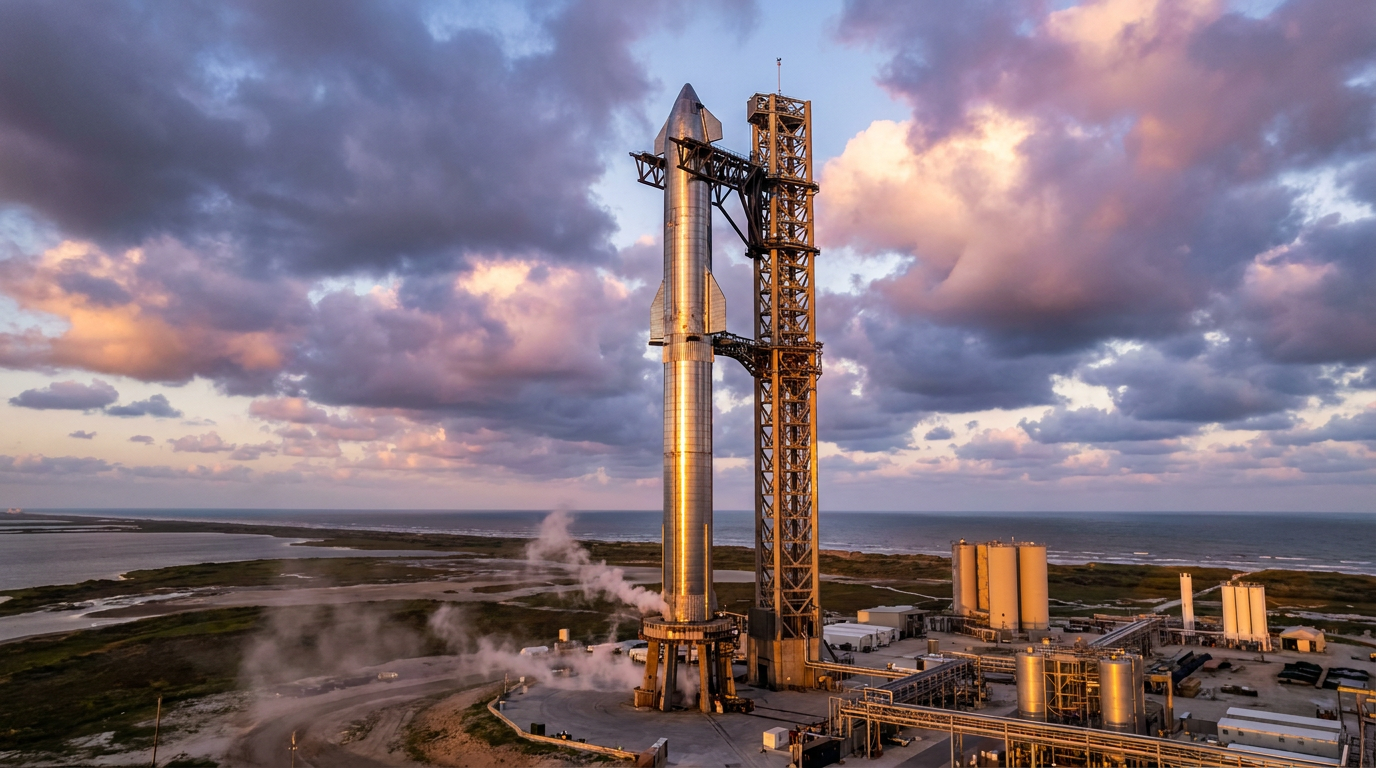
The $85.7 billion war chest will be deployed toward SpaceX's most capital-intensive and ambitious projects. Chief among these is the continued development of the Starship rocket system, a fully reusable super-heavy lift vehicle designed to make interplanetary travel economically feasible. Starship is critical not only for Musk's long-stated goal of colonizing Mars but also for deploying the next generation of massive Starlink satellites required to meet growing global bandwidth demands.[4][8]
Furthermore, the IPO prospectus revealed a deep integration between SpaceX and Musk's artificial intelligence startup, xAI, which SpaceX acquired earlier in the year. A significant portion of the newly raised capital is earmarked for building orbital artificial intelligence infrastructure. By placing data centers in space, SpaceX aims to leverage the vacuum and cold of orbit for cooling high-performance AI compute clusters, a radical approach to solving the energy and thermal constraints currently bottlenecking terrestrial AI development.[3][8]

In a move that underscored its aggressive expansion strategy, SpaceX announced on the heels of its IPO that it would acquire the software firm Anysphere in a deal valued at $60 billion. The acquisition is widely seen as a play to bolster the company's software engineering capabilities as it scales its orbital AI networks and integrates complex machine-learning models into its autonomous flight and satellite management systems.[6][8]
Despite the euphoria, seasoned market analysts are urging caution. The sheer scale of SpaceX's $2.85 trillion valuation implies decades of flawless execution and uninterrupted growth. Skeptics point out that the company still carries an accumulated deficit of over $41 billion and operates in an industry fraught with catastrophic physical risks. A single launch failure or regulatory setback could severely dent the high-flying stock, especially given the speculative premium currently baked into the share price.[6][8]
Moreover, the stock's trading patterns have drawn comparisons to the meme-stock craze of 2021, albeit on a macroeconomic scale. The combination of a charismatic, highly visible CEO, a retail-heavy shareholder base, and rampant options speculation has created an environment where price discovery is temporarily detached from traditional fundamental analysis. Market observers warn that once the initial lock-up periods expire and insiders begin selling their shares, the sudden increase in supply could trigger a sharp correction.[6][8]
For now, however, the momentum remains firmly upward. SpaceX is slated for fast-tracked inclusion into major equity indices, including the Nasdaq-100 and the CRSP U.S. Total Market Index. These additions will force passive index funds and mutual funds to purchase billions of dollars worth of SPCX shares, providing a structural backstop to the stock's price in the near term. As the dust settles on its historic debut, SpaceX has not only redefined the aerospace industry but has permanently altered the landscape of global financial markets.[6][8]
How we got here
April 2026
SpaceX confidentially files a draft registration statement with the SEC to begin the IPO process.
May 20, 2026
SpaceX publicly files its S-1 prospectus, revealing its financials and plans for orbital AI infrastructure.
June 11, 2026
The IPO is officially priced at $135 per share, valuing the company at $1.77 trillion.
June 12, 2026
SpaceX begins trading on the Nasdaq under the ticker SPCX, closing up nearly 20% on its first day.
June 16, 2026
Options trading for SpaceX launches, shattering volume records with 1.8 million contracts traded.
Viewpoints in depth
Growth Investors
Focus on the massive addressable market of space internet and AI infrastructure.
Institutional growth investors, exemplified by Cathie Wood's ARK Invest, view SpaceX not just as a rocket company, but as the foundational infrastructure for the next century of human technological advancement. They point to the $28.5 trillion addressable market outlined in the company's prospectus, emphasizing that Starlink's near-monopoly on low-Earth orbit broadband is already generating massive cash flows. Furthermore, the integration with xAI to build orbital data centers is seen as a visionary leap that could solve the terrestrial energy constraints currently bottlenecking artificial intelligence development.
Retail Speculators
View the IPO as a generational wealth-building event, utilizing call options to maximize leverage.
For the retail trading community, the SpaceX IPO represents a rare opportunity to participate directly in Elon Musk's most ambitious enterprise. Empowered by an unusually high 30% retail allocation, these traders have flooded the stock, driving unprecedented volume in the options market. By aggressively purchasing out-of-the-money call options, retail speculators are attempting to force a gamma squeeze, leveraging their collective buying power to push the stock's momentum even higher, regardless of traditional valuation metrics.
Market Skeptics
Warn that the $2.85 trillion valuation is detached from current fundamentals and poses severe risks.
Market skeptics and traditional analysts are sounding the alarm over what they perceive as a dangerous speculative bubble. They highlight that SpaceX's $2.85 trillion valuation is built on a tiny public float of roughly 4%, meaning the current share price is highly susceptible to extreme volatility and does not reflect a fully liquid market. Skeptics also point to the company's $41 billion accumulated deficit and the inherent physical risks of spaceflight, warning that any operational failure or the eventual expiration of insider lock-up periods could trigger a rapid and severe correction in the stock price.
What we don't know
- How the stock will react when early investor lock-up periods expire and more shares flood the market.
- Whether the ambitious plans for orbital AI data centers are technologically and economically viable in the near term.
- How regulatory bodies will respond to SpaceX's growing monopoly over low-Earth orbit infrastructure.
Key terms
- Initial Public Offering (IPO)
- The process of offering shares of a private corporation to the public in a new stock issuance.
- Call Option
- A financial contract giving the buyer the right, but not the obligation, to buy a stock at a specified price within a specific time period.
- Public Float
- The portion of a company's shares that are in the hands of public investors, as opposed to locked-in stock held by company insiders.
- Gamma Squeeze
- A rapid increase in a stock's price caused by market makers buying the underlying shares to hedge the call options they have sold to investors.
- Greenshoe Option
- A provision that allows underwriters to sell more shares than originally planned if investor demand is higher than expected.
Frequently asked
How much did SpaceX raise in its IPO?
SpaceX raised $85.7 billion after underwriters exercised their greenshoe option, making it the largest initial public offering in history.
Why did SpaceX's stock price surge so quickly?
A combination of massive retail demand, institutional buying, a small public float of around 4%, and a record-breaking debut in the options market drove the share price up rapidly.
What will SpaceX do with the IPO funds?
The company plans to fund capital-intensive projects, including the development of its Starship rocket and building orbital artificial intelligence infrastructure for its xAI subsidiary.
Is Elon Musk the world's first trillionaire?
Yes, the massive valuation of SpaceX at its IPO, combined with his existing stakes in Tesla and other ventures, pushed Musk's net worth past the $1 trillion mark.
Sources
Source coverage
8 outlets
3 viewpoints surfaced








[1]BloombergMarket Skeptics
Billions in SpaceX Trades Jolt ETFs Including Cathie Wood’s ARKK
Read on Bloomberg →[2]CNBCRetail Speculators
SpaceX surge is creating a unique hedging opportunity
Read on CNBC →[3]The GuardianMarket Skeptics
SpaceX makes largest ever stock market debut, making Elon Musk world's first trillionaire
Read on The Guardian →[4]ForbesGrowth Investors
SpaceX Opens At $150—Surging 20% After Largest IPO Ever
Read on Forbes →[5]MarketWatchRetail Speculators
Investors pile into moonshot SpaceX bets as first-day options trading shatters records
Read on MarketWatch →[6]BNN BloombergMarket Skeptics
SpaceX vaults past Amazon's market value as options listing fuels surge
Read on BNN Bloomberg →[7]Seeking AlphaGrowth Investors
Cathie Wood's ARK Invest goes all in on SpaceX after blockbuster IPO debut
Read on Seeking Alpha →[8]ReutersMarket Skeptics
SpaceX soars past Amazon in market value after IPO frenzy; options trading begins
Read on Reuters →
Every angle. Every day.
Get business stories with full source coverage and perspective breakdowns delivered to your inbox.