
How Vehicle-to-Grid (V2G) Technology is Turning EVs into Home Power Plants in 2026
Bidirectional charging has moved from pilot programs to mass-market reality, allowing electric vehicles to power homes and sell energy back to the grid. As automakers roll out V2G capabilities, the technology promises to stabilize power networks and save owners hundreds of dollars annually.
By Factlen Editorial Team
- Automakers & Energy Providers
- View EVs as dynamic infrastructure assets that can stabilize the grid and offer new revenue streams.
- Grid Regulators & Planners
- Focused on standardizing communication frameworks and managing the complexities of decentralized energy storage.
- Consumer Advocates & Early Adopters
- Excited by the financial savings and backup power, but cautious about the high initial hardware costs.
What's not represented
- · Traditional fossil fuel generator manufacturers facing market disruption
- · Independent electricians tasked with navigating complex local V2G installation codes
Why this matters
For consumers, V2G transforms an electric vehicle from a depreciating asset into a revenue-generating home battery that can provide backup power during outages and cut electricity bills. On a macro scale, tapping into millions of parked EVs could offset billions in required grid infrastructure upgrades.
Key points
- V2G technology allows EVs to discharge stored battery energy back into homes or the public power grid.
- A standard EV battery holds enough energy to power an average household for several days.
- Volkswagen is launching a fully integrated V2G service in Germany in late 2026, estimating €700–€900 in annual customer savings.
- General Motors already has over 250,000 bidirectional-capable vehicles on US roads.
- The EU estimates V2G could offset 25% of the €584 billion needed for upcoming grid infrastructure upgrades.
- High upfront costs for bidirectional chargers remain the primary barrier to mass adoption.
The average passenger car sits parked for roughly 95 percent of its life. In the era of internal combustion, that downtime represented nothing more than wasted utility. But as electric vehicle adoption scales globally, those parked cars represent something entirely different: massive, untapped reservoirs of electrical storage. In 2026, the long-promised concept of bidirectional charging is finally transitioning from isolated pilot programs to commercial reality, fundamentally changing the relationship between the automobile and the electrical grid.[6]
To understand the potential of this shift, one must look at the sheer scale of the hardware involved. A typical modern electric vehicle carries a battery pack with a capacity of 60 to 80 kilowatt-hours (kWh). That is roughly five to eight times the capacity of a standard wall-mounted home battery system. When fully charged, a single EV contains enough energy to power an average household for several days. Until recently, however, energy only flowed in one direction: from the grid into the car.[4][6]
Bidirectional charging flips that dynamic, allowing the vehicle to discharge its stored energy back out. The industry uses a specific set of acronyms to describe this ecosystem. V1G refers to standard smart charging, where the car simply times its energy intake to coincide with cheap, off-peak electricity. V2L (Vehicle-to-Load) allows owners to plug standard appliances directly into the car, which is highly useful for camping or operating power tools remotely.[4][5]

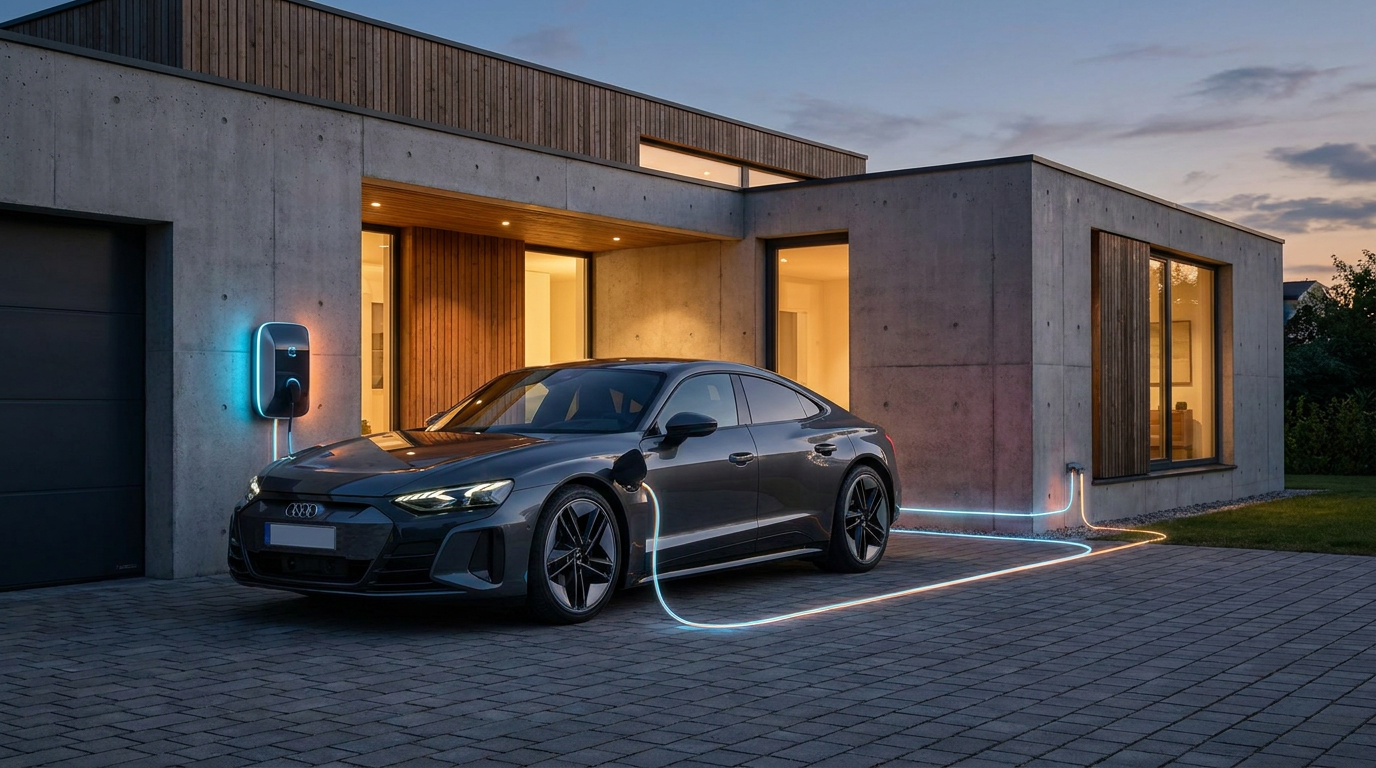
The true breakthroughs arriving at scale in 2026, however, are V2H and V2G. V2H (Vehicle-to-Home) connects the car directly to the house's electrical panel. This allows the EV to act as a seamless backup generator during blackouts, or to power the home during expensive peak-rate hours. V2G (Vehicle-to-Grid) goes a step further, exporting surplus energy directly to the utility network. In this scenario, the car effectively becomes a micro-power plant, earning its owner money by stabilizing the local power supply.[4][5][6]
Making this two-way flow work requires more than just a software update. Most electric vehicles store energy as Direct Current (DC), while homes and the broader electrical grid operate on Alternating Current (AC). Traditional charging relies on the car's onboard inverter to convert AC from the grid into DC for the battery. Bidirectional charging requires the reverse process, which is technically complex and heavily regulated.[4][6]
In 2026, this conversion is primarily achieved through specialized bidirectional DC wallboxes. These units handle the heavy lifting of converting the car's DC power back into grid-compliant AC. They must synchronize perfectly with the home's consumer unit and smart meter to ensure power flows safely, legally, and without backfeeding into the grid during a localized blackout—a critical safety requirement to protect utility workers repairing lines.[4][5]
For homeowners with rooftop solar arrays, V2H unlocks a particularly powerful synergy. During the day, when solar generation is at its peak but household consumption is typically low, the surplus energy can be routed directly into the EV's massive battery. When the sun sets and household energy use spikes, the home draws that stored solar power back from the car, drastically reducing reliance on expensive evening grid electricity.[5][6]
For homeowners with rooftop solar arrays, V2H unlocks a particularly powerful synergy.
The commercial rollout of these systems is accelerating rapidly. Volkswagen, in partnership with its energy subsidiary Elli, announced the launch of a fully integrated V2G service for private customers in Germany starting in the fourth quarter of 2026. The package includes the electric vehicle, a bidirectional charger, a smart meter, and a dynamic electricity tariff. By allowing the grid to draw on their parked ID-series vehicles during peak demand, VW estimates customers can save or earn between €700 and €900 annually.[1]

In the United States, General Motors has aggressively pursued the technology, noting that it already has over 250,000 bidirectional-capable vehicles on American roads today. GM is actively testing V2G integration with utilities like DTE Energy in Michigan, aiming to build reliable backup capacity that respects the driving preferences of homeowners. The automaker has committed to making V2G technology standard across its entire planned EV lineup, creating a massive, decentralized energy storage asset.[2]
Other major manufacturers have also integrated bidirectional hardware into their latest architectures. Hyundai and Kia's E-GMP platform, which underpins the Ioniq 5 and EV6, supports advanced V2X capabilities. Nissan's Leaf has supported a legacy version of the tech for years via its CHAdeMO plug, while newer models from Polestar and MG are rolling off assembly lines with the necessary hardware pre-installed, waiting only for localized firmware updates and utility approvals.[4]
For utility operators, the mass deployment of V2G is viewed as a potential lifeline. The global transition to renewable energy sources like wind and solar brings inherent volatility—the wind does not always blow, and the sun does not shine during the 6:00 PM evening demand peak. The International Energy Agency (IEA) recently identified V2G as offering the largest hourly energy flexibility of any evaluated grid technology.[2][3]

The financial implications for grid infrastructure are staggering. In Europe alone, the EU estimates that a properly deployed V2G network could offset roughly 25 percent of the €584 billion required for upcoming grid infrastructure upgrades. Instead of building massive, centralized lithium-ion battery farms to balance the grid, utilities can effectively lease the batteries already sitting in their customers' driveways, paying the vehicle owners a fraction of what a dedicated facility would cost.[4][6]
Despite the momentum, significant hurdles remain, primarily regarding the upfront cost of the hardware. Bidirectional DC chargers are complex pieces of equipment. In markets like the UK and Australia, installing a V2H or V2G setup can cost between $5,000 and $9,000, significantly more than a standard one-way smart charger. While the energy savings and export tariffs can offset this over a four-to-seven-year payback period, the initial capital expenditure keeps the technology out of reach for many early adopters.[4][5]

Another common consumer concern is battery degradation. Lithium-ion batteries degrade with every charge and discharge cycle, leading many to wonder if powering a house will prematurely kill an expensive EV battery. However, extensive research over the last five years indicates that V2G operations, when managed by intelligent software, have a negligible impact on battery health. The software limits the depth of discharge—typically only cycling the battery between 60% and 80%—and avoids the extreme thermal stress associated with rapid highway driving.[6]
The final piece of the puzzle is regulatory standardization. For V2G to work seamlessly, the car, the charger, the home's smart meter, and the utility company's backend software must all speak the same digital language. Protocols like ISO 15118-20 are becoming the global standard for this communication, but utility companies are notoriously slow to adapt. In many regions, homeowners still face bureaucratic delays when applying for the grid interconnection agreements required to export power.[2][6]
As hardware costs inevitably fall and utility companies streamline their onboarding processes, bidirectional charging is poised to become a standard feature of the EV ownership experience. The shift transforms the electric vehicle from a simple mode of transportation into a foundational pillar of the decentralized energy grid. By the end of the decade, plugging in a car will not just be about getting to work the next morning; it will be an active, profitable participation in the global energy market.[1][6]
How we got here
Early 2010s
Nissan introduces early bidirectional capabilities via the CHAdeMO plug on the Leaf, primarily used for pilot programs.
2022
The ISO 15118-20 standard is published, providing a unified digital communication protocol for bidirectional charging.
2024
Major automakers including GM, Hyundai, and Kia begin rolling out V2H-capable vehicles to the mass market.
Mid-2026
Pre-registration opens for Volkswagen's fully integrated V2G consumer package in Germany.
Late 2026
Commercial V2G services begin active deployment, allowing private EV owners to earn revenue from grid stabilization.
Viewpoints in depth
Automakers & Energy Providers
View EVs as dynamic infrastructure assets that can stabilize the grid and offer new revenue streams.
For manufacturers like Volkswagen and General Motors, bidirectional charging is a major value-add that differentiates EVs from internal combustion vehicles. By partnering with energy providers, automakers can offer customers dynamic tariffs and guaranteed savings, effectively lowering the total cost of EV ownership. They view the millions of vehicles they produce not just as transport, but as a massive, decentralized energy storage network that they can help manage and monetize.
Grid Regulators & Planners
Focused on standardizing communication frameworks and managing the complexities of decentralized energy storage.
Organizations like the International Energy Agency (IEA) and national grid operators see V2G as a critical tool for the renewable energy transition. Wind and solar power are inherently intermittent, requiring massive battery reserves to maintain grid stability. Regulators recognize that tapping into consumer EVs is vastly cheaper than building centralized utility-scale batteries. However, their primary concern is standardizing the digital communication protocols (like ISO 15118-20) to ensure millions of cars can safely interact with the grid without causing localized overloads.
Consumer Advocates
Excited by the financial savings and backup power, but cautious about the high initial hardware costs.
Consumer groups and early adopters are highly enthusiastic about the prospect of home energy independence and blackout resilience. However, they point out that the current economics are heavily front-loaded. With bidirectional chargers costing upwards of $5,000 to install, the technology remains a premium luxury. Advocates are pushing for government subsidies for V2G hardware and simpler, faster interconnection approvals from utility companies to democratize access to the technology.
What we don't know
- How quickly utility companies will streamline the bureaucratic approval process for homeowners to export power to the grid.
- Whether hardware costs for bidirectional DC wallboxes will drop significantly before the end of the decade.
- How dynamic electricity tariffs will evolve as millions of EVs begin participating in the energy market simultaneously.
Key terms
- Bidirectional Charging
- Technology that allows an electric vehicle charger to both send power to the car's battery and pull power from it.
- V2H (Vehicle-to-Home)
- A system where an EV discharges its battery to power a specific house, often used for backup power or to avoid peak electricity rates.
- V2G (Vehicle-to-Grid)
- A system where an EV exports surplus energy directly to the public utility network, often earning the owner money or credits.
- Inverter
- A device that converts Direct Current (DC) electricity, which batteries use, into Alternating Current (AC) electricity, which homes and the grid use.
- Peak Shaving
- The practice of reducing electrical power consumption during periods of maximum demand, often by switching to stored battery power.
- ISO 15118-20
- The international digital communication standard that allows electric vehicles and charging stations to securely negotiate bidirectional power flow.
Frequently asked
Will bidirectional charging ruin my EV battery?
Research shows that V2G operations have a negligible impact on battery health. Intelligent software limits the depth of discharge and avoids the thermal stress associated with rapid driving or fast charging.
Can any electric car be used for V2G?
No. Both the vehicle and the home charger must specifically support bidirectional power flow. While many new models from GM, VW, and Hyundai support it, older EVs generally do not.
Do I need solar panels to use Vehicle-to-Home?
No. While solar panels pair excellently with V2H by providing free daytime energy to store, you can also charge your EV from the grid overnight when rates are cheap, and use that power during expensive evening hours.
What happens if I need to drive but my car is powering the grid?
V2G systems are controlled by user-defined parameters via a smartphone app. You can set a minimum battery reserve (e.g., never drop below 50%) to ensure you always have enough range for your commute.
Sources
Source coverage
6 outlets
3 viewpoints surfaced






[1]Volkswagen GroupAutomakers & Energy Providers
Volkswagen and Elli launch Vehicle-to-Grid for private customers in Germany
Read on Volkswagen Group →[2]General MotorsAutomakers & Energy Providers
Unlocking the Potential of Vehicle-to-Grid Technology
Read on General Motors →[3]International Energy AgencyGrid Regulators & Planners
Vehicle-to-grid technology report
Read on International Energy Agency →[4]Amp RenewablesConsumer Advocates & Early Adopters
An honest look at V2H, V2G and bidirectional charging in 2026
Read on Amp Renewables →[5]Solar ChoiceConsumer Advocates & Early Adopters
Bidirectional EV Chargers in Australia
Read on Solar Choice →[6]Factlen Editorial TeamConsumer Advocates & Early Adopters
Synthesis by Factlen editorial team
Read on Factlen Editorial Team →
Every angle. Every day.
Get transportation stories with full source coverage and perspective breakdowns delivered to your inbox.