
Stablecoins and Tokenized Assets Graduate to Core Global Financial Infrastructure
Driven by major integrations from traditional payment networks and asset managers, stablecoins are now settling trillions of dollars annually, drastically reducing cross-border remittance costs and expanding global financial inclusion.
By Factlen Editorial Team
- Traditional Financial Institutions
- Focused on integrating stablecoins to enhance existing payment rails, maintain market share, and improve treasury efficiency.
- Blockchain Infrastructure Builders
- View the $32 billion RWA milestone and stablecoin volume as validation that decentralized rails are successfully upgrading legacy financial plumbing.
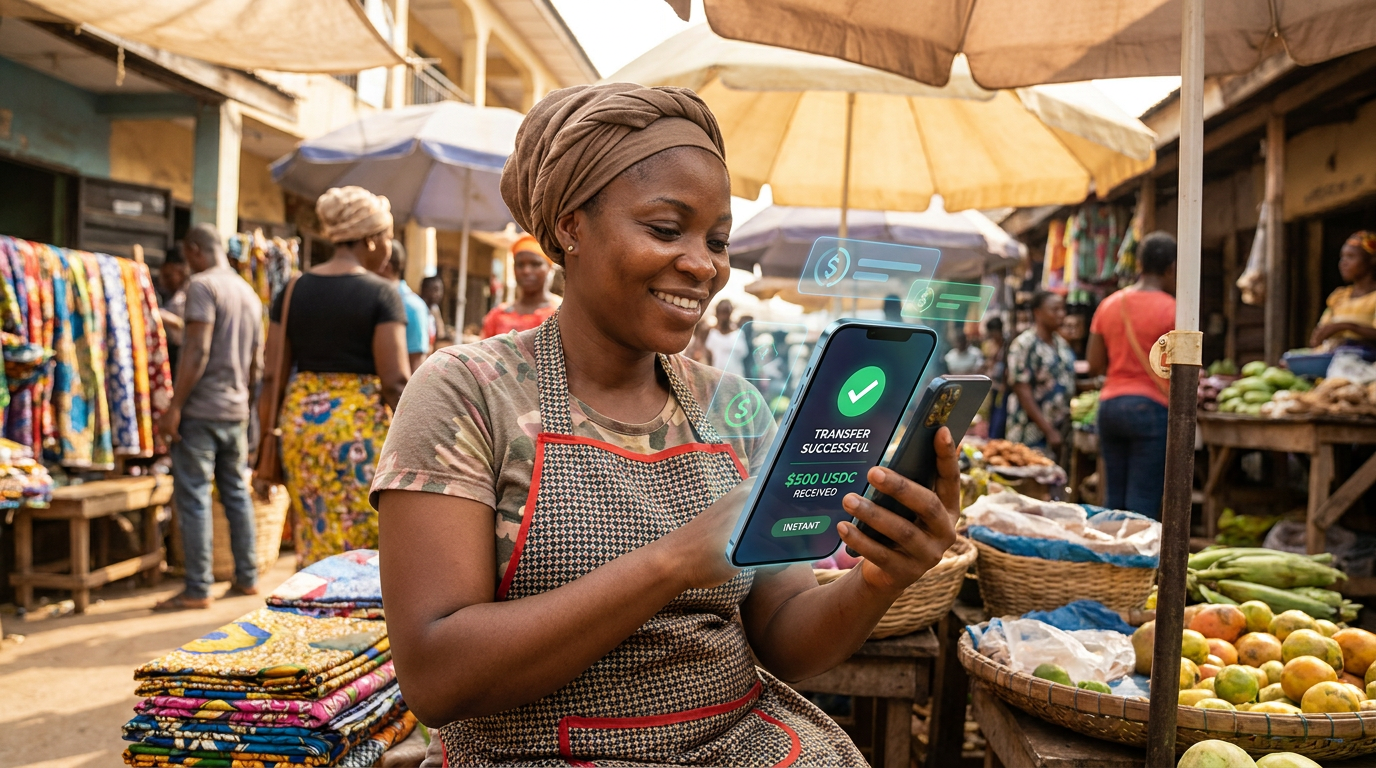
- Global Consumers & Merchants
- Care primarily about the practical benefits of the technology: faster settlement speeds, reduced transaction fees, and broader financial inclusion.
- Regulatory & Policy Analysts
- Focused on ensuring these new digital settlement rails have proper institutional controls, auditability, and consumer protections.
What's not represented
- · Local banks in emerging markets losing remittance revenue
- · Legacy wire transfer operators
Why this matters
The friction of moving money across borders has historically acted as a hidden tax on global commerce and migrant workers. The maturation of stablecoin infrastructure means international payments are becoming as fast and cheap as sending an email, unlocking capital efficiency for businesses and financial access for the underbanked.
Key points
- Stablecoins recently settled an estimated $33 trillion in value, outpacing traditional networks like Visa and Mastercard.
- Blockchain payment rails are bypassing correspondent banks, reducing cross-border transfer costs from an average of 6.49% to near zero.
- Major incumbents including Visa, Mastercard, and Stripe are actively integrating stablecoin settlement into their core operations.
- The tokenization of real-world assets (RWAs) crossed $32 billion in May 2026, driven by institutional adoption.
- Wall Street giants like BlackRock and JPMorgan have moved from experimental pilots to production-scale blockchain deployments.
- Mobile stablecoin wallets are providing a low-cost financial on-ramp for millions of unbanked individuals globally.
Something fundamental has shifted in how the world moves money. For years, cryptocurrencies were viewed primarily as speculative assets—a volatile casino disconnected from everyday commerce. But by mid-2026, the underlying technology has quietly graduated into the core plumbing of the global financial system.[7]
The numbers reveal a structural transformation. Stablecoins—digital currencies pegged to stable assets like the U.S. dollar—recently settled an estimated $33 trillion in value over a twelve-month period, outpacing the combined settlement volumes of traditional giants like Visa and Mastercard. Rather than replacing fiat currency, these blockchain-based tokens are upgrading how fiat currency moves.[7]
The most immediate beneficiary of this upgrade is the cross-border payments sector. Historically, moving money internationally required navigating a labyrinth of correspondent banks, limited operating hours, and pre-funded liquidity accounts. This legacy friction resulted in delays and high costs that disproportionately affected small businesses and migrant workers.[3]
According to World Bank data, the global average cost of sending a remittance has stubbornly hovered around 6.49%. By routing these transfers over stablecoin payment rails, financial technology companies can bypass the correspondent banking chain entirely, allowing for near-instant settlement 24 hours a day, seven days a week, and reducing transaction costs to fractions of a cent.[3][5]

Recognizing the existential threat and the massive opportunity, traditional payment incumbents are rapidly adapting. Visa recently reported an annualized stablecoin settlement run rate of $7 billion, utilizing the technology to enhance its own treasury operations. Similarly, Mastercard has integrated blockchain-based stablecoin providers into its Mastercard Move network, bridging the gap between fiat payouts and digital currency.[1][2]
The shift is also reaching everyday consumer software. Major payment service providers, including Stripe, have rolled out native support for stablecoin subscriptions and merchant checkouts. This allows an online creator in Europe to seamlessly accept digital dollars from a customer in Asia without either party absorbing exorbitant foreign exchange spreads.[1][5]
Major payment service providers, including Stripe, have rolled out native support for stablecoin subscriptions and merchant checkouts.
Beyond corporate efficiency, the proliferation of stablecoins is driving a new wave of global financial inclusion. In the United States alone, nearly 25 million households remain unbanked or underbanked, lacking access to basic credit and payment services. Globally, that number swells into the billions.[3]
For these populations, a smartphone is now sufficient to access secure, dollar-pegged digital assets. Much like the mobile money revolution that transformed telecommunications networks into banking infrastructure across Africa, stablecoins are providing a practical, low-cost on-ramp to the formal economy for users who have been priced out of traditional banking.[3][7]

But the modernization of financial infrastructure extends beyond just cash and payments. The same blockchain rails that move stablecoins are now being used to digitize traditional investments—a trend known as Real-World Asset (RWA) tokenization.[6]
By converting bonds, private credit, and real estate into programmable digital tokens, institutions are solving finance's most fundamental constraint: illiquidity. In May 2026, the total value of tokenized real-world assets on public blockchains crossed the $32 billion milestone, representing a 200% increase year-over-year.[6]
This growth is not being driven by crypto-native startups, but by Wall Street's largest asset managers. Firms like BlackRock, JPMorgan, and Franklin Templeton have transitioned from experimental pilots to production-scale deployments. Tokenized U.S. Treasuries alone account for roughly $8.7 billion of this market, offering a regulated, yield-bearing alternative to traditional stablecoins.[6]

The catalyst for this institutional embrace has been a convergence of mature technology and regulatory clarity. Clearer perimeters in major jurisdictions have given corporate treasurers and compliance officers the confidence to treat stablecoins and tokenized assets as legitimate, audit-ready operational tools rather than regulatory gray areas.[4][5]
The impact on corporate operations is profound. Businesses are increasingly utilizing stablecoins for B2B cross-border invoicing, global payroll, and contractor payouts. The ability to settle obligations in minutes rather than days—including on weekends and holidays—drastically improves cash flow visibility and reduces the need to trap capital in foreign exchange pre-funding accounts.[1][3][5]
Ultimately, the success of this financial upgrade will be measured by its invisibility. Industry leaders note that the final hurdle is the "integration gap"—embedding stablecoin technology so deeply into trusted banking and fintech applications that users benefit from the speed and cost savings without ever needing to understand the underlying blockchain mechanics. As that gap closes in 2026, the promise of a faster, fairer, and more frictionless global economy is finally becoming a reality.[1][7]

How we got here
2023–2024
Major financial institutions launch proof-of-concept pilots for blockchain settlement and asset tokenization.
Late 2025
Total stablecoin market capitalization tops $300 billion as utility shifts from trading to payments.
Jan 2026
Tokenized U.S. Treasuries cross $10 billion in on-chain value, signaling institutional confidence.
Mar 2026
Major payment processors and fintech platforms debut native stablecoin support for merchant checkouts.
May 2026
The broader tokenized Real-World Asset (RWA) market crosses the $32 billion milestone.
Viewpoints in depth
Traditional Payment Networks
Incumbents view stablecoins as a necessary infrastructure upgrade to maintain their market dominance.
For legacy payment giants, the rise of blockchain settlement is no longer viewed as a disruptive threat to be fought, but as an efficiency upgrade to be co-opted. By integrating stablecoin rails into their existing networks, these companies can drastically reduce their own treasury and liquidity costs while continuing to own the consumer-facing relationship. Their strategy hinges on closing the 'integration gap'—ensuring that users benefit from blockchain speeds without ever needing to leave the traditional banking apps they already trust.
DeFi and Blockchain Advocates
Crypto-native builders see institutional adoption as the ultimate validation of decentralized technology.
For the developers and advocates who built the underlying blockchain infrastructure, the $32 billion RWA milestone and the massive stablecoin settlement volumes are a vindication of their core thesis. They argue that traditional finance's reliance on correspondent banking and limited operating hours was always an artificial constraint. In their view, the migration of Wall Street asset managers and global payment processors to public blockchains proves that decentralized ledgers are fundamentally superior technology for moving and storing value.
Global Consumers and Merchants
Everyday users are entirely focused on the practical outcomes: speed, cost, and access.
For a freelance contractor in South America or a small business owner in Southeast Asia, the ideological debates over decentralization are irrelevant. Their perspective is purely pragmatic. Traditional cross-border payments routinely consume 5% to 7% of their revenue in fees and take days to clear. Stablecoins solve an immediate, painful business problem by allowing them to receive digital dollars instantly and for fractions of a cent, effectively leveling the playing field for global digital commerce.
What we don't know
- How quickly traditional banks will launch their own competing 'tokenized deposit' networks to rival public stablecoins.
- Whether the integration of stablecoins into everyday fintech apps will face pushback from local regulators in emerging markets trying to protect sovereign currencies.
Key terms
- Stablecoin
- A type of digital currency designed to maintain a stable value by pegging it to an external reference, such as the U.S. dollar.
- Real-World Asset (RWA) Tokenization
- The process of converting rights to a traditional physical or financial asset into a digital token on a blockchain.
- Settlement Rail
- The underlying infrastructure or network that facilitates the final transfer of funds between a payer and a payee.
- Correspondent Banking
- A traditional arrangement where one bank provides services on behalf of another bank in a different country, often creating delays and fees in cross-border transfers.
Frequently asked
What exactly is a stablecoin?
A stablecoin is a digital currency built on a blockchain that is pegged to a stable reserve asset, most commonly the U.S. dollar. This allows users to transfer value digitally without the price volatility associated with traditional cryptocurrencies like Bitcoin.
How do stablecoins make cross-border payments cheaper?
Traditional international transfers rely on a chain of correspondent banks, each taking a fee and operating only during business hours. Stablecoins move on decentralized networks that operate 24/7, allowing funds to settle directly between sender and receiver in minutes for fractions of a cent.
What are tokenized real-world assets (RWAs)?
RWA tokenization is the process of representing ownership of traditional financial assets—like government bonds, real estate, or private credit—as digital tokens on a blockchain. This makes traditionally illiquid assets easier to trade, divide, and settle.
Are traditional banks fighting this trend?
Rather than fighting it, major financial institutions are adopting the technology. Firms like Visa, Mastercard, BlackRock, and JPMorgan are actively integrating stablecoin settlement and asset tokenization into their core operations to improve efficiency.
Sources
Source coverage
7 outlets
4 viewpoints surfaced







[1]ForbesTraditional Financial Institutions
Stablecoin's payments maturation
Read on Forbes →[2]ReutersTraditional Financial Institutions
USDC circulation and OpenFX transfers see record growth
Read on Reuters →[3]Capgemini InventTraditional Financial Institutions
Why 2026 Could Be the Year Stablecoins Go Mainstream
Read on Capgemini Invent →[4]International Monetary FundRegulatory & Policy Analysts
Working Paper: Stablecoin Use in Payments and Incumbent Market Value
Read on International Monetary Fund →[5]Stablecoin InsiderBlockchain Infrastructure Builders
Stablecoin Use Cases In 2026
Read on Stablecoin Insider →[6]EasyMMBlockchain Infrastructure Builders
How $32 billion in on-chain assets is rewriting the rules of global finance
Read on EasyMM →[7]Factlen Editorial TeamGlobal Consumers & Merchants
Synthesis by Factlen editorial team
Read on Factlen Editorial Team →


Every angle. Every day.
Get finance stories with full source coverage and perspective breakdowns delivered to your inbox.