
AI and Crowdsourced Fact-Checking: What the Latest Evidence Shows
Recent studies reveal that while AI and crowdsourced community notes effectively reduce the spread of misinformation, their success depends heavily on speed and human-machine collaboration.
By Factlen Editorial Team

- Decentralized Moderation Advocates
- Argue that crowdsourcing and AI are the only scalable ways to combat the sheer volume of online misinformation.
- Human-AI Collaboration Researchers
- Focus on integrating machine efficiency with human judgment.
- Professional Fact-Checking Defenders
- Maintain that complex misinformation requires trained human expertise and journalistic standards.
What's not represented
- · Social Media Platform Executives
- · Free Speech Advocates
Why this matters
Understanding how platforms verify truth empowers you to better navigate your social media feeds. As AI and crowdsourcing replace traditional moderation, knowing their strengths and blind spots is essential for evaluating the information that shapes your worldview.
Key points
- Crowdsourced fact-checking, like Community Notes, reduces the spread of misleading posts by over 60% when visible.
- The primary flaw in crowdsourced notes is speed; they often appear too late to stop a post's initial viral surge.
- AI-generated notes are proving highly efficient, achieving an 88.8% success rate in passing human review.
- Experts warn that AI and crowdsourcing must supplement, not replace, professional fact-checkers for complex or highly polarized topics.
The internet moves significantly faster than professional fact-checkers. For years, the standard response to viral misinformation was to deploy dedicated teams of human experts to verify claims, write detailed rebuttals, and apply warning labels to offending posts. But this artisanal approach has a fatal flaw: by the time a professional fact-check is researched, written, and published, the false claim has often already reached millions of users and achieved its maximum viral impact. The sheer volume of content generated daily makes it mathematically impossible for human experts to review everything, leaving platforms vulnerable to coordinated disinformation campaigns and rapid-fire rumors.[7]
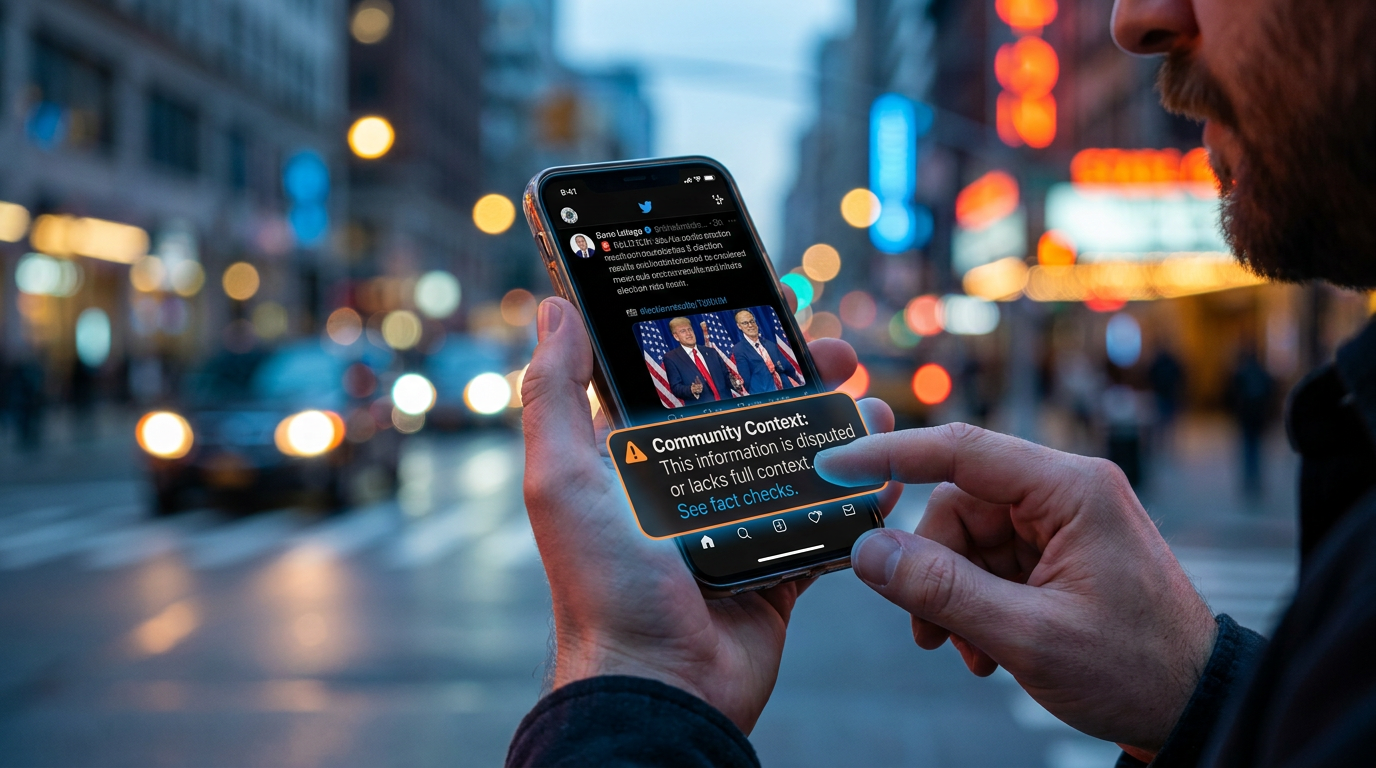
In response to this bottleneck, social media platforms have increasingly turned to decentralized, scalable solutions. The most prominent of these is crowdsourced fact-checking, best exemplified by X's Community Notes feature, which allows everyday users to append contextual information to misleading posts. More recently, platforms have begun experimenting with automated artificial intelligence systems designed to scan and flag content at machine speed. These models promise to match the unprecedented scale of the modern internet, shifting the burden of verification away from a small cadre of professionals and onto the collective intelligence of the crowd and the processing power of algorithms.[6][7]
But do these decentralized systems actually work in practice? A wave of new academic research and policy analysis published in 2025 and 2026 provides a comprehensive evidence pack on the efficacy, limits, and public perception of these next-generation moderation tools. By analyzing millions of data points across various platforms, researchers are beginning to understand exactly how crowds and algorithms alter the flow of information. The emerging consensus points to a powerful but imperfect system—one that successfully disrupts the spread of falsehoods but works best when humans and machines are forced to collaborate rather than operate in isolation.[7]
Claim 1: Crowdsourced notes effectively reduce the spread of misinformation. The empirical evidence supporting this claim is remarkably strong, provided the crowdsourced note actually becomes visible to the public. A comprehensive May 2026 study published in the journal Nature Communications analyzed over 237,000 community fact-checked cascades on the X platform, representing posts that had been shared more than 431 million times. The researchers utilized a rigorous Difference-in-Differences design to isolate the specific impact of the community notes on user behavior, providing some of the first causal evidence of the system's effectiveness at scale.[4]
The researchers found that exposing users to community notes reduced the subsequent spread of misleading posts by an impressive average of 61.2 percent. The intervention proved highly effective at stopping the momentum of a viral falsehood. Furthermore, the psychological impact on the original posters was profound: the presence of a community note increased the odds that a user would voluntarily delete their own misleading post by 94.3 percent. This suggests that public correction by a diverse group of peers creates significant social friction, discouraging users from leaving debunked claims on their public profiles.[4]

These findings are corroborated by a University of Washington study, which found that posts with Community Notes attached saw a 46 percent drop in reposts and a 44 percent drop in likes. The researchers noted that users who are distant in the social network from the original poster are much less likely to interact with the content once a note is attached. The mechanism appears to rely heavily on social signaling; when a post is visibly flagged by a consensus of users from across the political spectrum, it loses its uncritical appeal and stops being shared by casual observers.[6]
The Caveat: The speed problem. While crowdsourced notes are undeniably effective when they are attached, the Nature Communications study highlighted a critical systemic vulnerability: they frequently appear too late to matter. Because crowdsourced notes require a consensus of users from diverse ideological backgrounds to become visible—a design choice intended to prevent partisan manipulation—the voting process inherently takes time. During this deliberation period, the unchecked post continues to circulate freely, often accumulating the vast majority of its total views and engagement before the corrective label is ever applied.[4]
As a result, the notes frequently miss the early, most viral stage of a post's diffusion, which is when misinformation does the most damage. The researchers found that when accounting for the entire lifespan of the posts—including the period before the note achieved consensus—the system-wide effect was far more modest. Ultimately, the delayed appearance of the notes lowered total engagement with misleading posts by only 14.9 percent. This stark contrast between the note's effectiveness upon publication and its overall systemic impact underscores the urgent need for faster intervention mechanisms.[4]
Claim 2: Artificial intelligence is becoming highly effective at drafting fact-checks. To solve the persistent speed problem inherent in human crowdsourcing, platforms and researchers have begun integrating AI agents into the Community Notes ecosystem. A June 2026 policy study published by the R Street Institute evaluated seven months of data involving 24 active AI accounts operating through X's application programming interface. The researchers analyzed over 420,000 notes to determine how machine-generated context compared to human-authored corrections in a live, decentralized moderation environment.[1]
Claim 2: Artificial intelligence is becoming highly effective at drafting fact-checks.
The results of the R Street Institute analysis were striking. The study introduced a metric called the Verdict Success Rate, which measures how often a proposed note successfully passes the rigorous human review process and becomes publicly visible. AI-generated notes achieved a Verdict Success Rate of 88.8 percent, significantly outperforming human-written notes, which managed a success rate of only 68.5 percent. This performance gap held steady across highly contentious topic categories, including political content, international conflicts, and celebrity entertainment rumors.[1]

Beyond their high success rate, the AI notes proved to be remarkably efficient. The automated systems required three times fewer ratings per successful correction compared to their human counterparts. The R Street Institute estimated that this automated efficiency substituted for the equivalent of $577,000 to $3.4 million in professional fact-checking labor over the seven-month study period. By rapidly generating accurate, neutral context that human voters readily approve, AI agents appear capable of significantly reducing the time it takes for a corrective note to become visible to the public.[1]
Claim 3: The public trusts crowds and AI as much as experts, but for different tasks. A persistent concern among media scholars has been whether everyday users would actually trust automated or crowdsourced corrections over traditional journalistic authorities. A May 2026 study published in the journal PLOS ONE addressed this directly, finding that crowdsourced fact-checks were just as effective at reducing confidence in misinformation as expert fact-checks. The researchers concluded that the democratic nature of community consensus carries significant persuasive power, validating the shift toward decentralized moderation models.[3]
Meanwhile, a June 2026 study led by researchers at Penn State University explored the nuances of how users perceive artificial intelligence versus human fact-checkers. Through simulated social media environments, the researchers discovered that there is no definitive 'winner' in the battle for public trust. Instead, users intuitively grasped the distinct strengths and weaknesses of each system. Participants relied on 'machine heuristics'—mental shortcuts based on stereotypes about computers—assuming that AI systems were highly objective and accurate, but simultaneously distrusting them for lacking human judgment and contextual awareness.[2]
Specifically, the Penn State participants trusted AI more for large-scale scanning tasks, such as identifying linguistic 'red flags,' suspicious wording, or the telltale signs of coordinated bot activity. However, they strongly preferred human fact-checkers for nuanced tasks that required piecing together complex evidence, corroborating multiple primary sources, or interpreting highly sensitive political situations. The study suggests that public trust is not a zero-sum game between humans and machines, but rather a division of labor where each is trusted to perform the tasks suited to their inherent capabilities.[2]
The Counter-Argument: Crowdsourcing cannot entirely replace professional journalists. Despite the highly promising data on crowds and artificial intelligence, international experts warn against abandoning traditional fact-checking infrastructure. In March 2026, the European Fact-Checking Standards Network (EFCSN) highlighted a critical policy advisory opinion issued by Meta's independent Oversight Board. The Board evaluated the global expansion of community notes and concluded that decentralized models, while useful, are entirely inadequate as a standalone solution for addressing harmful misinformation on a global scale.[5]
The Oversight Board pointed to the 'limited number of published notes' as a fundamental design flaw in the crowdsourced model. They noted that while community notes generated roughly 900 visible labels during their initial U.S. rollout, professional fact-checkers enabled platforms to apply approximately 35 million warning labels over a similar period in the European Union. The requirement for cross-ideological consensus, while excellent for building trust, means that highly polarized or complex topics often fail to generate a visible note at all, leaving dangerous misinformation completely unchecked.[5]

Consequently, the Oversight Board explicitly called on major platforms to maintain and fund their relationships with independent professional fact-checkers. They emphasized that human experts are particularly vital during high-risk events, such as national elections or armed conflicts, and in linguistically complex markets where AI models lack training data and crowdsourcing struggles to achieve critical mass. Effective mitigation of systemic risk, the Board argued, requires prioritizing factual accuracy and expert intervention over the slow, sometimes flawed process of user consensus.[5]
The Synthesis: A Hybrid Future for Information Integrity. The overwhelming weight of the 2026 evidence suggests that the most robust defense against digital misinformation is not choosing between professional journalists, crowdsourced consensus, or artificial intelligence, but intelligently layering all three. Each system possesses unique strengths that directly compensate for the inherent weaknesses of the others, creating a comprehensive moderation ecosystem that is far more resilient than any single approach. Relying on just one method leaves platforms vulnerable to either the slow speed of humans or the contextual blindness of machines.[7]
In this optimal hybrid model, artificial intelligence excels at rapid detection, instantly scanning millions of posts to flag anomalies and draft initial contextual notes within seconds of publication. Crowdsourced consensus then provides the democratic legitimacy and social friction necessary to discourage users from sharing the flagged content, ensuring the corrections are viewed as fair rather than partisan. Finally, professional fact-checkers remain the essential ultimate arbiters, stepping in to investigate complex, high-stakes claims that machines cannot parse and polarized crowds simply cannot agree upon due to ideological divides.[7]
As these verification systems continue to evolve, the ultimate goal is no longer just to retroactively label falsehoods, but to build a proactive information ecosystem where truth can travel exactly as quickly as fiction. By combining the processing power of modern algorithms, the collective wisdom of the crowd, and the rigorous standards of professional journalism, society is finally developing the tools necessary to stabilize the digital public square. The challenge ahead lies not in inventing new methods, but in seamlessly integrating the ones we now know work.[7]
How we got here
2021
Twitter launches Birdwatch, the precursor to Community Notes, as a pilot program for crowdsourced fact-checking.
Late 2022
Following its acquisition, X makes Community Notes its primary form of content moderation, significantly reducing its professional trust and safety teams.
2025
Other major platforms, including Meta, begin testing and implementing their own versions of community-driven fact-checking.
May 2026
Studies in Nature Communications and PLOS ONE confirm that crowdsourced notes effectively reduce the spread of misinformation, though speed remains a challenge.
June 2026
Research reveals that AI agents integrated into the Community Notes system are achieving higher success rates than human contributors.
Viewpoints in depth
Decentralized Moderation Advocates
Argue that crowdsourcing and AI are the only scalable ways to combat the sheer volume of online misinformation.
This camp points to the efficiency and speed of AI, combined with the democratic consensus of community notes, as the future of content moderation. They argue that traditional fact-checking is too slow and often perceived as partisan, whereas crowdsourced notes that require cross-ideological agreement carry more legitimacy with skeptical users.
Professional Fact-Checking Defenders
Maintain that complex misinformation requires trained human expertise and journalistic standards.
Organizations like the EFCSN emphasize that crowdsourcing often fails to reach consensus on the most contentious and harmful issues. They argue that relying solely on community voting can allow dangerous misinformation to remain unchecked if a crowd is polarized, making professional fact-checkers indispensable for high-stakes interventions.
Human-AI Collaboration Researchers
Focus on integrating machine efficiency with human judgment.
Academic researchers suggest that treating AI and humans as competitors is a false dichotomy. Their studies show that users intuitively trust AI for rapid, surface-level scanning and humans for deep contextual analysis. The ideal system, they argue, uses AI to flag and draft, crowds to verify, and professionals to adjudicate edge cases.
What we don't know
- How adversarial actors might successfully game or manipulate AI-integrated crowdsourced voting systems at scale.
- Whether the high success rate of AI-generated notes will hold up in non-English languages and smaller international markets.
- The long-term impact of decentralized moderation on overall user trust in social media platforms.
Key terms
- Community Notes
- A decentralized moderation feature where social media users collaboratively add context or fact-checks to potentially misleading posts.
- Verdict Success Rate
- A metric used to measure how often a proposed fact-check note successfully passes the community review process and becomes publicly visible.
- Machine Heuristics
- Mental shortcuts people use when evaluating artificial intelligence, often based on stereotypes about machines being objective but lacking human nuance.
- Information Cascade
- The process by which a piece of information, such as a social media post, is rapidly shared and re-shared across a network of users.
Frequently asked
What are Community Notes?
Community Notes are a crowdsourced fact-checking system where everyday users can propose contextual notes to social media posts. If users from diverse viewpoints agree the note is helpful, it becomes publicly visible.
Can AI write fact-checks accurately?
Yes. Recent studies show AI-generated notes can achieve an 88.8% success rate in passing community review, often outperforming human-written notes in efficiency.
Do fact-checks actually change people's minds?
Research indicates they do. Both expert and crowdsourced fact-checks have been shown to significantly reduce users' confidence in misinformation and their willingness to share it.
Why don't platforms just use professional fact-checkers?
The volume and speed of misinformation on the internet far exceed the capacity of professional fact-checking teams. Platforms are increasingly using crowds and AI to scale their efforts.
Sources
Source coverage
7 outlets
3 viewpoints surfaced







[1]R Street InstituteDecentralized Moderation Advocates
AI Note Writers on Community Notes: An Evaluation of Seven Months of Data
Read on R Street Institute →[2]Penn State UniversityHuman-AI Collaboration Researchers
Users trust AI, human fact-checkers for different reasons
Read on Penn State University →[3]PLOS ONEDecentralized Moderation Advocates
Trust the crowd: Crowdsourced fact-checking is as effective at reducing confidence in misinformation as expert fact-checking
Read on PLOS ONE →[4]Nature CommunicationsHuman-AI Collaboration Researchers
Community notes reduce the spread of misleading posts on X
Read on Nature Communications →[5]European Fact-Checking Standards NetworkProfessional Fact-Checking Defenders
Meta’s Oversight Board Finds Community Notes Inadequate as Standalone Solution
Read on European Fact-Checking Standards Network →[6]University of WashingtonDecentralized Moderation Advocates
Community Notes help reduce the virality of false information on X, study finds
Read on University of Washington →[7]Factlen Editorial TeamHuman-AI Collaboration Researchers
Synthesis by Factlen editorial team
Read on Factlen Editorial Team →
More in news politics
See all 7 stories →Information Ecosystem
Evidence Pack: How Community-Driven Fact-Checking is Bridging the Partisan Divide
6 sources

Channel Tensions
Russian Warship Fires Warning Shots at British Yacht in English Channel
8 sources

US-Iran Relations
US and Iran Reach Tentative Peace Deal to End War and Reopen Strait of Hormuz
9 sources

Strait of Hormuz
US and Iran to Sign Deal Reopening Strait of Hormuz as Israel Rejects Ceasefire Terms
10 sources

Every angle. Every day.
Get news politics stories with full source coverage and perspective breakdowns delivered to your inbox.