
Perplexity vs. Google: Which Search Engine Fits Your Workflow in 2026
As AI answer engines capture a growing share of daily queries, a clear divide has emerged between Google's traditional link discovery and Perplexity's synthesized research.
By Factlen Editorial Team
- AI Synthesis Proponents
- Advocates for using AI to bypass SEO filler and get direct, cited answers.
- Traditional Discovery Advocates
- Supporters of the classic link-based model for broad exploration and local intent.
- Web Publishers
- Content creators navigating the transition from click volume to citation value.
What's not represented
- · Academic Researchers
- · Local Business Owners
Why this matters
As AI answer engines capture a larger share of daily queries, choosing the right search tool determines how quickly and accurately you can synthesize information, conduct research, and make purchasing decisions. Understanding the trade-offs between discovery and synthesis is now a core digital literacy skill.
Key points
- 37% of consumers now begin their online searches with AI platforms rather than traditional search engines.
- Google maintains a 90% global market share, dominating local, navigational, and shopping queries.
- Perplexity processes up to 1.5 billion queries monthly, excelling in multi-source synthesis and ad-free research.
- AI Overviews on Google have reduced top-position organic click-through rates by 58%.
- Traffic referred by AI citations converts at 14.2%, significantly higher than traditional organic search traffic.
The way people find information online has fractured. In 2026, the internet is no longer governed by a single search paradigm. While traditional search engines have dominated for decades, a new class of AI-powered answer engines has fundamentally altered consumer behavior. Recent data indicates that 37 percent of consumers now begin their online searches with AI platforms rather than traditional search bars. This shift has sparked a daily workflow debate for professionals and casual users alike: when is it better to use an AI synthesizer like Perplexity, and when does a traditional engine like Google still reign supreme?[7][8]
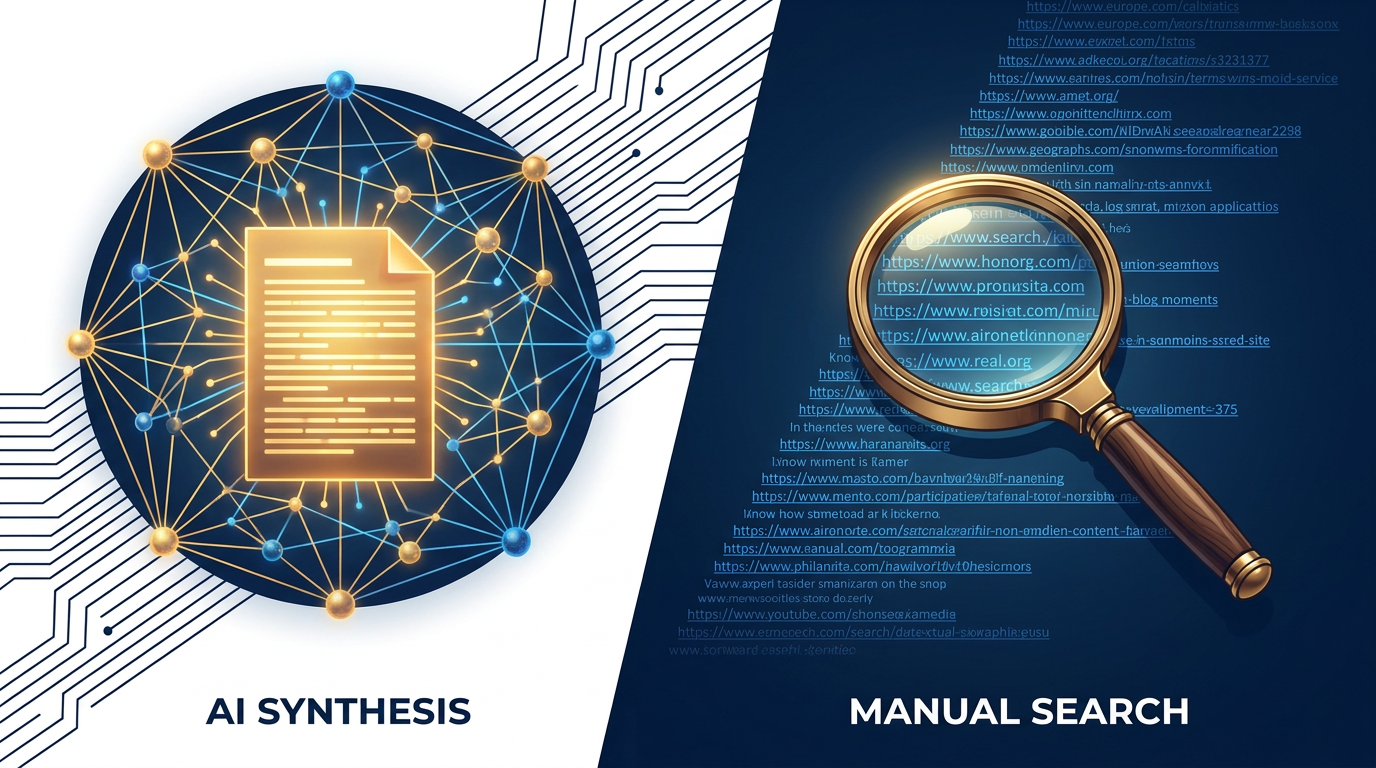
The core divide between these two approaches comes down to how information is delivered. Google operates on a discovery model, returning a ranked list of links—often accompanied by AI Overviews—that requires the user to open tabs, evaluate sources, and piece together the answer. Perplexity operates on a synthesis model, reading the live web on the user's behalf and generating a single, comprehensive answer backed by inline citations. This difference defines the modern productivity landscape, forcing users to choose between being presented with options or being presented with conclusions.[3][5]
Despite the rapid adoption of AI tools, the scale of the search landscape remains heavily skewed. Google still commands roughly 90 percent of global search traffic, processing tens of billions of queries daily. However, Perplexity has grown from a niche research tool into a formidable daily utility, processing up to 1.5 billion queries per month and attracting a highly educated, professional user base. The question in 2026 is no longer whether AI search will replace traditional search, but how users should divide their queries between the two.[6][7]

When evaluating Perplexity, the argument for the platform centers on speed, synthesis, and an ad-free experience. Proponents argue that for complex research, Perplexity eliminates the cognitive load of tab-hopping. Instead of parsing through SEO-optimized filler or scrolling past sponsored placements, users receive a structured brief. Every claim is tied to a specific numbered citation, allowing for immediate fact-checking and a cleaner signal-to-noise ratio.[1][2]
The argument against Perplexity highlights its limitations in broad exploration and real-time local data. Critics point out that by providing a single synthesized answer, the platform narrows the user's exposure to diverse opinions and serendipitous discovery. Furthermore, while it searches the live web, it lacks the deep ecosystem integration required for seamless turn-by-turn navigation, local business reviews, or complex flight and shopping comparisons.[3][5]
The evidence supporting Perplexity's utility in professional environments is substantial. Market analysis shows that 80 percent of its user base holds a college degree, and 30 percent occupy senior leadership roles. For tasks involving legal interpretation, medical information, or competitive market research, the platform's ability to maintain conversational context across follow-up questions has made it a staple in white-collar workflows.[1][8]

Conversely, when evaluating Google, the argument for the incumbent focuses on its unmatched breadth, real-time data integration, and ecosystem dominance. Defenders of traditional search emphasize that Google is not just an index of websites; it is a universal gateway. Its ability to instantly pull live sports scores, hyper-local business hours, and integrated map directions remains unparalleled, making it the default choice for actionable, real-world queries.[2][5]
Conversely, when evaluating Google, the argument for the incumbent focuses on its unmatched breadth, real-time data integration, and ecosystem dominance.
The argument against Google centers on the degradation of its core search experience through heavy monetization and the rise of zero-click searches. Critics argue that the top of a Google results page is increasingly cluttered with sponsored links and AI Overviews that push organic, high-quality links below the fold. This forces users to dig deeper to find primary sources, turning simple research tasks into an exercise in avoiding advertisements.[1][2]
The evidence surrounding Google's current model indicates a massive shift in how traffic flows across the web. Data from late 2025 and early 2026 shows that when Google's AI Overviews trigger—which now happens on nearly all informational queries—the click-through rate for the top organic position drops by 58 percent. In Google's dedicated AI Mode, a staggering 93 percent of searches end without a single click to an external website.[6][8]

Looking at the trade-offs in transparency, the two platforms offer fundamentally different approaches to sourcing. Perplexity provides granular, inline citations, tying specific statistics and claims directly to the publisher that provided them. Google's AI Overviews, while improving, typically list references at the end of a summary rather than linking them to specific sentences, which can make verifying individual facts more cumbersome for rigorous research.[2][5]
Looking at the trade-offs for web publishers, the rise of AI search presents a complex new reality. While traditional search volume is dropping, the traffic generated by AI citations is proving to be exceptionally valuable. Visitors arriving from AI platforms like Perplexity or ChatGPT spend 68 percent more time on websites and convert at a rate of 14.2 percent, compared to just 2.8 percent for traditional organic search. Being cited by an AI is rapidly becoming more lucrative than ranking on page one.[6][8]

Ultimately, Perplexity fits well when a user needs to synthesize complex regulations, compare technical specifications, or quickly assemble a market brief. It is the optimal tool for multi-step research tasks where the user previously would have spent thirty minutes manually extracting data from five different websites. It thrives in environments where the goal is to reach a conclusion quickly and cleanly.[1][3]
However, Perplexity does not fit when the intent is highly visual, local, or transactional. It struggles to provide the rich, comparative shopping experience needed to buy a pair of shoes, and it cannot replace the utility of finding a highly rated restaurant within walking distance. It is also less effective when a user wants to browse a wide variety of community opinions, such as reading through multiple forum threads.[1][5]
Google fits well when the search intent is actionable or requires deep ecosystem integration. It remains the undisputed leader for navigational queries, local discovery, and real-time data lookups. When a user needs to book a flight, check live traffic, or find a specific product across multiple retailers, Google's traditional link-based model and integrated services provide the necessary breadth of options.[2][7]

Conversely, Google does not fit when a user needs a fast, cohesive summary of a multi-layered academic or professional topic. If the query requires synthesizing the differences between two complex legal frameworks or summarizing the latest developments in a scientific field, relying on Google often means wading through ads and SEO filler to do the synthesis manually. In these cases, traditional search becomes a bottleneck rather than a shortcut.[1][4]
How we got here
Late 2022
Generative AI enters the mainstream consciousness, sparking the initial shift toward conversational answers.
Mid 2024
Google begins rolling out AI Overviews to a broader audience, fundamentally changing its search interface.
Early 2025
Perplexity introduces revenue-sharing models with publishers to address copyright and traffic concerns.
Spring 2026
Data reveals that 37% of consumers now begin their online searches with AI platforms rather than traditional engines.
Viewpoints in depth
AI Synthesis Proponents
Advocates for using AI to bypass SEO filler and get direct, cited answers.
This camp argues that the traditional search model is broken, cluttered with advertisements and SEO-optimized filler that forces users to do the heavy lifting of synthesis. They view platforms like Perplexity as a necessary evolution, pointing to the massive time savings of having an AI read, evaluate, and summarize multiple sources into a single coherent brief with inline citations.
Traditional Discovery Advocates
Supporters of the classic link-based model for broad exploration and local intent.
Defenders of traditional search emphasize that not every query has a single right answer. They argue that Google's model of presenting diverse, competing links is essential for exploratory research, shopping, and local discovery. This perspective warns that relying entirely on AI summaries creates a bottleneck of information, potentially narrowing a user's exposure to varied opinions and primary sources.
Web Publishers
Content creators navigating the transition from click volume to citation value.
For publishers, the rise of AI search is a double-edged sword. They point to alarming data showing a 58% drop in click-through rates for top-ranking pages as zero-click searches become the norm. However, they also acknowledge that traffic referred by AI citations is highly qualified, converting at nearly five times the rate of traditional search traffic, forcing a pivot from volume-based SEO to authority-based optimization.
What we don't know
- Whether Perplexity can maintain its ad-free, high-quality synthesis model as its user base and computing costs scale.
- How traditional web publishers will survive the long-term revenue impact of zero-click AI summaries.
- If Google will fully transition to a synthesis-first model or maintain its hybrid approach to protect its advertising revenue.
Key terms
- AI Overview
- A synthesized, AI-generated summary that appears at the top of Google search results to directly answer a query.
- Zero-Click Search
- A search engine query that is resolved directly on the results page, requiring no clicks to external websites.
- Inline Citation
- A numbered reference within a text that links directly to the source of the specific claim being made.
- Large Language Model (LLM)
- The underlying artificial intelligence technology that powers tools like Perplexity and Google's Gemini by predicting and generating human-like text.
Frequently asked
Is Perplexity completely replacing Google?
No. While Perplexity excels at synthesizing research, Google remains dominant for local searches, shopping, and quick navigational queries.
Does Perplexity show ads in its search results?
Currently, Perplexity offers an ad-free experience, ranking results based on relevance rather than sponsored placements, unlike Google's ad-heavy model.
How do AI Overviews affect website traffic?
AI Overviews have reduced traditional click-through rates by up to 58%, as users get answers without leaving the search page, though AI-referred traffic tends to convert at a much higher rate.
Which tool is better for academic research?
Perplexity is generally preferred for academic research because it provides inline citations for every claim, making it easier to verify specific facts.
Sources
Source coverage
9 outlets
3 viewpoints surfaced









[1]T-Minus AIAI Synthesis Proponents
Perplexity vs Google search comparison 2026
Read on T-Minus AI →[2]PlugMonkeyAI Synthesis Proponents
Perplexity vs Google: AI Answers or Traditional Links?
Read on PlugMonkey →[3]Track My VisibilityTraditional Discovery Advocates
Perplexity vs Google Search: Feature-by-Feature Comparison
Read on Track My Visibility →[4]Kamil Kwapisz BlogAI Synthesis Proponents
Google AI and Perplexity
Read on Kamil Kwapisz Blog →[5]ConbersaWeb Publishers
Perplexity vs Google for Research: Which Gives Better Answers?
Read on Conbersa →[6]UpgrowthWeb Publishers
AI Search vs Traditional Search: What Actually Changed in 2026
Read on Upgrowth →[7]Ridge MarketingTraditional Discovery Advocates
AI vs Traditional Search
Read on Ridge Marketing →[8]QuickSEOWeb Publishers
AI search vs traditional search statistics
Read on QuickSEO →[9]MediumTraditional Discovery Advocates
Search Transformed
Read on Medium →


Every angle. Every day.
Get meta stories with full source coverage and perspective breakdowns delivered to your inbox.