
How AI and Drone Swarms Are Revolutionizing Global Landmine Clearance
As conflict zones leave behind millions of explosive remnants, a new generation of machine learning models and magnetic resonance sensors is dramatically accelerating humanitarian demining.
By Factlen Editorial Team
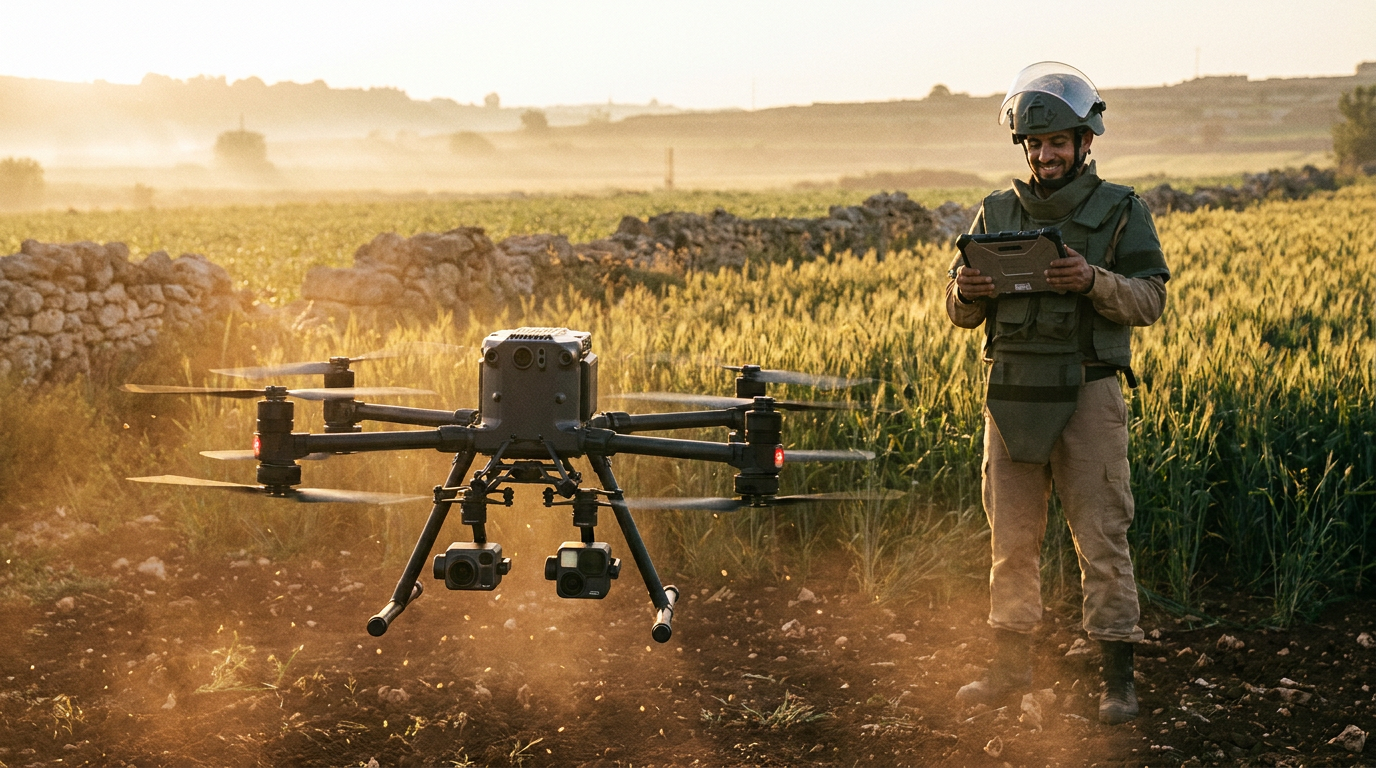
- Humanitarian Deminers
- Focus on leveraging AI and drones to safely return land to civilians and farmers as quickly as possible.
- Defense Tech Innovators
- Emphasize the role of machine learning algorithms and advanced sensors in achieving high-accuracy detection at scale.
- Geopolitical Realists
- Highlight the tension between humanitarian disarmament goals and national security concerns in active conflict zones.
What's not represented
- · Local farmers awaiting land clearance
- · Victims of landmine incidents
Why this matters
Landmines paralyze agricultural economies and threaten civilians for decades after conflicts end. The rapid deployment of AI and drone technology is dramatically accelerating clearance rates, directly restoring global food security and allowing displaced populations to safely return home.
Key points
- AI and drone swarms are replacing slow, manual probing in humanitarian mine clearance.
- Machine learning models can identify surface and semi-buried mines with over 96% accuracy using thermal imaging.
- New magnetic resonance detectors identify the molecular signature of explosives, eliminating false positives from scrap metal.
- Safe Pro Group's AI platform has successfully detected over 50,000 explosive threats in Ukraine.
- Rapid clearance is essential for restoring global food security and allowing displaced civilians to return home.
- Despite technological gains, several Eastern European nations recently withdrew from the 1997 Ottawa Treaty.
The global effort to eradicate landmines is navigating a complex geopolitical crossroads in 2026. While the 1997 Ottawa Treaty recently saw the withdrawal of several Eastern European nations citing national security concerns amid the Russo-Ukrainian War, the humanitarian demining sector is simultaneously experiencing a technological renaissance [6][7]. For decades, clearing explosive remnants of war has been a painstakingly slow and perilous process, relying heavily on manual probing and basic metal detectors. Today, the integration of artificial intelligence, unmanned aerial vehicles (UAVs), and advanced molecular sensors is fundamentally changing the math on a crisis that once threatened to take generations to solve [1][2].[1][2][6][7]
The traditional demining toolkit is increasingly mismatched against modern conflicts. Conventional electromagnetic induction (EMI) detectors are highly effective at finding metal, but they cannot distinguish between a lethal anti-personnel mine and harmless battlefield shrapnel [5]. In heavily contested areas, deminers often spend hours excavating false positives. Furthermore, modern "low-metal" or plastic-cased mines evade traditional sweeps entirely [1]. To overcome this bottleneck, organizations are deploying drone swarms equipped with multispectral and thermal infrared sensors to map vast tracts of land before a human ever steps foot in the hazardous area [4][5].[1][4][5]
The core of this revolution lies in deep learning algorithms trained to recognize the visual and thermal signatures of explosive devices. Commercial platforms have ingested massive datasets of real-world drone imagery to train computer vision models. In May 2026, defense technology firm Safe Pro Group announced that its AI-powered SPOTD system had successfully identified over 50,000 landmines and unexploded ordnance (UXO) in Ukraine [3]. By automating the analysis of aerial footage, these systems can identify more than 150 types of explosive threats, transforming a process that once took weeks of manual labor into a digital mapping exercise completed in a single day [2][3].[2][3]

Academic validation of these AI models demonstrates striking efficacy. Researchers utilizing the MobileNetV3-Large architecture on thermal images captured by commercial drones achieved a test accuracy of 96.1% in identifying surface and semi-buried mines [4]. Similarly, studies employing Faster Regional-Convolutional Neural Networks (Faster R-CNN) on RGB and thermal datasets have proven highly adept at locating scatterable munitions, such as the PFM-1 "butterfly" mine, which are notoriously difficult to clear due to their small size and wide dispersal patterns [5]. These models learn to detect subtle thermal anomalies—differences in heat retention between the explosive casing and the surrounding soil—that are invisible to the naked eye [4].[4][5]
Academic validation of these AI models demonstrates striking efficacy.
While drones provide a macro-level view, micro-level detection is also undergoing a paradigm shift. The HALO Trust, the world’s largest humanitarian mine clearance organization, has partnered with technology firms to field-test magnetic resonance detectors [1]. Unlike conventional tools that beep at any buried metal, these next-generation handheld devices detect the specific molecular identity of explosive compounds within the earth [1]. By confirming the presence of actual explosives rather than just metallic casings, deminers can confidently bypass scrap metal, drastically accelerating the pace of clearance operations in heavily bombarded agricultural regions [1].[1]

The economic and humanitarian stakes of rapid clearance are immense. Mine action is widely considered the fundamental enabler of post-conflict recovery; until land is certified safe, humanitarian aid cannot flow, infrastructure cannot be rebuilt, and farmers cannot plant crops [2]. In Ukraine alone, the HALO Trust has utilized these emerging technologies to clear over 36,000 explosives, safely returning more than 20 million square meters of land to local communities [1][7]. This rapid reclamation is vital not only for local livelihoods but for stabilizing global food supply chains that rely on these agricultural yields [3].[1][2][3][7]
Despite these breakthroughs, the technology is not without significant limitations and transparent uncertainties. AI models currently excel at identifying surface-laid or semi-buried munitions, but they struggle with deeply buried mines or those obscured by dense vegetation and heavy snowfall [5]. Furthermore, the mine action community remains highly cautious regarding "AI hallucinations"—false positives that waste time, or worse, false negatives that could cost lives [7]. Consequently, AI is currently deployed as a powerful auxiliary tool for area reduction and non-technical surveys, rather than a complete replacement for human verification [4][5].[4][5][7]

The threat landscape is also evolving to counter clearance efforts. The United Nations Mine Action Service (UNMAS) reports an increase in the deployment of "high-tech" landmines equipped with seismic and magnetic sensors [2]. These devices are designed to detonate upon detecting the approach of a deminer or the magnetic field of a clearance vehicle, turning the very tools used for detection into a liability [2]. To mitigate these risks, demining agencies are combining cutting-edge AI verification with traditional mechanical mine rollers, ensuring that fields are thoroughly neutralized before civilians are permitted to return [2].[2]
Ultimately, the fusion of artificial intelligence, aerial robotics, and molecular sensing is providing a scalable blueprint for global humanitarian disarmament. By open-sourcing datasets and providing free access to AI detection platforms for NGOs, the technology sector is democratizing tools that were once exclusive to advanced militaries [3][7]. As these machine learning models continue to ingest more field data, their accuracy and reliability will only improve, offering a realistic pathway to reclaiming millions of acres of contaminated land and saving countless lives in the decades to come [1][4].[1][3][4][7]
How we got here
1997
The Ottawa Treaty is drafted, aiming to globally ban the use, stockpiling, and production of anti-personnel landmines.
2014
States Parties to the Ottawa Treaty commit to an ambitious goal of completing global mine clearance by 2025.
2024
The HALO Trust and MRead successfully field-test magnetic resonance explosive detectors in Angola.
2025–2026
Several Eastern European nations withdraw from the Ottawa Treaty citing regional security threats, while AI demining tech sees rapid deployment.
May 2026
Safe Pro Group announces its AI platform has successfully detected over 50,000 landmines and UXOs in Ukraine.
Viewpoints in depth
Humanitarian Deminers
Focus on leveraging AI and drones to safely return land to civilians and farmers as quickly as possible.
For humanitarian organizations, the primary metric of success is the speed and safety with which land can be returned to productive use. Groups like the UN Mine Action Service and The HALO Trust view AI not as a replacement for human expertise, but as a critical enabler that triages vast areas of contamination. By using drones to map out where mines are—and crucially, where they are not—deminers can focus their resources on active threats rather than painstakingly probing empty fields. This approach is seen as essential for restoring agricultural economies and preventing civilian casualties.
Defense Tech Innovators
Emphasize the role of machine learning algorithms and advanced sensors in achieving high-accuracy detection at scale.
Technology developers approach the landmine crisis as a massive data processing challenge. By training neural networks on thousands of hours of drone footage, companies and academic researchers are proving that software can identify thermal anomalies and visual patterns far faster than the human eye. This camp advocates for the rapid scaling of commercial off-the-shelf drones paired with proprietary AI, arguing that democratizing these tools is the only realistic way to outpace the rate at which new mines are being deployed in modern conflicts.
Geopolitical Realists
Highlight the tension between humanitarian disarmament goals and national security concerns in active conflict zones.
While celebrating the technological advancements in clearance, geopolitical analysts point to the fracturing of international disarmament norms. The recent withdrawal of several Baltic states and Poland from the Ottawa Treaty underscores a grim reality: in the face of overwhelming conventional military threats, some nations still view anti-personnel mines as a necessary defensive deterrent. This perspective highlights the paradox of the current era, where the tools to clean up war are becoming vastly more sophisticated, even as the political consensus to ban the weapons themselves begins to fray.
What we don't know
- How quickly AI models can be trained to reliably detect deeply buried mines or those obscured by dense jungle canopies.
- Whether the withdrawal of several nations from the Ottawa Treaty will trigger a broader collapse of international norms against landmine use.
- The long-term reliability of magnetic resonance detectors across different soil types and extreme weather conditions.
Key terms
- Unexploded Ordnance (UXO)
- Explosive weapons, such as bombs, shells, and grenades, that did not explode when they were deployed and still pose a risk of detonation.
- Electromagnetic Induction (EMI)
- The technology used in traditional metal detectors, which senses metallic objects in the ground but cannot distinguish between a bomb and harmless scrap metal.
- Thermal Infrared Sensing
- A technology that detects heat signatures, allowing AI to spot landmines by recognizing how their casings retain heat differently than the surrounding soil.
- Scatterable Munitions
- Landmines that are dropped from aircraft or artillery over a wide area rather than being buried by hand, making them difficult to map and clear.
- Ottawa Treaty
- A 1997 international agreement aimed at eliminating anti-personnel landmines worldwide, though several major military powers are not signatories.
Frequently asked
How does AI detect landmines?
AI models analyze high-resolution visual and thermal imagery captured by drones to identify the specific shapes, patterns, and heat signatures of explosive devices on or near the surface.
Can AI find deeply buried landmines?
Currently, AI struggles with deeply buried mines or those hidden by dense vegetation. It is most effective at finding surface-laid, scatterable munitions and semi-buried threats.
What is a magnetic resonance detector?
Unlike traditional metal detectors that beep at any scrap metal, magnetic resonance detectors identify the specific molecular signature of explosive compounds, drastically reducing false alarms.
Why are some countries leaving the Ottawa Treaty?
In 2025 and 2026, several Eastern European nations, including Poland and the Baltic states, withdrew from the treaty, citing national security needs to use landmines for defense against potential invasions.
Sources
Source coverage
7 outlets
3 viewpoints surfaced







[1]The HALO TrustHumanitarian Deminers
HALO Trust Pioneers AI and Magnetic Resonance in Mine Clearance
Read on The HALO Trust →[2]United Nations Mine Action ServiceHumanitarian Deminers
New technologies paired with old to improve demining efficiency
Read on United Nations Mine Action Service →[3]Safe Pro GroupDefense Tech Innovators
Company Celebrates its 50,000th AI-Powered Landmine Detection Milestone
Read on Safe Pro Group →[4]ResearchGateDefense Tech Innovators
Deep Learning-Based Approach Utilizing UAVs and Thermal Imaging for Landmine Detection
Read on ResearchGate →[5]MDPI Remote SensingDefense Tech Innovators
Automated Landmine Detection Using Faster R-CNN on Multispectral and Thermal Datasets
Read on MDPI Remote Sensing →[6]Arms Control AssociationGeopolitical Realists
Baltic States and Poland Complete Withdrawal from Mine Ban Treaty
Read on Arms Control Association →[7]Factlen Editorial TeamGeopolitical Realists
Synthesis by Factlen editorial team
Read on Factlen Editorial Team →
Every angle. Every day.
Get defense security stories with full source coverage and perspective breakdowns delivered to your inbox.