
The Evidence Behind the Office-to-Residential Conversion Boom
The pipeline for converting vacant office buildings into apartments has surged nearly 500% in four years. While physical constraints limit the total number of viable buildings, the data shows adaptive reuse is cheaper, faster, and significantly greener than new construction.
By Factlen Editorial Team
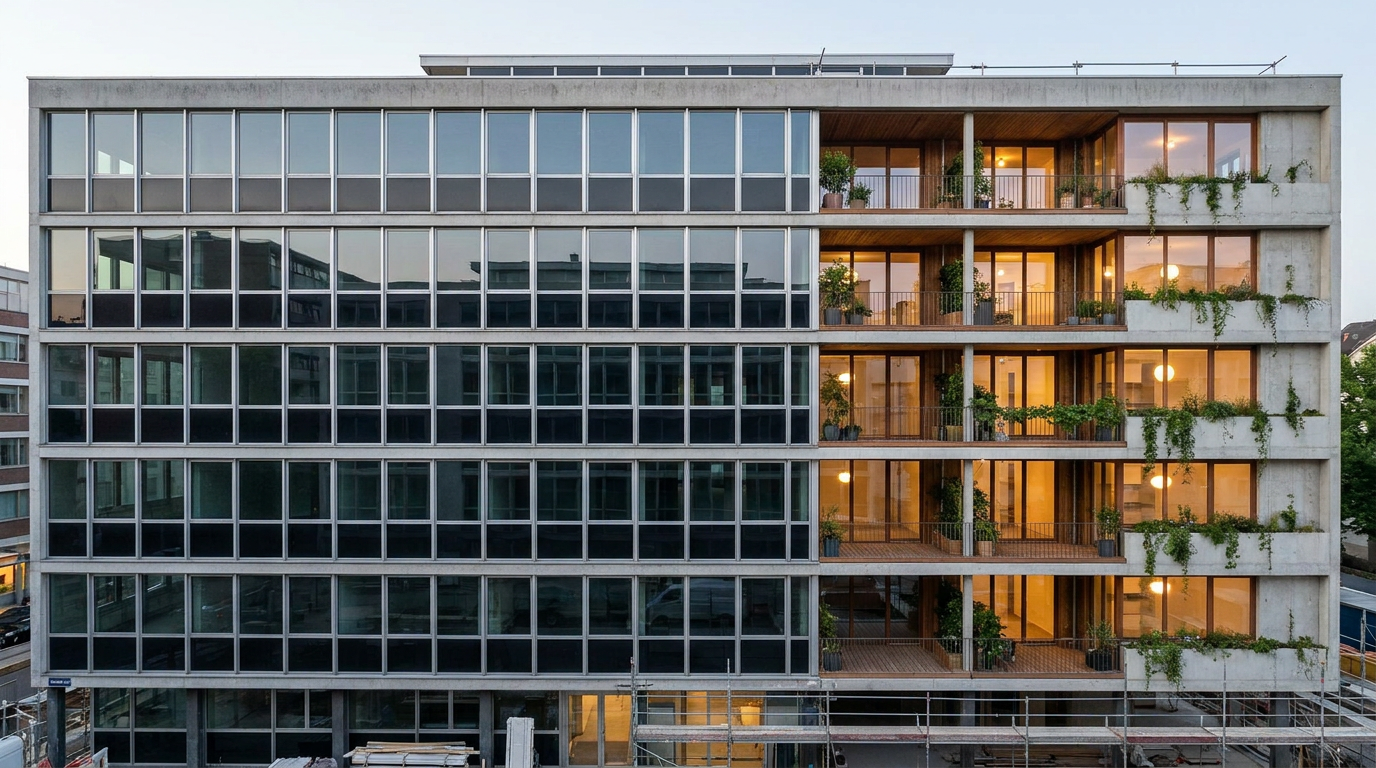
- Real Estate Developers
- Focuses on the financial and physical hurdles of conversions, arguing that deep floor plates and high acquisition costs require public subsidies to make projects viable.
- Urban Policymakers
- Views conversions as a necessary dual-solution to plummeting commercial property tax revenues and severe housing shortages, advocating for zoning reforms.
- Housing Affordability Advocates
- Warns that without strict policy guardrails and public-private partnerships, conversions will exclusively yield luxury apartments rather than accessible housing.
- Climate Economists
- Highlights the massive environmental benefits of adaptive reuse, specifically the reduction of embodied carbon by saving existing concrete and steel structures.
What's not represented
- · Commercial Office Tenants
- · Construction Labor Unions
Why this matters
As remote work leaves downtowns hollowed out and residential rents remain painfully high, converting empty offices into apartments offers a rare dual-solution. For readers, this trend dictates the future cost of urban housing, the environmental footprint of our cities, and whether downtowns will survive as vibrant, mixed-use neighborhoods.
Key points
- The U.S. pipeline for office-to-residential conversions has grown by 484% over the past four years.
- Only about 11% of downtown office buildings are physically suitable for conversion due to deep floor plates and lighting requirements.
- Converting an existing building is generally cheaper and faster than ground-up new construction.
- Adaptive reuse produces 50% to 75% fewer carbon emissions by preserving the embodied carbon of existing structures.
- High acquisition costs mean that public subsidies and zoning reforms are often required to make projects financially viable.
- Co-living micro-apartments offer a potential pathway to creating affordable housing within converted office spaces.
The American downtown is undergoing its most radical physical transformation since the post-war boom. Faced with the dual crisis of structurally vacant commercial real estate and a severe nationwide housing shortage, urban planners and developers are increasingly turning to a solution that seems obvious on paper: converting empty office cubicles into residential apartments. What began as a pandemic-era thought experiment has rapidly matured into a measurable, data-backed structural shift in the real estate market.[1][6]
The primary claim driving this trend is that adaptive reuse can meaningfully dent the housing shortage at scale. The evidence supporting this scale is strong and accelerating. According to industry data, the pipeline for converting office spaces into apartments has surged by 484% over the last four years. By mid-2026, the nationwide office-to-residential conversion pipeline reached over 90,300 units. In 2024 alone, developers completed nearly 25,000 adaptive reuse apartments, a record high driven largely by the repurposing of older Class B and C commercial buildings.[2][3][8]

However, transparent uncertainty remains regarding exactly how much of the existing office stock can actually be saved. A landmark study by the National Bureau of Economic Research (NBER) mapped the physical characteristics of office buildings across the 105 largest U.S. cities to determine their true conversion viability. The researchers found that only about 11% of downtown office buildings are physically suitable for residential conversion. Yet, even with this constraint, the NBER concluded that this 11% subset alone could add roughly 400,000 new apartments to the national housing stock.[4]
The reason that suitability number sits at 11% rather than 100% comes down to the rigid laws of architecture and building codes. Modern office buildings were designed with massive, deep floor plates to maximize desk space under artificial light. Residential building codes, however, strictly require bedrooms to have operable windows and natural light. In a deep office building, the center of the floor plate becomes a "dark core" that is legally uninhabitable. To make these buildings work, architects must creatively carve out blind shafts or central light wells, which adds immense engineering complexity.[6][8]

A secondary claim is that when the physical layout does cooperate, adaptive reuse is significantly cheaper and faster than building from scratch. The evidence here points to clear cost advantages. Global real estate services firm CBRE estimates that retrofitting a suitable office building costs around $213 per square foot, compared to $275 per square foot for ground-up new construction. Furthermore, developers report that adaptive reuse can shave six to twelve months off the standard construction timeline, allowing them to bring units to market faster and avoid the prolonged carrying costs of a vacant lot.[7]
A secondary claim is that when the physical layout does cooperate, adaptive reuse is significantly cheaper and faster than building from scratch.
The third major claim centers on the environmental impact, with proponents arguing that conversions are a vital climate strategy. The evidence for this is robust. The construction industry is a massive contributor to global greenhouse gas emissions, largely due to the "embodied carbon" generated by manufacturing and transporting steel and concrete. By preserving the existing structural frame of an office building, the NBER study found that developers can produce 50% to 75% fewer carbon emissions than they would by demolishing the site and building a new residential tower in its place.[4]

Despite the physical and environmental benefits, a significant "feasibility gap" threatens many projects. Even when a building is architecturally perfect for apartments, the math often fails because the cost of acquiring the half-empty office building remains too high relative to the projected residential rents. This financial friction means that without intervention, the free market alone will not convert enough buildings to solve the downtown vacancy crisis.[6]
This leads to the final claim: aggressive policy interventions are the deciding factor in making the math work. The evidence strongly supports this, showing that cities with proactive zoning and tax incentives are capturing the lion's share of the conversion boom. In New York, the "City of Yes" zoning initiative and a new state tax abatement have pushed the city to start roughly 9.5 million square feet of conversions in 2026 alone. Similarly, Los Angeles recently adopted a Citywide Adaptive Reuse Ordinance that streamlines the permitting process for commercial buildings older than 15 years, bypassing years of bureaucratic red tape.[1][8]
A lingering debate surrounds the affordability of these new units. Because of the high costs involved in acquiring and retrofitting commercial towers, developers naturally gravitate toward luxury apartments to recoup their investments. Housing advocates warn that without strict policy guardrails, the conversion boom will do little to help middle- and lower-income renters who are most affected by the housing shortage.[5][6]
To counter this, researchers at The Pew Charitable Trusts suggest that cities can maximize their affordable housing budgets by subsidizing "co-living" micro-apartments. By utilizing the existing central plumbing of an office building for shared kitchens and bathrooms, and placing small, fully furnished bedrooms along the windowed perimeter, developers can cut per-unit costs to as low as $123,000. This model proves that with the right design, conversions can serve a diverse range of income levels.[5]

Ultimately, the transformation of America's downtowns will not happen overnight, and it will not save every obsolete office building. But the accelerating pace of conversions, backed by strong economic and environmental data, signals a permanent shift away from the 20th-century model of single-use business districts. By embracing adaptive reuse, cities are slowly paving the way for more resilient, 24/7 mixed-use neighborhoods.[1][3][6]
How we got here
2020–2022
The pandemic normalizes remote work, causing downtown office vacancy rates to spike and commercial property values to drop.
January 2023
New York City's Office Adaptive Reuse Task Force recommends sweeping policy changes to encourage conversions.
2024
A record-breaking 25,000 apartments are completed from adaptive reuse projects across the U.S.
February 2026
Los Angeles adopts a Citywide Adaptive Reuse Ordinance to streamline the conversion of commercial buildings into housing.
June 2026
The U.S. office-to-residential conversion pipeline reaches a historic high of over 90,000 units.
Viewpoints in depth
Real Estate Developers
Focuses on the financial and physical hurdles of executing conversions.
Developers emphasize that while the concept of adaptive reuse is popular, the execution is fraught with physical and financial peril. They point out that modern office buildings feature massive, deep floor plates that create "dark cores" where legal residential bedrooms cannot exist. Fixing this requires carving out expensive central light wells. Furthermore, they argue that even obsolete Class B and C office buildings are often priced too high by their current owners, creating a "feasibility gap" where the cost of acquisition and renovation exceeds the potential rental income. Consequently, they argue that widespread conversions are impossible without significant public subsidies and tax abatements.
Urban Policymakers
Views conversions as an existential necessity to save downtown tax bases.
City planners and local governments view the office vacancy crisis as an existential threat to municipal budgets, which rely heavily on commercial property taxes. For policymakers, incentivizing office-to-residential conversions is a dual-solution: it removes excess office supply to stabilize commercial property values while simultaneously adding desperately needed housing units to the market. They advocate for aggressive zoning reforms, such as New York's "City of Yes" initiative, to remove bureaucratic red tape, arguing that creating 24/7 mixed-use neighborhoods is the only way to ensure the long-term survival of the American downtown.
Housing Affordability Advocates
Questions whether the conversion boom will actually serve middle- and lower-income residents.
Housing advocates generally support the addition of new units to the market but remain highly skeptical of the conversion boom's impact on affordability. Because developers face such high costs to acquire and retrofit commercial towers, they almost exclusively build luxury apartments to maximize their return on investment. Advocates argue that without strict policy guardrails—such as requiring a percentage of units to be rented below market rate in exchange for tax breaks—the trend will do nothing to alleviate the housing crisis for those who need it most. They champion alternative models, such as co-living micro-apartments, which use shared infrastructure to drastically lower per-unit costs.
What we don't know
- Whether the current wave of government tax incentives will be enough to bridge the feasibility gap for buildings in secondary and tertiary markets.
- How the influx of residential units will permanently alter the retail and transit infrastructure needs of traditionally commercial downtowns.
- If the commercial real estate market will eventually correct its pricing to make acquisition costs low enough for unsubsidized affordable housing conversions.
Key terms
- Adaptive Reuse
- The process of repurposing an existing building for a use other than what it was originally designed for, such as turning an office into apartments.
- Floor Plate
- The total leasable square footage of a single floor in a commercial building, which dictates how much natural light reaches the interior.
- Class B and C Offices
- Older or less desirable commercial buildings that lack the modern amenities and premium locations of Class A properties, making them prime candidates for conversion.
- Embodied Carbon
- The total greenhouse gas emissions generated by the manufacturing, transportation, and assembly of building materials like steel and concrete.
- Feasibility Gap
- The financial shortfall that occurs when the cost of acquiring and converting a building exceeds its projected value on the open market.
Frequently asked
Can any vacant office building be converted into apartments?
No. Research indicates that only about 11% of downtown office buildings have the right physical characteristics, such as suitable floor plates and plumbing access, to be legally and economically converted.
Is it cheaper to convert an office or build a new apartment?
Generally, conversion is cheaper. Industry estimates show that retrofitting a suitable office building costs around $213 per square foot, compared to $275 per square foot for new construction.
Will converted offices provide affordable housing?
It depends heavily on local policy. Without subsidies, high acquisition and construction costs push developers toward luxury units, but targeted grants and co-living designs can make affordable models viable.
How does adaptive reuse affect the environment?
It is highly beneficial. Rehabilitating an existing building produces 50% to 75% fewer carbon emissions than demolishing it and building from scratch, largely by saving the embodied carbon in the concrete and steel.
Sources
Source coverage
8 outlets
4 viewpoints surfaced








[1]Multifamily DiveReal Estate Developers
Office-to-housing conversion initiatives proliferate in California
Read on Multifamily Dive →[2]Facilities DiveReal Estate Developers
Adaptive reuse apartment conversions hit record high in 2024
Read on Facilities Dive →[3]ResiClubReal Estate Developers
The office-to-residential conversion pipeline has surged 484% in 4 years
Read on ResiClub →[4]NBERClimate Economists
Converting Brown Offices to Green Apartments
Read on NBER →[5]The Pew Charitable TrustsHousing Affordability Advocates
Co-Living Microapartments Could Help Solve the Housing Crisis
Read on The Pew Charitable Trusts →[6]Brookings InstitutionUrban Policymakers
Simulating the impacts of office-to-residential conversion
Read on Brookings Institution →[7]CBREReal Estate Developers
Office Conversions and Redevelopment in Washington, D.C.
Read on CBRE →[8]GenslerReal Estate Developers
5 Strategies That Make Office-to-Residential Conversions Viable
Read on Gensler →
Every angle. Every day.
Get real estate stories with full source coverage and perspective breakdowns delivered to your inbox.