
Office-to-Residential Conversions Hit Record High as Cities Tackle Housing Shortage
More than 90,000 apartments are currently under construction inside former U.S. office buildings, driven by plunging commercial property values and aggressive new city tax incentives.
By Factlen Editorial Team
- Commercial Developers
- Focusing on the financial math, acquisition costs, and necessity of tax incentives to make retrofitting viable.
- Urban Planners & City Officials
- Viewing conversions as a lifeline for struggling downtowns and a tool to increase housing supply.
- Architects & Engineers
- Tackling the physical limitations of mid-century commercial architecture, such as deep floorplates and centralized HVAC.
- Affordable Housing Advocates
- Pushing to ensure public subsidies and zoning variances benefit low- and middle-income renters.
What's not represented
- · Existing commercial tenants navigating construction in partially converted buildings
- · Local school districts preparing for an influx of downtown families
Why this matters
Transforming empty office buildings into apartments addresses two of the most pressing urban crises of the decade: the collapse of commercial real estate values and the severe shortage of affordable housing. For residents, this trend promises to revitalize sterile downtowns into vibrant, 24/7 neighborhoods with new housing options.
Key points
- More than 90,300 apartments are currently under construction in former U.S. office buildings, a nearly 300% increase since 2022.
- New York City leads the nation with over 16,300 units in the pipeline, followed by Washington D.C., Chicago, and Los Angeles.
- Cities are offering massive tax abatements and streamlined zoning to encourage developers to take on the expensive retrofits.
- In exchange for public subsidies, many municipalities are requiring developers to set aside 17% to 25% of the new units as affordable housing.
Across the United States, downtowns are grappling with a stark contradiction: office towers sit half-empty while residential rents skyrocket due to a severe housing shortage. With national office vacancy rates hovering near 20% following the permanent shift to hybrid work, millions of square feet of commercial space are generating little to no revenue. At the same time, cities are desperate for housing. This dual crisis has accelerated a solution that was once considered a niche architectural experiment: adaptive reuse.[5][9]
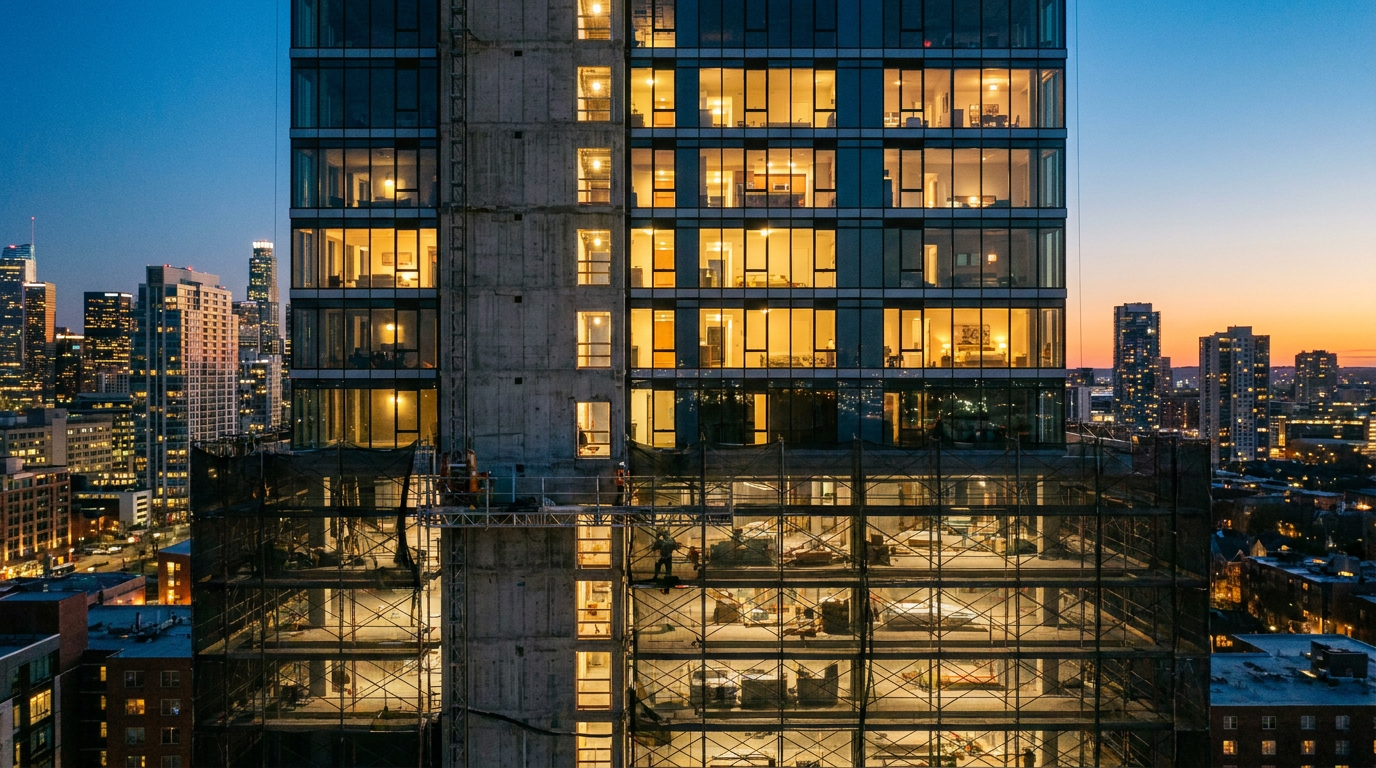
In 2026, the conversion of obsolete office buildings into residential apartments has scaled into a massive national movement. Driven by plummeting commercial property values, targeted government incentives, and advancements in retrofit engineering, developers are fundamentally rewiring the American downtown. Rather than waiting for corporate tenants who may never return, property owners are tearing out cubicles and suspended ceilings to build vertical neighborhoods.[1][2]
The sheer volume of this transition is unprecedented. As of early 2026, more than 90,300 apartments are actively under construction within former office buildings across the country. This represents a 28% year-over-year jump and a nearly 300% increase since 2022. New York City leads the nation by a wide margin, with over 16,300 conversion units underway, followed closely by Washington D.C., Chicago, and Los Angeles. Offices now account for nearly half of all adaptive reuse projects nationwide, outpacing hotels and industrial spaces.[1][2]

However, transforming a space designed for cubicles into comfortable housing is not as simple as putting up drywall. The primary hurdle is the "floorplate"—the total square footage of a single floor. Mid-century office buildings were often built with massive, deep floorplates designed to maximize desk space under artificial fluorescent lighting. When converting these floors to apartments, developers face a geometric problem: residential building codes require bedrooms to have windows, but the center of a deep office building is entirely cut off from natural light.[6][8]
To solve this, architects are performing radical structural surgery. A common technique involves coring out the center of a building from the roof down to the lobby, creating a massive internal "lightwell" or open-air courtyard. This allows developers to wrap apartments around the newly created interior perimeter, ensuring every unit receives natural light and ventilation while turning the dark core of the building into a shared amenity space.[8]
Beyond geometry, the invisible infrastructure of an office building must be entirely replaced. Commercial towers rely on massive, centralized HVAC systems and clustered bathrooms near the elevators. Residential buildings require decentralized climate control and plumbing in every unit. Engineers must drill through decades of concrete to install "vertical wet stacks"—aligned plumbing pipes that run from the ground floor to the roof—and replace industrial chillers with energy-efficient Variable Refrigerant Flow (VRF) systems that allow individual tenants to control their own temperatures.[8]

Beyond geometry, the invisible infrastructure of an office building must be entirely replaced.
These structural challenges make conversions expensive, with retrofit costs ranging from $100 to $500 per square foot. For the math to work, developers must acquire the empty office buildings at a steep discount. In some upstate New York markets, for example, obsolete office complexes are trading for as little as $25 per square foot. When the acquisition basis is that low, developers have the financial flexibility to absorb the high construction costs and still deliver a profitable residential project.[9][10]
Recognizing the financial hurdles, local governments are aggressively rewriting zoning codes to grease the wheels. In February 2026, Los Angeles adopted a sweeping Citywide Adaptive Reuse Ordinance. The new rules allow commercial buildings as young as 15 years old to be converted into housing by-right, bypassing years of lengthy environmental reviews and zoning hearings. The policy is expected to unlock thousands of new units across the city, expanding on a 1999 ordinance that originally revitalized downtown L.A.[3]
Other cities are deploying direct financial incentives to bridge the funding gap. Boston recently launched an Office-to-Residential Conversion Program that offers developers a 75% property tax abatement for up to 29 years, provided they begin construction quickly. In Chicago, the LaSalle Corridor Revitalization initiative has injected $315 million in tax increment financing (TIF) to support six major projects, aiming to convert 2 million square feet of historic financial district office space into nearly 1,800 apartments.[4][7]
In exchange for these lucrative tax breaks and zoning variances, cities are demanding a public return on investment: affordable housing. Boston's program requires developers to set aside 17% of all newly created units for low- and middle-income residents. Similarly, New York's 467-m tax incentive mandates that at least 25% of the converted apartments be income-restricted. These requirements ensure that the wave of adaptive reuse doesn't exclusively produce luxury penthouses, but actually chips away at the workforce housing shortage.[4][7]

The impact of these conversions extends far beyond the walls of the buildings themselves. Urban planners view adaptive reuse as a vital tool for neighborhood stabilization. Traditional central business districts were designed as 9-to-5 monocultures that emptied out after dark. By injecting thousands of full-time residents into these areas, cities are fostering 24/7 neighborhoods. The influx of foot traffic supports ground-level retail, restaurants, and public transit, creating a more resilient urban ecosystem.[4][6]
Despite the momentum, adaptive reuse is not a silver bullet for the commercial real estate crisis. Industry analysts estimate that only about 1.9 billion square feet of U.S. office space—roughly 15% to 20% of the total inventory—is structurally and economically viable for conversion. Buildings with low ceilings, unworkable floorplates, or stubborn debt structures will likely remain stranded assets, eventually facing demolition.[1][9]
Yet, for the thousands of buildings that do fit the criteria, the transformation is profound. The 2026 surge in office-to-residential conversions proves that cities can adapt to massive economic shifts without tearing down their architectural history. By turning the liability of empty offices into the asset of new housing, the commercial real estate industry is slowly but surely building a more sustainable and livable urban future.[2][5]
How we got here
1999
Los Angeles passes its original Adaptive Reuse Ordinance, sparking a downtown residential renaissance.
2020–2022
Remote work empties downtown office towers, pushing national vacancy rates toward 20%.
2023–2024
Cities like New York and Chicago introduce tax incentives and zoning changes to encourage conversions.
February 2026
Los Angeles expands its adaptive reuse rules citywide, allowing buildings just 15 years old to be converted by-right.
Mid-2026
The number of U.S. apartments under construction in former office buildings crosses 90,000, a nearly 300% increase since 2022.
Viewpoints in depth
Urban Planners & City Officials
Viewing conversions as a lifeline for struggling downtowns.
City governments see adaptive reuse as a dual-purpose tool: it eliminates the blight of empty office towers while chipping away at severe housing shortages. Planners argue that replacing 9-to-5 commuters with 24/7 residents fundamentally improves urban resilience. By offering tax abatements and streamlined zoning, they hope to transform sterile corporate districts into vibrant, mixed-use neighborhoods that support local retail and transit.
Commercial Developers
Focusing on the financial math and acquisition costs of retrofitting.
For developers, the decision to convert is strictly a math problem. They point out that retrofitting an office building is fraught with structural unknowns and high contingency budgets. The model only works when they can acquire obsolete office buildings at massive discounts—sometimes as low as $25 per square foot—and secure municipal tax incentives to offset the $100 to $500 per square foot construction costs.
Architects & Engineers
Tackling the physical limitations of mid-century commercial architecture.
Design professionals emphasize that not every building can be saved. They focus on the geometric challenges of deep floorplates, which leave interior spaces devoid of natural light. Their solutions involve radical structural surgery, such as carving massive lightwells through the center of towers and replacing centralized commercial HVAC systems with decentralized residential units. They argue that successful conversions require highly specific building 'bones.'
Affordable Housing Advocates
Pushing to ensure public subsidies benefit low- and middle-income renters.
Housing advocates are generally supportive of the conversion trend but remain skeptical of developers receiving massive tax breaks without giving enough back to the community. They argue that any project utilizing public funds or zoning variances must include strict, permanent mandates for affordable housing—typically pushing for 17% to 25% of units to be set aside for residents making below the area median income.
What we don't know
- How the influx of residential units will affect long-term property tax revenues for cities that rely heavily on commercial assessments.
- Whether decentralized residential HVAC systems will strain aging downtown electrical grids.
- How many partially converted 'mixed-use' buildings will successfully retain their remaining commercial tenants during years of construction.
Key terms
- Adaptive Reuse
- The process of repurposing an existing building for a use other than what it was originally designed for, such as turning an office into apartments.
- Floorplate
- The total leasable square footage of a single floor in a commercial building. Deep floorplates make it difficult to get natural light into the center of the building.
- Lightwell
- An unroofed external space provided within the volume of a large building to allow light and air to reach what would otherwise be a dark interior.
- Vertical Wet Stack
- The aligned plumbing pipes that run vertically through a building, essential for adding individual bathrooms and kitchens to former office floors.
- Variable Refrigerant Flow (VRF)
- A decentralized, energy-efficient HVAC technology that allows individual apartment units to control their own heating and cooling, replacing massive centralized office systems.
Frequently asked
Why are so many office buildings being converted now?
A combination of persistent post-pandemic office vacancies (around 20% nationally) and a severe housing shortage has made conversions both necessary and financially viable.
Can any office building become an apartment complex?
No. Only about 1.9 billion square feet of U.S. office space is considered structurally suitable. Buildings with very deep floorplates or low ceilings are often too expensive to retrofit.
Do these projects create affordable housing?
Many do, but usually because cities mandate it. Programs in Boston and New York require developers to set aside 17% to 25% of units as affordable in exchange for tax breaks.
Is it cheaper to convert an office or build from scratch?
Conversion costs range from $100 to $500 per square foot. It is generally cheaper and faster than ground-up construction, provided the developer can acquire the empty office building at a steep discount.
Sources
Source coverage
10 outlets
4 viewpoints surfaced









[1]ConstructConnectArchitects & Engineers
Adaptive Reuse Surge: Office-to-Residential Projects Nearly Quadruple Since 2022
Read on ConstructConnect →[2]The Real DealCommercial Developers
Office-to-resi conversions hit record high of 90K units
Read on The Real Deal →[3]Los Angeles TimesUrban Planners & City Officials
Los Angeles loosens rules for office-to-residential conversions
Read on Los Angeles Times →[4]Boston Planning & Development AgencyUrban Planners & City Officials
Office to Residential Conversion Program
Read on Boston Planning & Development Agency →[5]Cushman & WakefieldCommercial Developers
New York City Office-to-Residential Conversions Hit Highest Level Since 2008
Read on Cushman & Wakefield →[6]J.P. MorganAffordable Housing Advocates
What’s driving office-to-residential conversion demand?
Read on J.P. Morgan →[7]CommercialSearchCommercial Developers
City Programs Fueling Office-to-Residential Conversions
Read on CommercialSearch →[8]SnaphomzArchitects & Engineers
Zoning the Vertical Neighborhood: Adaptive Reuse in 2026
Read on Snaphomz →[9]RealtyAdsCommercial Developers
The Era of Office-to-Residential Conversions
Read on RealtyAds →[10]Largo CapitalCommercial Developers
Undervalued Office Assets Are Becoming Upstate New York's Next Housing Play
Read on Largo Capital →
Every angle. Every day.
Get real estate stories with full source coverage and perspective breakdowns delivered to your inbox.