
How Neuroaesthetics is Turning Interior Design into a Science of Well-Being
Researchers are using brain scans and biometric data to prove that specific interior design choices can actively lower stress and improve human health.
By Factlen Editorial Team
- Neuroscience Researchers
- Scientists focused on the biological and evolutionary mechanisms behind spatial perception.
- Evidence-Based Designers
- Architects and interior designers translating clinical data into practical spatial applications.
- Neurodiversity Advocates
- Voices championing inclusive environments that accommodate varying sensory processing needs.
What's not represented
- · Traditional Decorators
- · Real Estate Developers
Why this matters
For decades, interior design was treated as a luxury focused on visual appeal. Understanding neuroaesthetics empowers anyone to transform their home into a biological tool that actively lowers stress, improves sleep, and supports mental health.
Key points
- Neuroaesthetics bridges brain science and interior design to measure how spaces affect human biology.
- Specific design choices can lower blood pressure, reduce cortisol, and increase dopamine.
- The brain evaluates rooms based on coherence, fascination, and hominess.
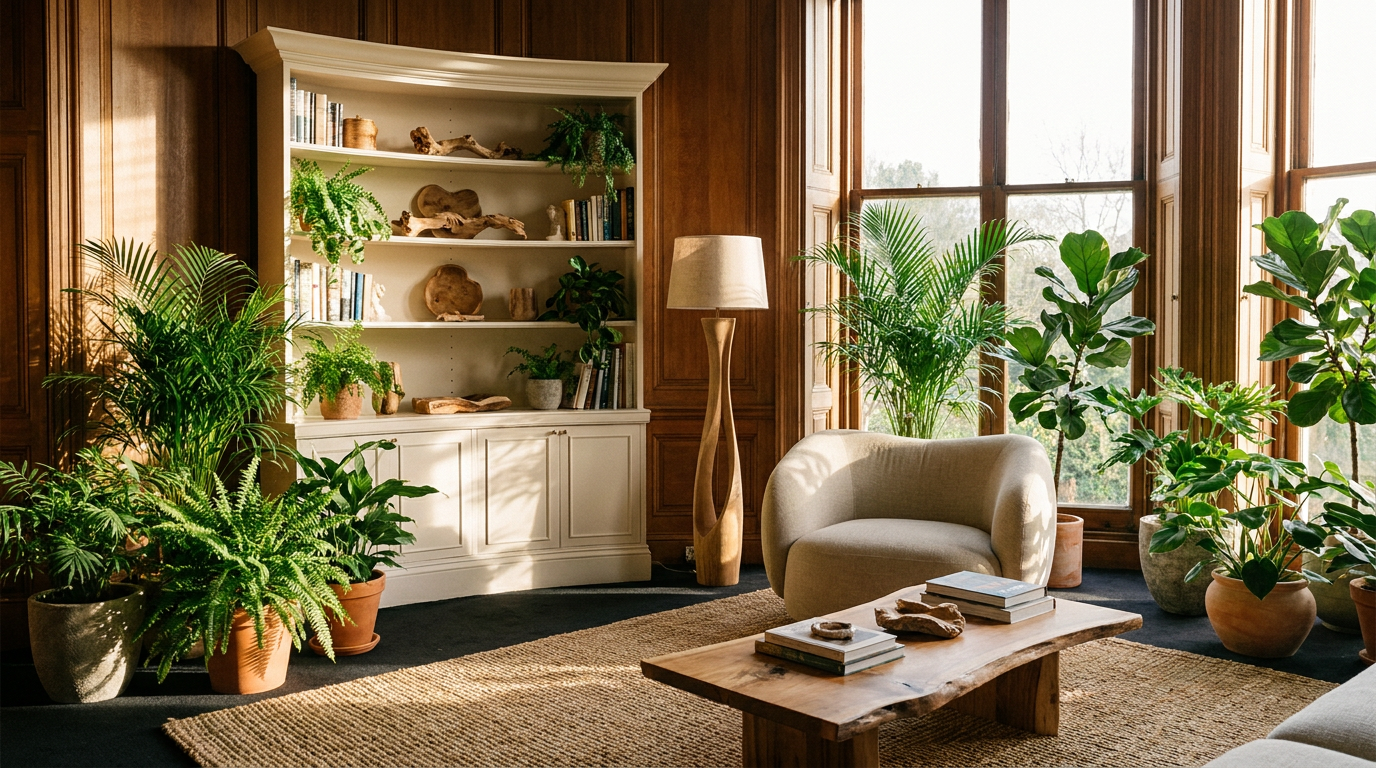
- Biophilic elements, like natural light and organic textures, trigger evolutionary safety signals.
- Curvilinear shapes and rounded edges activate the brain's reward centers more than sharp angles.
- The industry is shifting toward inclusive design that accommodates varying sensory needs.
For decades, interior design was treated as a purely subjective art form—a matter of matching swatches, balancing proportions, and chasing aesthetic trends. But a quiet revolution is redefining how we build the spaces we inhabit, shifting the focus from visual flair to biological function.[8]
Enter neuroaesthetics, an emerging discipline at the intersection of brain science and spatial design. Rather than simply asking what a room looks like, this field asks what a room actively does to the human nervous system.[4][8]
The premise is deeply rooted in evolutionary biology. Our brains evolved to constantly scan our surroundings for safety, resources, and threats. When we step into a modern living room, those ancient neural networks are still firing, processing light, geometry, and texture as vital biological signals.[3][4]
Researchers can now measure these reactions in real time. Using functional magnetic resonance imaging (fMRI) and biometric sensors, scientists observe that specific design choices trigger measurable physiological responses. Heart rates slow, blood pressure drops, and stress hormones like cortisol decrease when individuals are exposed to certain spatial conditions.[3][5]

Conversely, environments that lack these elements—spaces with harsh lighting, sharp angles, or excessive visual noise—can activate the sympathetic nervous system, keeping the body in a low-grade state of fight-or-flight that drains cognitive energy over time.[4][5]
At the forefront of this research is the Penn Center for Neuroaesthetics, directed by Dr. Anjan Chatterjee. His team has developed the "Aesthetic Triad," a framework explaining how we experience environments through three interacting neural systems: sensory-motor responses, meaning-making, and emotional valuation.[1][2]
To translate this complex neurology into architecture, Chatterjee's research identifies three core psychological dimensions that our visual cortex processes when evaluating an interior space: coherence, fascination, and hominess.[1][2]
"Coherence" refers to the brain's ability to easily organize and comprehend a scene. A room with clear sightlines, balanced proportions, and intuitive navigation requires less cognitive load to process, immediately signaling safety to the subconscious mind.[2]
"Coherence" refers to the brain's ability to easily organize and comprehend a scene.
"Fascination" is the informational richness of a space—the elements that gently capture our attention without overwhelming it. This is often achieved through layered textures, curated art, or complex patterns that invite the eye to wander and the mind to engage.[2]

"Hominess," a dimension unique to architectural interiors, relates to personal ease and comfort. It is the profound feeling of refuge, often cultivated through warm lighting, soft acoustics, and tactile materials that invite physical touch.[2]
One of the most potent tools in evidence-based design is biophilia—the integration of natural elements into the built environment. The International Arts + Mind Lab at Johns Hopkins University has extensively documented how exposure to nature, or even representations of nature, profoundly impacts brain chemistry.[6]
The brain responds to natural forms by releasing serotonin and dopamine, neurotransmitters associated with well-being and pleasure. This is why incorporating wood grain, stone, and living plants into a home is not just an aesthetic choice, but a direct biological intervention.[3][6]
Interestingly, the brain does not always require real nature to reap these benefits. Fractal patterns—the self-repeating geometries found in leaves, snowflakes, and coastlines—can be woven into textiles, wallpapers, and architectural details to trigger the exact same neurological soothing effect.[5][6]
Lighting is another critical lever in neuroaesthetic design. The human circadian rhythm is synchronized by the shifting color temperature of the sun. Spaces that mimic this progression—bright, cool light in the morning for focus, transitioning to warm, dim light in the evening—help regulate melatonin production and drastically improve sleep architecture.[4][8]

The geometry of furniture and architecture also plays a surprising role. Studies show that curvilinear spaces and rounded edges activate the orbitofrontal cortex, a brain region linked to reward and emotion. Sharp, jagged angles, by contrast, can subtly trigger the amygdala, the brain's threat-detection center.[1][4]
As this science matures, the interior design industry is shifting its focus toward inclusive, sensory-aware environments. Organizations like BIFMA emphasize that because human neurology exists on a spectrum, spaces must be designed to accommodate varying degrees of sensory sensitivity.[7]
For neurodivergent individuals, a room with high visual complexity or poor acoustic dampening can be actively debilitating. By applying neuroaesthetic principles, designers can create adaptable spaces that offer both stimulation for those who need it and quiet refuge for those easily overwhelmed.[7]

How we got here
1990s
Semir Zeki pioneers the term 'neuroaesthetics' to describe how the brain reacts to visual art.
2014
Researchers begin publishing comprehensive frameworks linking architectural design to measurable neural responses.
2019
The International Arts + Mind Lab at Johns Hopkins expands research into how aesthetic experiences enhance human potential.
2023
The Penn Center for Neuroaesthetics identifies the three core psychological dimensions of architectural interiors.
2025
Industry groups like BIFMA formally integrate neuroaesthetic principles into commercial and residential design standards.
Viewpoints in depth
Neuroscience Researchers
Scientists focused on the biological and evolutionary mechanisms behind spatial perception.
For neuroscientists, the built environment is a series of sensory inputs that the brain must constantly decode. Researchers emphasize that our aesthetic preferences are not arbitrary, but deeply rooted in evolutionary survival mechanisms. They utilize fMRI scans and biometric data to prove that the brain's reward centers activate in response to specific geometries, while threat-detection centers can be triggered by harsh, unnatural environments. Their goal is to map the exact neural pathways that link spatial design to physiological health.
Evidence-Based Designers
Architects and interior designers translating clinical data into practical spatial applications.
This camp bridges the gap between the laboratory and the living room. Evidence-based designers argue that the industry has a responsibility to move beyond subjective taste and prioritize human health. They advocate for the intentional use of biophilia, circadian lighting, and acoustic dampening as standard building practices rather than luxury add-ons. For these practitioners, a successful room is measured not just by its visual appeal, but by its ability to lower the occupant's heart rate and foster emotional regulation.
Neurodiversity Advocates
Voices championing inclusive environments that accommodate varying sensory processing needs.
Advocates for inclusive design caution against a one-size-fits-all approach to neuroaesthetics. They highlight that human neurology exists on a spectrum, and what is soothing to one person may be overwhelming to another. This perspective pushes the industry to design adaptable spaces that offer user control over lighting, acoustics, and visual complexity, ensuring that environments are accessible and supportive for neurodivergent individuals, including those with autism or ADHD.
What we don't know
- How highly individualized cultural backgrounds and personal memories override universal biological responses to space.
- The long-term, compounding health effects of living in a fully optimized neuroaesthetic home versus a standard environment.
- How to perfectly balance spaces for households with wildly different sensory processing needs.
Key terms
- Neuroaesthetics
- The scientific study of how the brain responds to beauty, art, and spatial environments.
- Biophilia
- The innate human instinct to connect with nature and other living systems.
- fMRI
- Functional magnetic resonance imaging, a technology used to measure and map brain activity in real time.
- Circadian Rhythm
- The body's internal 24-hour clock that regulates sleep-wake cycles, heavily influenced by light.
- Fractal Patterns
- Self-repeating geometric shapes found in nature, such as the branching of trees or the structure of snowflakes.
- Orbitofrontal Cortex
- A region of the brain involved in emotional regulation, decision-making, and the processing of rewards.
Frequently asked
What is the difference between neuroaesthetics and regular interior design?
Traditional interior design often focuses on subjective visual appeal and trends. Neuroaesthetics uses scientific data, such as brain scans and heart rate monitoring, to design spaces that actively improve biological and emotional health.
Do I need to buy expensive furniture to apply neuroaesthetics?
No. Many neuroaesthetic principles involve simple changes, such as maximizing natural light, incorporating houseplants, decluttering to reduce visual noise, and using colors that mimic nature.
How does lighting affect the brain in a home?
Lighting regulates the body's circadian rhythm. Bright, cool light signals the brain to be alert, while warm, dim light triggers the release of melatonin, preparing the body for rest.
What is biophilic design?
Biophilic design is the practice of connecting people and nature within built environments. It includes using natural materials, organic shapes, and indoor plants to reduce stress and boost cognitive function.
Sources
Source coverage
8 outlets
3 viewpoints surfaced








[1]Penn Center for NeuroaestheticsNeuroscience Researchers
The neuroaesthetics of architectural spaces
Read on Penn Center for Neuroaesthetics →[2]Cognitive ProcessingNeuroscience Researchers
The neuroaesthetics of architectural spaces
Read on Cognitive Processing →[3]Science in DesignEvidence-Based Designers
Neuroaesthetics for Interior Designers
Read on Science in Design →[4]ArchDailyEvidence-Based Designers
Neuroesthetics: The Influence of Design on Human Experience
Read on ArchDaily →[5]Artful LivingEvidence-Based Designers
A Neuroaesthetics Approach to Home Design
Read on Artful Living →[6]Johns Hopkins UniversityNeuroscience Researchers
International Arts + Mind Lab: Neuroaesthetics
Read on Johns Hopkins University →[7]BIFMANeurodiversity Advocates
Designing for the Mind: How Neuroaesthetics is Reshaping the Built Environment
Read on BIFMA →[8]Factlen Editorial TeamEvidence-Based Designers
Synthesis by Factlen editorial team
Read on Factlen Editorial Team →
Every angle. Every day.
Get home stories with full source coverage and perspective breakdowns delivered to your inbox.