
The Science of Swimming: Why the Pool May Be the Ultimate Longevity Tool
Decades of research suggest that swimming not only dramatically reduces all-cause mortality compared to running or walking, but also triggers unique neurological benefits that protect the aging brain.
By Factlen Editorial Team
- Longevity Researchers
- Focus on the dramatic reductions in all-cause and cardiovascular mortality.
- Neuroscientists
- Emphasize the cognitive protections and structural brain changes induced by swimming.
- Sports Physiotherapists
- Value the joint-sparing resistance of water but caution about bone density.
- Public Health Advocates
- Focus on accessibility, water safety, and the mental health benefits of aquatic environments.
What's not represented
- · Municipal Planners
- · Community Recreation Directors
Why this matters
As populations age, finding sustainable, low-impact ways to maintain cardiovascular and cognitive health is critical. Swimming offers a scientifically backed method to extend healthspan without the joint degradation associated with high-impact sports.
Key points
- A 32-year study found swimmers have a 53% lower risk of all-cause mortality compared to sedentary individuals.
- Swimming is an ideal vehicle for Zone 2 cardiovascular training, building endurance without joint impact.
- Aquatic exercise stimulates the release of BDNF, a protein that promotes neural plasticity and memory.
- The rhythmic breathing and sensory isolation of swimming actively lower cortisol and reduce chronic stress.
- Because it is non-weight-bearing, swimmers should supplement with resistance training to maintain bone density.
The search for the ultimate anti-aging exercise usually leads to the track or the weight room. But a growing body of evidence suggests the fountain of youth might actually be filled with chlorinated water.[5]
For decades, researchers have sought to quantify exactly how different forms of movement impact human lifespan. One of the most comprehensive efforts, the Aerobics Center Longitudinal Study led by researchers at the University of South Carolina, tracked over 40,000 men aged 20 to 90 for 32 years.[1]
The results of the three-decade observation were staggering. Regular swimmers exhibited a 53 percent lower risk of all-cause mortality compared to sedentary individuals. More surprisingly, the swimmers also outlived their active peers, demonstrating a 50 percent lower mortality rate than walkers and a 49 percent lower rate than runners.[1][6]
These findings are not an anomaly. Data from the UK Biobank, which followed over 80,000 British adults for nearly a decade, corroborated the aquatic advantage. In that cohort, regular swimmers showed a 28 percent lower risk of all-cause mortality and a 41 percent reduction in cardiovascular-related death compared to non-swimmers.[2]

Why does swimming seemingly outperform land-based cardio when it comes to extending life? Sports scientists believe the answer lies in the unique physics of water and the specific physiological demands of moving a human body through it.[5]
At the core of swimming's longevity benefit is its capacity to serve as an ideal vehicle for "Zone 2" cardiovascular training. Zone 2 refers to a moderate intensity level where the heart rate hovers between 60 and 70 percent of its maximum capacity.[5]
In this specific aerobic zone, the body relies primarily on fat oxidation for fuel, building a massive cardiovascular base without overtaxing the central nervous system. Furthermore, the horizontal posture required for swimming increases venous return—the flow of blood back to the heart—allowing the cardiovascular system to pump more blood per beat with significantly less effort than standing exercises.[5]
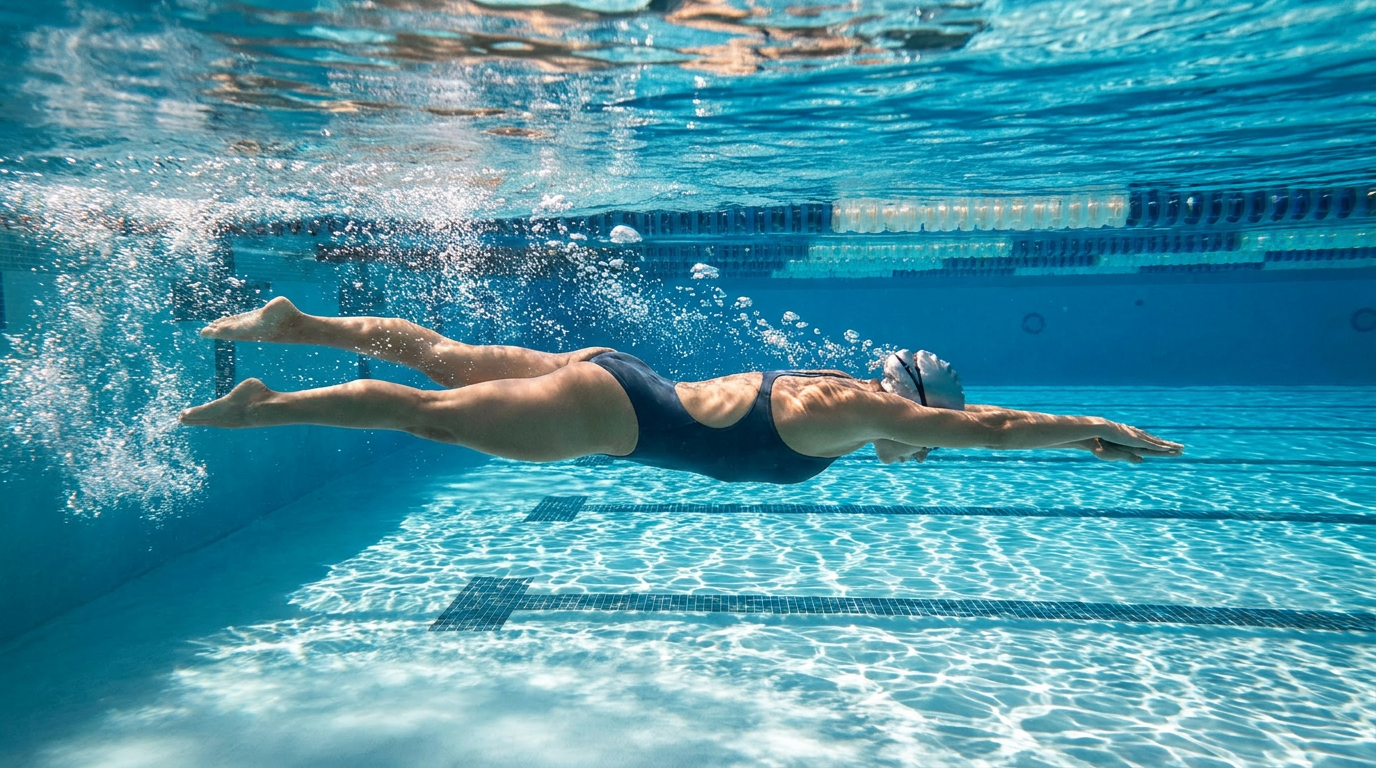
Beyond the heart, the pool offers an unparalleled environment for joint preservation. Water is roughly 830 times denser than air, creating constant, omnidirectional resistance. Every pull and kick engages the musculature, effectively turning the pool into a fluid weight room that builds full-body strength.[6]

Yet, because of buoyancy, swimming removes the gravitational impact that inevitably degrades cartilage over time. While runners must absorb forces equal to several times their body weight with every single stride, swimmers glide. This lack of mechanical wear-and-tear means individuals can maintain high volumes of aerobic training well into their seventies and eighties without succumbing to the knee, hip, and ankle injuries that frequently sideline land athletes.[5][6]
Yet, because of buoyancy, swimming removes the gravitational impact that inevitably degrades cartilage over time.
The benefits of the pool extend far beyond the neck. Neuroscientists are increasingly focused on how swimming alters the physical structure of the aging brain. While aerobic exercise generally promotes neurogenesis—the creation of new neurons—swimming appears to offer highly specific cognitive protections.[3]
Studies indicate that the aerobic demand of swimming stimulates a profound increase in cerebral blood flow and triggers the release of Brain-Derived Neurotrophic Factor. This crucial protein acts as fertilizer for the brain, promoting neural plasticity, accelerating learning, and cementing memory formation.[3]
Furthermore, regular aquatic exercise has been shown to reduce inflammation in the hippocampus, the brain's primary memory center. By suppressing cellular apoptosis, or programmed cell death, swimming helps maintain cognitive processing speed and executive function, offering a buffer against age-related mental decline.[3]

The mental health benefits of swimming also encompass what environmental psychologists call the "Blue Mind" effect. The sensory isolation of being submerged, combined with the rhythmic, controlled breathing required to swim laps, induces a mildly meditative state that land-based sports struggle to replicate.[4]
This aquatic environment actively lowers levels of cortisol, the body's primary stress hormone. Because chronic stress is a known accelerator of both cardiovascular disease and cognitive decline, the daily stress-dampening effect of a swim provides a compounding protective mechanism for long-term health.[4]
Additionally, the complex coordination required for strokes like freestyle or breaststroke forces the brain to constantly engage both of its hemispheres. This cross-pattern movement strengthens the corpus callosum and enhances neural connectivity across the brain, keeping the central nervous system sharp and responsive.[3][5]
Despite its near-perfect profile, swimming does have one physiological blind spot: bone density. Because the skeleton is supported by water rather than gravity, swimming does not provide the mechanical loading required to stimulate bone remodeling.[5]

For this reason, sports physiologists and longevity experts universally recommend that dedicated swimmers supplement their pool time with land-based resistance training or weight-bearing exercises to stave off osteopenia and osteoporosis as they age.[5]
The primary barrier to swimming as a widespread public health intervention remains infrastructure. Access to clean, affordable, and well-maintained lap pools is a privilege not available in all communities, making water safety and facility access critical issues for public health advocates.[4][5]
Nevertheless, for those who can access the water, the scientific consensus is unambiguous. Swimming offers a rare convergence of cardiovascular conditioning, joint preservation, and neurological protection.[5]
In the pursuit of a longer, healthier life, the most effective prescription might not be found in a pill bottle or on a treadmill. It might simply require putting on a pair of goggles and diving in.[5]
Viewpoints in depth
Longevity Researchers
Focus on the dramatic reductions in all-cause and cardiovascular mortality.
Epidemiologists and longevity scientists point to massive longitudinal datasets, such as the Aerobics Center Longitudinal Study, which tracked tens of thousands of individuals over decades. Their primary takeaway is that the cardiovascular efficiency built in the pool translates directly to a longer lifespan. Because swimming allows for sustained, moderate-intensity aerobic work without the mechanical wear-and-tear of land sports, individuals can maintain their training volume well into old age, compounding the cardiovascular benefits.
Neuroscientists
Emphasize the cognitive protections and structural brain changes induced by swimming.
For brain researchers, the pool is a laboratory for neuroplasticity. They highlight how the rhythmic, bilateral coordination required for swimming engages both hemispheres of the brain, while the aerobic exertion increases cerebral blood flow. The resulting surge in Brain-Derived Neurotrophic Factor (BDNF) helps forge new neural pathways and suppress cellular apoptosis in the hippocampus, offering a powerful, non-pharmacological defense against age-related cognitive decline and dementia.
Sports Physiotherapists
Value the joint-sparing resistance of water but caution about bone density.
Physical therapists view swimming as the ultimate rehabilitation and maintenance tool. The buoyancy of water removes up to 90 percent of a person's body weight, eliminating the impact forces that degrade cartilage in the knees and hips. However, they also note the physiological trade-off: because the skeleton is not subjected to gravitational loading, swimming does not stimulate bone remodeling. They universally recommend that dedicated swimmers incorporate weight-bearing exercises to prevent osteopenia.
What we don't know
- The exact minimum dosage (minutes per week) of swimming required to trigger neurogenesis in humans.
- Whether the cognitive benefits of swimming differ significantly between various strokes (e.g., freestyle vs. breaststroke).
Key terms
- All-cause mortality
- The death rate from all causes of death for a population in a given time period.
- Zone 2 training
- Aerobic exercise performed at 60 to 70 percent of maximum heart rate, optimizing fat oxidation and cardiovascular endurance.
- Neurogenesis
- The biological process by which new neurons are formed in the brain.
- Brain-Derived Neurotrophic Factor (BDNF)
- A protein that promotes the survival of nerve cells and plays a key role in learning, memory, and higher thinking.
- Apoptosis
- The death of cells which occurs as a normal and controlled part of an organism's growth or development.
- Hippocampus
- A complex brain structure embedded deep into the temporal lobe, playing a major role in learning and memory.
Frequently asked
Does swimming build muscle?
Yes, the density of water provides omnidirectional resistance, which tones and strengthens muscles, though it does not build mass as rapidly as heavy weightlifting.
Is swimming good for bone density?
Because swimming is non-weight-bearing, it does not significantly improve bone density. Experts recommend supplementing pool workouts with land-based resistance training.
How often should I swim for longevity benefits?
Research suggests that 30 to 60 minutes of moderate-intensity swimming, two to four times a week, is sufficient to trigger significant cardiovascular and cognitive benefits.
What is the 'Blue Mind' effect?
It refers to the mildly meditative, stress-reducing state induced by being in or near water, which helps lower cortisol levels and improve mental health.
Sources
Source coverage
6 outlets
4 viewpoints surfaced





[1]Aerobics Center Longitudinal StudyLongevity Researchers
Swimming and Mortality in Men
Read on Aerobics Center Longitudinal Study →[2]UK BiobankLongevity Researchers
Associations of specific types of sports and exercise with all-cause and cardiovascular-disease mortality
Read on UK Biobank →[3]Journal of PhysiologyNeuroscientists
Cerebral blood flow and cognitive function during water immersion
Read on Journal of Physiology →[4]Health Promotion InternationalPublic Health Advocates
Blue space, health and well-being: A narrative overview and synthesis of potential benefits
Read on Health Promotion International →[5]Factlen Editorial TeamSports Physiotherapists
Synthesis by Factlen editorial team
Read on Factlen Editorial Team →[6]International Journal of Aquatic Research and EducationLongevity Researchers
Swimming and All-Cause Mortality Risk Compared With Running, Walking, and Sedentary Habits
Read on International Journal of Aquatic Research and Education →
Every angle. Every day.
Get fitness stories with full source coverage and perspective breakdowns delivered to your inbox.