
How 'Master Proteins' Shield Us From Deadly Mutations—And Inspire New Drugs
Scientists are decoding how specialized 'buffering' proteins mask potentially harmful genetic mutations. This hidden biological shield could unlock entirely new classes of treatments for cancer and rare genetic diseases.
By Factlen Editorial Team
- Oncology Researchers
- View chaperone proteins as a vulnerability in cancer cells, aiming to inhibit them to trigger tumor collapse.
- Evolutionary Biologists
- Focus on how genetic buffering allows hidden genetic diversity to build up, driving rapid adaptation during times of environmental stress.
- Therapeutic Geneticists
- Seek to boost or mimic chaperone activity to correct misfolded proteins in rare genetic and neurodegenerative diseases.
What's not represented
- · Patient Advocacy Groups for Rare Diseases
- · Bioethicists
Why this matters
By understanding how our cells naturally hide genetic errors, researchers are developing drugs that can selectively strip this protection away from cancer cells, or boost it to cure hereditary diseases without altering DNA.
Key points
- The human genome contains many mutations that are 'masked' by master proteins called chaperones.
- These chaperones force mutated, misshapen proteins into their correct functional forms.
- Under severe stress, chaperones are overwhelmed, suddenly revealing the hidden mutations.
- Cancer cells rely heavily on chaperones to survive their massive mutation loads.
- New drugs aim to inhibit chaperones to kill cancer, or boost them to treat rare genetic diseases.
The human genome is not a pristine blueprint; it is a chaotic draft riddled with typographical errors. Every person carries dozens of novel genetic mutations, alongside thousands of inherited variants. Yet, despite this constant barrage of genetic noise, the vast majority of us develop normally and remain healthy.[1][6]
For decades, biologists assumed that most of these mutations were simply "silent"—meaning the changes in the DNA code didn't alter the final biological product in a meaningful way. But recent advances in molecular biology have revealed a far more active and astonishing defense mechanism at play.[1]
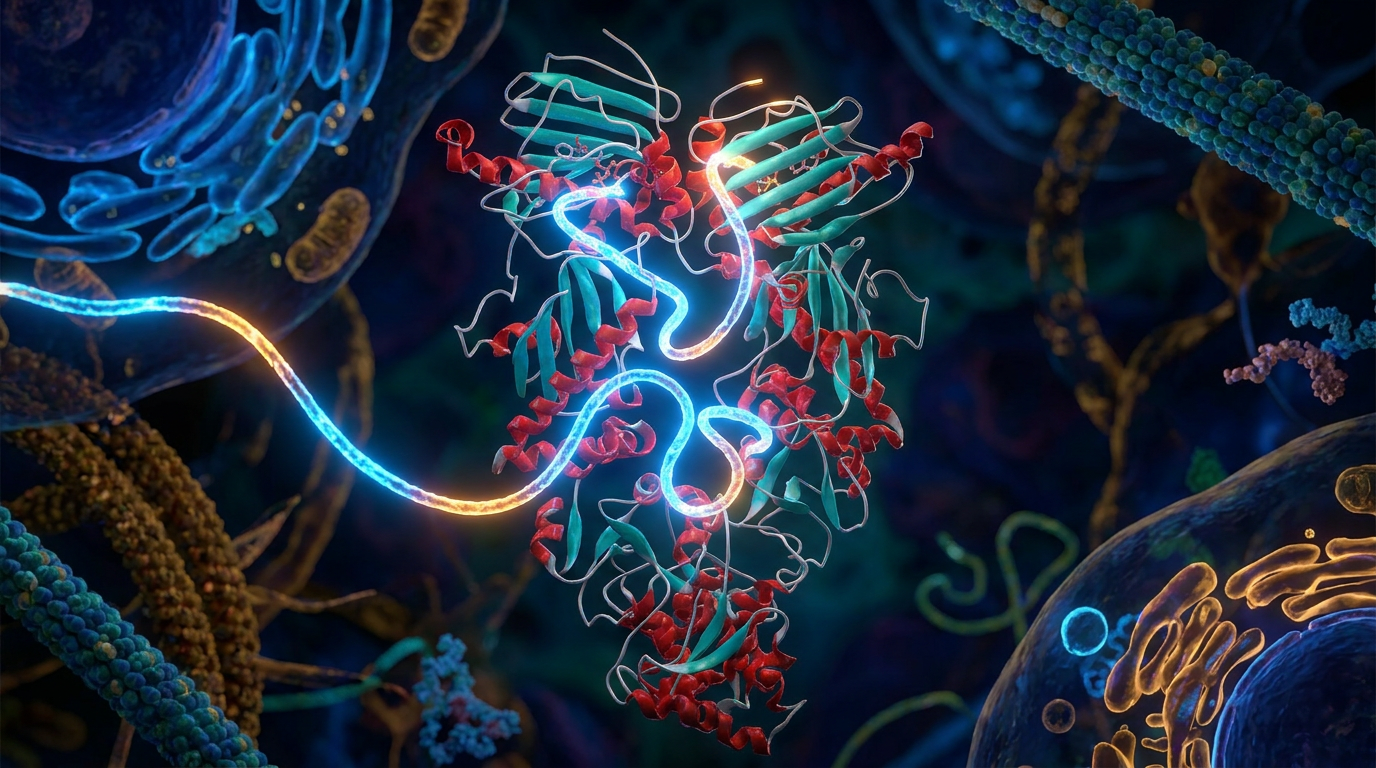
Deep within our cells, a specialized class of "master proteins" is working tirelessly to mask the effects of potentially deadly genetic errors. These molecules, known as molecular chaperones, act as a biological buffer, absorbing the shock of genetic variation and preventing it from manifesting as disease.[1][2]
To understand how this works, one must look at how genes function. Genes encode proteins, which are essentially long chains of amino acids. To do their jobs—whether that is digesting food, carrying oxygen, or fighting viruses—these chains must fold into highly specific, intricate three-dimensional shapes.[2]

A genetic mutation often results in a protein that struggles to fold correctly. Left to its own devices, this misfolded protein would either fail to function entirely or, worse, clump together with other proteins to cause severe cellular toxicity—the root cause of many severe neurodegenerative diseases.[3][4]
This is where the master proteins step in. Chaperones like HSP90 (Heat Shock Protein 90) physically bind to these struggling, mutated proteins. Using cellular energy, they force the defective proteins into their correct functional shapes, effectively hiding the underlying genetic error from the organism.[1][5]
The implications of this hidden buffering system are profound, fundamentally altering our understanding of evolution. Because chaperones mask mutations, genetic diversity can quietly accumulate in a population over generations without causing any immediate harm or benefit.[4][5]
The implications of this hidden buffering system are profound, fundamentally altering our understanding of evolution.
However, this buffering capacity has a strict limit. When an organism experiences severe environmental stress—such as extreme heat, starvation, or exposure to toxins—the chaperones are suddenly overwhelmed. They must abandon their normal buffering duties to rescue other essential proteins damaged by the stress.[5]
As the chaperones are diverted, the hidden mutations are suddenly unmasked all at once. This phenomenon, known as evolutionary capacitance, allows a population to rapidly display a wide array of new traits exactly when they are most needed to survive a rapidly changing environment.[5][6]
Today, the medical field is racing to translate this evolutionary quirk into a new generation of therapeutics. If chaperones control the manifestation of genetic disease, then manipulating these master proteins could offer an entirely new way to treat illness.[1][3]

In oncology, researchers are exploring how to intentionally break the buffer. Cancer cells are notoriously mutated, carrying thousands of genetic errors that should theoretically be lethal to the cell. They survive only by hijacking the body's chaperone networks, producing massive amounts of HSP90 to keep their mutated, cancer-driving proteins functional.[3]
By developing drugs that specifically inhibit HSP90, oncologists can strip away this protective shield. Without their chaperones, the cancer cells' mutated proteins collapse, triggering a catastrophic failure that selectively kills the tumor while sparing healthy tissue that relies less heavily on the buffer.[3]

Conversely, in the realm of rare genetic disorders and neurodegeneration, the goal is to reinforce the buffer. Diseases like cystic fibrosis are caused by a single mutation that prevents a crucial protein from folding correctly, leading to devastating systemic effects.[1][4]
Pharmacological chaperones—small molecules designed to mimic or boost the body's natural master proteins—are now entering clinical use. These drugs bind to the specific misfolded protein and coax it into the correct shape, restoring function and alleviating the disease without ever altering the patient's DNA.[1][3]

The discovery of genetic buffering reminds us that biology is rarely a simple linear equation of gene to trait. It is a dynamic, resilient system. By learning to tune the dials of this cellular machinery, medicine is moving beyond merely attacking symptoms, stepping into a future where we can manage the very expression of our genetic code.[1][6]
How we got here
1998
Researchers first demonstrate that the chaperone HSP90 acts as an evolutionary capacitor in fruit flies, hiding genetic mutations.
2004
The first generation of HSP90 inhibitors enters clinical trials as a potential broad-spectrum cancer treatment.
2019
The FDA approves targeted therapies that act as pharmacological chaperones to correct misfolded proteins in cystic fibrosis patients.
2026
Advanced mapping of the cellular 'buffering network' opens new pathways for treating neurodegenerative diseases.
Viewpoints in depth
Evolutionary Biologists
Focus on how genetic buffering allows hidden genetic diversity to build up, driving rapid adaptation during times of environmental stress.
For evolutionary biologists, master proteins solve a long-standing mathematical puzzle: how organisms can evolve complex new traits without dying from intermediate, harmful mutations along the way. By acting as an evolutionary capacitor, chaperones allow populations to safely stockpile genetic diversity. When an environmental crisis hits—like extreme heat or famine—the chaperones are diverted to handle the stress, unmasking the stockpiled mutations all at once. This sudden explosion of physical variation gives the population a much higher chance of surviving the new environment.
Oncology Researchers
View chaperone proteins as a vulnerability in cancer cells, aiming to inhibit them to trigger tumor collapse.
Oncologists view the buffering system as cancer's Achilles' heel. A tumor cell is a chaotic environment, heavily reliant on mutated proteins to drive its rapid growth. To prevent these defective proteins from simply clumping up and killing the cell, cancers massively upregulate the production of chaperones like HSP90. Researchers argue that by administering HSP90 inhibitors, they can pull the rug out from under the tumor. Without the buffer, the cancer cell is crushed by the weight of its own mutations, offering a therapeutic strategy that targets the tumor's survival mechanism rather than a specific genetic flaw.
Therapeutic Geneticists
Seek to boost or mimic chaperone activity to correct misfolded proteins in rare genetic and neurodegenerative diseases.
In the field of rare diseases, the perspective shifts from breaking the buffer to reinforcing it. Many devastating conditions, from cystic fibrosis to early-onset Parkinson's, are caused by a single genetic typo that results in a misfolded, useless protein. Rather than attempting risky gene-editing procedures to fix the DNA, these researchers are developing 'pharmacological chaperones.' These small-molecule drugs are designed to slip into the cell, bind to the specific misfolded protein, and act as a molecular scaffold, physically forcing it into the correct shape so it can perform its vital function.
What we don't know
- How to selectively inhibit chaperones in cancer cells without causing toxicity in healthy, highly active tissues like the heart or liver.
- The full extent of which specific genetic mutations are buffered by which specific chaperone proteins across the human genome.
- Whether long-term use of pharmacological chaperones could inadvertently mask new, harmful mutations that arise during treatment.
Key terms
- Molecular Chaperone
- A class of proteins whose primary function is to assist other proteins in folding into their correct three-dimensional shapes.
- Genetic Buffering
- The biological process where the effects of a genetic mutation are hidden or compensated for by other cellular mechanisms, preventing disease.
- Evolutionary Capacitance
- The buildup of hidden genetic variation in a population that is suddenly revealed during times of stress, allowing for rapid evolutionary adaptation.
- Pharmacological Chaperone
- A synthetic drug designed to bind to a specific misfolded protein and force it into its correct, functional shape.
Frequently asked
What happens if a master protein fails?
If chaperones fail or are overwhelmed by stress, the mutated proteins they were hiding misfold. This can lead to cellular toxicity and is a primary driver of neurodegenerative diseases.
Why do cancer cells need these proteins more than healthy cells?
Cancer cells carry thousands of mutations that would normally kill them. They rely heavily on an overproduction of chaperones to keep their mutated, cancer-driving proteins functional.
Can we boost these proteins to live longer?
While boosting chaperones can help clear misfolded proteins associated with aging, over-activating them carries risks, as it could inadvertently protect pre-cancerous cells.
Sources
Source coverage
6 outlets
3 viewpoints surfaced






[1]NatureTherapeutic Geneticists
These 'master' proteins protect us from deadly mutations — and could inspire new drugs
Read on Nature →[2]eLifeEvolutionary Biologists
Mutational robustness and the buffering of genetic variation by molecular chaperones
Read on eLife →[3]CellOncology Researchers
Chaperone-targeted therapies in oncology and neurodegeneration
Read on Cell →[4]Cold Spring Harbor Perspectives in BiologyTherapeutic Geneticists
Protein Homeostasis and the Phenotypic Manifestation of Genetic Diversity
Read on Cold Spring Harbor Perspectives in Biology →[5]ScienceEvolutionary Biologists
Hsp90 as a capacitor for morphological evolution
Read on Science →[6]Factlen Editorial Team
Synthesis by Factlen editorial team
Read on Factlen Editorial Team →


Every angle. Every day.
Get science stories with full source coverage and perspective breakdowns delivered to your inbox.