
The Rise of Agentic AI: How 'Action Models' Are Automating Daily Life
Artificial intelligence is moving beyond chatbots that generate text to 'agentic' systems capable of autonomously booking flights, managing calendars, and executing complex workflows.
By Factlen Editorial Team
- Enterprise & Integration Leaders
- Focus on workflow reinvention, converting labor costs to software spending, and scaling operations without scaling headcount.
- Productivity Advocates
- Focus on the democratization of technical skills and the massive time savings for individuals managing daily administrative tasks.
- AI Safety & Governance Experts
- Focus on the risks of autonomous execution, the need for strict API guardrails, and the dangers of hallucinated actions.
What's not represented
- · Frontline administrative workers whose roles are being automated
- · Data privacy advocates concerned about AI agents reading personal emails
Why this matters
If you have ever felt overwhelmed by digital administrative chores, agentic AI promises to act as a highly capable personal proxy. By delegating the friction of execution to software, individuals and businesses can reclaim hours of time previously lost to scheduling, booking, and data entry.
Key points
- Agentic AI moves beyond text generation to autonomously execute multi-step tasks across different software platforms.
- Systems operate on a continuous loop of sensing data, reasoning through options, taking action via APIs, and learning from the results.
- Consumer applications are already automating calendar management and complex travel bookings with zero human intervention.
- Enterprise adoption is shifting human roles from manual task executors to supervisors of autonomous AI agents.
- Safety remains the primary hurdle, requiring strict 'human-in-the-loop' guardrails to prevent unintended actions.
For years, the promise of artificial intelligence has been hampered by a frustrating bottleneck: execution. You could ask a chatbot to draft an email, plan a travel itinerary, or write a block of code, but the actual work of sending that email, booking those flights, or deploying that software still fell squarely on human shoulders. The AI was a brilliant consultant that refused to lift a finger. In 2026, that dynamic is fundamentally changing. The technology industry has pivoted from systems that merely talk to systems that act, ushering in the era of "Agentic AI." This shift represents a transition from passive digital assistants to autonomous digital workers capable of navigating the web, using software tools, and completing multi-step administrative chores on our behalf.[1]
The distinction between traditional generative AI and this new agentic paradigm lies in autonomy and agency. While generative models like the early iterations of ChatGPT were designed to predict the next word in a sequence to create text, agentic AI systems are designed to pursue defined goals. Researchers at MIT note that this new breed of AI can perceive its environment, reason through complex problems, and take independent action with minimal human supervision. Instead of just answering a prompt, an agentic system breaks a high-level command—like "fix my flight itinerary for tomorrow and keep it under $500"—into a sequence of logical steps, executing them across various applications.[2][3]
To understand how these systems operate, enterprise analysts at Bain & Company point to a continuous, four-step operational loop: sense, reason, act, and learn. First, the AI agent senses its environment by collecting unstructured data from emails, calendars, databases, or live application programming interfaces (APIs). It doesn't just read this data; it contextualizes it. If a user receives an email about a canceled meeting, the agent recognizes the schedule change and immediately identifies the newly available block of time. This perception phase is the critical foundation that allows the system to operate in dynamic, real-world digital environments rather than static chat windows.[3]

The second phase is reasoning, which serves as the "brain" of the operation. Here, the system leverages large language models to analyze the gathered data, understand the user's ultimate goal, and formulate a plan. According to IBM's architecture guidelines, the AI evaluates multiple potential solutions, weighing constraints like budget, time, and user preferences. If the goal is to schedule a team offsite, the reasoning engine parses the calendars of all attendees, cross-references available flight times, and selects the optimal overlap. It effectively mimics human decision-making, anticipating roadblocks and planning contingencies before a single action is taken.[4][5]
The third and most defining phase is action. This is where agentic AI separates itself from its predecessors. Using tools and APIs, the system reaches out into external software to execute its plan. It clicks buttons, fills out forms, runs database queries, and processes payments. Platforms like Kore.ai emphasize that this execution happens autonomously; the AI doesn't just draft the calendar invite, it sends it. Finally, the system enters the reflection or learning phase. It observes the outcome of its actions—did the API call succeed? Did the user approve the purchase?—and uses that feedback to adjust its future behavior, creating a continuous loop of improvement.[4][5]
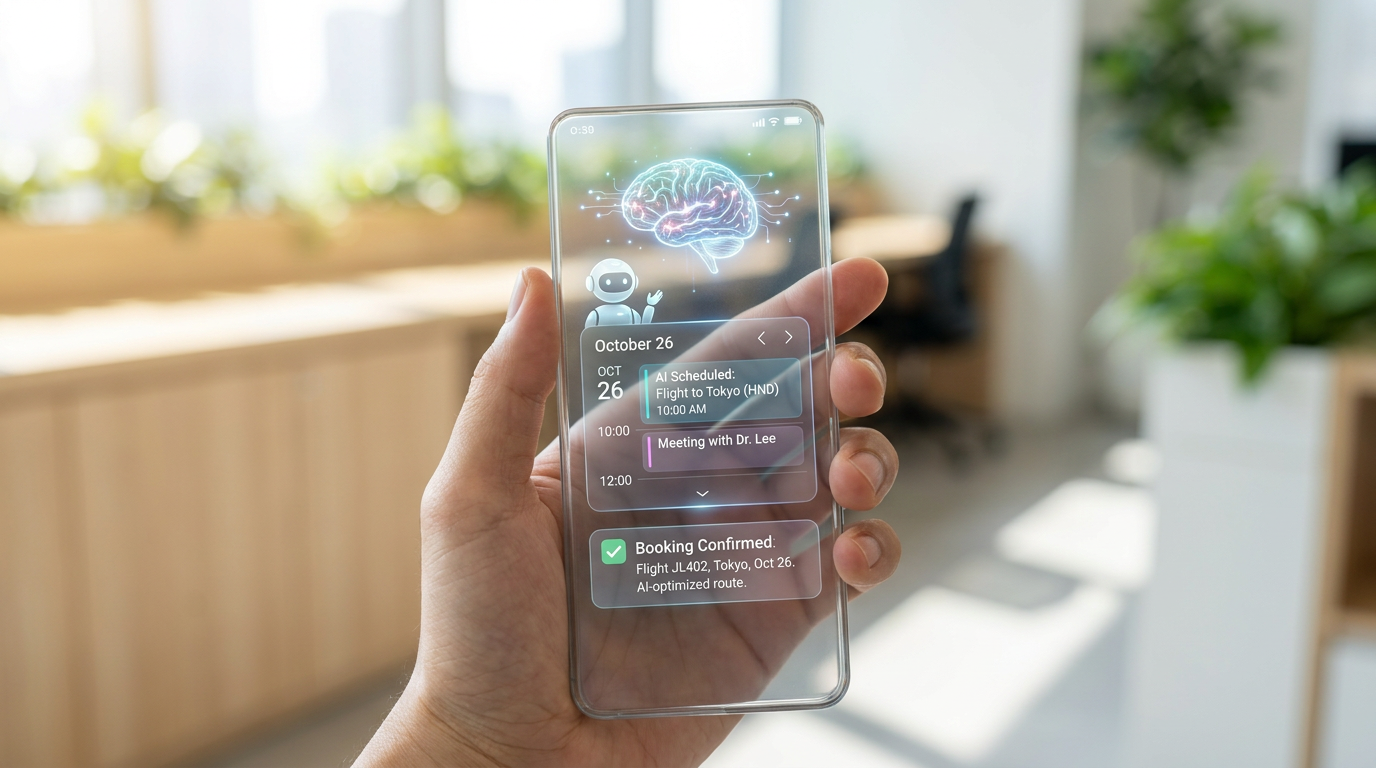
In the consumer space, this technology is already automating the mundane administrative tasks that eat up hours of the average workday. Calendar management, long a source of professional friction, has been entirely overhauled. Applications like Motion and Lindy now function as autonomous executive assistants. Rather than requiring users to manually drag and drop meeting blocks, these agents use intelligent algorithms to dynamically shuffle schedules based on shifting priorities. If an urgent project lands on your desk, the AI agent automatically reschedules lower-priority meetings, notifies the attendees, and blocks out the necessary deep-work time, reportedly increasing task completion speeds by over 30 percent.[7]
Travel booking has seen a similar revolution, moving far beyond the clunky chatbot interfaces of the early 2020s. Modern AI travel agents do not just suggest destinations; they handle the entire logistical lifecycle. Platforms like Zenvoya and Navan's corporate booking tools can autonomously coordinate multi-city itineraries for several travelers, cross-referencing visa requirements, company expense policies, and real-time flight availability. More importantly, these agents monitor bookings for disruptions. If a 5:00 AM flight is canceled, the AI detects the change, searches for alternative routes, rebooks the ticket, and updates the hotel check-in time before the traveler even wakes up.[8][9]

Travel booking has seen a similar revolution, moving far beyond the clunky chatbot interfaces of the early 2020s.
The implications for enterprise operations are even more profound. Businesses are deploying agentic AI to move beyond single-task automation into end-to-end process execution. Bain & Company analysts highlight that this shift is transforming human workers from task executors into AI supervisors. Instead of a human resources representative manually processing a dozen forms to onboard a new employee, an AI agent can autonomously provision software licenses, set up payroll accounts, and schedule orientation meetings. The human simply reviews the final output and approves it, drastically accelerating decision cycles and operational efficiency.[3]
To facilitate this enterprise adoption, a new ecosystem of "agentic platforms" has emerged. Systems like Salesforce Agentforce, Moveworks, and Creatio provide visual, no-code environments where businesses can build custom AI agents tailored to their specific workflows. According to Creatio, these platforms allow organizations to deploy digital workers that collaborate seamlessly with human employees. A customer service agent, for example, can instantly pull a client's purchase history, analyze their current issue, process a refund, and update the CRM—all without a human representative needing to toggle between five different software applications.[6]
The economic calculus of this shift is staggering. By automating the complex coordination work that happens between different software systems, agentic AI is effectively converting traditional labor costs into software spending. Analysts estimate that the market for automating this system-level coordination could reach $100 billion in the United States alone. As these tools become more sophisticated, the focus for large organizations is shifting from simply cutting costs to fundamentally reinventing workflows, allowing teams to scale their output without linearly scaling their headcount.[3]

Underpinning this revolution is a rapid advancement in the foundational AI models themselves. While early generative AI relied heavily on proprietary models from a few major tech companies, the agentic era is being driven by a mix of highly capable open-source and specialized commercial models. These "Large Action Models" are specifically trained not just on human language, but on how software interfaces work. They understand the structure of web pages, the syntax of API requests, and the logic of database queries, allowing them to navigate digital environments with the same fluency that a human navigates a physical office.[1]
However, granting software the autonomy to take real-world actions introduces significant new risks. When a chatbot hallucinates a false fact in a text summary, the consequence is usually minor confusion. When an agentic AI hallucinates while holding the keys to a corporate database or a user's credit card, the consequences can be disastrous. Unintended actions—such as sending an inappropriate email to a client, deleting critical files, or overspending on a marketing campaign—are the primary hurdles to widespread adoption. Ensuring these systems act predictably in nondeterministic environments is the defining engineering challenge of 2026.[3]
To mitigate these risks, developers are implementing strict guardrails and "human-in-the-loop" architectures. Rather than granting agents unchecked autonomy, systems are designed with rigid boundaries and escalation protocols. For high-stakes actions, such as transferring funds or finalizing a contract, the AI agent prepares the entire workflow but pauses to request explicit human cryptographic approval before execution. Additionally, enterprise agents are often confined to sandboxed environments where their actions can be observed, audited, and reversed if necessary, ensuring compliance and security are built in from the start.[3][5]
The ultimate success of agentic AI also relies heavily on the quality of the data it consumes. Agents do not just analyze data; they act on it. If an enterprise's underlying data foundation is fragmented, outdated, or poorly governed, the AI agent will inevitably make flawed decisions. Organizations are now racing to structure their vast troves of unstructured data—from legacy PDFs to scattered email threads—into formats that these autonomous systems can reliably parse. Without this foundational cleanup, the promise of seamless automation quickly devolves into automated chaos.[3]

Despite these challenges, the trajectory is clear: agentic AI is fundamentally reshaping our relationship with computers. We are moving away from a paradigm where humans must learn the rigid language of software, toward one where software understands the fluid goals of humans. By delegating the friction of digital execution to autonomous agents, individuals and organizations are freeing up their most valuable resource—time—to focus on strategy, creativity, and connection. The era of the AI consultant is ending; the era of the AI proxy has arrived.[1][2]
How we got here
Nov 2022
ChatGPT launches, popularizing Generative AI and demonstrating advanced natural language reasoning.
2023–2024
The rise of AI 'copilots' that assist users with drafting and coding but still require human execution.
2025
Early autonomous agents begin handling single-domain tasks like email sorting and basic data entry.
Early 2026
Multi-agent systems launch, capable of cross-platform actions like booking travel, managing budgets, and executing enterprise workflows.
Viewpoints in depth
Productivity Advocates
Focus on the democratization of technical skills and the massive time savings for individuals.
Proponents of consumer-grade agentic AI argue that the technology is the ultimate equalizer for personal productivity. By delegating calendar management, travel booking, and inbox triage to autonomous agents, individuals can reclaim hours of their week. This camp emphasizes that users no longer need to learn complex software integrations or write code to automate their lives; they simply need to state their goals in natural language and let the AI handle the friction of execution.
Enterprise & Integration Leaders
Focus on workflow reinvention and scaling operations without scaling headcount.
For corporate leaders and enterprise architects, agentic AI is viewed as a fundamental shift in unit economics. Rather than hiring more administrative staff to handle the coordination between disparate software systems, companies can deploy digital workers. This camp argues that the true value of agentic AI lies not just in doing old tasks faster, but in entirely reinventing workflows, allowing human employees to transition into supervisory roles where they manage AI output rather than executing manual data entry.
AI Safety & Governance Experts
Focus on the risks of autonomous execution and the dangers of hallucinated actions.
Safety researchers caution that moving from text generation to real-world action introduces severe operational risks. If an AI hallucinates while drafting an email, the user can simply delete the text. If an AI hallucinates while holding API access to a corporate bank account or a live customer database, the damage is immediate and tangible. This camp advocates for strict 'human-in-the-loop' architectures, sandboxed testing environments, and cryptographic approvals to ensure agents cannot take high-stakes actions without explicit human oversight.
What we don't know
- How liability will be handled when an autonomous AI agent makes a costly financial or legal mistake on behalf of a user.
- The long-term impact of agentic automation on entry-level administrative and data-entry jobs.
- Whether open-source action models can maintain parity with heavily funded proprietary models in complex enterprise environments.
Key terms
- Agentic AI
- Artificial intelligence systems capable of autonomous decision-making and action to achieve a specific goal with minimal human intervention.
- Large Action Model (LAM)
- An AI model trained specifically to understand software interfaces and execute actions across different applications, rather than just generating text.
- API (Application Programming Interface)
- A set of rules that allows different software applications to communicate with each other, serving as the 'hands' that AI agents use to take action.
- Human-in-the-loop
- A safety architecture where an AI system prepares a workflow but requires explicit human approval before executing high-stakes actions.
- Multi-agent orchestration
- A system where several specialized AI agents collaborate, passing tasks and context to each other to solve complex, multi-step problems.
Frequently asked
What is the difference between Generative AI and Agentic AI?
Generative AI primarily creates content (text, images, code) based on prompts. Agentic AI uses those models as a reasoning engine to autonomously execute multi-step actions, like booking a flight or updating a database.
Can AI agents spend my money?
Yes, if granted access to payment APIs. However, most consumer and enterprise platforms require explicit 'human-in-the-loop' approval before executing financial transactions to prevent unauthorized spending.
What happens if an AI agent makes a mistake?
Because agents take real-world actions, mistakes can have tangible consequences. Developers mitigate this by running agents in sandboxed environments and implementing strict rollback protocols for reversible actions.
Do I need to know how to code to use AI agents?
No. Modern agentic platforms use natural language processing, allowing users to build and deploy complex automated workflows simply by describing what they want the agent to do.
Sources
Source coverage
9 outlets
3 viewpoints surfaced








[1]Factlen Editorial TeamAI Safety & Governance Experts
Synthesis by Factlen editorial team
Read on Factlen Editorial Team →[2]MITAI Safety & Governance Experts
The next evolution of generative AI: AI agents
Read on MIT →[3]Bain & CompanyEnterprise & Integration Leaders
How does agentic AI work in enterprises?
Read on Bain & Company →[4]IBMEnterprise & Integration Leaders
What is agentic AI?
Read on IBM →[5]Kore.aiEnterprise & Integration Leaders
Agentic AI: Unlocking Enterprise Potential in 2026
Read on Kore.ai →[6]CreatioEnterprise & Integration Leaders
Best AI Agent Tools & Platforms in 2026
Read on Creatio →[7]TechVisionZoneProductivity Advocates
Top 5 AI Agents That Can Run Your Calendar in 2026
Read on TechVisionZone →[8]NavanProductivity Advocates
What Is an AI Travel Agent?
Read on Navan →[9]ZenvoyaProductivity Advocates
Best AI Trip Planners 2026: 7 Categories Ranked
Read on Zenvoya →



Every angle. Every day.
Get ai stories with full source coverage and perspective breakdowns delivered to your inbox.