
Physics-Trained AI Discovers Viable Rare-Earth-Free Permanent Magnets
Scientists at the Ames National Laboratory have developed an AI model called DuctGPT that uses physics-based modeling to invent new, rare-earth-free magnetic materials. The breakthrough could secure supply chains for electric vehicles and defense systems while reducing reliance on overseas mining.
By Factlen Editorial Team
- National Security Analysts
- Focus on the strategic independence gained by eliminating reliance on foreign rare-earth refinement.
- Materials Scientists
- Highlight the paradigm shift of using physics-informed AI rather than trial-and-error discovery.
- Green Energy Advocates
- Emphasize the potential to lower costs and environmental impact for electric vehicles and wind turbines.
What's not represented
- · Traditional rare-earth mining operators
- · Automakers evaluating the cost-to-retool for the new magnets
Why this matters
Permanent magnets are essential components in everything from electric vehicle motors to F-35 fighter jets, but the U.S. relies almost entirely on foreign supply chains for the rare-earth metals needed to build them. By using AI to invent alternative materials that don't require these metals, this breakthrough could simultaneously lower the cost of green technology and eliminate a major national security vulnerability.
Key points
- Ames Laboratory scientists used an AI named DuctGPT to invent a new class of rare-earth-free permanent magnets.
- The AI relies on physics-based modeling of electron behavior rather than simply analyzing historical material data.
- The breakthrough utilizes a manganese and bismuth composite, coating the crystals in a polymer to maintain magnetization.
- The discovery could eliminate U.S. reliance on foreign rare-earth refinement for defense systems and electric vehicles.
- The research is part of the Department of Energy's Genesis Mission aimed at securing energy dominance.
Scientists at the Ames National Laboratory have successfully utilized a novel artificial intelligence workflow to discover a new class of permanent magnets that require zero rare-earth elements. The breakthrough, announced as part of the U.S. Department of Energy's Genesis Mission, represents a major leap in materials science that could reshape global manufacturing. By leveraging an AI model that understands the fundamental physics of electron behavior, researchers were able to bypass decades of trial-and-error laboratory work. The resulting material—a specialized composite of manganese and bismuth—demonstrates the ability to retain its magnetic field under extreme conditions, matching the performance profile required for commercial and military applications without using a single ounce of rare-earth metals.[1][2]
Permanent magnets are the invisible, indispensable workhorses of the modern industrialized world. They are essential components in everything from the electric motors powering consumer electric vehicles to critical defense applications, including advanced radar systems, nuclear submarines, and the F-35 Lightning II fighter jet. To function effectively in these high-stress environments, the magnets must maintain their magnetization even when subjected to extreme heat, radiation, and mechanical friction. Historically, only specialized alloys containing rare-earth elements like neodymium and dysprosium could meet these rigorous performance standards, forcing manufacturers to rely on a highly constrained global supply chain.[1][3][5]
While the United States does possess domestic rare-earth deposits—most notably the Mountain Pass mine in California—the domestic supply chain remains severely bottlenecked by a lack of processing infrastructure. Currently, over 95 percent of the raw minerals extracted domestically are exported to Asia for the complex, expensive, and environmentally hazardous refinement process. This near-total reliance on overseas processing has long been viewed by policymakers as a critical economic and national security vulnerability. A viable rare-earth-free alternative could simultaneously lower the production costs of green technology and secure the defense supply chain against potential geopolitical embargoes or trade disputes.[1][6]

The artificial intelligence model behind the discovery, dubbed DuctGPT, was not originally built with electric vehicle motors in mind. It was initially designed by researchers to discover highly resilient materials capable of surviving the extreme radiation and heat inside experimental fusion power plants. For fusion applications, materials must withstand unprecedented thermal stress while remaining ductile enough to be machined into workable parts without shattering. Recognizing the model's capability to solve complex material constraints, the Department of Energy pivoted the AI's focus toward the rare-earth magnet shortage under the umbrella of the Genesis Mission.[1][4]
The artificial intelligence model behind the discovery, dubbed DuctGPT, was not originally built with electric vehicle motors in mind.
The key advancement in DuctGPT is its architectural foundation. Unlike traditional machine learning models in materials science that simply search for hidden patterns within massive databases of known chemical compounds, DuctGPT operates as a physics-informed AI. It is trained directly on the fundamental laws of physics and the quantum behavior of electrons. Because the artificial intelligence natively understands the underlying science of how atoms interact and bond under varying conditions, it can theoretically invent entirely novel material structures from scratch rather than merely interpolating or tweaking existing compounds.[1][2][6]
Applying this physics-based reasoning to the permanent magnet problem, the AI directed researchers toward a specific composite of manganese and bismuth. While these abundant materials possess natural magnetic properties, they traditionally lose their magnetization far too easily to be useful in industrial motors. When subjected to the heat generated by a spinning motor, the magnetic alignment of the crystals breaks down. However, the AI's simulation suggested that altering the physical structure of the composite at the microscopic level could stabilize the magnetic field, prompting Ames scientists to develop a novel synthesis process based on the AI's exact parameters.[1][2][5]

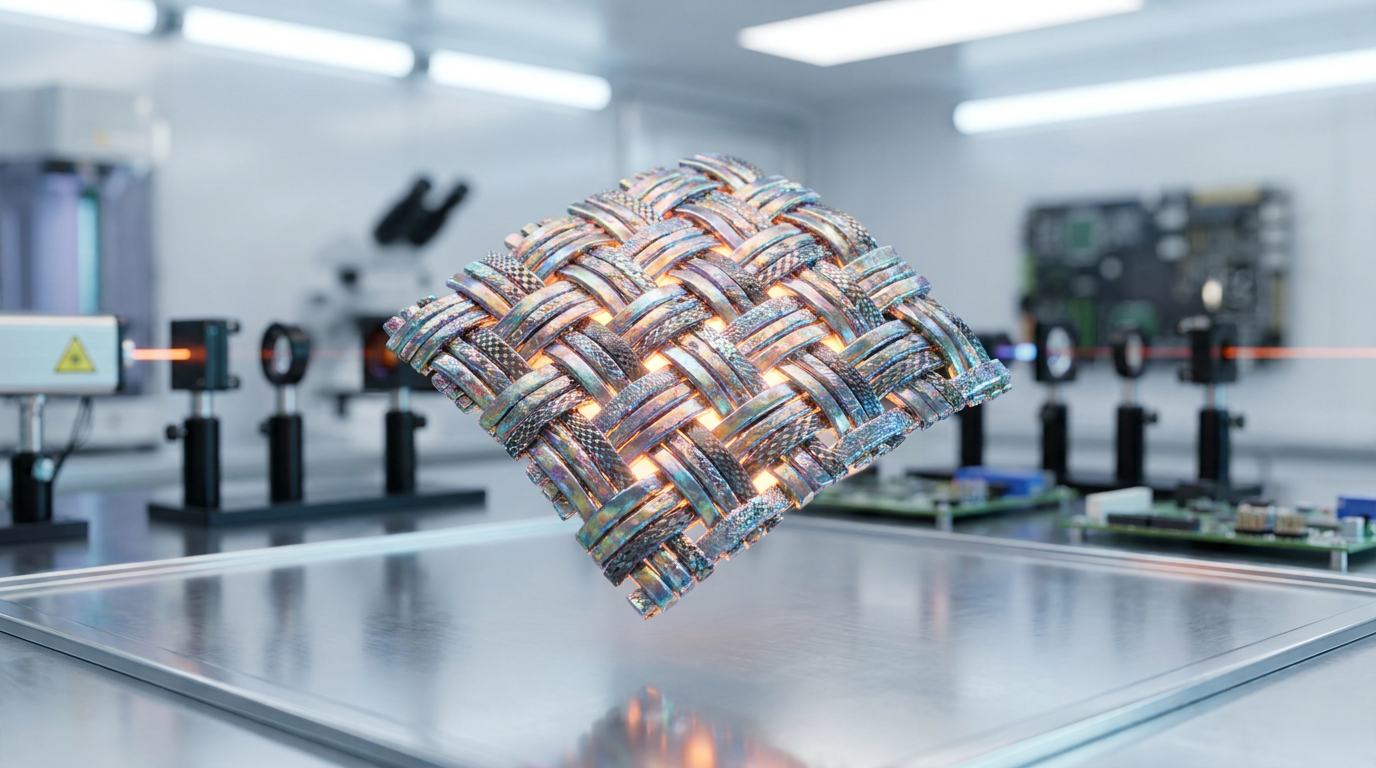
To solve the degradation problem, the Ames Laboratory scientists successfully coated the individual microscopic crystals within the manganese-bismuth material with a specialized polymer. This polymer barrier acts as a microscopic shield, preventing the crystals from making direct physical contact with one another. In traditional composites, such physical contact causes a cascading loss of magnetization when the material is subjected to heat or external magnetic interference. By isolating the crystals, the polymer coating preserves the overall magnetic integrity of the material even under the extreme operating temperatures of an electric vehicle motor.[1][2]
The project's success serves as a primary validation of the Department of Energy's Genesis Mission, an initiative explicitly designed to leverage government supercomputing resources alongside academic expertise to drive breakthroughs in energy dominance and discovery science. By proving that AI can successfully design commercially viable materials that solve acute national security challenges, the DOE hopes to accelerate funding and adoption of physics-informed AI across other critical sectors, including battery chemistry and semiconductor manufacturing.[3][6]

While the laboratory synthesis of the manganese-bismuth composite is a proven scientific success, the next major hurdle is commercialization. Researchers are now working closely with industry partners and automotive manufacturers to ensure the new material can be manufactured at scale. The transition from a controlled laboratory environment to mass production requires adapting existing electric motor assembly lines to handle the new polymer-coated composite, a process that will determine how quickly these AI-designed magnets can begin replacing rare-earth components in consumer products.[5][6]
How we got here
2023-2024
AI models begin demonstrating high accuracy in predicting molecular structures and material properties.
2025
DuctGPT is initially developed to identify resilient, ductile materials for experimental fusion reactors.
Early 2026
The DOE's Genesis Mission pivots the AI's focus toward solving the rare-earth permanent magnet shortage.
June 2026
Ames Laboratory successfully synthesizes the AI-designed manganese-bismuth composite, proving its viability.
Viewpoints in depth
National Security Analysts
Focus on the strategic independence gained by eliminating reliance on foreign rare-earth refinement.
Defense experts view the reliance on overseas processing for rare-earth elements as a critical vulnerability, particularly for advanced weapons systems like the F-35 and nuclear submarines. For this camp, the AI breakthrough is less about environmental sustainability and entirely about securing a domestic supply chain that cannot be leveraged or embargoed during geopolitical conflicts.
Green Energy Sector
Emphasize the potential to lower costs and environmental impact for electric vehicles and wind turbines.
Manufacturers of EVs and renewable energy infrastructure see rare-earth metals as a bottleneck for scaling up production. Mining and refining these materials is ecologically destructive and expensive. By substituting them with abundant materials like manganese and bismuth, the green energy sector hopes to dramatically reduce the cost of electric motors, accelerating the transition away from fossil fuels.
Materials Scientists
Highlight the paradigm shift of using physics-informed AI rather than trial-and-error discovery.
For the academic and research community, the specific magnet discovered is secondary to the method used to find it. Traditional AI models in materials science rely on interpolating existing data, which limits them to tweaking known compounds. By training DuctGPT on the fundamental physics of electron behavior, scientists argue we have entered an era where AI can genuinely invent entirely novel material classes from scratch.
What we don't know
- How quickly the new manganese-bismuth composite can be scaled for mass commercial manufacturing.
- Whether the polymer-coated magnets will match the exact lifespan of traditional rare-earth magnets under decades of continuous use.
Key terms
- Permanent Magnet
- A material that creates its own persistent magnetic field, essential for converting electrical energy into mechanical motion in motors.
- Rare-Earth Elements
- A set of 17 metallic elements that are crucial for high-tech devices but are difficult and environmentally costly to mine and refine.
- Ductility
- The ability of a solid material to deform under tensile stress—essentially, how easily it can be stretched into a wire or formed into parts without breaking.
- Physics-Informed AI
- Artificial intelligence that is programmed with the fundamental laws of physics, allowing it to simulate real-world interactions rather than just finding patterns in historical data.
Frequently asked
Why are rare-earth magnets currently necessary?
They are the only materials known to maintain a strong magnetic field under the extreme heat and stress found inside high-performance electric motors and defense systems.
Does the U.S. mine its own rare-earth metals?
Yes, primarily at the Mountain Pass mine in California, but roughly 95% of the extracted material is currently exported to Asia for the complex refinement process.
How is this AI different from ChatGPT?
Instead of being trained on human language, DuctGPT is trained on the laws of physics and electron behavior, allowing it to simulate and invent new physical materials.
Sources
Source coverage
6 outlets
3 viewpoints surfaced






[1]BGRNational Security Analysts
Scientists use AI to discover rare-earth-free magnets
Read on BGR →[2]Ames National LaboratoryMaterials Scientists
Ames Lab AI Workflow Accelerates Discovery of Rare-Earth-Free Magnets
Read on Ames National Laboratory →[3]U.S. Department of EnergyNational Security Analysts
Genesis Mission: AI for Energy Dominance and Discovery Science
Read on U.S. Department of Energy →[4]arXivMaterials Scientists
DuctGPT: A Physics-Informed Generative Model for Extreme Environment Materials
Read on arXiv →[5]The VergeGreen Energy Advocates
An AI just invented a magnet that could change the EV industry
Read on The Verge →[6]Factlen Editorial TeamGreen Energy Advocates
Synthesis by Factlen editorial team
Read on Factlen Editorial Team →

Every angle. Every day.
Get ai stories with full source coverage and perspective breakdowns delivered to your inbox.