
The 'Synthetic Renaissance': How AI is Slashing Drug Discovery Timelines in 2026
Artificial intelligence has officially transitioned from a research novelty to the core engine of pharmaceutical development, compressing early drug discovery from years to months. As the first fully AI-designed therapeutics enter late-stage clinical trials, the industry is bracing for a paradigm shift in how medicines are created.
By Factlen Editorial Team
- Biotech Innovators
- Argue that generative AI will fundamentally cure the pharmaceutical industry's 90% clinical failure rate by designing perfect molecules before physical testing begins.
- Clinical Pragmatists
- Emphasize that while AI accelerates early discovery, the ultimate bottleneck remains human biology, which is too complex to simulate perfectly.
- Infrastructure Providers
- Focus on the massive compute, data integration, and novel hardware required to power these biological simulations at scale.
What's not represented
- · Patient advocacy groups awaiting faster access to rare disease treatments.
- · Bioethicists concerned about the safety and oversight of fully AI-generated proteins.
Why this matters
The traditional process of developing a new medicine takes a decade and costs billions, severely limiting treatments for rare diseases. By compressing discovery timelines to mere months, AI is democratizing pharmaceutical research and accelerating the arrival of life-saving cures for patients worldwide.
Key points
- AI is compressing early drug discovery timelines from 3-4 years down to roughly 13 months.
- Generative models are now designing entirely new proteins and antibodies from scratch.
- The first wave of fully AI-designed therapeutics is currently advancing through Phase III clinical trials.
- Pharmaceutical giants are building dedicated AI supercomputers to simulate molecular interactions at scale.
- Automated 'lab-in-the-loop' systems allow AI to design, test, and learn from physical experiments 24/7.
For decades, the pharmaceutical industry has been bound by a punishing mathematical reality: developing a single new drug takes an average of ten years, costs roughly $2.6 billion, and carries a staggering 90 percent failure rate. Scientists have historically relied on a painstaking process of trial and error, screening massive libraries of existing chemicals in physical laboratories to find a compound that might bind to a disease target. It was a system defined by its bottlenecks, where human intuition and manual experimentation could only scale so fast. But in 2026, that paradigm has fundamentally shattered.[1][7]
The industry has officially entered what researchers are calling the "Synthetic Renaissance." Artificial intelligence is no longer just an experimental tool used to analyze data after the fact; it has moved into the very core of drug discovery. The first generation of therapeutics designed entirely by generative AI models is now advancing through pivotal Phase II and Phase III clinical trials, marking a watershed moment for clinical validation. This transition from algorithmic promise to tangible medical proof is reshaping the entire trajectory of how medicines are conceived, tested, and manufactured.[1][2]
The most immediate impact of this shift is a breathtaking compression of time. What traditionally required three to four years of exhaustive "wet lab" experimentation—physically mixing and testing compounds in petri dishes—is now being accomplished in as little as 13 months. By leveraging advanced foundation models, pharmaceutical companies can simulate millions of molecular interactions in a matter of hours, identifying the most promising candidates before a single physical experiment is ever conducted.[4][7]

This acceleration is driven by a leap in "de novo" drug design. Instead of merely searching through databases of known chemicals, generative AI models are now capable of inventing completely novel molecules from scratch. These systems learn the underlying patterns of biology and chemistry from vast datasets, allowing them to design proteins, antibodies, and enzymes that do not exist in nature but are perfectly tailored to neutralize specific disease targets. It is the molecular equivalent of asking an AI to write a completely original symphony, rather than just remixing existing songs.[1][4]
The shift toward computational prediction is fundamentally altering the daily workflow of discovery scientists. In 2026, identifying disease targets relies heavily on "in silico" exploration—computer simulations—before any physical validation begins. AI-guided platforms seamlessly integrate massive genomic, proteomic, and transcriptomic datasets, revealing hidden molecular patterns and disease mechanisms that human researchers could never spot when analyzing data in isolation. This multi-omics approach provides a far more precise starting point for developing complex biologics.[2][8]
Capital is flowing into this space at an unprecedented rate, reflecting the industry's confidence in the technology. In early 2026, AI-driven biologics startup Earendil Labs raised a staggering $787 million to develop its proprietary platform for antibody design. This surge in venture funding underscores a broader trend: investors are no longer satisfied with theoretical models; they are demanding—and funding—platforms that can deliver clinical-grade therapeutic candidates at scale.[3]
Capital is flowing into this space at an unprecedented rate, reflecting the industry's confidence in the technology.
Legacy pharmaceutical giants are refusing to be left behind by nimble startups. Eli Lilly, for example, has partnered with NVIDIA to construct a dedicated AI "supercomputer" specifically for drug discovery and manufacturing. This "AI factory" is designed to shorten research and development cycles by enabling rapid, continuous iteration. The system designs drug candidates, simulates their molecular interactions, and automatically plans the subsequent wet-lab experiments, creating an unbroken loop of digital and physical research.[3][8]

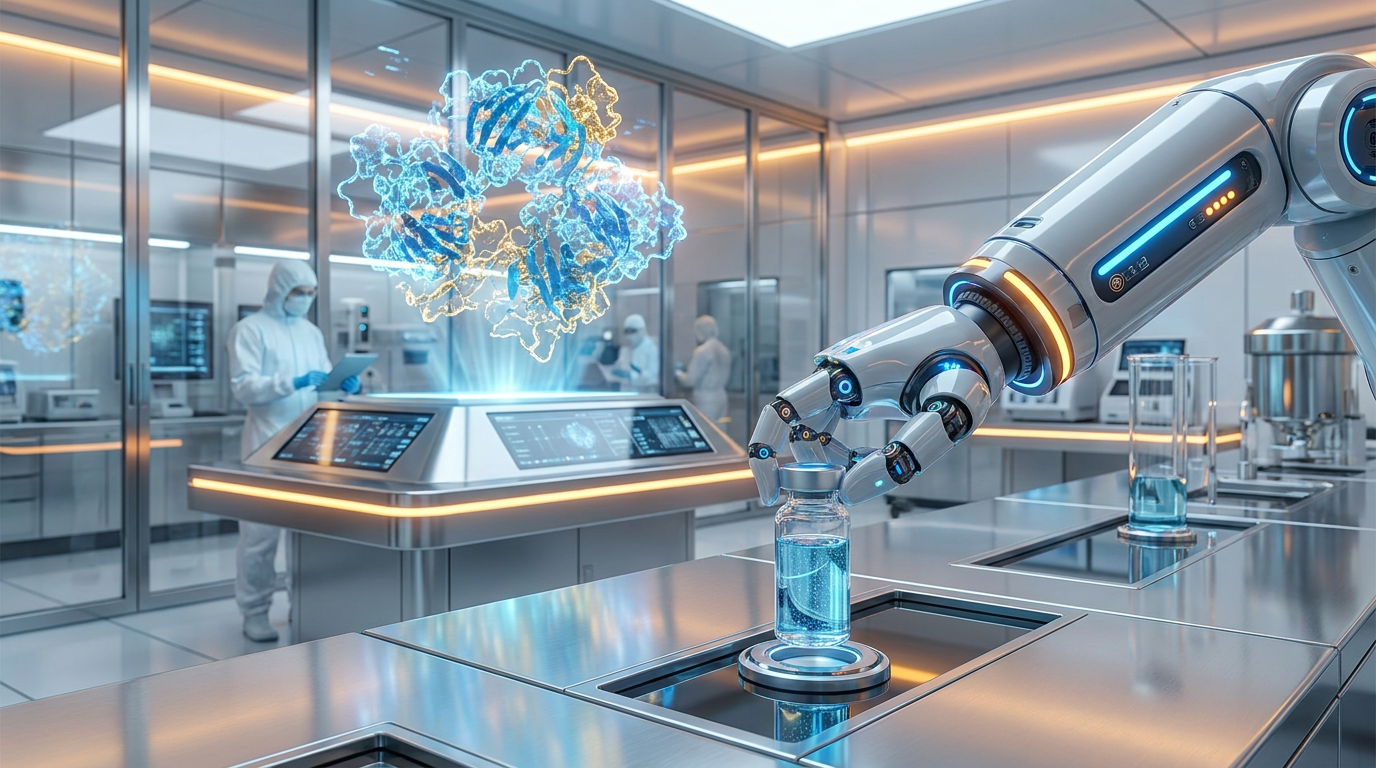
This concept of the "lab-in-the-loop" is becoming the gold standard for modern R&D. In these highly automated facilities, an AI agent generates a biological hypothesis and designs a molecule. Robotic arms and automated synthesizers then physically create and test the molecule in the lab. The results are immediately fed back into the AI model, allowing it to learn from its mistakes and refine its next design. This closed-loop system operates 24/7, drastically reducing human error and accelerating the pace of discovery.[4][7]
As these AI models become increasingly complex, they are pushing the limits of traditional computing hardware. The massive energy demands and processing bottlenecks of silicon-based chips have prompted researchers to explore radical new architectures. Scientists at the University of Pennsylvania have recently developed a hybrid light-matter particle that could dramatically speed up AI computing while consuming a fraction of the energy. By using ultra-efficient light-based technology instead of electricity, these advancements could provide the computational horsepower needed to simulate entire biological systems.[6]
The role of the scientist is also evolving in tandem with the technology. AI is shifting from being a passive instrument to an active, collaborative partner. In the most advanced laboratories of 2026, AI agents act as digital colleagues—generating hypotheses, controlling scientific instruments, and collaborating with human researchers to solve complex biological puzzles. The goal is not to replace human expertise, but to amplify it, allowing a small team of scientists to achieve what once required an entire pharmaceutical division.[5][8]

However, this rapid technological acceleration has triggered a wave of regulatory scrutiny. With the European Union's AI Act officially enforcing strict requirements for high-risk systems in 2026, pharmaceutical companies must navigate a complex new legal landscape. Regulators are demanding unprecedented transparency regarding how AI models make decisions, insisting on human-centric oversight and rigorous validation to ensure that machine-generated therapeutics meet the highest standards of safety and efficacy.[7]
Despite the breathtaking speed of computational discovery, the ultimate arbiter of success remains the human body. Biology is notoriously chaotic, and a molecule that performs flawlessly in a computer simulation can still fail unpredictably when introduced to a living patient. The enduring challenge of Phase III clinical trials—where drugs are tested on thousands of humans to prove efficacy and safety—serves as a humbling reminder that AI cannot entirely eliminate the inherent risks of medical development.[1][7]
The data emerging from these late-stage trials over the next year will serve as the ultimate litmus test for the Synthetic Renaissance. If the first wave of AI-designed drugs can successfully navigate Phase III and secure regulatory approval, it will validate billions of dollars in investment and permanently rewrite the economics of the pharmaceutical industry. More importantly, it will prove that humanity finally possesses the tools to decode biology at scale.[1][8]
The implications for global health are profound. By drastically lowering the time and cost required to develop new medicines, AI makes it economically viable to pursue treatments for rare diseases that were previously ignored by major pharmaceutical companies. As the technology matures, the focus will shift from treating symptoms to engineering precise, personalized cures, fundamentally transforming the future of human longevity and well-being.[2][8]
How we got here
2021-2023
Breakthroughs in protein-folding prediction, such as AlphaFold, prove that AI can accurately map biological structures.
2024-2025
Venture capital floods into generative biology startups, shifting focus from analyzing existing drugs to designing new ones.
Early 2026
Major pharmaceutical companies announce massive investments in dedicated AI supercomputers and automated labs.
Mid 2026
The first generation of fully AI-designed therapeutic molecules enters late-stage Phase III clinical trials.
Viewpoints in depth
Biotech Innovators
Argue that generative AI will fundamentally cure the pharmaceutical industry's 90% clinical failure rate.
For the vanguard of biotech startups and AI researchers, the current moment represents a permanent break from the past. They argue that the pharmaceutical industry's historically abysmal 90% failure rate in clinical trials is a symptom of human limitation—specifically, the inability to process enough biological variables simultaneously. By using generative AI to design molecules from scratch and simulating their interactions across millions of data points, these innovators believe they can engineer perfect therapeutic candidates before a single physical experiment is conducted. They view the current wave of Phase III trials not as an experiment, but as the inevitable validation of computational biology.
Clinical Pragmatists
Emphasize that while AI accelerates early discovery, the ultimate bottleneck remains human biology.
Veteran pharmacologists and clinical trial directors acknowledge the breathtaking speed of AI in the early stages of discovery, but they urge caution regarding the final outcomes. This camp emphasizes that the human body is infinitely more chaotic and complex than any computer simulation. A molecule that binds perfectly to a target in a digital model can still trigger unforeseen toxicities or fail to metabolize correctly in a living patient. For pragmatists, AI is a powerful tool for generating better starting points, but it cannot bypass the grueling, expensive reality of testing drugs on thousands of human subjects to prove safety and efficacy.
Infrastructure Providers
Focus on the massive compute, data integration, and novel hardware required to power these biological simulations.
Tech giants, hardware manufacturers, and cloud providers view the Synthetic Renaissance primarily as a massive computational challenge. Simulating the folding of novel proteins and the interactions of multi-omics datasets requires an unprecedented amount of processing power. This camp is focused on building the "AI factories" of the future—dedicated supercomputers, specialized silicon, and even experimental light-matter processors. They argue that the true bottleneck in 2026 is no longer the algorithms themselves, but the physical infrastructure required to run them at the scale necessary to model entire biological systems.
What we don't know
- Whether the first wave of AI-designed drugs will actually succeed in Phase III clinical trials and beat the industry's historical 90% failure rate.
- How regulatory bodies like the FDA and EMA will ultimately adapt their approval processes for therapeutics designed entirely by autonomous systems.
- To what extent the massive energy and compute requirements of biological AI models will limit their accessibility to smaller research institutions.
Key terms
- De novo design
- The creation of complex, entirely new molecules from scratch using computational models, rather than modifying existing compounds.
- In silico
- Biological experiments or simulations performed on a computer, as opposed to in a physical laboratory.
- Multi-omics
- The integrated analysis of multiple biological data types, such as genomics (DNA), proteomics (proteins), and transcriptomics (RNA), to understand disease mechanisms.
- Wet lab
- A traditional laboratory environment where chemicals, drugs, or biological matter are physically tested and analyzed by scientists.
- Lab-in-the-loop
- An automated system where AI models design experiments, robotic labs execute them, and the resulting data is immediately fed back to improve the AI's next design.
Frequently asked
What is 'de novo' drug design?
De novo design is the process of using artificial intelligence to create completely new, custom-tailored molecules from scratch, rather than searching through existing chemical libraries.
How much faster is AI drug discovery?
AI platforms have compressed the early discovery phase—which traditionally took three to four years—down to as little as 13 months.
Are AI-designed drugs already being tested on humans?
Yes. As of 2026, the first generation of therapeutics designed entirely by AI is advancing through Phase II and Phase III clinical trials.
Will AI replace human scientists?
No. AI is acting as a collaborative partner to generate hypotheses and crunch massive datasets, while human researchers steer the strategy and validate the clinical results.
Sources
Source coverage
8 outlets
3 viewpoints surfaced








[1]International Journal of Pharmaceutical SciencesClinical Pragmatists
Artificial Intelligence in Pharmaceutical R&D: From Algorithms to Approvals
Read on International Journal of Pharmaceutical Sciences →[2]Drug Target ReviewClinical Pragmatists
AI moves into the core of drug discovery in 2026
Read on Drug Target Review →[3]Intuition LabsBiotech Innovators
The Convergence of AI and Biologics: 2026 Industry Report
Read on Intuition Labs →[4]ZenovelBiotech Innovators
How Artificial Intelligence Is Transforming Drug Discovery in 2026
Read on Zenovel →[5]MicrosoftInfrastructure Providers
AI evolves from instrument to partner in 2026
Read on Microsoft →[6]University of PennsylvaniaInfrastructure Providers
Light-Matter AI Breakthrough
Read on University of Pennsylvania →[7]Global Health TechBiotech Innovators
The 2026 Synthetic Renaissance in Pharma
Read on Global Health Tech →[8]Factlen Editorial TeamInfrastructure Providers
Synthesis by Factlen editorial team
Read on Factlen Editorial Team →

Every angle. Every day.
Get ai stories with full source coverage and perspective breakdowns delivered to your inbox.