
Neuroaesthetics and Biophilic Design: How Interior Spaces Shape Brain Health
Emerging research in neuroscience reveals that interior design is not just aesthetic—it actively rewires our nervous systems. By integrating natural elements and evidence-based spatial layouts, architects are creating spaces that measurably reduce stress and boost cognitive performance.
By Factlen Editorial Team
- Neuroaesthetics Researchers
- Focus on the empirical data, arguing that spatial configurations directly alter brain chemistry and hormonal balance.
- Architects & Designers
- Focus on translating science into practice to advocate for better materials, lighting, and spatial flow in client projects.
- Public Health Advocates
- Focus on the democratization of healthy spaces, arguing that biophilic elements are a fundamental standard for well-being.
What's not represented
- · Low-Income Housing Developers
- · Facilities Management Professionals
Why this matters
As humans spend up to 90 percent of their time indoors, the built environment has become a primary determinant of public health. Understanding how spaces affect the brain empowers individuals and organizations to design homes, offices, and hospitals that actively support mental resilience.
Key points
- Neuroaesthetics studies how the human brain responds to beauty, art, and spatial arrangements.
- Aesthetically pleasing spaces activate the orbitofrontal cortex, aiding in emotional regulation.
- Biophilic design integrates nature into buildings to reduce stress and improve cognitive function.
- Nature-inspired environments can reduce cortisol levels by up to 20 percent.
- Hospital patients with views of nature have been shown to recover faster and require less medication.
- Institutions like Johns Hopkins are using this science to solve health and well-being challenges.
The universal experience of walking into a room and feeling an immediate shift in mood—whether a sudden wave of calm or a subtle spike in anxiety—is not just a matter of personal taste. It is a biological reflex.[7]
For decades, interior design was treated primarily as an aesthetic or functional discipline. Today, a rapidly growing scientific field is proving that the environments we inhabit are actively rewiring our nervous systems, altering everything from our stress levels to our cognitive performance.[1][5]
Enter neuroaesthetics, a specialized branch of neuroscience that studies how the human brain responds to beauty, art, and spatial arrangements. By bridging the gap between biology and architecture, researchers are uncovering the precise mechanisms that make a space feel welcoming or hostile.[1][2]
The impact of design on the brain is immediate and measurable. When a person enters a visually pleasing space, functional imaging shows heightened activation in the orbitofrontal cortex, the brain region intimately linked to emotional regulation and decision-making.[5]

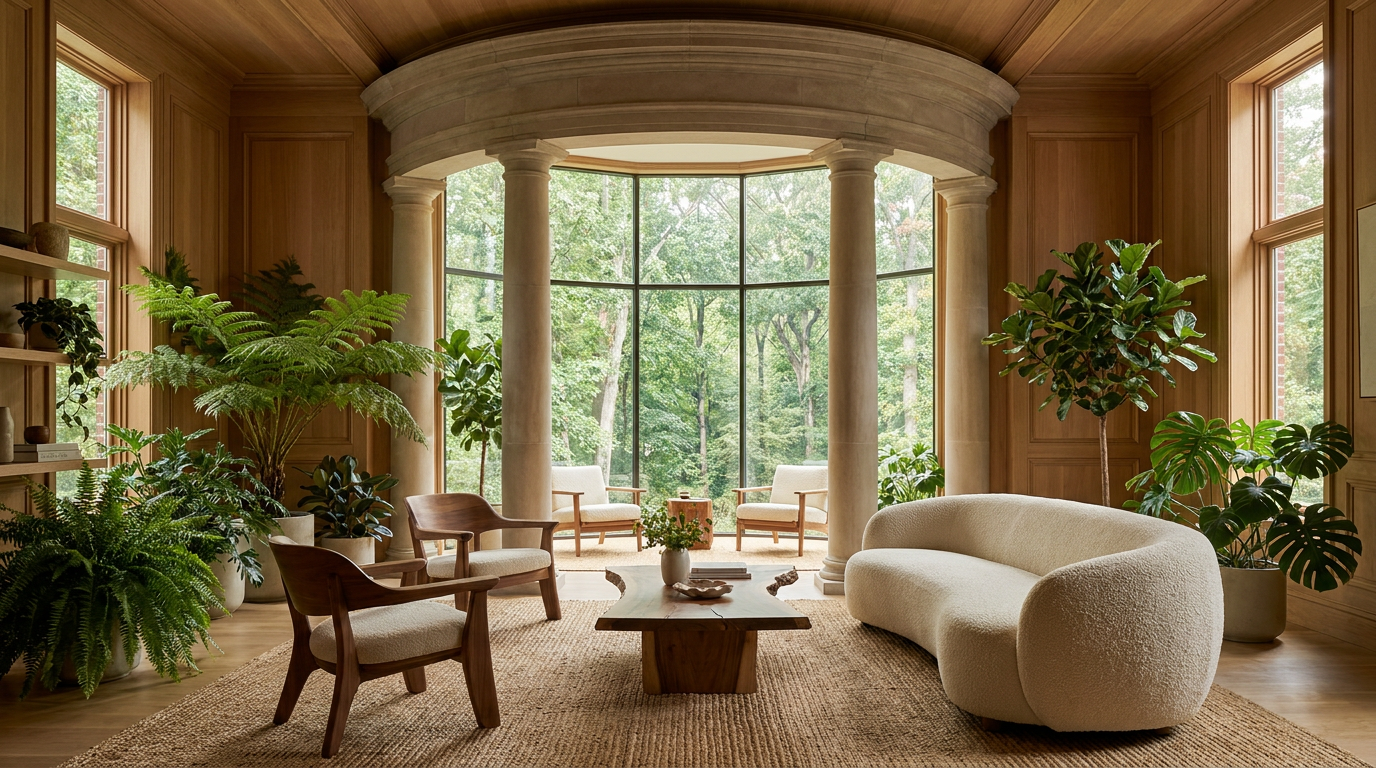
This neurological response extends far beyond simply "looking nice." Textures play a crucial role; materials like natural wood or woven fabrics stimulate the somatosensory cortex, producing subconscious feelings of comfort and belonging. Similarly, curvilinear shapes—soft edges rather than harsh angles—have been shown to activate the brain's pleasure centers.[5]
A major pillar of this evidence-based approach is biophilic design, which operates on the premise that humans possess an innate biological affinity for the natural world.[3][4]
The cognitive benefits of biophilic design are largely explained by Attention Restoration Theory (ART). Modern life demands "directed attention"—the intense focus required for screens and complex tasks—which quickly depletes our cognitive reserves. Natural stimuli, such as daylight, indoor plants, or water features, engage "soft fascination," allowing the brain to rest and recover its processing power.[3][4]

The cognitive benefits of biophilic design are largely explained by Attention Restoration Theory (ART).
The biological impacts of these design choices are highly measurable. Studies consistently demonstrate that thoughtfully designed, nature-inspired spaces can reduce the production of stress hormones, like cortisol, by 15 to 20 percent.[5]
In corporate environments, the introduction of biophilic elements has yielded dramatic results. Research indicates that employees working in offices with abundant natural light and greenery experience a 15 percent increase in productivity and report significantly lower rates of mental fatigue.[4][5]
The most profound data, however, comes from the healthcare sector. Landmark studies have demonstrated that hospital patients assigned to rooms with views of nature recovered faster and required fewer painkillers than those staring at brick walls.[3][5]

Educational environments are also being reimagined through this lens. Classrooms optimized with dynamic daylighting, acoustic dampening, and natural finishes have been shown to enhance student concentration and emotional stability, proving that the physical classroom is a vital component of the learning process.[6]
This intersection of science and design is gaining formidable institutional backing. Organizations like the Johns Hopkins International Arts + Mind Lab are pioneering "Impact Thinking," a translational research approach designed to solve health and well-being problems through evidence-based architectural practices.[2]
Beyond visual elements, neuroaesthetics also heavily emphasizes the invisible aspects of a room, such as acoustics and circadian lighting. Unpredictable noise elevates cortisol and maintains heightened stress states, while pleasant ambient sounds or strategic acoustic dampening reduce stress markers and improve focus.[5]
However, researchers caution that biophilic design is not a standalone cure for unhealthy environments. Adding a few potted plants or a wooden desk cannot overcome fundamentally poor indoor environmental quality, such as toxic air, lack of ventilation, or severe overcrowding.[3]

How we got here
1984
Environmental psychologist Roger Ulrich publishes a landmark study showing hospital patients recover faster with views of nature.
1990s
Advances in brain scanning technology, such as fMRI, allow scientists to measure neurological responses to aesthetic stimuli.
2019
Google and Johns Hopkins debut 'A Space for Being' at Milan Design Week, showcasing neuroaesthetics in action.
2020s
The post-pandemic shift toward remote work accelerates the adoption of biophilic design in residential and corporate spaces.
Viewpoints in depth
Neuroaesthetics Researchers
Focus on the empirical data, arguing that spatial configurations directly alter brain chemistry and hormonal balance.
Researchers in this camp rely on functional magnetic resonance imaging (fMRI) and biometric data to prove that design is not subjective. They argue that specific architectural choices—such as ceiling height, lighting temperature, and acoustic dampening—trigger predictable neurological responses. By quantifying these effects, they aim to establish a rigorous, evidence-based foundation for architecture that prioritizes human biology over mere visual trends.
Architects & Designers
Focus on translating science into practice to advocate for better materials, lighting, and spatial flow in client projects.
For practitioners, neuroaesthetics provides the scientific validation for what many have long known intuitively: beauty and comfort matter. Designers use this data to justify the often higher costs of natural materials, dynamic lighting systems, and complex spatial layouts to clients. They view their role as translating clinical findings into cohesive, livable environments that actively enhance the daily experience of the occupants.
Public Health Advocates
Focus on the democratization of healthy spaces, arguing that biophilic elements are a fundamental standard for well-being.
Public health experts view the built environment as a critical frontier in preventative medicine. They argue that access to natural light, clean air, and biophilic design should not be a luxury reserved for high-end corporate offices or wealthy homeowners. Instead, they advocate for updating building codes and urban planning policies to ensure that schools, public hospitals, and affordable housing integrate these stress-reducing principles.
What we don't know
- How different neurodivergent populations respond to specific biophilic stimuli compared to neurotypical baselines.
- The exact threshold of nature exposure required to trigger measurable cognitive restoration in highly stressful environments.
- How long the stress-reducing effects of a neuroaesthetic space last once an individual leaves the environment.
Key terms
- Neuroaesthetics
- The scientific study of how the brain responds to beauty, art, and design, and how these elements affect physical and mental well-being.
- Biophilic Design
- An architectural approach that seeks to connect building occupants more closely to nature through lighting, ventilation, plants, and natural materials.
- Orbitofrontal Cortex
- A region of the brain involved in decision-making and emotional regulation that is highly activated by aesthetically pleasing environments.
- Attention Restoration Theory (ART)
- A psychological theory suggesting that exposure to nature helps the brain recover from the cognitive fatigue caused by intense focus.
- Somatosensory Cortex
- The part of the brain that processes tactile sensations, which is stimulated by natural textures like wood and woven fabrics to produce feelings of comfort.
Frequently asked
What is neuroaesthetics?
It is a branch of neuroscience that studies how the brain responds to visual stimuli, beauty, and spatial environments, and how these factors influence mood and health.
How does biophilic design reduce stress?
By incorporating natural elements like sunlight, plants, and wood, biophilic design lowers cortisol levels and heart rates, tapping into our innate biological connection to nature.
Can interior design really affect physical healing?
Yes. Landmark studies have shown that hospital patients with views of nature and access to natural light recover faster and require less pain medication.
Is biophilic design just about adding indoor plants?
No. While plants are a component, true biophilic design also involves natural light, organic shapes, acoustic comfort, and materials that mimic natural textures.
Sources
Source coverage
7 outlets
3 viewpoints surfaced







[1]ArchDailyArchitects & Designers
Neuroesthetics: The Influence of Design on Human Experience
Read on ArchDaily →[2]Johns Hopkins IAM LabNeuroaesthetics Researchers
Center for Applied Neuroaesthetics
Read on Johns Hopkins IAM Lab →[3]Terrapin Bright GreenPublic Health Advocates
14 Patterns of Biophilic Design
Read on Terrapin Bright Green →[4]INTEGRIS HealthPublic Health Advocates
What Are the Benefits of Biophilic Design?
Read on INTEGRIS Health →[5]Science in DesignNeuroaesthetics Researchers
Neuroaesthetics for Interior Designers
Read on Science in Design →[6]Building and EnvironmentNeuroaesthetics Researchers
Clever classrooms: Summary report of the HEAD project
Read on Building and Environment →[7]Factlen Editorial TeamArchitects & Designers
Synthesis by Factlen editorial team
Read on Factlen Editorial Team →

Every angle. Every day.
Get home stories with full source coverage and perspective breakdowns delivered to your inbox.