
The 12-MPH Ascent: How Stratospheric Balloons Are Redefining Space Tourism for 2026
A new class of aerospace startups is swapping rocket fuel for massive zero-pressure balloons, promising a gentle, carbon-neutral journey to the edge of space.
By Factlen Editorial Team
- Aerospace Innovators
- Startups building the balloons view this as the democratization of near-space travel.
- Aviation Regulators
- Agencies like the FAA and EASA are focused on adapting existing frameworks to a novel hybrid vehicle.
- Spaceflight Traditionalists
- Rocket operators and purists emphasize the technical distinction between the stratosphere and true outer space.
- Industry Analysts
- Market observers tracking the economic and environmental viability of the new sector.
What's not represented
- · Marine ecologists monitoring ocean splashdown impacts
- · Helium supply chain analysts
Why this matters
By removing the extreme G-forces, rigorous training, and massive carbon footprint of rocket launches, stratospheric ballooning opens the 'Overview Effect' to a much broader demographic of travelers—shifting space tourism from an extreme sport to a luxury hospitality experience.
Key points
- Commercial stratospheric balloon flights are scheduled to begin in 2026, offering a gentle alternative to rocket-based space tourism.
- Passengers will ascend to 100,000 feet in pressurized luxury capsules, experiencing the 'Overview Effect' without G-forces or weightlessness.
- Major operators include Florida-based Space Perspective, France's Zephalto, and Arizona's World View, with tickets ranging from $50,000 to $130,000.
- The industry emphasizes sustainability, utilizing zero-emission lift gases like hydrogen and helium instead of carbon-heavy rocket fuels.
The era of commercial space tourism has largely been defined by fire, extreme G-forces, and multi-million-dollar rocket engines. For the past decade, companies like SpaceX, Blue Origin, and Virgin Galactic have dominated the headlines, offering brief, adrenaline-fueled suborbital hops or multi-day orbital missions for the ultra-wealthy. But a new sector of the aerospace industry is preparing to launch in 2026, fundamentally altering the mechanics and the mood of near-space travel. By replacing explosive propulsion with the quiet physics of buoyancy, these new ventures are poised to transform the final frontier into an accessible luxury experience.[2]
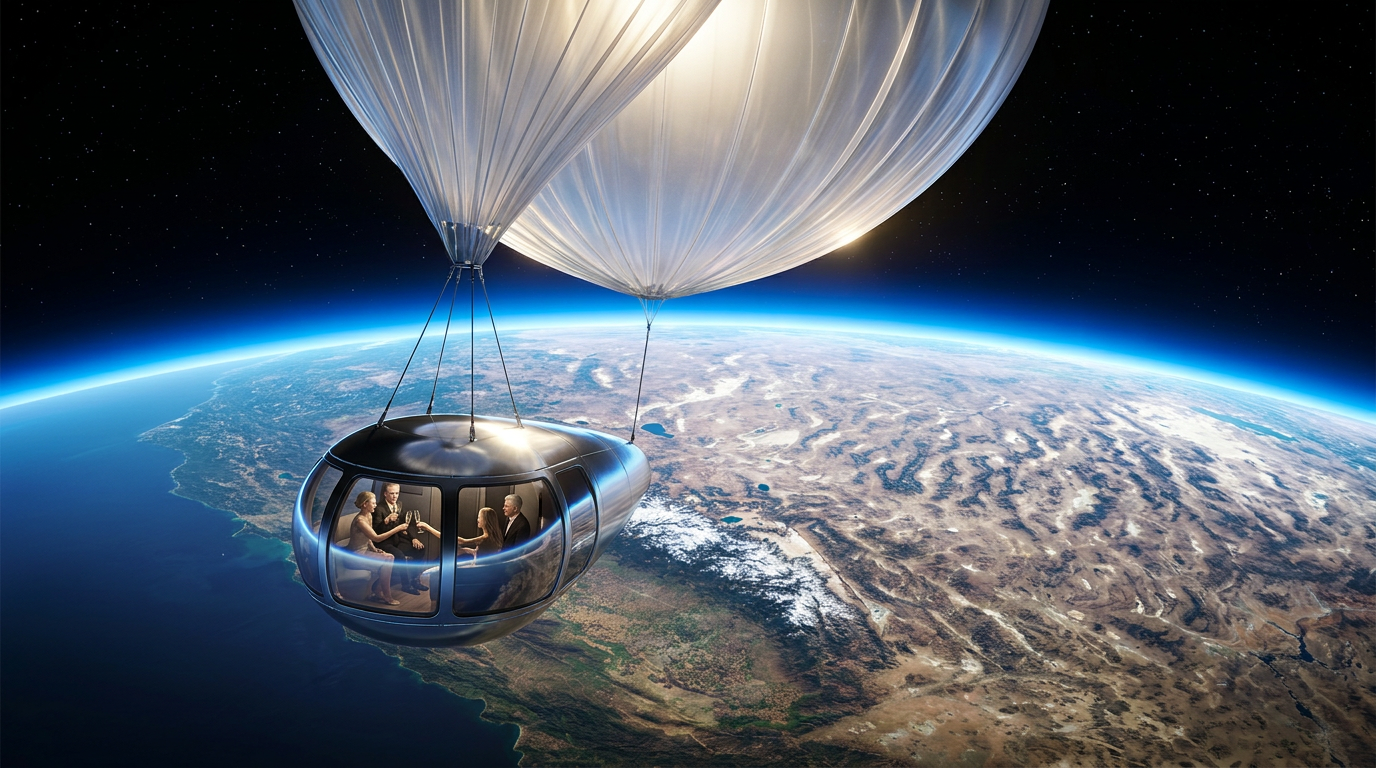
Instead of strapping passengers to controlled explosions, startups like Florida-based Space Perspective, France's Zephalto, and Arizona's World View are utilizing stratospheric balloons. These massive, zero-pressure envelopes are designed to gently lift pressurized luxury capsules to the edge of space at a serene pace of roughly 12 miles per hour. The approach represents a stark departure from the traditional aerospace playbook, prioritizing comfort, sustainability, and extended observation time over sheer velocity and altitude. By utilizing technology that has been quietly perfected by meteorological agencies for decades, these companies are bringing a proven mechanism into the commercial hospitality market.[1][3]
The shift from rockets to balloons removes the physical barriers that have historically kept spaceflight restricted to highly trained astronauts or the exceptionally fit. Because the ascent is slow and the capsule maintains a "shirt-sleeve environment"—meaning normal atmospheric pressure and temperature—passengers require no specialized spacesuits, no rigorous centrifuge training, and experience no crushing G-forces. This opens the market to individuals of varying ages and physical abilities, allowing anyone who can safely board a commercial airliner to embark on a journey to the stratosphere.[2][4]
The target altitude for these flights is roughly 100,000 feet, or about 19 miles above sea level. While this falls short of the internationally recognized Kármán line (62 miles) that defines the boundary of outer space, it is nearly three times higher than the cruising altitude of a commercial airliner. At this height, the atmosphere is thin enough that the sky transitions from the familiar daytime blue to the deep, star-studded blackness of the cosmos, providing a visual experience that rivals orbital flight.[1][7]

At 100,000 feet, passengers are positioned above 98% of the Earth's atmosphere. From this unique vantage point, the curvature of the Earth becomes distinctly visible, framed by the glowing blue halo of the atmosphere that shields the planet. The sheer scale of the view allows travelers to witness massive weather systems forming, entire continents stretching across the horizon, and the stark, humbling contrast between the vibrant, living planet and the desolate void of space surrounding it. It is a perspective previously reserved for a fraction of a percent of humanity.[3]
This visual phenomenon is known as the "Overview Effect." First described by Apollo astronauts in the late 1960s, it is a profound cognitive shift characterized by a sudden awareness of the planet's fragility and the deep interconnectedness of human life. By democratizing access to this transformative view, balloon operators hope to inspire a new wave of environmental consciousness among their clientele. The underlying philosophy is that those who see the Earth as a single, borderless organism suspended in a hostile vacuum will inevitably return home as more dedicated and active stewards of the global environment.[2][7]
The flight profile typically spans six hours, offering a stark contrast to the fleeting minutes of weightlessness provided by suborbital rockets. Passengers spend two hours ascending through the atmosphere, two hours floating at peak altitude for contemplation and dining, and two hours gently descending back to Earth. This extended duration allows travelers to fully absorb the experience, moving freely around the cabin, taking photographs, and sharing the moment with companions rather than remaining strapped into a high-G acceleration seat.[4]
The interior experience is meticulously designed to mirror a high-end hospitality suite rather than a utilitarian, switch-heavy spacecraft. Space Perspective's "Spaceship Neptune" capsule features plush lounge seating, a fully stocked cocktail bar, a private lavatory, and high-speed Wi-Fi, allowing passengers to livestream their extraordinary view directly to friends and family on the ground. The pressurized cabin is surrounded by massive, 360-degree panoramic windows, which are specially engineered to withstand the extreme temperature differentials of the stratosphere while providing an entirely unobstructed, glare-free view of the cosmos.[1]

European competitor Zephalto is leaning heavily into its French heritage, partnering with the French space agency (CNES) and renowned interior architect Joseph Dirand to craft its distinct aesthetic. Their "Céleste" capsule promises a Michelin-star culinary experience and fine French wines, elevating the journey into an unprecedented tier of luxury dining at the edge of the atmosphere. By seamlessly combining the thrill of aerospace exploration with the meticulous refinement of Parisian hospitality, Zephalto aims to attract a demographic that values sensory indulgence and artistic design just as much as technological achievement.[3]
The underlying technology relies on highly advanced zero-pressure balloons, which have been successfully used for decades by agencies like NASA and CNES to lift heavy scientific payloads into the upper atmosphere. These balloons are only partially inflated with lift gas—either helium or hydrogen—at sea level. As the balloon rises and the outside atmospheric pressure steadily drops, the trapped gas naturally expands, eventually filling the massive, ultra-thin envelope to the size of a professional football stadium by the time it reaches its cruising altitude in the stratosphere.[2][7]
These balloons are only partially inflated with lift gas—either helium or hydrogen—at sea level.
Sustainability is a core pillar of the balloon tourism pitch, sharply contrasting with the environmental impact of traditional spaceflight. Traditional rocket launches emit significant amounts of carbon dioxide, black carbon soot, and other greenhouse gases directly into the fragile upper atmosphere, raising serious concerns about their long-term ecological viability. In contrast, balloon operators are aggressively marketing their flights as carbon-neutral, appealing directly to eco-conscious luxury travelers who want to explore the boundaries of the planet without contributing to its atmospheric degradation.[1][3]
Because the balloons rely entirely on the physics of buoyancy rather than chemical combustion, there are zero emissions generated from propulsion during the flight itself. Space Perspective, for instance, utilizes renewable hydrogen lift gas and actively offsets the carbon footprint of its marine recovery vessels through verified blue carbon initiatives, such as extensive coastal mangrove planting. This holistic approach to sustainability is deliberately designed to ensure that the industry's overall environmental footprint remains negligible, even as the cadence of commercial passenger flights scales up in the coming years.[1][7]
Launch and recovery mechanisms vary significantly between the competing companies. Space Perspective operates from "Marine Spaceport Voyager," a specialized, custom-built ship that allows the balloon to launch directly from the open ocean, taking advantage of optimal global weather patterns and avoiding congested terrestrial airspace. After the six-hour flight concludes, the capsule gently splashes down in the water, where it is quickly stabilized by a team in speedboats and safely hoisted back aboard the Voyager vessel using a specialized, 16-meter-long lifting frame.[1][4]
Conversely, Zephalto and World View plan to launch from and land on solid ground, utilizing designated terrestrial spaceports across various continents. World View's system incorporates an innovative and highly controlled descent mechanism: after the primary balloon is released at the end of the flight, the capsule deploys steerable parafoils—similar to highly advanced, oversized parachutes. This aerodynamic design allows an onboard pilot to actively glide the craft through the lower atmosphere, navigating local wind currents to reach a precise, pre-determined landing zone in the desert.[2][3]
Safety remains the paramount concern for both the commercial operators and the government agencies tasked with overseeing them. In the United States, the Federal Aviation Administration (FAA) oversees these balloon operations under its commercial human spaceflight regulations, specifically Part 460. This stringent regulatory framework requires rigorous, documented testing of the capsule's life support systems, environmental controls, and overall structural integrity, ensuring that the pressurized cabin can safely sustain passengers in the freezing, near-vacuum environment of the upper stratosphere.[5]
In Europe, the European Union Aviation Safety Agency (EASA) is actively adapting its extensive balloon operations framework to accommodate the unique challenges of pressurized stratospheric flight. By working closely with companies like Zephalto and the French space agency, EASA aims to establish a unified set of certification specifications that address the specific risks of high-altitude passenger transport. This collaborative effort is essential for bridging the complex regulatory gap between traditional, low-altitude hot-air ballooning and the rigorous demands of modern orbital spacecraft engineering.[6]
To mitigate the catastrophic risk of a primary balloon failure, all passenger capsules are equipped with highly redundant, aerospace-grade safety systems. If the massive balloon envelope were to tear, leak, or otherwise fail during the ascent or cruise phase, a reserve descent system consisting of multiple backup parachutes would automatically deploy. This critical fail-safe mechanism ensures that the capsule would immediately stabilize and descend at a safe, controlled speed, protecting the passengers inside from the extreme forces of a free-fall.[1][7]
The timeline for commercial operations is rapidly approaching, moving the industry from conceptual renders to physical, operational reality. In September 2024, Space Perspective successfully completed a full uncrewed test flight of its Spaceship Neptune-Excelsior vehicle. The milestone flight definitively validated the company's patented marine launch system, confirmed the capsule's ability to maintain stable cabin pressure at peak altitude, and successfully demonstrated the complex ocean splashdown and retrieval procedures required for routine passenger service. This successful demonstration served as a critical benchmark on the path to crewed test flights.[1]
With ticket prices currently ranging from $50,000 for World View's experience to $130,000 for Zephalto's Michelin-starred journey, the market remains undeniably exclusive. However, these price points represent a mere fraction of the $450,000 price tag commanded by suborbital rocket flights, and an even smaller percentage of the multi-million-dollar cost of a multi-day orbital mission. Industry analysts predict that as the balloon technology matures, infrastructure is amortized, and flight cadences increase, economies of scale could eventually drive prices down, making the edge of space accessible to a broader segment of the upper-middle class.[2][3]

As the industry prepares to welcome its first paying passengers in 2026, stratospheric ballooning stands poised to fundamentally redefine the boundaries of luxury travel. By stripping away the noise, the pollution, and the physical strain of traditional rocketry, these companies are offering a silent, sustainable, and profoundly awe-inspiring bridge between the Earth and the stars. For the thousands of ticket holders already on the waitlist, the ultimate luxury is no longer just a destination, but a completely new perspective on the planet they call home.[4][7]
How we got here
2018
Space Perspective is founded by former World View executives with the goal of creating a carbon-neutral space tourism experience.
2023
French startup Zephalto partners with the French space agency (CNES) to develop its luxury Céleste capsule.
September 2024
Space Perspective successfully completes a full uncrewed test flight of its Spaceship Neptune vehicle from a marine spaceport.
2026
First commercial passenger flights are scheduled to begin across multiple stratospheric balloon operators.
Viewpoints in depth
Aerospace Innovators
Startups building the balloons view this as the democratization of near-space travel.
Companies like Space Perspective and Zephalto argue that the physical toll of rocket launches has artificially restricted who gets to experience the cosmos. By utilizing a gentle, 12-mph ascent in a pressurized cabin, they believe they can open the 'Overview Effect' to the elderly, the disabled, and those without specialized training. Furthermore, they position their zero-emission lift mechanisms as the only sustainable path forward for commercial space tourism.
Aviation Regulators
Agencies like the FAA and EASA are focused on adapting existing frameworks to a novel hybrid vehicle.
For regulators, stratospheric balloons occupy a gray area between traditional aviation and commercial spaceflight. The FAA currently categorizes these flights under human spaceflight regulations, requiring rigorous testing of life-support systems. Meanwhile, European regulators are working to expand their existing balloon operation codes to account for pressurized cabins and extreme altitudes, ensuring that redundant safety systems—like backup parafoils—can reliably return passengers if the primary envelope fails.
Spaceflight Traditionalists
Rocket operators and purists emphasize the technical distinction between the stratosphere and true outer space.
Some veterans of the aerospace industry point out that balloon flights, which peak at roughly 19 miles above sea level, fall well short of the 62-mile Kármán line that internationally defines the boundary of space. Because the capsules do not achieve orbital velocity or cross this threshold, passengers will not experience weightlessness or zero gravity. For these purists, ballooning is viewed as extreme high-altitude aviation rather than true space exploration.
What we don't know
- How frequently weather conditions will delay or cancel the 6-hour flights, given the extreme sensitivity of massive balloons to stratospheric wind shears.
- Whether the global supply chain for helium can sustainably support a high volume of commercial flights without driving up operational costs.
- How international airspace regulations will adapt if a balloon drifts across national borders during its ascent or descent.
Key terms
- Overview Effect
- A cognitive shift reported by astronauts when viewing Earth from space, characterized by a profound sense of interconnectedness and an awareness of the planet's fragility.
- Zero-Pressure Balloon
- A specialized balloon where the atmospheric pressure inside matches the outside, allowing it to safely expand as it rises into the thin upper atmosphere without popping.
- Kármán Line
- The internationally recognized boundary of outer space, located 62 miles (100 kilometers) above sea level.
Frequently asked
Will I experience zero gravity on a balloon flight?
No. Because the capsule does not reach orbital speeds or cross the Kármán line into true outer space, passengers remain in normal Earth gravity throughout the entire flight.
What happens if the main balloon fails?
The capsules are equipped with redundant safety mechanisms, including a reserve descent system of steerable backup parachutes that automatically deploy to safely glide the capsule back to Earth.
Do I need astronaut training to go?
No. The ascent is gentle (roughly 12 mph) and the capsule is fully pressurized, meaning passengers can wear normal clothes and require only a brief safety orientation before boarding.
Sources
Source coverage
7 outlets
4 viewpoints surfaced







[1]Space.comSpaceflight Traditionalists
Space Perspective's luxury balloon-lifted space capsule completes full flight
Read on Space.com →[2]CNBCSpaceflight Traditionalists
Startups are hoping to hoist tourists to the stratosphere using massive balloons
Read on CNBC →[3]ForbesAerospace Innovators
Zephalto Is Pioneering Luxury Flights Into Space
Read on Forbes →[4]Travel WeeklyAerospace Innovators
Space Perspective plans commercial flights in 2026
Read on Travel Weekly →[5]Federal Aviation AdministrationAviation Regulators
Commercial Human Spaceflight Requirements
Read on Federal Aviation Administration →[6]European Union Aviation Safety AgencyAviation Regulators
Balloon Operations and Safety Framework
Read on European Union Aviation Safety Agency →[7]Factlen Editorial TeamIndustry Analysts
Synthesis by Factlen editorial team
Read on Factlen Editorial Team →
Every angle. Every day.
Get travel stories with full source coverage and perspective breakdowns delivered to your inbox.