
SpaceX IPO Raises Additional $10.7 Billion as Underwriters Exercise Options, Cementing $2.1 Trillion Valuation
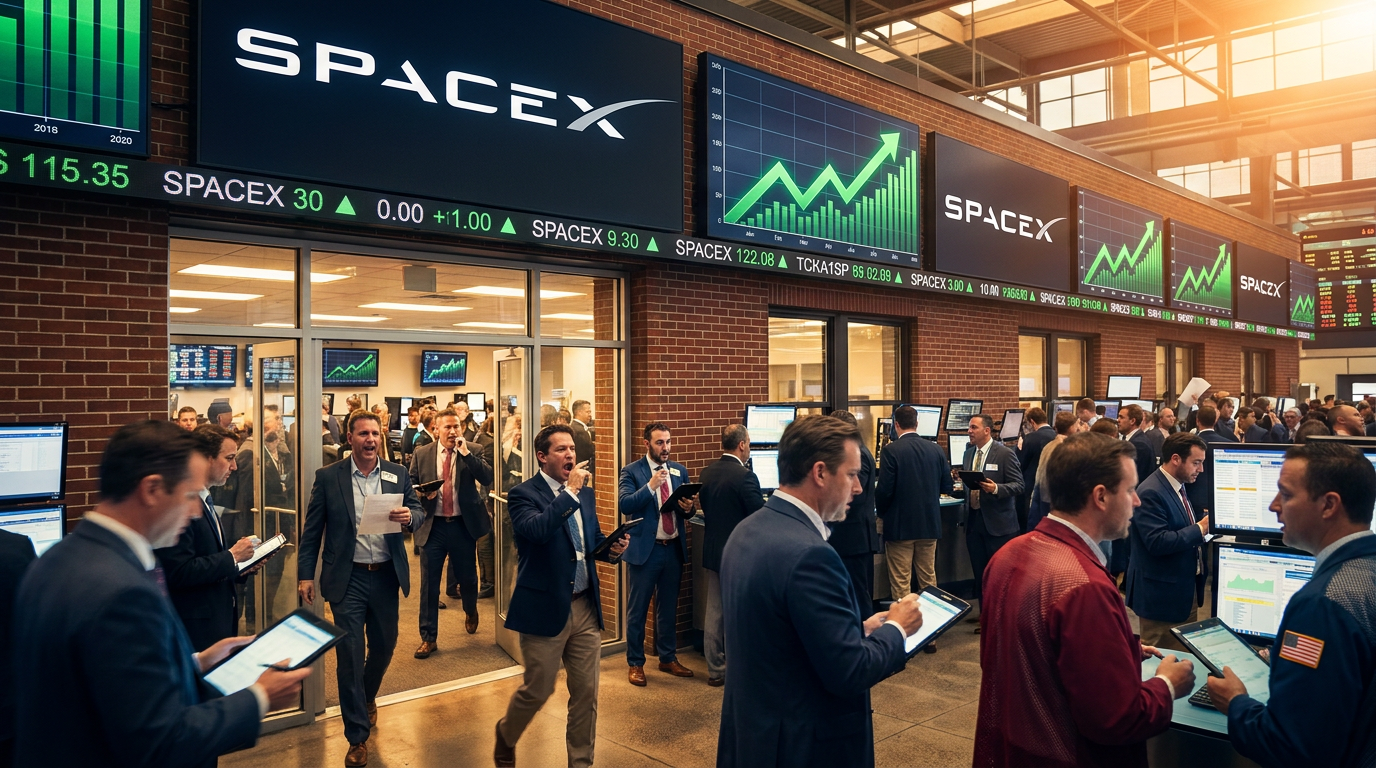
Underwriters for SpaceX's record-breaking initial public offering have purchased an additional 83 million shares, injecting another $10.7 billion into the aerospace giant. The move cements the company's $2.1 trillion valuation as options trading prepares to launch later this week.
By Factlen Editorial Team
- Space Economy Optimists
- Investors who view the record-breaking IPO as a rising tide that will elevate the entire commercial space sector.
- Market Structure Analysts
- Traders focused on the mechanical impact of integrating a mega-cap stock into global indices and derivatives markets.
- Valuation Skeptics
- Market strategists warning that the sheer size of the company will mathematically limit its future stock performance.
What's not represented
- · Retail Investors
- · Regulatory Bodies
Why this matters
SpaceX's public debut is not only the largest capital raise in history, but it also establishes a massive new anchor for the commercial space economy. The sheer scale of the $2.1 trillion valuation will force mutual funds and institutional investors to rebalance their portfolios, fundamentally altering the weighting of the broader stock market.
Key points
- Underwriters exercised their overallotment option, buying 83 million additional SpaceX shares.
- The move injects $10.7 billion into SpaceX, cementing its $2.1 trillion valuation.
- Options trading for the stock is set to launch during this week's 'triple witching' event.
- Rival space stocks like Rocket Lab rebounded, indicating the IPO is lifting the broader sector.
- Analysts are modeling the massive forced buying that will occur when SpaceX is added to major indices.
SpaceX's historic entry into the public markets just grew even larger, cementing its status as a financial juggernaut. On Monday, the aerospace giant revealed that underwriters for its initial public offering exercised their overallotment option to purchase an additional 83 million shares. This maneuver injects another $10.7 billion into the company's coffers, adding to an already record-breaking capital raise. The sheer scale of the transaction underscores the unprecedented institutional demand for a piece of Elon Musk's orbital empire, setting a new high-water mark for public market debuts.[1][5]
The overallotment exercise firmly cements SpaceX's valuation at a staggering $2.1 trillion, placing it instantly among the world's most valuable publicly traded companies. This valuation places the rocket manufacturer in the elite company of tech titans like Apple, Microsoft, and Nvidia. The sheer scale of the debut has captivated Wall Street, transforming the commercial space sector from a speculative, niche venture-capital play into a cornerstone of global institutional portfolios. Portfolio managers who previously viewed space exploration as a distant frontier are now forced to treat it as a core equity allocation.[2][6]
The timing of the underwriter announcement coincides with a critical week for market mechanics and derivatives trading. Options trading for SpaceX contracts is slated to launch in the coming days, perfectly aligning with the June 'triple witching' event. This quarterly phenomenon involves the simultaneous expiration of stock options, stock index futures, and stock index options, a convergence that traditionally drives massive trading volume and erratic price swings. Introducing a highly anticipated, $2.1 trillion asset into this already volatile mix is expected to create a frenzy of activity on trading desks worldwide.[4][7]

Traders are bracing for a surge in both volatility and volume as the derivatives market opens for SpaceX. The introduction of options for such a massive asset provides a vast new playground for both retail speculators and institutional hedgers. Market participants have been eagerly awaiting the ability to trade around the company's aggressive launch schedule, Starship development milestones, and the rapid subscriber growth of its Starlink satellite internet service. The options chain will allow investors to place leveraged bets on these catalysts or hedge their existing equity exposure against potential launch failures.[4][7]
Initially, the immense gravity of SpaceX's massive valuation sparked fears that it would siphon capital away from smaller aerospace competitors. Analysts worried that a $2.1 trillion behemoth would act as a black hole for space-focused investment, leaving pure-play satellite operators and smaller launch providers starved for institutional funding. The logic dictated that mutual funds with a fixed allocation for the space sector would dump their smaller holdings to make room for the undisputed industry leader. However, the market's actual reaction over the past few trading sessions has begun to dismantle this zero-sum narrative.[9]
Initially, the immense gravity of SpaceX's massive valuation sparked fears that it would siphon capital away from smaller aerospace competitors.
Shares of rival launch provider Rocket Lab rebounded sharply on Monday, leading a broader rally among adjacent space stocks. Analysts noted that the initial selloff in these smaller competitors was largely misguided. Instead of draining the ecosystem, the overwhelming demand for SpaceX shares underscores a deep, unfulfilled investor appetite for the broader space economy. The successful overallotment is acting as a rising tide, drawing fresh capital into the sector and validating the business models of smaller companies that provide specialized services in orbit, satellite manufacturing, and lunar logistics.[3][8]

Looking ahead, the most profound impact of SpaceX's public debut may be structural rather than purely financial. At $2.1 trillion, the company is simply too large for major index funds to ignore. Portfolio managers and quantitative analysts are already modeling the inevitable inclusion of SpaceX into major benchmarks, most notably the S&P 500. Because passive index funds are strictly mandated to buy shares to match the benchmark's weighting, SpaceX's eventual inclusion will trigger a massive, automated reallocation of capital across the global financial system.[6][9]
This index inclusion will force billions of dollars in mandatory buying of SpaceX stock. However, because index funds have a finite pool of capital, this forced buying must come at the expense of other equities. Strategists anticipate that funds will have to trim their positions in other mega-cap technology stocks to make room for the aerospace giant. This mechanical rebalancing could introduce subtle headwinds for established tech leaders while simultaneously providing a permanent floor of passive bid support for SpaceX shares.[6][9]
Yet, some market strategists warn that SpaceX's massive valuation could ultimately become its own worst enemy. Companies of this unprecedented scale often struggle to consistently outperform the broader market simply due to the mathematical law of large numbers. To double a $2.1 trillion valuation and deliver the kind of outsized percentage returns that growth investors typically demand, SpaceX would need to generate truly staggering amounts of free cash flow. Maintaining a hyper-growth trajectory at a multi-trillion-dollar market capitalization is a feat achieved by only a handful of companies in history.[2]

The backdrop for this historic IPO is a surprisingly favorable macroeconomic environment. The broader stock market has been buoyed by recent geopolitical developments, including a tentative peace framework between the U.S. and Iran. This de-escalation has stabilized global energy markets, driving down oil prices and easing inflation fears. Consequently, the bond market is signaling that the Federal Reserve may hold off on further rate hikes, creating a 'risk-on' environment where investors are highly receptive to ambitious, capital-intensive growth stories like SpaceX.[11]
Furthermore, the ongoing artificial intelligence buildout continues to drive a massive, broader technology rally. Companies like Nvidia and AMD are seeing historic valuations, creating a high-liquidity environment where investors are willing to pay premium multiples for dominant, paradigm-shifting companies. SpaceX is benefiting directly from this tech-heavy exuberance. Investors view the company not just as a rocket manufacturer, but as a foundational infrastructure play for the next century, drawing parallels between the deployment of the Starlink constellation and the buildout of global AI data centers.[10][11]
As the dust settles on the largest initial public offering in history, the focus on Wall Street will inevitably shift from capital raising to operational execution. With an additional $10.7 billion in fresh underwriter capital added to its already formidable war chest, SpaceX is uniquely positioned to accelerate its most ambitious projects. The funds will likely fast-track the development of the Starship deep-space vehicle and the expansion of the Starlink network, setting the pace for the next decade of orbital commerce and cementing the company's multi-trillion-dollar valuation.[1][10]
How we got here
Early 2026
SpaceX files confidential S-1 paperwork for its highly anticipated initial public offering.
May 2026
The company officially debuts on the public markets, shattering records for the largest IPO in history.
June 15, 2026
Underwriters exercise their overallotment option, purchasing an additional 83 million shares for $10.7 billion.
June 19, 2026
Options contracts for SpaceX stock are scheduled to begin trading during the June 'triple witching' expiration.
Viewpoints in depth
Space Economy Optimists
Investors who view the record-breaking IPO as a rising tide that will elevate the entire commercial space sector.
This camp argues that SpaceX's $2.1 trillion valuation permanently legitimizes the space economy in the eyes of institutional investors. Rather than viewing the market as a zero-sum game where SpaceX starves its competitors of capital, optimists point to the recent rebound in stocks like Rocket Lab as evidence of a 'halo effect.' They believe the massive liquidity event will encourage mutual funds to create dedicated aerospace allocations, ultimately funding a broader ecosystem of satellite operators, lunar logistics firms, and orbital manufacturers.
Valuation Skeptics
Market strategists warning that the sheer size of the company will mathematically limit its future stock performance.
Skeptics do not doubt SpaceX's technological dominance, but they question the mechanics of its stock moving forward. At a $2.1 trillion market capitalization, the company faces the 'law of large numbers.' To double in value and provide the returns growth investors typically seek, SpaceX would need to add another $2 trillion in market cap—a feat that requires unprecedented, sustained free cash flow. This camp warns that the stock may struggle to keep pace with the broader market simply because of its immense starting size.
Market Structure Analysts
Traders focused on the mechanical impact of integrating a mega-cap stock into global indices and derivatives markets.
For this group, the story is entirely about market plumbing. The impending launch of SpaceX options contracts during a 'triple witching' week is expected to inject massive volume and potential volatility into the market. Furthermore, analysts are modeling the inevitable inclusion of SpaceX into major benchmarks like the S&P 500. Because passive index funds are mandated to match benchmark weightings, SpaceX's inclusion will trigger billions of dollars in forced buying, which could inadvertently drain liquidity from other mega-cap technology stocks as portfolios rebalance.
What we don't know
- Exactly when SpaceX will be added to major indices like the S&P 500.
- How the introduction of options trading will impact the stock's short-term volatility.
- Whether the $2.1 trillion valuation will hold steady during upcoming Starship test flights.
Key terms
- Overallotment Option (Greenshoe)
- A provision in an underwriting agreement that allows underwriters to sell more shares than originally planned if demand is high.
- Triple Witching
- The simultaneous expiration of stock options, stock index futures, and stock index options, which occurs four times a year and typically causes high market volume.
- Index Inclusion
- The process by which a newly public or growing company is added to a major stock market benchmark, such as the S&P 500, forcing funds that track the index to buy its shares.
- Free Cash Flow
- The cash a company generates after accounting for cash outflows to support operations and maintain its capital assets.
Frequently asked
How much did SpaceX raise from the underwriter option?
Underwriters purchased an additional 83 million shares, raising an extra $10.7 billion for the company.
What is SpaceX's total market valuation?
Following the IPO and the exercise of the overallotment option, SpaceX is valued at approximately $2.1 trillion.
When will options trading for SpaceX begin?
Options contracts are expected to launch this week, coinciding with the June 'triple witching' expiration event.
Did the SpaceX IPO hurt other space companies?
Initially, there were fears it would drain capital from rivals, but stocks like Rocket Lab have actually rebounded as the IPO brought more broad investor attention to the space economy.
Sources
Source coverage
11 outlets
3 viewpoints surfaced







[1]MarketWatchMarket Structure Analysts
SpaceX’s stock jumps as the company reveals its IPO has raised another $10.7 billion
Read on MarketWatch →SpaceX’s massive $2.1 trillion valuation may soon become its own worst enemy
Read on MarketWatch →Rocket Lab’s stock rebounds, as one analyst says the SpaceX-fueled selloff was misguided
Read on MarketWatch →Options traders are bracing for a very busy week, with June ‘triple witching’ and launch of SpaceX contracts on deck
Read on MarketWatch →[5]CNBCSpace Economy Optimists
SpaceX underwriters exercise overallotment, adding $10.7 billion to record-breaking IPO
Read on CNBC →[6]BloombergMarket Structure Analysts
The $2.1 Trillion Space Giant: How SpaceX's Public Debut is Reshaping the Market
Read on Bloomberg →[7]ReutersMarket Structure Analysts
SpaceX options trading to launch amid 'triple witching' week
Read on Reuters →[8]Financial TimesSpace Economy Optimists
Rocket Lab and satellite stocks rebound as SpaceX IPO fears subside
Read on Financial Times →[9]The Wall Street JournalValuation Skeptics
SpaceX's Market Gravity: Will the $2.1 Trillion Valuation Crush Competitors?
Read on The Wall Street Journal →[10]Barron'sSpace Economy Optimists
Why the SpaceX IPO is a Watershed Moment for the Commercial Space Economy
Read on Barron's →The chip-stock rally is back in full force — thanks to two big geopolitical developments
Read on MarketWatch →

More in finance
See all 5 stories →Commercial Space
SpaceX's Historic IPO Expands to $85.7 Billion as Underwriters Exercise Option
0 sources
Retirement Planning
Working in Retirement: How the Earnings Test Impacts Your Social Security Benefits
0 sources

Valuation Metrics
The Return of GARP: How to Identify Growth Stocks Trading at Value Prices
0 sources

Every angle. Every day.
Get finance stories with full source coverage and perspective breakdowns delivered to your inbox.