
SpaceX Completes Record-Breaking IPO, Making Elon Musk the World's First Trillionaire
SpaceX's highly anticipated public market debut delivered a 19% first-day return, transforming the space exploration company into one of the world's most valuable public entities and pushing its founder's net worth past the $1 trillion mark.
By Factlen Editorial Team
- Space Economy Optimists
- Believe the IPO unlocks the massive capital needed for Mars colonization and cements US dominance in the orbital economy.
- Retail Investors
- View the stock as a long-term, generational hold and a unique opportunity to participate in humanity's expansion into space.
- Financial Historians
- Focus on the societal and historical implications of a single individual controlling $1 trillion in wealth, comparing it to the Gilded Age.
- Market Skeptics
- Question whether the astronomical valuation multiples are justified for a capital-intensive aerospace and hardware company.
What's not represented
- · Tax Policy Advocates
- · Space Regulation Authorities
Why this matters
This milestone not only marks a historic moment in wealth accumulation but also signals a massive shift in the commercial space economy, opening the door for retail investors to directly fund interplanetary exploration and global satellite internet infrastructure.
Key points
- SpaceX completed the largest initial public offering in history, valued at $75 billion.
- Shares of the aerospace company surged 19% on their first day of public trading.
- The massive market debut pushed CEO Elon Musk's net worth past $1 trillion.
- Capital from the IPO will fund the expansion of the Starlink network and Starship production.
- Retail investors and institutions heavily oversubscribed the offering, viewing it as a generational asset.
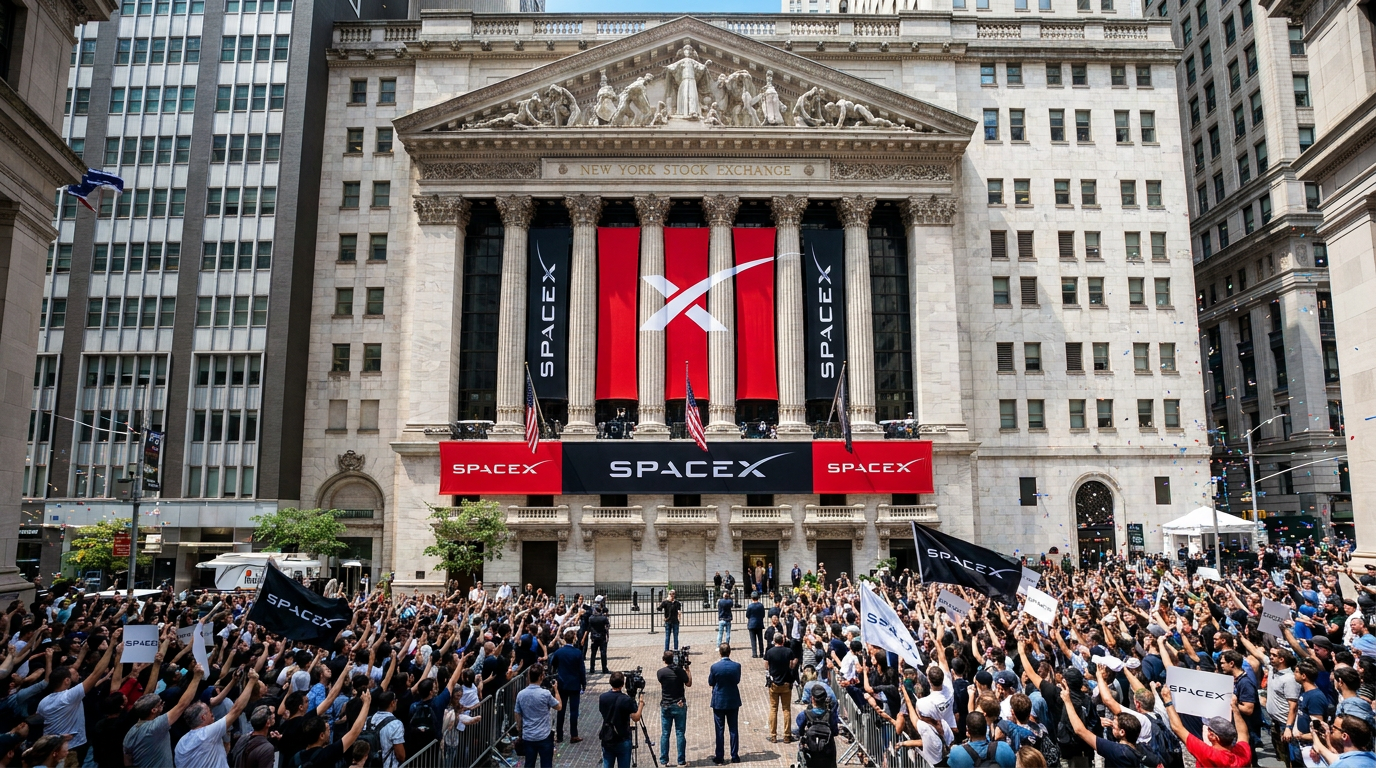
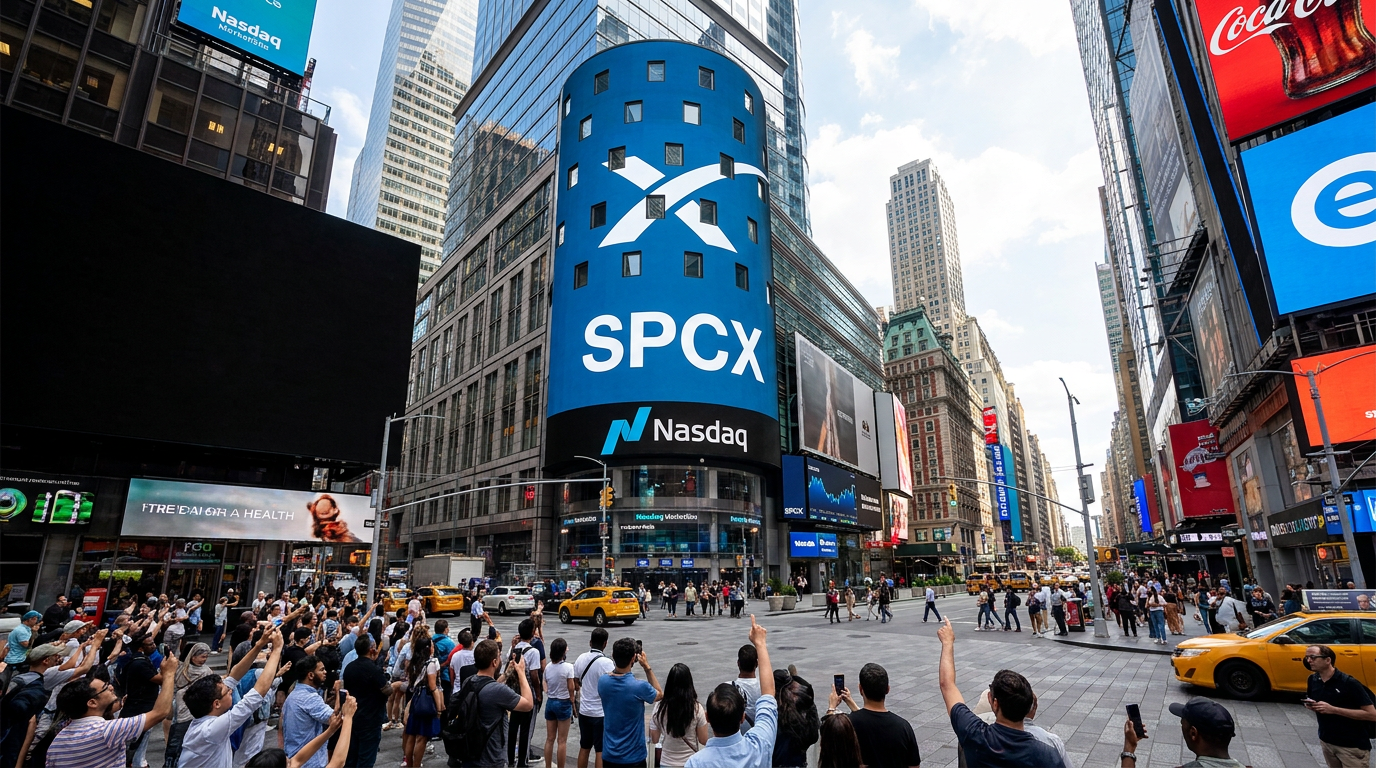
SpaceX officially entered the public markets on Friday in a historic initial public offering that transformed the commercial spaceflight pioneer into one of the world’s most valuable publicly traded companies. The stock surged 19% in its first day of trading, reflecting massive institutional and retail demand for a piece of the aerospace giant.[1][5][6]
The massive market debut also triggered a historic wealth milestone. The 19% pop in SpaceX shares pushed founder and CEO Elon Musk’s personal net worth past the $1 trillion threshold, making him the first individual in modern history to achieve trillionaire status.[2][4][7]
The $75 billion IPO represents the largest public offering in history, dwarfing previous records set by tech and energy conglomerates. Wall Street analysts noted that the offering was heavily oversubscribed, with investors eager to back a company that effectively monopolizes global launch services and operates the world's largest satellite internet constellation.[1][5]

For years, Musk had insisted that SpaceX would remain private until regular flights to Mars were underway. However, the accelerating capital requirements for the next-generation Starship rocket, coupled with the rapid expansion of the Starlink network and the broader AI boom, prompted a strategic shift to tap into public market liquidity.[1][8]
For years, Musk had insisted that SpaceX would remain private until regular flights to Mars were underway.
Financial historians are already drawing parallels between Musk's milestone and John D. Rockefeller, who became America's first billionaire in 1916 during the Gilded Age oil boom. Just as Standard Oil fueled the industrial revolution, analysts suggest SpaceX is laying the foundational infrastructure for the orbital economy.[2][4]
Retail investors have flooded into the stock, viewing it as a generational asset rather than a standard technology play. Market commentators, including CNBC's Jim Cramer, advised that it is not too late for everyday investors to buy in, provided they view the stock as a long-term bet on space exploration rather than a short-term trade.[3][6]

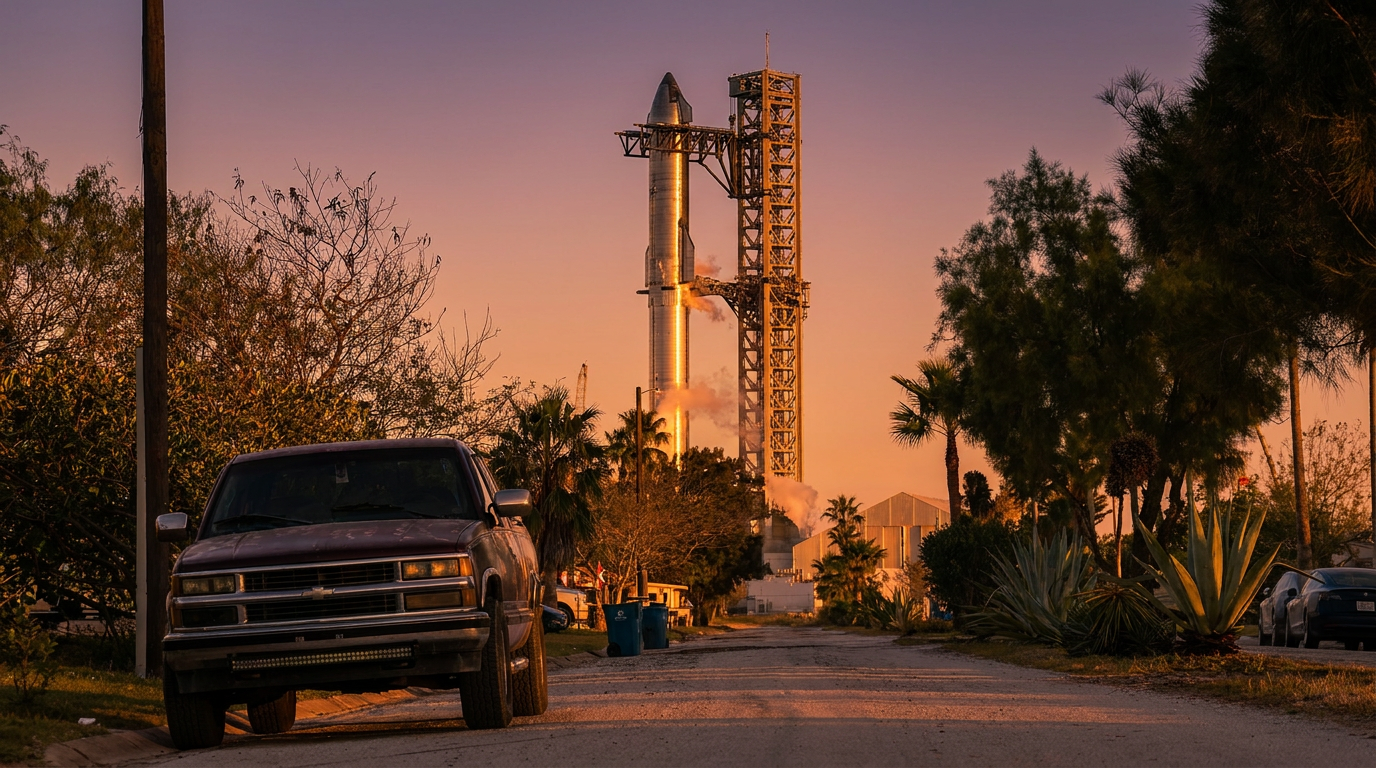
The influx of public capital is expected to dramatically accelerate SpaceX's timeline for interplanetary travel. The company has stated that the proceeds from the IPO will be directly funneled into scaling Starship production facilities in Texas and expanding the Starlink constellation to provide global cellular broadband.[5][8]
While some market skeptics question the astronomical valuation multiples applied to a hardware-heavy aerospace company, proponents argue that SpaceX should be valued as a unique hybrid of a defense contractor, a global telecommunications provider, and a pioneering technology platform.[7][8]

As the dust settles on the historic trading day, the broader aerospace sector is experiencing a halo effect. Competitors and suppliers across the space economy saw their own valuations rise, signaling that Wall Street is increasingly comfortable underwriting the commercialization of space and the eventual expansion of humanity beyond Earth.[5][7]
How we got here
2002
SpaceX is founded by Elon Musk with the goal of reducing space transportation costs to enable the colonization of Mars.
2008
Falcon 1 becomes the first privately developed liquid-fuel launch vehicle to reach Earth orbit.
2020
SpaceX becomes the first private company to send human astronauts to the International Space Station.
June 2026
SpaceX goes public in a record-breaking $75 billion IPO, pushing Musk's net worth past $1 trillion.
Viewpoints in depth
Space Economy Optimists
Believe the IPO unlocks the massive capital needed for Mars colonization and cements US dominance in the orbital economy.
Proponents of the commercial space industry view the SpaceX IPO as the ultimate validation of the orbital economy. By tapping into the deep liquidity of public markets, SpaceX can now fund the astronomically expensive development of its Starship program without relying solely on private funding rounds or government contracts. This group argues that the $75 billion IPO is not just a corporate milestone, but a necessary step to ensure the United States maintains its leadership in space exploration and satellite infrastructure over the coming decades.
Financial Historians
Focus on the societal and historical implications of a single individual controlling $1 trillion in wealth.
Historians and economists are contextualizing Musk's new status by looking back at the Gilded Age. When John D. Rockefeller became the first billionaire in 1916, it sparked intense national debates about wealth concentration, monopoly power, and the role of the individual in shaping critical national infrastructure. Today, historians note that Musk's trillion-dollar net worth—tied to companies that control vital communications, transportation, and aerospace assets—will likely trigger similar conversations about the balance of power between private citizens and sovereign governments.
Retail Investors
View the stock as a long-term, generational hold and a unique opportunity to participate in humanity's expansion into space.
For everyday investors, the SpaceX IPO represents a rare opportunity to buy into a company that is actively shaping the future of human civilization. Unlike traditional tech stocks that offer software solutions, retail investors see SpaceX as a tangible, hardware-driven bet on the future. Financial commentators note that many retail buyers are treating the stock as a 'buy and hold forever' asset, driven by a philosophical belief in the company's mission to make humanity multi-planetary, rather than standard quarterly earnings metrics.
What we don't know
- How the public market's demand for quarterly earnings reports will impact SpaceX's long-term, high-risk research and development timelines.
- Whether the massive influx of capital will be enough to fully fund a crewed mission to Mars within Musk's aggressive timeline.
- How international regulators will respond to SpaceX's growing dominance in both the launch sector and global telecommunications.
Key terms
- IPO (Initial Public Offering)
- The process of offering shares of a private corporation to the public in a new stock issuance, allowing the company to raise capital from public investors.
- Trillionaire
- An individual with a net worth equal to or exceeding one trillion units of a specific currency, such as US dollars.
- Starlink
- A satellite internet constellation operated by SpaceX, providing broadband internet access to over 70 countries.
- Starship
- SpaceX's fully reusable, super heavy-lift launch vehicle designed for missions to the Moon and Mars.
Frequently asked
How much did SpaceX raise in its IPO?
SpaceX's initial public offering was valued at $75 billion, making it the largest IPO in history.
How much did the stock rise on its first day?
SpaceX shares surged 19% during their first day of trading on the public market.
Why did Elon Musk decide to take SpaceX public now?
While Musk previously stated he would wait until regular Mars flights began, the massive capital requirements for scaling the Starship rocket and Starlink satellite network prompted the move.
Who was the first billionaire?
John D. Rockefeller became the world's first billionaire in 1916, driven by the success of Standard Oil.
Sources
Source coverage
8 outlets
4 viewpoints surfaced








[1]BloombergSpace Economy Optimists
Inside SpaceX and Elon Musk’s $75 billion IPO
Read on Bloomberg →[2]NYTFinancial Historians
Musk Is the World’s First Trillionaire. Who Was the First Billionaire?
Read on NYT →[3]CNBCRetail Investors
Jim Cramer says it's not too late to buy SpaceX — under one condition
Read on CNBC →[4]ForbesFinancial Historians
How Elon Musk Just Became The World's First Trillionaire
Read on Forbes →[5]ReutersSpace Economy Optimists
SpaceX goes public in world's largest IPO, valuing space firm at record high
Read on Reuters →[6]Wall Street JournalRetail Investors
SpaceX Shares Surge 19% in Market Debut, Minting First Trillionaire
Read on Wall Street Journal →[7]Fox BusinessMarket Skeptics
Elon Musk hits $1 Trillion net worth as SpaceX IPO shatters records
Read on Fox Business →[8]Financial TimesSpace Economy Optimists
SpaceX IPO transforms space economy as Musk wealth crosses $1tn threshold
Read on Financial Times →
Every angle. Every day.
Get business stories with full source coverage and perspective breakdowns delivered to your inbox.