
Rivian R2 vs. Tesla Model Y: The Ultimate 2026 EV Trade-Off Analysis
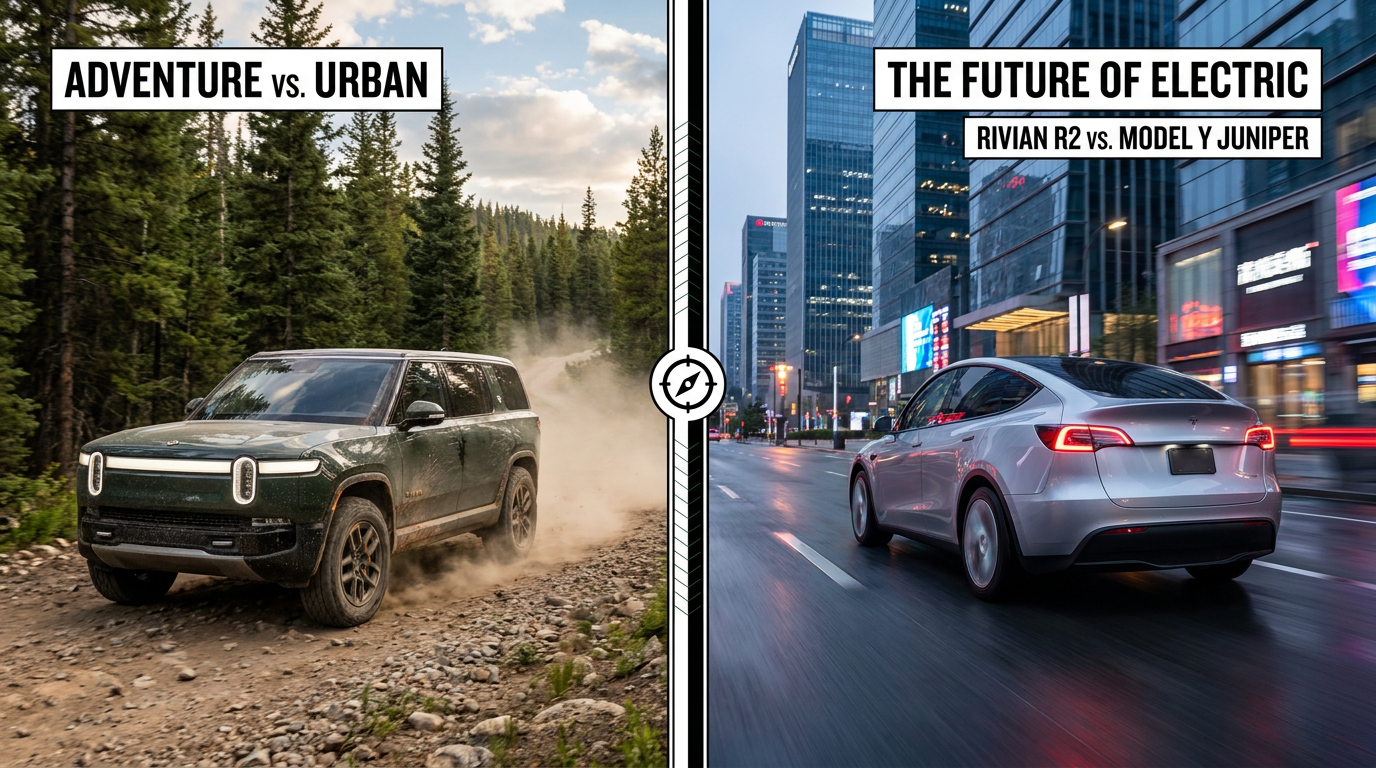
The heavily updated 2026 Tesla Model Y faces its toughest challenger yet in the all-new Rivian R2, forcing buyers to choose between aerodynamic efficiency and rugged versatility.
By Factlen Editorial Team
- Efficiency & Value Advocates
- Argues that the Model Y's superior aerodynamics, lower starting price, and proven on-road dynamics make it the most logical choice.
- Outdoor & Utility Enthusiasts
- Values the Rivian R2's massive cargo space, fold-flat seating, and genuine off-road capability over highway efficiency.
- Tech & Practicality Reviewers
- Focuses on the day-to-day usability of both vehicles, noting that shared charging infrastructure makes this a pure lifestyle choice.
What's not represented
- · Traditional auto manufacturers losing market share to pure-play EV brands
- · European buyers awaiting the R2's international rollout
Why this matters
For the first time, buyers in the $40,000 to $60,000 EV market have a genuine choice between two radically different vehicle philosophies without having to compromise on charging infrastructure. This decision dictates whether your money goes toward minimizing daily commute costs or maximizing weekend outdoor capability.
Key points
- The 2026 Tesla Model Y Juniper refresh offers superior aerodynamic efficiency, on-road handling, and immediate affordability.
- The Rivian R2 counters with massive cargo capacity, fold-flat seating, and genuine off-road capability.
- In 2026, the Model Y starts at $39,990, while the Rivian R2 is only available in its $57,990+ launch trims.
- Both vehicles feature native NACS charging ports, neutralizing Tesla's historical Supercharger advantage.
- The Model Y is the logical choice for highway commuters, while the R2 is built for outdoor enthusiasts.
The mid-size electric SUV segment has reached a boiling point in 2026, offering consumers more capable and refined choices than ever before. For years, the Tesla Model Y has dominated the global sales charts, providing a blend of range, performance, and seamless charging infrastructure that traditional automakers struggled to match. Now, the heavily revised 2026 Model Y—widely known by its development codename, Juniper—faces its most serious and highly anticipated challenger yet: the all-new Rivian R2. While they are closely matched in physical footprint and overlap perfectly in top-end pricing, these two vehicles represent fundamentally different philosophies about what a modern electric crossover should be and who it is designed to serve.[1][2]
The case for the 2026 Tesla Model Y centers on supreme aerodynamic efficiency, on-road driving dynamics, and immediate affordability. The Juniper update addressed the vehicle's historical weaknesses by adding a significantly quieter, sound-deadened cabin, upgraded interior materials, and a retuned suspension system that absorbs road imperfections without sacrificing cornering grip. It remains a street-oriented machine designed to slip through the air with minimal resistance, making it an ideal long-distance highway cruiser. Tesla's relentless optimization of its electric motors and battery management software ensures that every kilowatt-hour is stretched to its absolute limit on paved roads.[1][6]
The case against the Tesla Model Y involves its sheer ubiquity and its limitations in rugged, off-pavement environments. Its egg-like, aerodynamic shape restricts maximum cargo capacity compared to boxier rivals, and its lower ground clearance means it is strictly an on-road or light-gravel vehicle. Furthermore, while the Juniper update sharpens the exterior styling with sleek new light bars and reprofiled bumpers, the Model Y remains one of the most common vehicles on the road. For buyers who view their vehicle as an expression of individuality or who crave a distinctive, head-turning aesthetic, the ubiquitous Tesla may feel too much like a default appliance rather than an adventure companion.[2][7]
The evidence for the Model Y's on-road superiority is clearly quantified in its 2026 specifications. The Premium Rear-Wheel Drive trim achieves an impressive EPA-estimated 357 miles of range and an industry-leading efficiency rating of 144 MPGe. For buyers seeking raw speed, the top-tier Performance model sprints from zero to 60 mph in a blistering 3.3 seconds. On the pricing front, the Model Y holds a massive advantage for buyers shopping right now. The base rear-wheel-drive version starts at just $39,990, making it immediately accessible to a broader demographic without having to wait for future production ramps.[1][6]

Conversely, the case for the Rivian R2 centers on rugged versatility, maximum utility, and a distinctive, adventure-ready aesthetic. Rivian has successfully shrunk the go-anywhere persona of its larger R1S SUV into a more compact, garage-friendly footprint. The R2 features a traditional boxy design, a unique roll-down rear window for carrying long items like surfboards, and seats in both the first and second rows that fold completely flat. This clever packaging effectively turns the cabin into a hard-shell tent for car camping or a cavernous cargo van for weekend hardware store runs, prioritizing functional space over aerodynamic sleekness.[2][4][8]

Conversely, the case for the Rivian R2 centers on rugged versatility, maximum utility, and a distinctive, adventure-ready aesthetic.
The case against the Rivian R2 involves its delayed rollout for budget-conscious buyers and the inherent aerodynamic penalties of its squared-off shape. In 2026, only the top-tier Performance and Premium trims—priced between $55,485 and $59,485—are available to customers. The highly anticipated, more affordable $45,000 standard models will not arrive until the summer of 2027. Additionally, pushing a boxy silhouette through the air requires significantly more energy at highway speeds, making the R2 less efficient per kilowatt-hour than its sleeker rival and slightly more expensive to keep charged over the course of a year.[1][3]
The evidence for the Rivian R2's utility is found in its massive interior volume and impressive off-road geometry. The R2 boasts 90.1 cubic feet of total storage—including a spacious 5.2-cubic-foot front trunk—absolutely crushing the Model Y's roughly 76 cubic feet of total capacity. The R2 Performance trim generates a staggering 656 horsepower, and its 9.6 inches of ground clearance, combined with 32-inch tires and dedicated off-road driving modes like Soft Sand and Rally, allows it to confidently tackle trails and deeply rutted roads that would leave the Tesla stranded.[2][4][8]

Historically, the deciding factor in any electric vehicle comparison was the reliability of the charging infrastructure, but the 2026 landscape has neutralized that advantage. The Rivian R2 ships from the factory with a native North American Charging Standard (NACS) port, granting it seamless, adapter-free access to the sprawling Tesla Supercharger network. While the Model Y still charges slightly faster—reaching an 80 percent state of charge in roughly 24 minutes compared to the R2's 29 minutes—the gap in actual road-trip convenience has effectively closed, allowing buyers to choose based on the vehicle's merits rather than the plug.[1][3]
When evaluating these trade-offs, the 2026 Tesla Model Y fits well when a buyer prioritizes highway efficiency, sporty on-road handling, and immediate budget constraints. It is the logical, sensible choice for daily commuters who want the absolute most range for the lowest purchase price, and who value the proven reliability of Tesla's software ecosystem. It does not fit well when a buyer needs to frequently haul bulky outdoor gear, desires high ground clearance for trail driving, or wants a vehicle that stands out visually in a crowded suburban parking lot.[1][2]

On the other hand, the Rivian R2 fits well when a driver prioritizes outdoor adventures, versatile cargo space, and a rugged, distinctive design. It is the ideal companion for camping trips, active lifestyles, and buyers who want the utility of a traditional SUV without the tailpipe emissions. It does not fit well when a buyer is shopping strictly under the $50,000 mark in 2026, or when their daily commute involves long stretches of high-speed interstate driving where aerodynamic efficiency and low running costs are the absolute highest priorities.[2][4]
Ultimately, the direct overlap between these two highly capable vehicles occurs only at the top of their respective ranges. At roughly $58,000, buyers can choose between the blistering 3.3-second acceleration and refined street manners of the Model Y Performance, or the 656-horsepower, trail-ready capability of the R2 Performance. The decision no longer hinges on charging networks or basic viability, but rather on whether the driver's weekend plans involve carving mountain canyons on smooth asphalt or crawling over rocks and dirt to reach a remote summit.[1][8]
How we got here
March 2024
Rivian officially unveils the R2 and R3, generating over 68,000 reservations in 24 hours.
Late 2025
Tesla begins rolling out the highly anticipated 'Juniper' refresh for the Model Y.
Spring 2026
The first Rivian R2 Performance Launch Edition models begin reaching customers.
Summer 2027
Projected release window for the entry-level $45,000 Rivian R2 Standard trims.
Viewpoints in depth
Efficiency & Value Advocates
This camp prioritizes aerodynamics, immediate affordability, and on-road driving dynamics.
Reviewers and analysts in this camp argue that the Tesla Model Y remains the undisputed king of sensible daily driving. They point to the 144 MPGe rating and the $39,990 starting price as evidence that Tesla offers unmatched value for the average commuter. From this perspective, the Rivian R2's boxy shape is an aerodynamic liability that forces owners to pay more for electricity over the vehicle's lifespan, while its delayed rollout for base models makes it irrelevant for budget-conscious buyers shopping in 2026.
Outdoor & Utility Enthusiasts
This camp values maximum cargo space, off-road capability, and rugged design over highway efficiency.
For this group, an SUV must actually function as a utility vehicle. They celebrate the Rivian R2's 90.1 cubic feet of storage, 9.6 inches of ground clearance, and fold-flat seats as game-changers for camping and hauling. They argue that the Model Y's egg-like shape and low stance compromise its usefulness for active lifestyles. To these enthusiasts, the slight penalty in highway efficiency is a more than acceptable trade-off for a vehicle that can confidently tackle deeply rutted trails and carry a weekend's worth of outdoor gear.
Tech & Practicality Reviewers
This camp focuses on the leveling of the playing field through shared charging infrastructure.
Reviewers focused on the broader EV market emphasize that 2026 marks a turning point where charging anxiety is no longer a competitive moat. Because the Rivian R2 natively uses the NACS port to access Tesla's Supercharger network, this camp argues that buyers are finally free to choose a vehicle based purely on its physical merits. They view the Model Y and R2 not as direct substitutes, but as complementary options that serve entirely different consumer personas within the same price bracket.
What we don't know
- Whether Rivian will be able to scale production fast enough to meet the massive reservation backlog for the R2.
- The exact final specifications and range numbers for the entry-level $45,000 Rivian R2 arriving in 2027.
- How the used market for pre-Juniper Model Ys will affect the pricing dynamics of the new 2026 models.
Key terms
- NACS
- The North American Charging Standard, originally developed by Tesla, which allows vehicles to use the Supercharger network without an adapter.
- MPGe
- Miles Per Gallon Equivalent, a metric used by the EPA to compare the energy consumption of electric vehicles to traditional gas-powered cars.
- Frunk
- A front trunk located under the hood of an electric vehicle where a traditional gas engine would normally sit.
- Juniper
- The internal codename for Tesla's major 2026 design and engineering refresh of the Model Y crossover.
Frequently asked
When can I buy the $45,000 Rivian R2?
The entry-level Rivian R2 trims are scheduled to arrive in the summer of 2027. In 2026, only the higher-end Premium and Performance trims are available.
Do I need an adapter to charge the Rivian R2 at a Tesla Supercharger?
No, the Rivian R2 comes equipped from the factory with a native NACS port, allowing direct plug-in access to Tesla Superchargers.
Which vehicle has more cargo space?
The Rivian R2 offers significantly more utility, with 90.1 cubic feet of total storage compared to the Model Y's roughly 76 cubic feet.
Does the 2026 Tesla Model Y have ventilated seats?
Yes, as part of the Juniper refresh, the 2026 Model Y features ventilated front seats, upgraded interior materials, and a quieter cabin.
Sources
Source coverage
8 outlets
3 viewpoints surfaced








[1]Road EthosEfficiency & Value Advocates
Rivian R2 Vs. Tesla Model Y: An Honest Comparison For 2026 Buyers
Read on Road Ethos →[2]AutoblogOutdoor & Utility Enthusiasts
2026 Rivian R2 Performance vs. 2026 Tesla Model Y: Which Crossover EV Should You Choose?
Read on Autoblog →[3]EdmundsTech & Practicality Reviewers
2027 Rivian R2 Prices, Reviews, and Pictures
Read on Edmunds →[4]CarBuzzOutdoor & Utility Enthusiasts
All The Ways The Rivian R2 Performance Beats Tesla's Top Model Y
Read on CarBuzz →[5]CarwowTech & Practicality Reviewers
Rivian R2 vs Tesla Model Y: which electric SUV does Mat Watson prefer?
Read on Carwow →[6]Car and DriverEfficiency & Value Advocates
2026 Tesla Model Y Review, Pricing, and Specs
Read on Car and Driver →[7]Kelley Blue BookTech & Practicality Reviewers
2026 Rivian R2 Price, Pictures, Release Date & More
Read on Kelley Blue Book →[8]RivianOutdoor & Utility Enthusiasts
Rivian R2 Electric SUV: Price, Range & Features
Read on Rivian →

Every angle. Every day.
Get automotive stories with full source coverage and perspective breakdowns delivered to your inbox.